
4d games! Is it possible?
Science by Rubayyat Akbar on Jul 25, 2010
Today, we see the light of so-called 3D games. You use glasses for games, and you feel that you are really into the environment since the position of the elements in the game is 3D aligned. Although for the past 20 years, there were numerous games designed with 3D graphics, but today just because those gamers can see some elements at areas away from TV, the game is labeled 3D.
So, what should we call the games we played for the past 20 years? 2.5D? Maybe I should term this type of game as 4D! 4D??? Hmm! Imagine if a game is originally made in 4D. How is that even possible, since we know that a space consists of x, y, and z coordinates? It is something that some people are curious about: What will the games be like?
Since my early childhood days, I was taught that the fourth dimension is considered time, along with length, breadth, and height. It seemed logical since our eyes can see everything in 3D form. Perhaps a person or object moving away from me has some connection to the changing image. Perhaps the length, breadth, and height are changing over time.
Well, I am not that intellectual to think like this (I started thinking like this when I learnt Einstein’s theory of relativity). I used to read a lot of science fiction books (mostly from my favorite local Bengali author, Mohammed Zafar Iqbal). In some of his writings, he termed the 4th dimension as time, but it was always a fictional term. The reason is of time dilation, which only happens in space due to difference in gravity.
Also, in some cases, what someone observes can be different if another person from somewhere else observes it. Maybe the change in observation or time is 4D. Time dilation is not possible on Earth unless billions of dollars are invested in experimenting with it or creating a billion-dollar game console that allows users to interact with and change time (wow, what an imagination!).
Perhaps the change in hologram images in some 3D games we see today can be considered 4D, as people’s observations can differ according to their perception. The theory of relativity might work here in this case, too, since light is playing a major role in changing the behavior of the image. From my point of view, 3D is always considered static, and 4D is dynamic, which has vector properties due to the movement of coordinates.
Due to my constant prejudice of taking time as a fourth dimension, the movement of x, y, and z coordinates depends on time. Perhaps that’s why there is software called Cinema 4D, which is primarily used for creating animations in movies and games. Perhaps the software is taking into account the fact that you can design everything in 3D orthographic mode, but also move it over time.
Nowadays, the time factor is not supported, since a vector property cannot support the concept of dimensions that creates images. Both time and length are different SI units in physics. So what else can be considered? Psychology? Maybe! If we think about the fact that we have different perceptions of 3D hologram images in games, then we are thinking differently. Perhaps the image is intended to confuse viewers into judging it differently. The best example I can give is by showing two images. Let's look at the first one.

Source: Wikipedia
This is the picture of two cubes with edge points connected. The image is static and has 3D properties. What if this simple image is rotated constantly? Let's see the next animated picture.
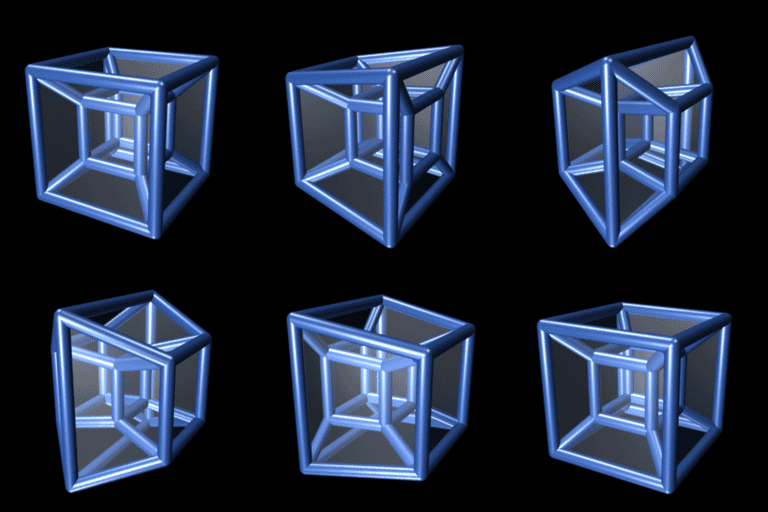
Source: Wikipedia
Can you figure out what kind of shape it is? It shows many faces and changes shape. A cube is not a cube anymore. Just see how our brains are analyzing this image. It is so confusing anyway. The whole factual image is turning out to be too abstract.
The image shows the property of a term called tesseract. Perhaps the 4th dimension is playing a significant role in distorting our perception. Scientists are still seeking a solid mathematical theory to explain this phenomenon. Psychologically, it is playing a huge role.
Now imagine this: if the above-rotated image can be further developed to create graphics and objects in a game, how will the game be played? Will this change the way gamers play games? Will the confusion and abstraction of the graphics make gamers’ brains dead? Will someone make an innovative game out of this concept, just like games like Flower or LocoRoco? Will the developers exploit graphical confusion and psychological perception differences to create a game that relies solely on how people perceive and interact with the graphics?
Only time will tell. It’s a relief anyway, since we can clearly rule out time as the 4th dimension, cause if that ever becomes true, then gamers would have to spend billions of dollars to buy a 4D console or protection against a changing environment due to 4D. For the time being, we can safely tell that it's all going to be a brain-teasing game.
Subscriber, NoobFeed
Latest Articles
No Data.