

Intel Core i7-14700K vs. Ryzen 7 9700X: Win 11 23H2 vs. 24H2 Gaming Performance
A comprehensive comparison of 14700K and 9700X covering gaming performance, operating system impact, efficiency metrics, and real-world benchmark results
Hardware by Yoshi on Dec 10, 2025
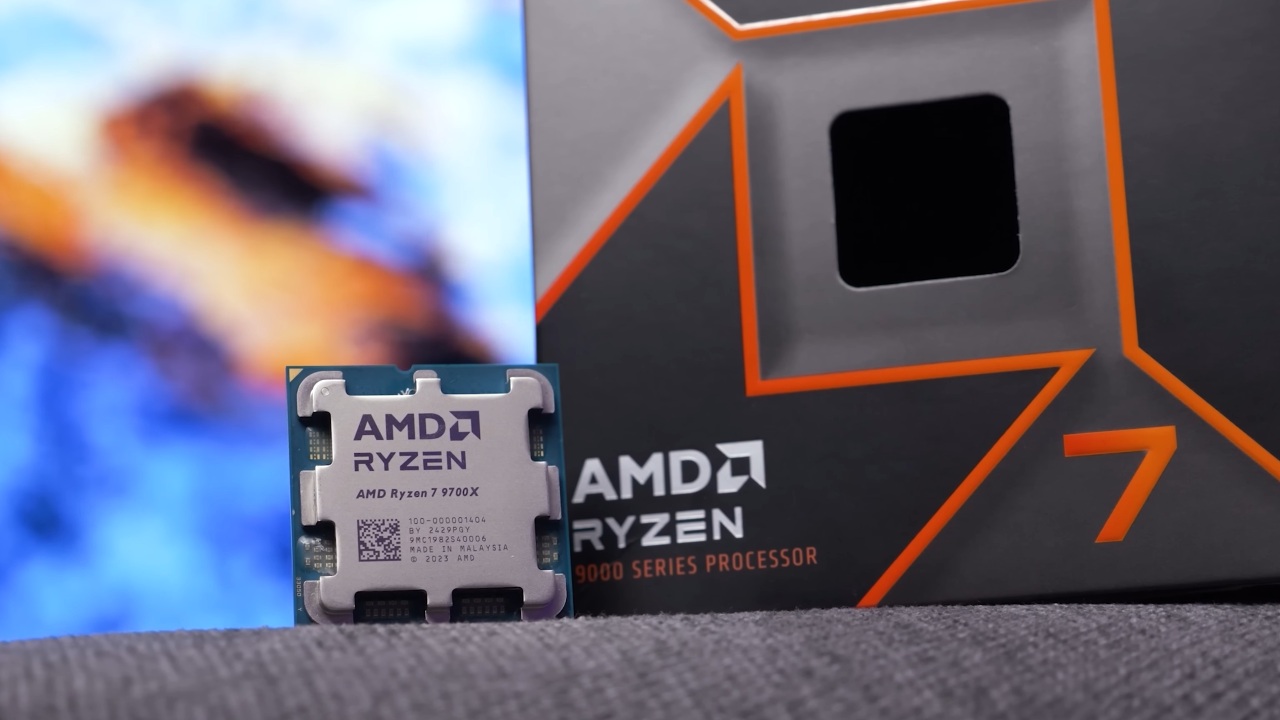
Before release, AMD made big promises about how well new Zen5 processors would work for gaming. They said that Ryzen 7 9700X would be 6% quicker than Intel's Core i7-14700K. Later, AMD changed their mind and said that 9700X is only as good as 14700K when it is run with Intel Extreme Pro Profile and same high-speed RAM that most reviewers use.
This suggests that AMD's marketing promises were based on reducing Intel's performance through a 125W profile, which Intel has said should not be used with K-SKU parts.

Even yet, AMD's claim that 9700X is as good for gaming as 14700K is still bold, because earlier tests revealed it to be 5% slower. The following breakdown looks at how these CPUs stack up against each other in more than 40 games that run on Windows 11 23H2 without the latest patch and Insider Preview 24H2.
Test System Specifications
We utilized the most recent BIOS with revised microcode and Intel Extreme Profile for Core i7-14700K. We set PL1 and PL2 to 253W. BIOS version F33bS was also installed on X670 motherboard.
Assetto Corsa Competizione
When using 23H2, 9700X, and 14700K had identical performance, but Intel's 1% lows were 7% higher. 14700K stayed the same on 24H2, but 9700X gained 8%, giving it a clear lead.
Halo Infinite
14700K worked the same on both OS versions; however, 9700X became 4% better on 24H2, which brought the gap a little closer.
F1 24
9700X was 4% faster on 23H2. That went up to 9% on 24H2, which gave AMD a big edge.
Call of Duty: Modern Warfare III
Performance stayed the same throughout all OS versions for both CPUs, with 9700X having a 6% lead.
Microsoft Flight Simulator 2020 [DX12]
9700X was 13% slower on 23H2, which shows that it has become worse. The problem was fixed by 24H2, when performance was the same as 14700K.
Spider-Man Remastered
9700X was 15% slower when using 23H2. That gap shrank to 9% on 24H2, which was an improvement but remained behind Intel.
A Plague Tale: Requiem
9700X was 3% quicker on 23H2 and 9% faster on 24H2, which is a big improvement.
Ghost of Tsushima
9700X was 4% slower on 23H2. It pulled ahead by 2% on 24H2.
Cyberpunk 2077: Phantom Liberty
9700X was 6% slower on 23H2. On 24H2, performance achieved the same level as it did in Flight Simulator.
Borderlands 3 [DX12]
14700K worked the same on both versions of Windows. 9700X went up 10% on 24H2, yet Intel still had the best 1% lows.
Baldur's Gate 3
There was no uplift for either CPU on 24H2. Overall, 9700X was 12% slower.

Black Myth: Wukong
14700K didn't change across OS versions. 9700X gained 5% on 24H2, bringing its average up to Intel's level. However, Intel still had 10% greater 1% lows.
Hitman 3
Both CPUs went up by 3% on 24H2. 14700K was still about 12% faster.
Total War: Warhammer III
9700X was 8% slower with 23H2 and 5% slower with 24H2. AMD's 1% lows got better.
Returnal
There were no significant differences in performance between CPUs on any OS version.
Hogwarts Legacy
Both CPUs got a lot better on 24H2. 14700K was 14% faster on 23H2 and just 6% quicker on 24H2. 9700X got better by 177%, and 14700K got better by 10%.
Star Wars Jedi: Survivor
14700K was 6% faster on 23H2. On 24H2, margin grew to 11% because Intel's share went up by 20%.
Dying Light 2
Both CPUs got a little better on 24H2, but Intel still has a 9% edge.
The Last of Us Part I
14700K was 8% faster on 23H2 and 10% faster on 24H2.
Fortnite [DX11]
9700X did a lot better in Fortnite on 24H2, but 14700K didn't get any better. 9700X was 14% faster on 24H2 than on 23H2, but performance was the same on both.
Starfield
Zen5 does not work well in Starfield. No matter how tests were set up, 14700K was at least 177% faster on 24H2.
Watch Dogs: Legion
9700X was 9% slower on 23H2. On 24H2, AMD's score went up by 9%, while Intel's score also went up, leaving AMD 7% behind.
Remnant 2
9700X was 13% slower on 23H2. The margin was only 1% on 24H2, which was a big fix for AMD.
Horizon Forbidden West
There was no difference in performance between OS versions. 9700X was always 7% slower.
The Riftbreaker
9700X was 13% slower on 23H2 and 6% slower on 24H2. Intel stayed in the lead, but it was by a smaller amount.
9700X vs 14700K on 23H2
9700X was 5% slower on average in 42 games that were evaluated. In 23 games, it was at least 6% slower, and in 13 of them, it lost by double digits. It was evident that 14700K was speedier.
9700X vs 14700K on 24H2
14700K's edge was cut down to 3% when it was upgraded to 24H2. Intel part was still faster overall, but difference was small enough that performance could be deemed similar, especially if you only looked at a certain group of games.
14700K Gains on 24H2
Intel made most gains in three games: Homeworld3, Gears5, and Star Wars Jedi: Survivor. 14700K only got a 3% boost on average across all 42 games, while more than 80% of games changed by 5% or less.
9700X Gains on 24H2
9700X had an average improvement of 7%, which was far more than Intel's.
Power Consumption
In Baldur's Gate 3 on 23H2, 9700X used 84W, while 14700K used 171W. 14700K was 133% faster but used 104% more power. 14700K worked 8% better in The Last of Us Part I, although it used 127% more power.14700K was 7% faster in Cyberpunk 2077, but it used 129% more power.
This big difference between power and performance is still a big problem for Intel's 13th and 14th-generation processors.
Conclusion
14700K costs $380 US, and 9700X costs $340 US, which makes them direct competitors; however, neither CPU is recommended. It makes more sense to spend a little more on 7800X3D for best gaming performance, but it is still hard to find.
If you can't find that CPU, we suggest saving money by buying 7700X. It's easy to find for $270US or less, which is up to 26% less than 9700X and offers equal performance on Windows 10, Windows 11, and 24H2.
9700X performs quite well and uses much less power than 14700K, but its price is still the biggest problem. 7700X is a better choice at $340US than 7700X at $280US.
14700K can be speedier at times, but its high power use and unresolved stability issues hold it back. We can't endorse it unless those problems are proven to be fixed.
In the end, 7700X is a better choice between 9700X and 14700K.
The main goal of this study was to see how well Intel CPUs work with Windows 11 23H2 and 24H2. Intel did see some advancements, but they weren't as big as ones we saw with Ryzen. Before next Intel generation, we will wait for entire deployment of 24H2 before upgrading all of our CPU benchmarks to make sure they are correct.
Check Our Other Intel Chips Articles:
- Intel Core Ultra 9 285K Review And Performance Breakdown (2025)
- Intel Core Ultra 9 285K vs AMD Ryzen 7 9800X3D: In-Depth Gaming Performance and Benchmark Comparison
- Intel Core i5-13400F Gaming Performance: Still Worth It in 2025?
- Intel Core i9‑14900K vs. AMD Ryzen 7 7800X3D: Power Profiles & Gaming Benchmarks
- Intel Core i9 14900K: Specs, Benchmarks, and Competitor Comparison
- Intel Core Ultra 5 245K Review: Gaming, Productivity & Power Efficiency Tested
- Intel Core Ultra 9 285 K's iGPU Gaming: In-Depth Benchmarks & Analysis
- Intel vs. AMD Gaming Laptop: Performance, Thermals & Battery Life Compared
- AMD Ryzen 7 9800X3D vs.7800X3D vs. Intel Core Ultra 7 265K: Gaming, Thermals & Price Analysis
Subscriber, NoobFeed
Latest Articles
No Data.