
GPD Win 5 Ryzen AI Max 385 vs. 395: Full Wattage Scaling and Real Gaming
Performance scaling across wattage levels reveals unexpected efficiency advantages for lower core count configurations in handheld gaming systems.
Hardware by Tanvir Kabbo on Dec 23, 2025
High-end mobile APUs are becoming more common in modern handheld gaming devices. These chips are meant to give desktop-level performance in small systems. There are two such configurations in the GPD Win 5 lineup, both based on AMD's Strix Halo platform.
They have various CPU and GPU combinations that look quite similar on paper but perform very differently in real life. When tested at a wide range of wattage levels in both real games and synthetic benchmarks, the performance scaling exhibits some interesting aspects that have a direct effect on gaming efficiency, battery life, and overall value.
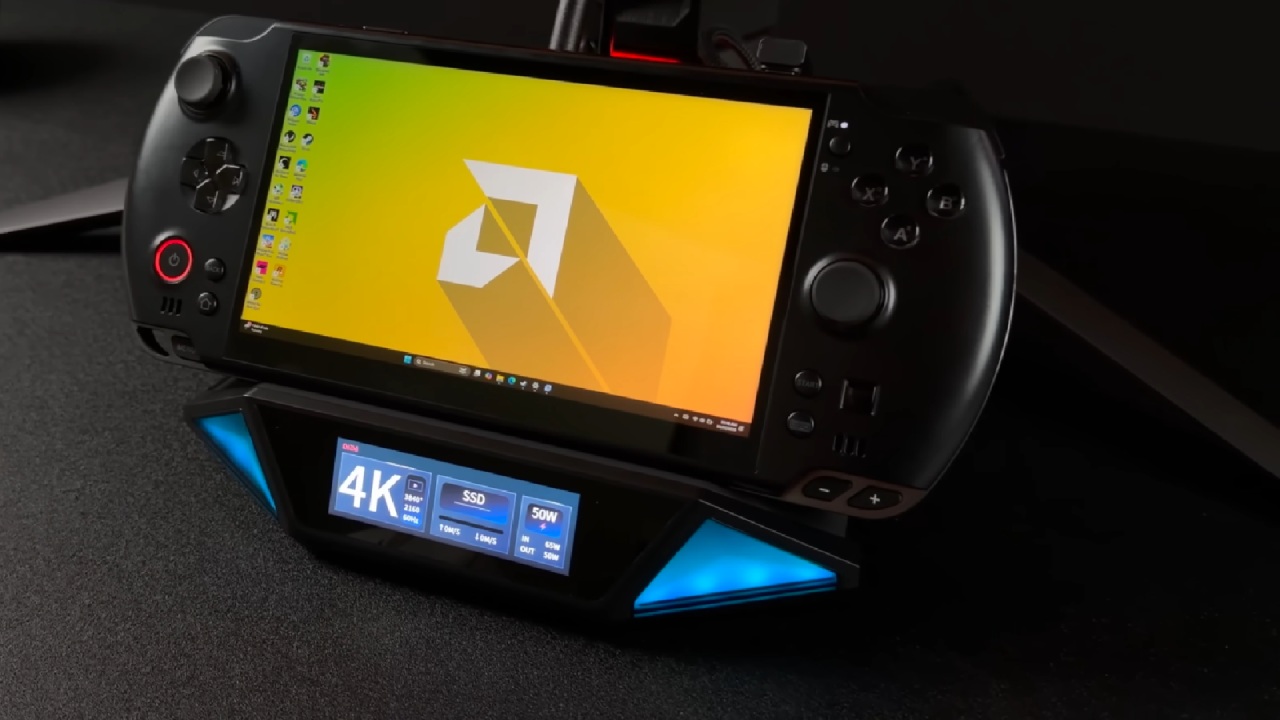
Hardware Configuration and Test Setup
The two handhelds used for testing are GPD Win 5 devices that have the identical case design, cooling power, and 32GB of RAM. The APU is the only thing that makes a difference. Strix Halo is AMD's best mobile APU architecture. It combines high-core-count CPUs with integrated GPUs that can perform as well as an RTX 4060 mobile.
Ryzen AI Max Plus 395 has 16 cores and 32 threads, and it comes with a Radeon 8060S with 40 CUs. The Ryzen AI Max 385 has 8 cores and 16 threads, and it comes with a Radeon 8050S with 32 CUs.
We used the system control software to manually adjust the APU wattage for all testing, starting at about 4W and increasing to 85W. But both handhelds now ignore wattage settings below about 10–13W; data below that range can't be used and were left out of the analysis.
Shadow of the Tomb Raider Scaling Behavior
Shadow of the Tomb Raider is a great game for wattage-scaling tests because it responds well to changes in CPU power, GPU speed, and memory bandwidth. We tested at 1080p native resolution with high settings in the same in-game area while slowly raising the wattage.
Ryzen AI Max 385 always beat the AI Max Plus 395 at wattages between 13W and 23W, even though it had fewer CPU cores and a weaker GPU. Both devices performed almost the same at around 25–28W, but the 385 pulled ahead again between 29W and 34W.
Just after that, the 395 took a steady lead, and even then, the gap was no more than 7–10%. The 395 started acting strangely and, in some cases, lost performance as the wattage exceeded 80W. At the highest wattage levels, both handhelds performed almost identically, which was surprising. It's still fantastic to see frame rates around 114–115 fps at 1080p on a handheld. Still, it clearly shows how diminishing returns set in at higher power levels.

Efficiency and FPS per Watt
When looking at FPS per watt, both CPUs were more efficient at various power levels. The 385 worked best between 13W and 24W, and the 395 worked best between 23W and 30W. Outside of these ranges, efficiency declined quickly, and adding more watts made the heat production and battery depletion much worse, with little to no improvement in FPS.
At low wattages, performance improved quickly, then leveled off in the early mid-range, and finally dropped off sharply as wattage rose further.
Cyberpunk 2077 Results
We tested Cyberpunk 2077 at 1080p with the high setting and FSR2.1 set to Quality. To ensure the findings remained consistent, the benchmark was run more than 200 times. Once again, the Ryzen AI Max 385 was quicker from 13W to 29W.
This is especially important for mobile gaming, where battery life is quite important. At about 30W, both devices gave almost the same results. Then the 385 briefly took the lead again before the 395 eventually pushed ahead at higher wattages, albeit the difference stayed close to 10%.
Impact of Reducing CPU Core Count
We disabled several cores in the BIOS to see if fewer CPU cores would make gaming more efficient. When the core count on the AI Max Plus 395 was cut from 16 to 6, performance improved across most wattage levels, with the biggest increases (up to 7%) in the middle range. Even though the number of cores was lower, this improvement was repeatable and easy to see.
A similar method used on the AI Max 385 yielded substantially fewer benefits. From 13W to 35W, performance was usually the same, regardless of the number of cores. Above that range, the changes were still small. Even cutting the 395 down to just 4 active cores improved performance at lower TDP levels.
This makes sense because a limited power budget can't support a strong iGPU and a CPU with a lot of cores at the same time. Testing shows that six active cores seem to be the best number for gaming because there are no extra stuttering or frame rate problems.
Plugged-In vs Battery Performance
Cyberpunk 2077 was also used to test how well devices that are plugged in and those that run on batteries worked. For the AI Max Plus 395, performance remained almost the same at lower wattages, regardless of the power source. The only time performance dropped significantly was around 45W, when the system imposed constraints when disconnected.
AI Max 385 had significantly bigger performance drops on battery at most wattage levels. However, there was one strange case at 30W where battery performance was better, which was probably due to a configuration issue that persisted throughout all tests.

System Power Draw and Battery Life
As TDP went up, the system used more power than it should have. At 15W TDP, the system's total power demand was roughly 25W, indicating that about 10W was used by components other than the APU. At 80W TDP, the overall system draw went up to about 109W, which is almost 29W more than before.
System doesn't pay attention to wattage below 10–13W, hence the longest battery life seen was about 4.5 hours. When the CPU cores were cut back, battery life improved slightly, especially at lower wattages, where even a few more minutes could make a big difference when using a handheld device.
3DMark Fire Strike Analysis
We ran Fire Strike around 150 times on both handhelds, and the results were very similar to what we saw in real games. The 385 led at lower wattages; both devices worked about the same in the middle range; and the 395 pushed ahead at higher wattages, but it was often unstable near the maximum.
Fire Strike has a separate CPU test, and the 395 scored over double that of the 385. This shows that its 16 cores are better for workloads that require many threads, even though this advantage didn't translate well to gaming.
Final Thoughts
Most people won't think the Ryzen AI Max Plus 395's gaming performance is good enough to justify its much higher price. In most cases, frame rate improvements are small or don't happen at all. At some critical wattage levels for handhelds, the cheaper AI Max 385 actually performs better.
395 is perfect for users who want to use their handheld as a desktop replacement or for jobs that require heavy processing, including AI workloads and video editing. The AI Max 385 is better for gaming because it uses less power, has the same performance, and is a much better value. It also works excellently on a portable device.
Also, check our other Handheld articles below :
- ASUS ROG Ally X Handheld Review: Double the Battery, Double the Comfort
- Nintendo Switch 2 Vs. Original Switch 1: A Full Comparison
- How To Connect A Camera And Join Voice Chat With Nintendo Switch 2
- Nintendo Switch 2 Review: Handheld Performance, Features & Value Breakdown
- ROG Xbox Ally X Vs. ROG Ally X: Display, Battery & Controls
- ASUS ROG Ally X vs. Steam Deck OLED: Display, Battery & Gaming Benchmarks
- MSI Claw 8 AI+ Review: Display, Controls & Gaming
- Nintendo Switch 2 vs. Steam Deck OLED: Gaming, Performance, Battery, Display and Value
- PlayStation Portal Review: Remote Play, Cloud Streaming & Travel Gaming
- PlayStation Portal vs. Lenovo Legion Go: Best Portable Gameplay
- Cyberpunk 2077 Patch 2.3 FPS Test on MSI Claw 8 AI+
Senior Editor, NoobFeed
Gaming Hardware Updates
No Data.