
Corsair MP700 Pro XD Gen5 SSD Review and Performance Breakdown
High-speed Gen5 storage performance demonstrated through benchmarks, controller efficiency insights, gaming workload behavior, and long-term workload observations.
Hardware by Nahe Yan on Dec 12, 2025
Phison E28 controller makes the new Corsair MP700 Pro XD SSD the first Gen5 drive on the market. The drive's goal is to improve performance over older Gen5 models. It comes in 1TB, 2TB, and 4TB sizes, with an 8TB variant planned for early 2026.
No heat sinks are provided, so it's best to add additional cooling. The spec sheet has 3D TLC memory and general performance ratings that go "up to." It has a TBW rating of 700 TB per 1 TB of storage and a 5-year warranty.
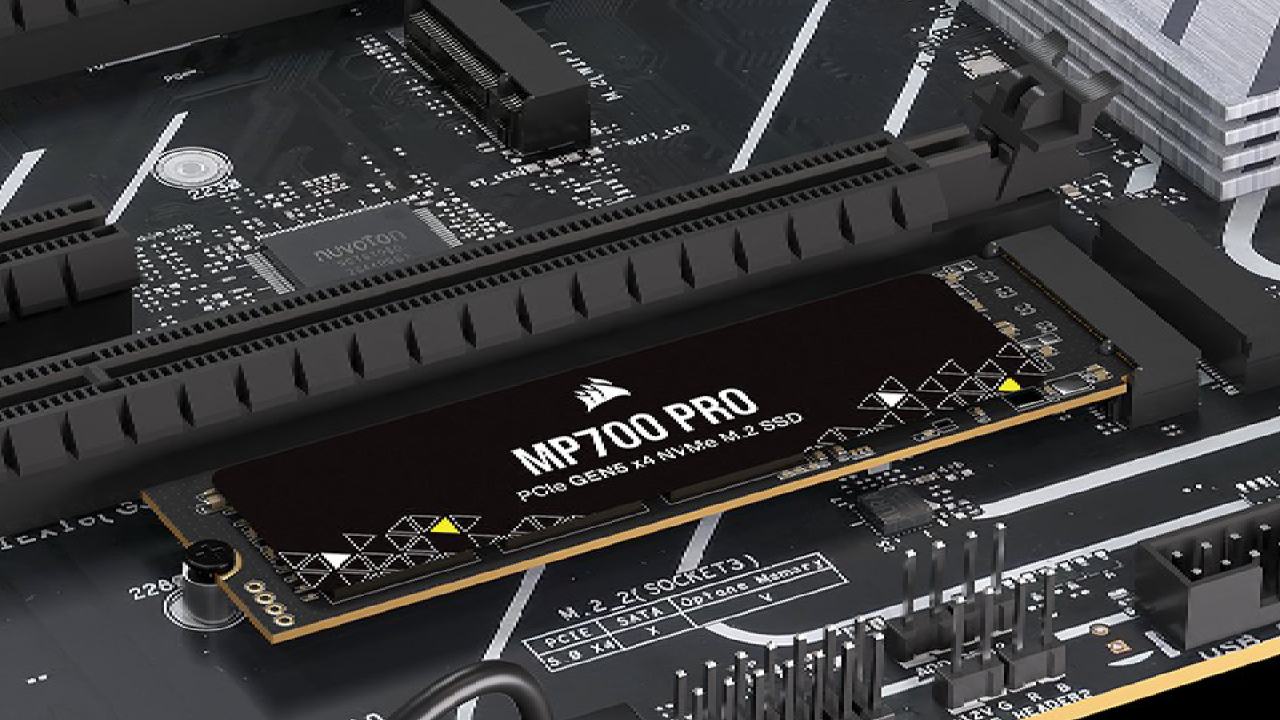
Information about the Hardware
The new Phison E28 controller is the most important part. It makes the device work better than the earlier E26 models and the Silicon Motion SM2508 options. The drive has DRAM cache and Kioxia BICS8 3D TLC flash modules. The hardware makes it look like a high-end choice on paper, but benchmarks show how it performs across diverse workloads.
How it Works Every Day
MP700 Pro XD beats over E26-based drives, the WD Black SN8100, and the Fury Renegade G5 by a wide margin in the PCMark 10 Quick Benchmark, which tests everyday tasks like working on documents, browsing photos, and loading games. These jobs don't require a Gen5 SSD, but the fact that it performs well overall shows it is responsive.
Performance Under Heavy Workloads
The whole PCMark 10 suite tests more difficult tasks. In this case, the drive once again comes out on top, with a clear gap above its rivals. The same pattern is evident in latency results.
The consistency test shows that performance has dropped to an average of 623 MB/s. Other high-end models score far higher. Even when comparing only 2TB drives, a few models perform better on this very heavy task that most people never have to deal with.
Things to do With Gaming
3DMark Storage tests things like loading, installing, recording, and relocating game files. MP700 Pro XD comes in third, just behind the SN8100 and the T710. It comes in second place in testing for loading, installing, and updating, with all three drives performing relatively similarly.
Sequential Performance
The Gen5 interface often can't keep up with sequential read/write speeds. The fastest SM2508-based drives get a little higher score in sequential writes, but the difference is tiny.
When it comes to sequential reads, the best drives are mostly equal. The read speed is faster than needed for PS5 use, but the PS5 does not support Gen5 performance. A less expensive Gen4 DRAM-based SSD is a better choice.
Cooling and Power
Compared to E26 models, the E28 controller uses less power, dropping from about 10W to about 5–6W under heavy workloads. Even at these levels, significant heat buildup occurs, especially when the SSD is under a GPU. To keep the right temperatures, we suggest utilizing a motherboard heat sink or a cheap third-party heat sink.
Cost and Value
Prices for new Gen5 SSDs usually start high and then go down. MP700 Pro XD 4TB version costs $460 in the US. It costs less than the Fury Renegade G5 and a little more than the SN8100, but it is still over $100 more than the 9100 Pro. The price difference between Gen4 and Gen5 SSDs is getting smaller, making the choice easier than before.
MP700 Pro XD needs to come down in price for it to make sense to buy. If that happens, E28-based SSDs might be great choices for high-end setups. The drive performs well on both real-world trace benchmarks and gaming-focused metrics. Still, it doesn't perform as well on extremely long-duration consistency workloads, which are useful only in very specific situations.
Final Thoughts
If you plan to upgrade to a more expensive SSD later, it's a good idea to keep an eye on the MP700 Pro XD once prices go down. It works well in real-life situations and for gaming, but at the current price, it doesn't offer good value compared to other options.
Also, check our other hardware articles below:
- AMD Ryzen 9 9950X3D Review: Setting The Standard For 2025 Gaming CPU
- Amazon Luna 2025 Review: Is Prime Gaming's Cloud Service Your Go-To For Casual Fun?
- AMD RX 9070 XT Review: AMD's RDNA 4 Champion for 1440p Gaming
- GeForce Now Ultimate: Ditching Your Gaming PC For Cloud RTX 4080 Power?
- NVIDIA GeForce RTX 5080 Review (2025): Still A 4K Gaming Powerhouse?
- Intel Core Ultra 9 285K Review And Performance Breakdown (2025)
- AMD Ryzen 7 9800X3D Review: 3D V-Cache Goes God Mode with Stunning Gaming Performance
- Intel Core Ultra 9 285K vs AMD Ryzen 7 9800X3D: In-Depth Gaming Performance and Benchmark Comparison
- NVIDIA GeForce RTX 5080 Super Performance In Cyberpunk 2077: Path Tracing & DLSS 4.0 Tested
- AMD Radeon RX 9070 XT In Cyberpunk 2077: Ray Tracing & FSR 4.0 Tested
- Intel Arc B580 Review: The $250 GPU Revolutionizing 1440p Gaming
- Intel Arc B570 Vs. B580: Value, Specs, And Real-World Gaming Performance
- RTX 5090 Laptop Vs. M4 Max MacBook Pro: Ultimate Raw Performance Vs. Battery Endurance
- Intel Arc b580 Vs. RTX 4060: Game Performance And Value Analysis
- RTX5090 Hell Is Us Demo 4K Ultra Benchmark: DLSS Vs. Native Performance Guide
- NVIDIA RTX 5070 Review: Mid-Range Muscle or Marketing Hype?
- Nintendo Switch 2 Review: Handheld Performance, Features & Value Breakdown
- RTX 5070 Ti Review: Performance, Thermals & Power Efficiency Tested
- Samsung Odyssey OLED G81SF Review 2025: Ultimate 32-Inch QD-OLED Gaming Monitor
- AMD RX 9070 Performance Review: Thermals, Clocks, and Real-World FPS
- AMD Ryzen 5 7600 Review: Best Budget Gaming CPU of 2025?
- AMD Radeon RX 7800 XT Review: RDNA 3 Power For Midrange Gaming
- Asus ROG RTX 5090 Astral OC Vs. Founders Edition: The 4K Gaming Benchmark
- Intel Core i5-13400F Gaming Performance: Still Worth It in 2025?
- ASUS GeForce RTX 5090 LC Liquid Cooled GPU Review: Unmatched Silence & Speed
- ASUS ROG Ally X Handheld Review: Double the Battery, Double the Comfort
- Lenovo Legion Go S Review: The Ultimate Steam Deck 2 Alternative
- Sapphire NITRO+ AMD Radeon RX 9070 XT Review: The Ultimate 4K Gaming GPU
- Alienware 16 Area 51 Review: The Ultimate 2025 Gaming Laptop
- Alienware Area-51 Review: Unmatched 4K, Thermal, and Acoustic Performance
- AMD Ryzen 7 7800X3D: Delivers Gaming Performance Far Beyond Expectations
- AMD Ryzen 9 7900X Review: Powering the AM5 Era with DDR5 & PCIe 5.0
- Intel Core i9‑14900K vs. AMD Ryzen 7 7800X3D: Power Profiles & Gaming Benchmarks
- Intel Core i9 14900K: Specs, Benchmarks, and Competitor Comparison
- ASRock Radeon RX 7800 XT Challenger OC Review: Best Price-to-Performance GPU of 2025
Editor, NoobFeed
Gaming Hardware Updates
No Data.