
Ryzen 7 8700G Performance Review: RDNA 3 Graphics Meets Zen 4 Efficiency
Featuring RDNA 3 graphics and Zen 4 cores, AMD’s latest APU targets gamers on a tight hardware budget
Hardware by Tanvir Kabbo on Jul 21, 2025
AMD’s Ryzen 7 8700G claims to deliver the most powerful integrated graphics ever offered in a desktop CPU. Featuring a 12-CU RDNA 3 GPU alongside an on-die neural processing unit, it aims to make 1080p gaming feasible without the need for a separate graphics card.
We examined whether this all in one solution truly holds up against both its predecessors and budget discrete alternatives.
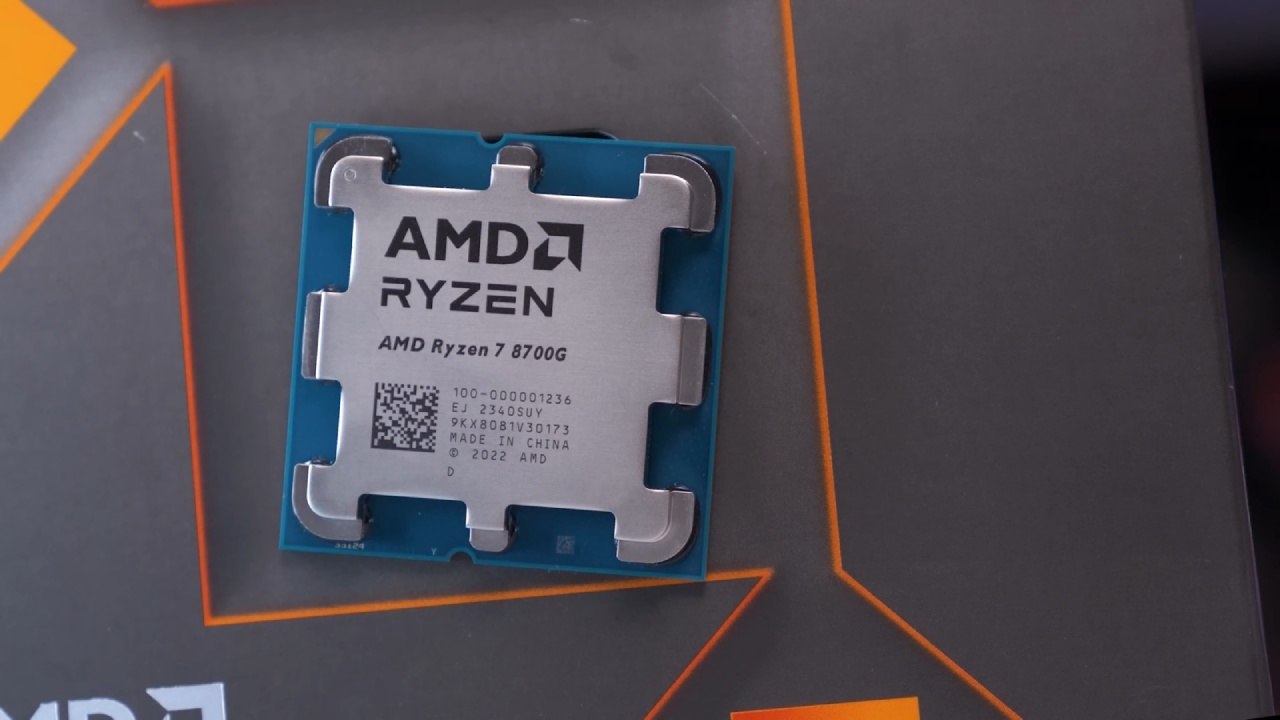
Ryzen 7 8700G Architecture and Specifications
Ryzen 7 8700G packs eight Zen 4 CPU cores with 16 threads on a single 4 nm monolithic die. To accommodate Radeon 780M GPU—boasting 12 compute units that reach up to 2.9 GHz—cache capacity is reduced to 16 MB of L3 and 8 MB of L2.
Connectivity is limited to 20 lanes of PCIe 4.0, offering up to eight lanes for a discrete graphics card. A standout feature is the Ryzen AI engine, AMD’s first desktop neural processing unit, clocked at 1.6 GHz under the XDNA architecture.
Test System and Configuration
All tests were conducted on an ASUS ROG Strix B650-A Gaming Wi-Fi motherboard, running BIOS version 2263. Our memory configuration consisted of a 32 GB DDR5-6400 C32 kit from G.Skill, manually set to a 2400 MHz FCLK due to a BIOS issue that was slated for correction in the public release.
For integrated graphics benchmarks, we focused on 1080p resolution with low quality presets to ensure apples to apples comparisons across different processors and GPUs.
Productivity and Rendering Benchmarks
In Cinebench 2024’s single core test, 8700G scored 111 points, making it 21% faster than its predecessor, 5700G, and merely 5% slower than Ryzen 7 7700X. When all cores were utilized, it matched the multi-core output of the 7700X, which is unsurprising given their identical 8-core, 16-thread configurations.
Compared to 5700G, 8700G achieved a 37% higher multi core score and outpaced a Core i3 1200F by 44%. During 7 Zip compression tests, we observed a 40% performance increase over 5700G, while decompression trailed 7700X by only 12%.
In application benchmarks, Photoshop 2024 saw a 34% uplift versus 5700G, and Premiere Pro GPU accelerated tasks were just 6% slower than 7700X.

Integrated Graphics Gaming Performance
When testing integrated graphics at 1080p with low quality settings, 8700G delivered a smooth 49 fps average in Baldur’s Gate 3—a leap of 145% over 5700G that transformed the experience from unplayable to comfortably playable.
Counter Strike 2 ran at an average of 119 fps, nearly doubling 5700G’s frame rate and making casual play entirely viable. Fortnite, under DX11, achieved an average of 132 fps, marking a 78% improvement over the previous generation.
Even demanding titles like Cyberpunk 2077: Phantom Liberty managed 41 fps on average with 1% lows at 30 fps, demonstrating the GPU’s potential at the lowest settings. F1 2023 performed exceptionally well, hitting 125 fps on average—a 23% uplift over Ryzen 7 7700X—and clearly outpacing 5700G.
Spider Man Remastered maintained a playable 68 fps, more than twice what 5700G achieved, while Ratchet & Clank Rift Apart hovered around 30 fps, sufficient for those tolerant of lower frame rates. Finally, Call of Duty: Modern Warfare III averaged 74 fps, tripling the output of the 5700G and enabling a genuinely playable experience on integrated graphics.
Memory Scaling and Bandwidth Sensitivity
Because integrated GPU performance depends heavily on memory bandwidth, we tested both higher-speed DDR5 7200 in a 1:2 ratio and the official DDR5 5200 specifications. In Fortnite, DDR5 7200 delivered a modest 4% performance uplift, whereas DDR5 5200 resulted in a 15% decline. F1 2023 proved less sensitive, gaining 2% with DDR5 7200 and losing 8% with DDR5 5200.
Spider-Man Remastered demonstrated that higher-speed memory does not always guarantee gains, as it dropped 1 fps with DDR5 7200 and suffered a 22% reduction with DDR5 5200. While AMD specifies DDR5 5200, faster kits can yield noticeable, if not earth-shattering, improvements in specific titles.

Comparison with Radeon RX 6500 XT
At $140 US, RX 6500 XT positions itself as a budget discrete GPU, yet its performance varies greatly with PCIe generation. On PCIe 3.0, 8700G’s iGPU outpaces 6500 XT in some titles by up to 33%, but PCIe 4.0 restores a 45% advantage to the discrete card.
In Counter Strike 2 and Fortnite, RX 6500 XT delivers between 58% and 74% higher frame rates on PCIe 4.0, highlighting the importance of platform pairing. Cyberpunk 2077 on PCIe 3.0 sees 8700G iGPU leading, though the balance tips back once PCIe 4.0 is enabled.
Across other tested games, RX 6500 XT generally outperforms the iGPU when given full PCIe 4.0 bandwidth.
Value Proposition and Budget Alternatives
When comparing cost-effective CPU+GPU combos, 8700G struggles to make sense. A Core i3 1200F ($100) paired with an RX 6600 ($200) delivers 127% more performance in Baldur’s Gate 3, 113% more in Counter Strike 2, and 182% more in Fortnite. Even in GPU limited titles like Cyberpunk 2077, the discrete combo offers 124% higher frame rates, while F1 2023 sees a whopping 154% gain.
This Core i3+RX 6600 setup not only outperforms the 8700G iGPU across the board but also comes in at a lower total cost, making it the superior gaming investment for budget-conscious builders.
Power Consumption and Efficiency
One area where 8700G shines is its efficiency. Our test system drew just 41 W at idle, rose to 79 W under a single core load, peaked at 131 W during full CPU stress, and recorded 148 W while gaming in Spider Man.
These figures highlight the platform’s low power requirements, which can be a significant advantage in compact or thermally constrained builds.

Final Thoughts
While Ryzen 7 8700G is undeniably impressive as an all in one APU—combining an 8 core Zen 4 CPU, a robust 12 CU RDNA 3 GPU, and a dedicated AI engine—it remains a niche product. For most gamers and PC builders, pairing a more affordable CPU with a discrete GPU delivers far greater performance per dollar.
If your priority is a compact mini PC with integrated graphics, 8700G offers an elegant solution. However, if you seek the highest frame rates and best value, you’ll achieve more by investing in separate components.
Check Our Other AMD articles:
- AMD Ryzen 9 9950X3D Review: Setting The Standard For 2025 Gaming CPU
- AMD Ryzen 7 9800X3D Review: 3D V-Cache Goes God Mode with Stunning Gaming Performance
- AMD RX 9070 Performance Review: Thermals, Clocks, and Real-World FPS
- AMD Ryzen 5 7600 Review: Best Budget Gaming CPU of 2025?
- AMD Radeon RX 7800 XT Review: RDNA 3 Power For Midrange Gaming
- Sapphire NITRO+ AMD Radeon RX 9070 XT Review: The Ultimate 4K Gaming GPU
- AMD Ryzen 7 7800X3D: Delivers Gaming Performance Far Beyond Expectations
- AMD Ryzen 9 7900X Review: Powering the AM5 Era with DDR5 & PCIe 5.0
- ASRock Radeon RX 7800 XT Challenger OC Review: Best Price-to-Performance GPU of 2025
- Intel Core i9‑14900K vs. AMD Ryzen 7 7800X3D: Power Profiles & Gaming Benchmarks
Senior Editor, NoobFeed
Gaming Hardware Updates
No Data.