
AMD Ryzen 9950X3D2 Review: Minimal Gains, Higher Power, Bigger Price
Dual 3D V-Cache design delivers high core count performance with increased power consumption and limited real-world gaming improvements.
Hardware by Tanvir Kabbo on Apr 22, 2026
AMD is again introducing a new CPU. A CPU that would have been quite interesting 1.5 years ago, but is now likely to be irrelevant. That is the summary of the 9950X3D2. AMD currently has Ryzen 9000 with two CCDs, each with 3D V-Cache. This is likely the most impressive desktop CPU on the market, just based on the technical specifications. Still, it is not always the one to purchase.
A Late Arrival with Familiar Foundations
Approximately 1.5 years ago, AMD released the 9950X3D. Right before that release, fans were already talking about a real high-end CPU with 16 3D V-Cache cores. This is what is happening now. The specifications are definitely impressive, with 16 cores and more than 200 MB of cache.
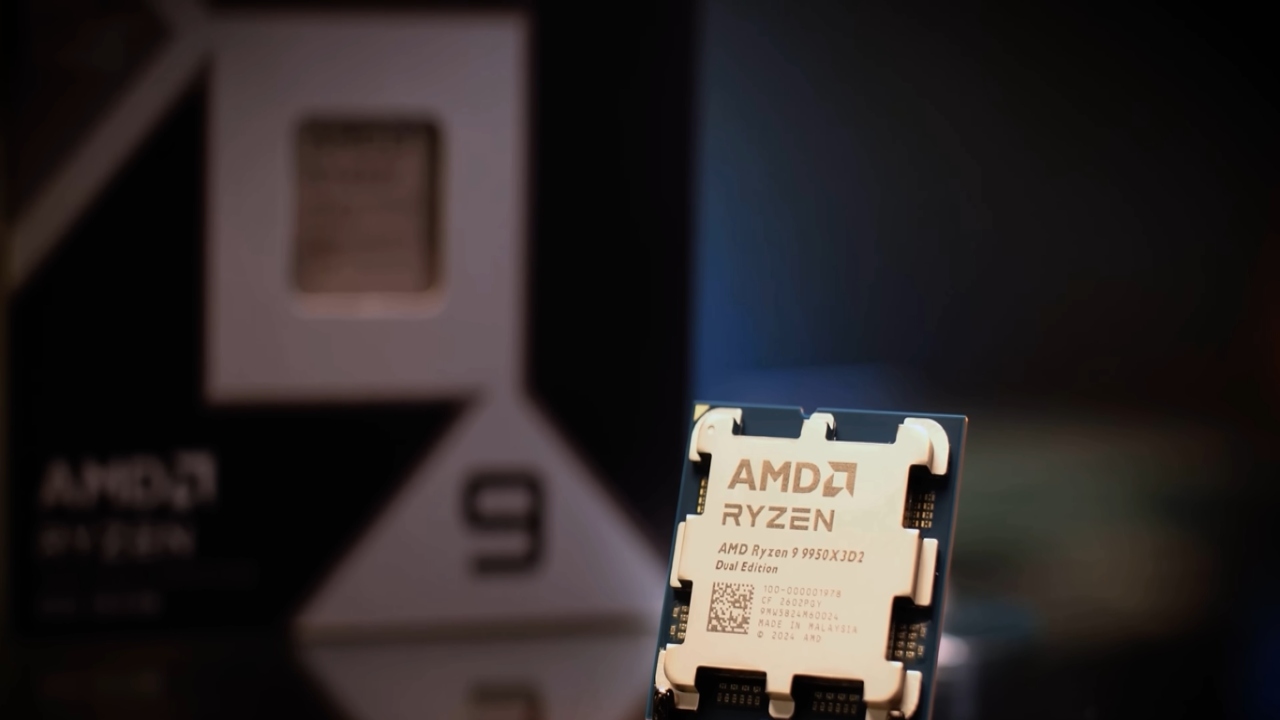
AMD has also raised the TDP of this CPU above that of the 9950X3D. Moreover, the bottom of both Zen5 CCDs now has 3D V-Cache. Physically, though, the CPU is identical to the 9950X3D. Other than the naming, X3D2 and dual edition, there are no physical differences. It also implies that compatibility is not lost between coolers, direct die setups, and mounting systems.
Limited Real-World Gains
The primary problem with this CPU is its timing. The differences between the original X3D and this X3D2 version are significant, but the technical enhancements are not significant. The only actual modification is the introduction of eight more 3D V-Cache cores. But most games cannot use this effectively.
This limitation is even reflected in the presentation of AMD itself. There are minor gains in productivity and AI workloads, ranging from 3 to 7% in some cases. Still, gaming performance is largely similar to the 9950X3D. These findings are not surprising, as merely increasing the number of caches does not have a significant effect in most gaming situations. Observable improvements are largely restricted to artificial standards.
Performance and Power Behavior
The CPU demonstrates an 11% performance improvement in benchmarks such as 3DMark Profile Max, with a score of 18,456 points versus the 9950X3D. This, however, is accompanied by an 8% rise in power consumption, to approximately 184W.
The CPU exhibits normal dual CCD behavior during Cinebench R23 testing. One CCD runs at approximately 5150 MHz, and the other at approximately 5050 MHz, with a 100 MHz difference. The package's power consumption increases to about 250W under load. With custom water cooling at 26 C, core temperatures would be approximately 70 C at full load. With a 360mm AIO, temperatures would probably be 80-90 C at full load.
The CPU scores an average of 44,021 points across five runs. This is approximately a 5 percent performance improvement over the 9950X3D, but power consumption increases by 25%. This puts it in the same performance range as competing CPUs that use less power and cost much less.
.jpg)
Gaming Performance: Small Differences
There is virtually no significant improvement in gaming results. In games such as Star Wars: Outlaws at 1080p, the performance disparity is insignificant due to the graphics card's constraints, even with the most powerful cards. The slight differences observed can be attributed to differences in drivers, not to the CPU's capability.
The X3D2 is a little better in Counter-Strike 2 at 4K but uses 8W more power. At 1080p, the minimum FPS is a little higher, but the power consumption is 13% higher in Cyberpunk 2077. At 4K, the performance difference is completely eliminated, and power consumption increases to approximately 117W, which is less efficient than the CPU.
Final Thoughts
The total performance improvement is between 3% and 5% when all benchmarks, including synthetic ones, are combined. This, however, is accompanied by a power consumption of about 20%. The efficiency is much lower than that of the 9950X3D, and it offers no meaningful performance improvements.
Technically, the CPU is very impressive. It has good specifications and would be a good base for a high-end system. But at a cost of approximately $900, it is hard to justify. The low performance gain, power consumption, and high cost make it a bad value relative to the existing options.
The CPU is not very sensitive in the present market, objectively. Although it is a good and strong alternative, there are already more appropriate price-to-performance options.
Also, check our other hardware articles:
- AMD Ryzen 9 9950X3D Review: Setting The Standard For 2025 Gaming CPU
- Amazon Luna 2025 Review: Is Prime Gaming's Cloud Service Your Go-To For Casual Fun?
- AMD RX 9070 XT Review: AMD's RDNA 4 Champion for 1440p Gaming
- GeForce Now Ultimate: Ditching Your Gaming PC For Cloud RTX 4080 Power?
- NVIDIA GeForce RTX 5080 Review (2025): Still A 4K Gaming Powerhouse?
- Intel Core Ultra 9 285K Review And Performance Breakdown (2025)
- AMD Ryzen 7 9800X3D Review: 3D V-Cache Goes God Mode with Stunning Gaming Performance
- Intel Core Ultra 9 285K vs AMD Ryzen 7 9800X3D: In-Depth Gaming Performance and Benchmark Comparison
- NVIDIA GeForce RTX 5080 Super Performance In Cyberpunk 2077: Path Tracing & DLSS 4.0 Tested
- AMD Radeon RX 9070 XT In Cyberpunk 2077: Ray Tracing & FSR 4.0 Tested
- Intel Arc B580 Review: The $250 GPU Revolutionizing 1440p Gaming
- Intel Arc B570 Vs. B580: Value, Specs, And Real-World Gaming Performance
- RTX 5090 Laptop Vs. M4 Max MacBook Pro: Ultimate Raw Performance Vs. Battery Endurance
- Intel Arc b580 Vs. RTX 4060: Game Performance And Value Analysis
- RTX5090 Hell Is Us Demo 4K Ultra Benchmark: DLSS Vs. Native Performance Guide
- NVIDIA RTX 5070 Review: Mid-Range Muscle or Marketing Hype?
- Nintendo Switch 2 Review: Handheld Performance, Features & Value Breakdown
- RTX 5070 Ti Review: Performance, Thermals & Power Efficiency Tested
- Samsung Odyssey OLED G81SF Review 2025: Ultimate 32-Inch QD-OLED Gaming Monitor
- AMD RX 9070 Performance Review: Thermals, Clocks, and Real-World FPS
- AMD Ryzen 5 7600 Review: Best Budget Gaming CPU of 2025?
- AMD Radeon RX 7800 XT Review: RDNA 3 Power For Midrange Gaming
- Asus ROG RTX 5090 Astral OC Vs. Founders Edition: The 4K Gaming Benchmark
Senior Editor, NoobFeed
Gaming Hardware Updates
No Data.