
Zen 5 X3D Evolution: AMD Ryzen 9 9900X3D Performance, Efficiency, and Gaming Benchmark
Zen 5 X3D architecture introduces enhanced cache behavior and frequency scaling aimed at improving gaming consistency across demanding titles.
Hardware by Tanisha Aria on Nov 17, 2025
AMD's first wave of Zen 5 desktop processors with 3D V-Cache is the Ryzen 9 9900X3D. It features a hybrid dual-CCD configuration designed to balance gaming performance, multithreading performance, and power efficiency.
Although this early engineering unit doesn't demonstrate how the end product will function, the way it behaves in real-life tests reveals a great deal about how Zen 5 3D V-Cache operates internally and how it compares to older AMD and Intel hardware.
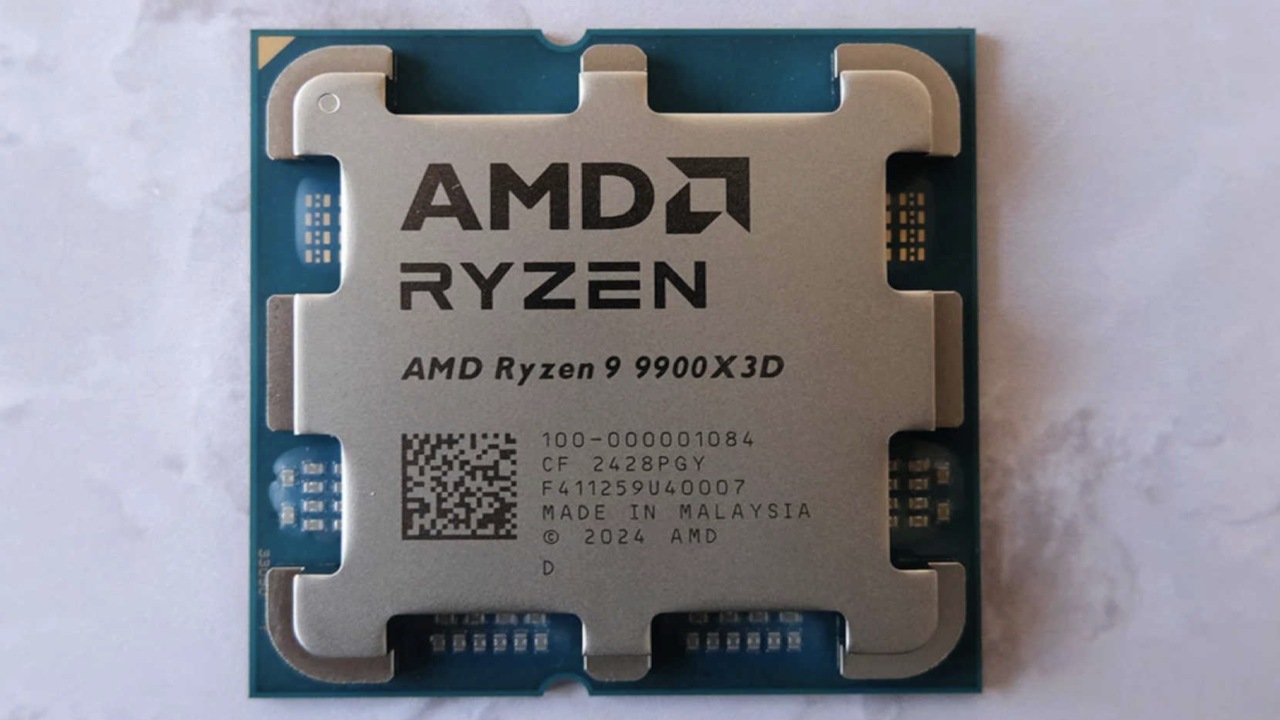
Architecture and Design Characteristics
The processor features a dual-CCD layout, comprising one Zen 5 CCD that operates at full clock speed and one Zen 5 3D V-Cache CCD that runs at a lower frequency but with significantly more L3 cache. This asymmetric design is similar to older AMD 3D V-Cache generations.
It keeps the predictable thread-scheduling behavior, where light-threaded jobs tend to use the faster CCD and gaming workloads tend to use the stacked-cache CCD.
Windows properly assigns gaming tasks to the V-Cache CCD, as shown by an internal analysis of thread migration. Performance monitoring also indicates that gaming threads remain stable during extended sessions.
The engineering sample also exhibits consistent inter-CCD latency values, which are similar to those observed in earlier Zen 4 X3D processors. This shows that AMD's approach to optimizing games based on cache remains a key part of their strategy.
Synthetic Benchmark Performance
Early tests show that, based on the workload, the Ryzen 9 9900X3D performs between the 9900X and the higher-end expected 9950X3D.
- When only one thread is running, the results are similar to those with the normal Zen 5 clock, as those tasks typically occur on the non-stacked CCD.
- Multithreaded scores are slightly higher than the base 9900X because the cache works better in a variety of tasks.
- Tools that are sensitive to memory delay benefit from Zen 5's improvements to the architecture and the stacked CCD's larger cache footprint.
- Although they don't reveal the exact retail numbers, synthetic results indicate that scaling trends remain consistent with those in previous X3D generations, and Zen 5's IPC improvements are still evident.

Gaming Benchmarks and Behavior Across Titles
Through testing with various new and old games, it was found that the 3D V-Cache CCD remains the primary speed driver in gaming situations.
Games that heavily rely on memory delay and large working sets experience significant improvements. In contrast, games limited by GPU or bandwidth capacity don't see substantial changes.
Observed Game Behavior Across Test Titles
- Cyberpunk 2077 has better frame-time consistency because the larger L3 cache can handle spikes in shader and AI tasks.
- Spider-Man 2 has fewer streaming hitches, which helps, especially in scenes where you have to move quickly through a lot of objects.
- The cache-enhanced CCD makes Oblivion Remastered run a lot better, especially during heavy draw-call clusters.
- The necessary frame rates for Hogwarts Legacy have improved when streaming heavy assets, allowing for smoother gameplay.
- Cache-driven latency decreases work especially well for games like Space Marine II and StarCraft II, as well as older titles that rely on lengthy simulation loops.
- Games like Counter-Strike 2, PUBG, and Escape From Tarkov, which are known to be very sensitive to frame delay, show better stability and frame rates, as expected from 3D V-Cache hardware.
- Emulated games, such as Uncharted 3, on RPCS3 have their own scheduling behavior, but testing has shown that the V-Cache CCD still prevents jumps in shader recompilation.
Overall, gaming performance is very similar to the benefits seen in earlier versions of X3D, indicating that the stacked CCD is more important for workloads that require low latency.
Thermal Performance and Power Efficiency
A thermal analysis shows that the Zen 5 has normal thermal properties. The stacked CCD runs slightly cooler due to frequency limits. Still, the non-stacked CCD achieves normal Zen 5 operating temperatures under mixed load.
The total package power is still lower than that of similar models that don't use X3D graphics. This is part of AMD's ongoing trend toward game SKUs that focus on efficiency.
The research sample keeps its boost behavior and doesn't experience any sudden thermal throttling. This shows that power and scheduling are managed correctly at the firmware level, even before the final BIOS is fully developed.
Platform Behavior and Memory Compatibility
The updated memory controller and larger cache structure in Zen 5 make all DDR5 versions more responsive overall.
Initial testing shows stable operation at commonly supported memory speeds, and early firmware seems to handle CCD scheduling transitions smoothly, similar to how late Zen 4 X3D BIOS builds behave more smoothly.
In synthetic latency tests, low-latency memory configurations show a measurable improvement. However, in most game cases, the stacked-cache CCD still hides the effect of main memory latency.

Final Thoughts
The engineering sample for Ryzen 9 9900X3D makes it clear how AMD plans to place Zen 5 in the performance and gaming market.
There is uniform architectural behavior, recognizable X3D scheduling patterns, and improved efficiency on the chip without compromising the gaming benefits of 3D V-Cache.
The data strongly suggest that AMD will keep its lead in latency-sensitive gaming workloads. The final performance will depend on how well the firmware develops and how the silicon is binning.
A high-clocked Zen 5 CCD and a cache-enhanced CCD work together to provide the laptop with a flexible performance profile that makes it well-suited for gaming, work, and mixed tasks.
When the 9900X3D goes on sale, it will reveal its position in comparison to the flagship 9950X3D. However, even now, the design exhibits clear strengths and predictable scaling behavior that aligns with AMD's plan for Zen 5.
Also, check our other AMD articles:
- AMD Ryzen 9 9950X3D Review: Setting The Standard For 2025 Gaming CPU
- AMD Ryzen 7 9800X3D Review: 3D V-Cache Goes God Mode with Stunning Gaming Performance
- AMD RX 9070 Performance Review: Thermals, Clocks, and Real-World FPS
- AMD Ryzen 5 7600 Review: Best Budget Gaming CPU of 2025?
- AMD Radeon RX 7800 XT Review: RDNA 3 Power For Midrange Gaming
- Sapphire NITRO+ AMD Radeon RX 9070 XT Review: The Ultimate 4K Gaming GPU
- AMD Ryzen 7 7800X3D: Delivers Gaming Performance Far Beyond Expectations
- AMD Ryzen 9 7900X Review: Powering the AM5 Era with DDR5 & PCIe 5.0
- ASRock Radeon RX 7800 XT Challenger OC Review: Best Price-to-Performance GPU of 2025
- Intel Core i9‑14900K vs. AMD Ryzen 7 7800X3D: Power Profiles & Gaming Benchmarks
Contributor, NoobFeed
Gaming Hardware Updates
No Data.