
Dawn of Defense Review
PC
A tower defense, a small RTS, and a roguelite, all competing for your attention.
Reviewed by Adeela Tas on Nov 18, 2026
Dawn of Defense comes from 6side Studio, a small independent team, and it throws tower defense, real-time strategy, and roguelite progression into one game. Rekoup and Gamersky Games are publishing it together with the studio, and it landed on Steam for PC on November 17, 2026.
It is built for one player, and no console version has been announced. The pitch fits in one breath. You defend a base against waves of enemies while pushing outward across a chain of islands with your own army. Both jobs run in parallel, and ignoring either ends a run.
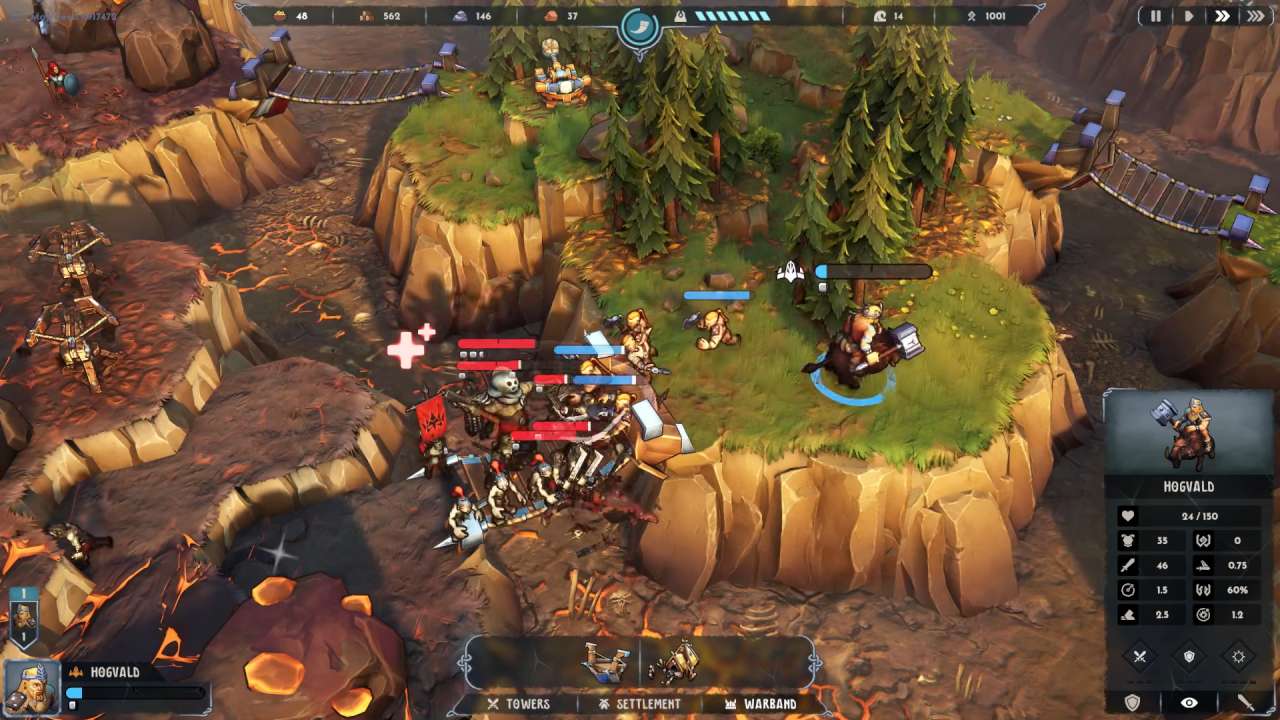
Dawn of Defense never lets you settle into a single rhythm for long.
The story is thin, and Dawn of Defense does not try to hide that. You play the Norse side as Hogvald, a heavily armored warrior who rides a boar and swings a massive warhammer. You protect the Spiridun, a pillar on your home island that must survive for the run to continue.
The enemy is an empire whose names and gear lean Roman, with Legionnaires, gladiators, praetorian guards, and a commander called Legatus, mixed in with trolls, ogres, and minotaurs. Each fortress is held by a warlord, the first being Gor-Thrax, and the whole map is built around reaching those strongholds and breaking them.
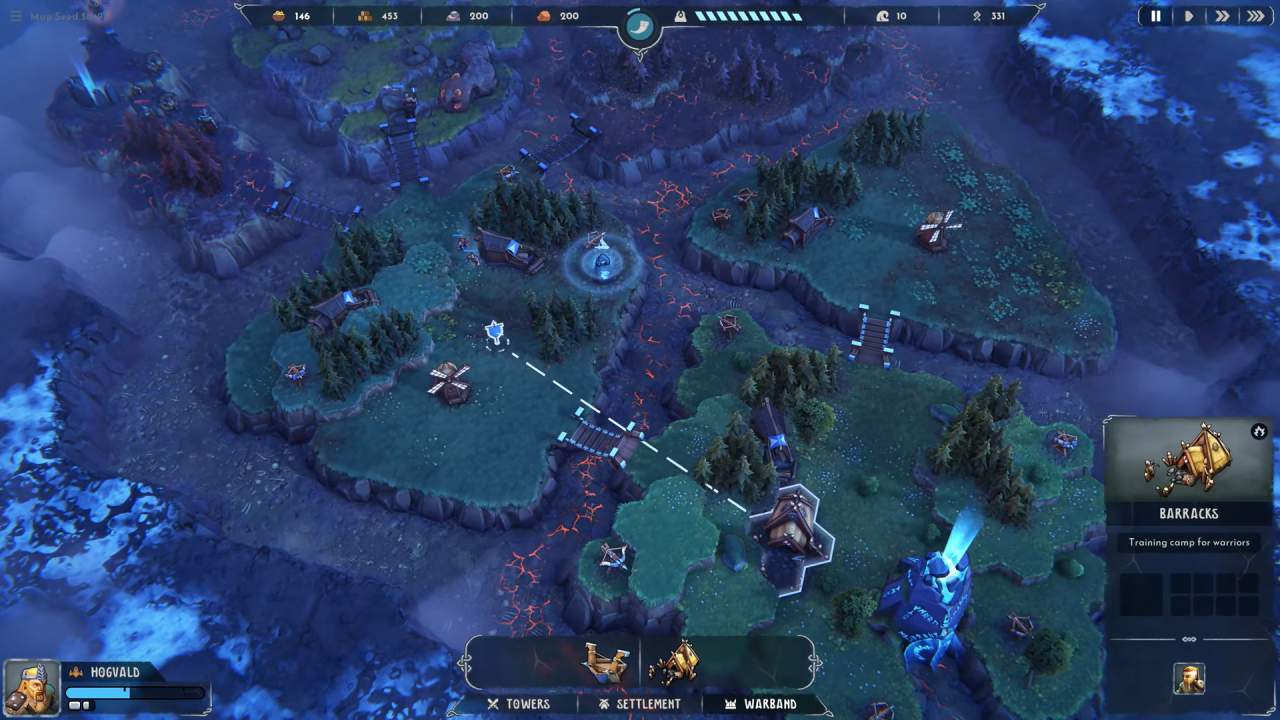
Three bosses wait in total. When one falls, the next fortress starts sending out its own waves, and you are told to go after the next warlord. That is about all the narrative on offer, but it gives your pushes a clear direction. Every map is split into two layers. The upper layer is a cluster of irregular hex islands, where you build your economy, claim ground, and command troops.
The lower layer is a set of canyons cut between those islands, and enemy waves walk through them toward the Spiridun. Maps are generated at random, so you never get the same layout twice. A run begins on your home island. Place your first towers to cover the canyon paths, add a few economy buildings, then blow the war horn to start the first wave.
Enemy spawn points show up as magma ground, so you can see where trouble will come from.
If the Spiridun falls, the run ends right there. In Dawn of Defense, resources arrive only at the end of a round, so during a wave you have nothing to spend and can only watch and direct. The early waves are light, so that's when you build.
You can call waves early, speed the game up with the button in the top right, and pause whenever things get busy, which helps when you want to place towers and move troops without rushing. Tutorial prompts are short, appear only when a mechanic matters, and can be turned off.
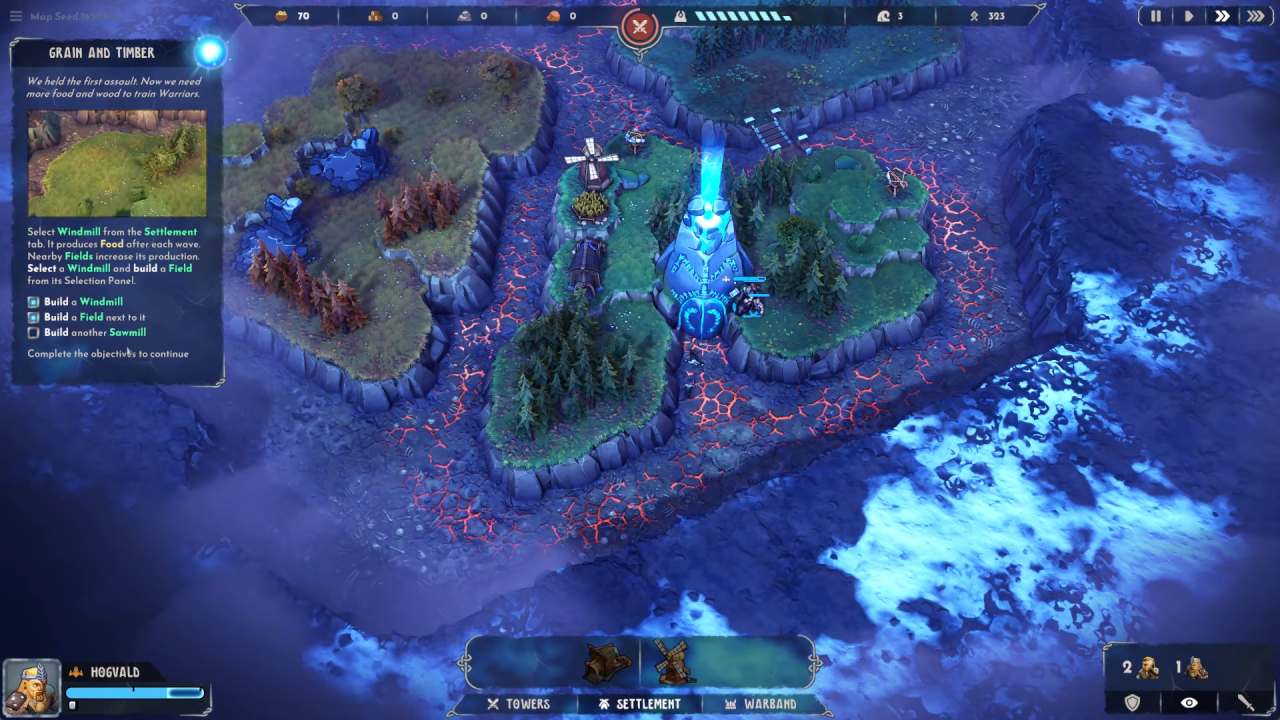
There are four resources: wood, food, stone, and iron. Wood is the base of everything, and it is tight at the start. A Sawmill produces more when more trees are nearby, so placement counts from turn 1. A Windmill gives around 40 food by itself, and every field you till on a neighboring hex adds more, 10 each by default and 14 once a permanent bonus is in place.
It reaches its best output only when all six surrounding tiles are fields, and that eats a lot of room. Quarries and Iron Mines work only on fixed deposits, so what you can get depends on the map. On some maps, the iron sits past the first boss, so you have to take that fortress just to reach it. A Mead Hall placed next to food or resource buildings lifts their output by 50 percent, though it is awkward to fit into a crowded island.
Space is the real limit in Dawn of Defense.
Every island has a plot cap, and towers count against it, so each tile you give to a Sawmill is a tile that cannot hold a defense. Build too much infrastructure and your damage is too low. Build too many towers and your income stalls. Islands also come in elevation levels.
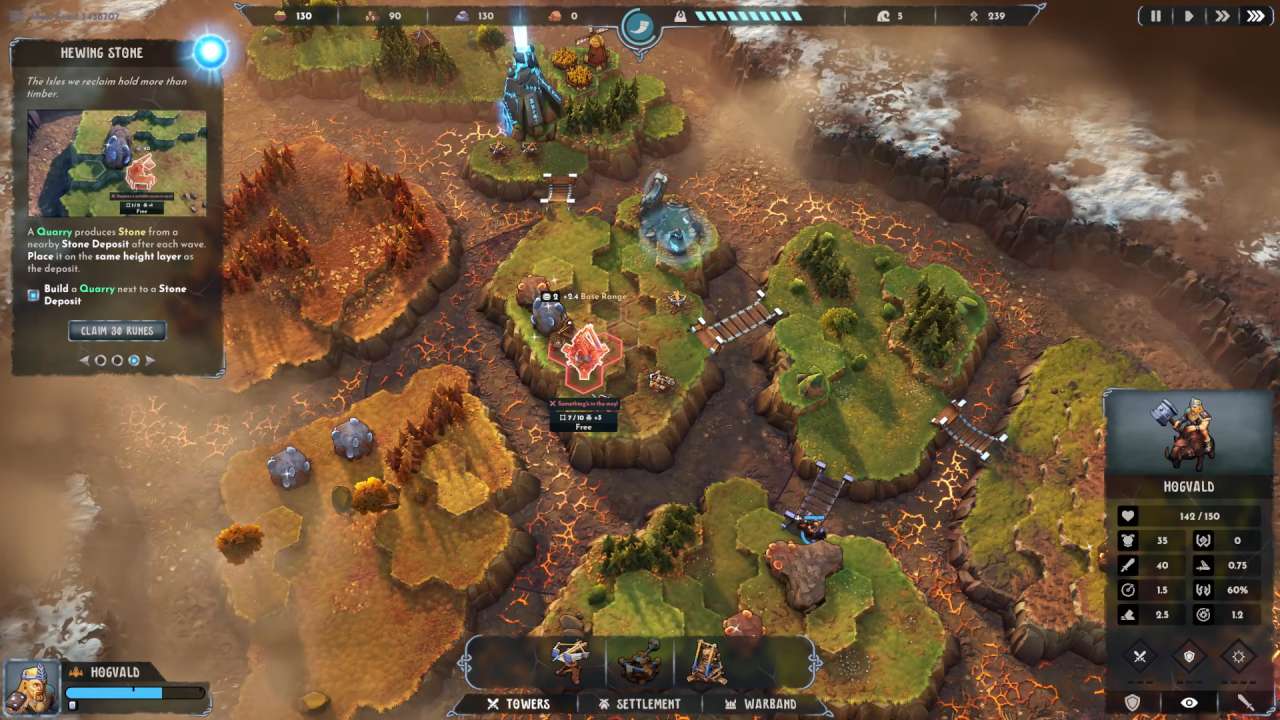
Towers on higher ground gain extra range, so a catapult on a ridge covers a long stretch of canyon. The catch is that height differences can block placement, and a deposit sitting next to a tall cliff can leave you with only one or two usable tiles. Every tile becomes a question of what deserves the spot.
Growth in Dawn of Defense comes from conquest. You build bridges between islands, which cost 65 wood early on, and send Hogvald across to claim the land. Every island you hold pays out at the end of a round, including an island tax of 30 wood and Runes for the skill tree, and each one adds plots for more buildings.
The enemy plays the same game. Rival forces build their own bridges, take your islands and defend theirs, and a bridge is destroyed once the island it leads to changes hands. Shrines sit on some islands. Claiming one buffs your nearby warriors or gives you a draft pick, while enemy-held shrines are corrupted and strengthen their troops.
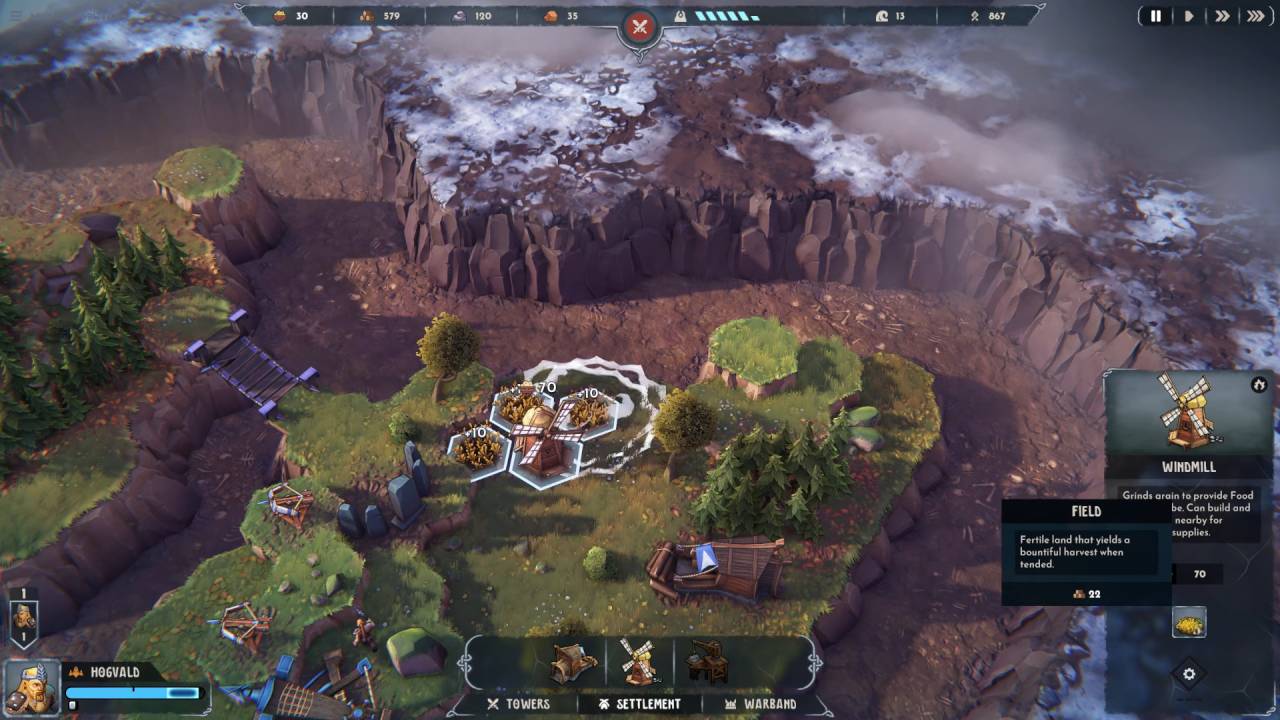
Barracks troops and five tower types now decide whether your conquests hold.
Some of these buffs work map-wide, so losing a speed shrine means enemy soldiers move faster above and canyon waves rush your Spiridun faster below. Troops come from the Barracks, which costs 100 wood early on and trains units with food.
You can set a rally point for them. Axemen cleave through packed enemies, Spearmen hold the line and can be upgraded to Pikemen, mounted Lancers cover ground quickly, and the Shieldmaiden, added just before launch, can hold off an entire enemy squad on her own.
Your troops cannot walk on the lava level. Through the first fortress, a few buffed Axemen are usually enough. Further out, speed matters, because you need to reach a collapsing flank in time. Stances and control groups help you split your army. Hogvald comes back after dying and regenerates, but he cannot carry a map alone.
Defense in Dawn of Defense rests on five tower types, each with three upgrade levels split across two paths. The Boltskot is the basic ballista, and it hits single targets hard, which makes it dependable against armored enemies. The Skullbrakkr is a catapult that lobs boulders over a long range and deals splash damage to clusters.
The Tarbarl slows enemies, costs little, and takes up an odd triangular footprint across several tiles.
The Eyodin shrine marks enemies so they take more damage, which helps against elites, and it needs iron to build. The Krokran fires a narrow, piercing cone. The first copy of each tower you unlock is free, and the higher tiers cost stone and iron, so sitting at home is never a real option. The upgrades change how a tower behaves instead of only raising numbers.
A first-tier Boltskot upgrade makes bolts splinter on impact and send two extra shards into nearby enemies. A later one charges every fourth shot into a hit worth around 500 percent damage, and another path adds attack speed each time a shot lands, which suits single targets. A Skullbreaker fires faster for each Quarry on its island, and a further upgrade pays out iron for kills, which helps a lot when deposits are scarce.
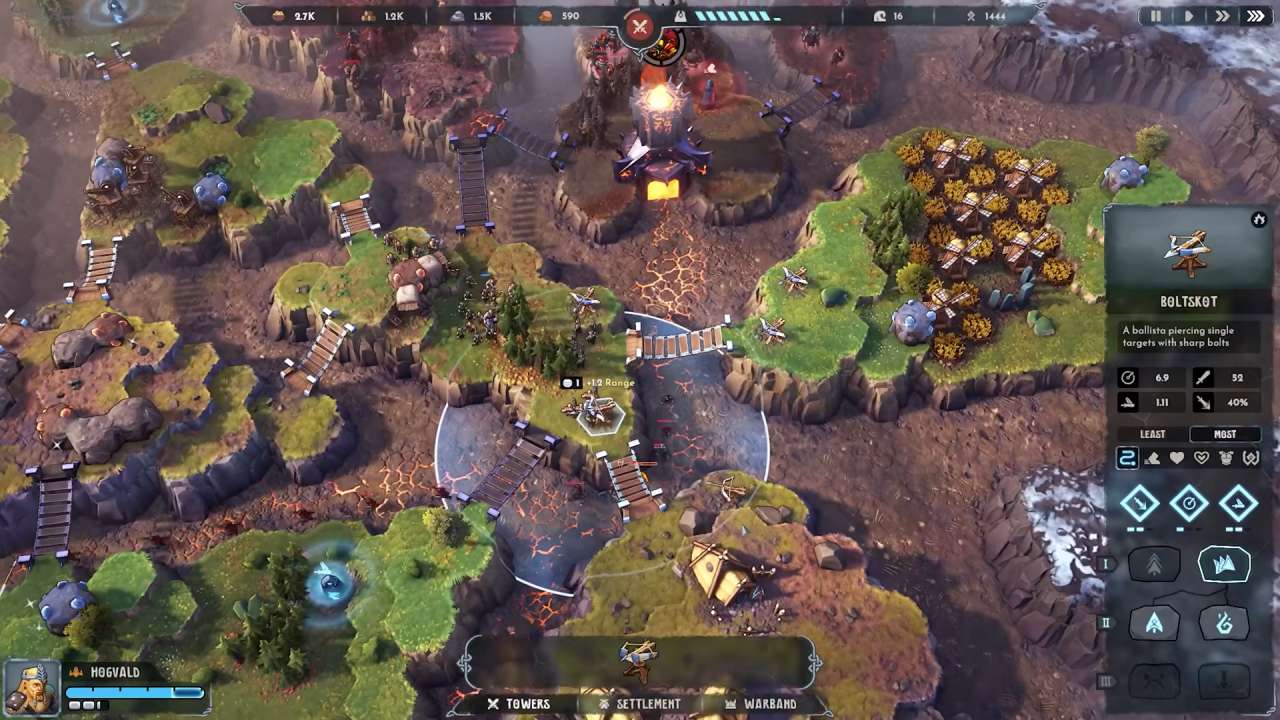
Putting every point into the Boltskot line leaves you short against heavy waves, and the catapult line you skipped is the one you end up missing. You can also set each tower to target the farthest enemy along the path, the one with the lowest health, or the one with the highest health, and the last option is handy for dealing with elites first.
Enemies vary a lot. Early waves bring golems and zombies, then armored Legionnaires, fast riders that reach the Spiridun sooner than you expect, cave trolls and ogres with huge health pools, gladiators, a Flinger, and units that carry protections or strengthen nearby units.
Elites glow, and they have a higher chance of dropping a chest with materials or a fresh Runestone.
The chest stays on the ground until you pick it up. Towers close to the Spiridun matter because fast enemies cover the distance quickly, and waves can arrive from both sides or along new paths as the enemy expands. Each warlord sits in a fortress, and a ring around it lights up one at a time over the final three waves before he attacks on his own. Every lit ring adds a buff, and Gor-Thrax gains health.
If you destroy the fortress early, you face him weaker, and cutting its links triggers a three-round cooldown before the boss arrives. When he spawns, he heads straight for the Spiridun without detours. Beating a boss expands the map and opens paths to two more bastions, and taking a fortress gives you a pick from three Runestones. The first boss is manageable even without permanent upgrades. The later ones are a different matter.
What works best in Dawn of Defense is that the pressure comes from two places, and neither one feels optional. Waves are never something you just watch. While the canyon holds, you bridge, raid outposts, and decide where the next tower goes, which keeps the game busy in a way passive tower defense isn't.
Islands differ enough that no single build works every time. A heavy Boltskot nest, a catapult plateau, and an economy-first start all stay viable, and the Runestone drafts let you steer toward whichever you prefer. When a run fails, it usually feels like a timing mistake on your part, not plain bad luck. The rough edges are easy to list.
Many Runestone bonuses give you no way to learn what they actually do, and no screen shows the perks you have gathered during a run.
Unit collision for your warriors and your hero is poor, and on narrow islands, pathfinding around bottlenecks is inconsistent, which sends troops into danger. Charged tower shots pick a random target and do not favor elites. Elite chests have no clear marker, so they are easy to miss mid-fight.
Some maps produce outliers, like very short canyon paths or elevation that blocks building spots. The shapes on the Rune Wheel for different items come with no explanation. The RTS side is shallow if you want deep micro, since upper-layer combat is mostly about territory, and canyon lanes are fixed, so you get no mazing.
Runes sometimes failed to show up after a finished game, which is frustrating when the whole loop depends on them. Progression in Dawn of Defense happens on two levels, starting with the Runestones you draft inside a run. After each wave, you pick one of three, and you get five rerolls per run, so you can steer toward a synergy.
They come in white, blue, and purple rarities, and a higher rarity on a key tower sharply raises its stats. The offers cover tower damage, attack speed and range, Sawmill efficiency, Windmill output, plot expansions, hero health and damage, Spiridun healing, a lump of wood such as 150 or 600, treasure drops, and new towers or units.
Unlocking a tower through a pick can feel like a wasted choice, though you often need the stronger buildings later.
The second level is the skill tree. Every run, win or lose, banks Runes, and holding more islands raises your Runes per turn. You spend them on stat bumps for towers, armor piercing, troop strength, hero health, higher base yields from Windmills, Sawmills and Quarries, Spiritun health and healing, and island tax.
You also unlock Pikemen, the Tarbarl, the Eyodin shrine and the Mead Hall, plus free starting towers. Read the numbers before you buy, because one armor-piercing upgrade turned out to be worth only 1 percent. Unlocking buildings permanently frees your drafts for real upgrades instead of unlocks, and stronger Runestone tiers show up in later runs.
Without that tree, early runs of Dawn of Defense hit a wall. Your first run ends fast, your troops are weak, and enemy outposts look out of reach. After a round of spending, the same Axemen look noticeably stronger, and the first fortress becomes a fair fight. Chasing the next unlock can feel grindy, though clever play lets you move faster. Each defeat leaves something behind, which keeps you starting another run to try a build a little cleaner.
Dawn of Defense has a comic-style Norse aesthetic that reminds you of Warcraft. Color does real work. Your islands are a lively green, neutral islands are autumn brown, and hostile ones burn in dark embers, so you can read the front line at a glance. Magma marks enemy spawns, elites glow, and the rings around a fortress light up as the boss countdown moves along.
The canyon routes can tangle, and large waves create clutter that makes it harder to follow your troops.
Performance holds up well, with big waves and large battles running without heavy frame drops on mid-range hardware. Sound in Dawn of Defense stays in the background. The small details that stand out are the Axemen singing work songs as they get to building, the growling of enemies as they close in, and the war horn that starts each wave, which becomes the cue you wait for.
Beyond that, the audio doesn't change much in how you play. Overall, Dawn of Defense does what many tower defense games skip: keeping you moving while the clock runs down. You expand, build, raid, and defend, often within the same minute. It does not reach the depth of games that focus on only one genre, and RTS veterans will miss the micro tools and tidier unit control.
Still, the loop is addictive, the maps stay fresh, and the package holds together well. Dawn of Defense suits you if you like scarcity puzzles and active pressure. It is a poor fit if you want a relaxed town builder or classic mazing, and the early hours will wear on you without the permanent unlocks. Clearer perks and better unit pathing would go a long way.
Editor, NoobFeed
Verdict
Dawn of Defense blends tower defense, light RTS, and roguelite progression into a loop that keeps you coming back, despite unclear perks and clumsy unit pathing. It is worth a look if you enjoy pressure.
77
Related News
No Data.