
Intel D270 Crescent Island GPU Claims 5.9x FP64 Performance
Intel's Crescent Island GPU combines full-rate FP64 computing, massive LPDDR5X capacity, and lower power consumption to challenge established HPC accelerators.
Hardware by Tanvir Kabbo on Nov 19, 2026
Intel is making an ambitious return to the high-performance computing (HPC) accelerator market. At Supercomputing 2026 (SC26), the company revealed performance benchmarks for its next-generation Intel D270 GPU, codenamed Crescent Island. Powered by the new Xe3P architecture, the accelerator combines high-precision computing, AI inference capabilities, and unusually large memory capacity within a relatively modest power envelope.
The headline is striking: Intel claims its 350W D270 delivers up to 5.9x higher FP64 throughput than NVIDIA's 600W RTX PRO 6000 Blackwell Server Edition in selected financial modeling workloads. However, the comparison comes with an important caveat about NVIDIA's hardware choice.
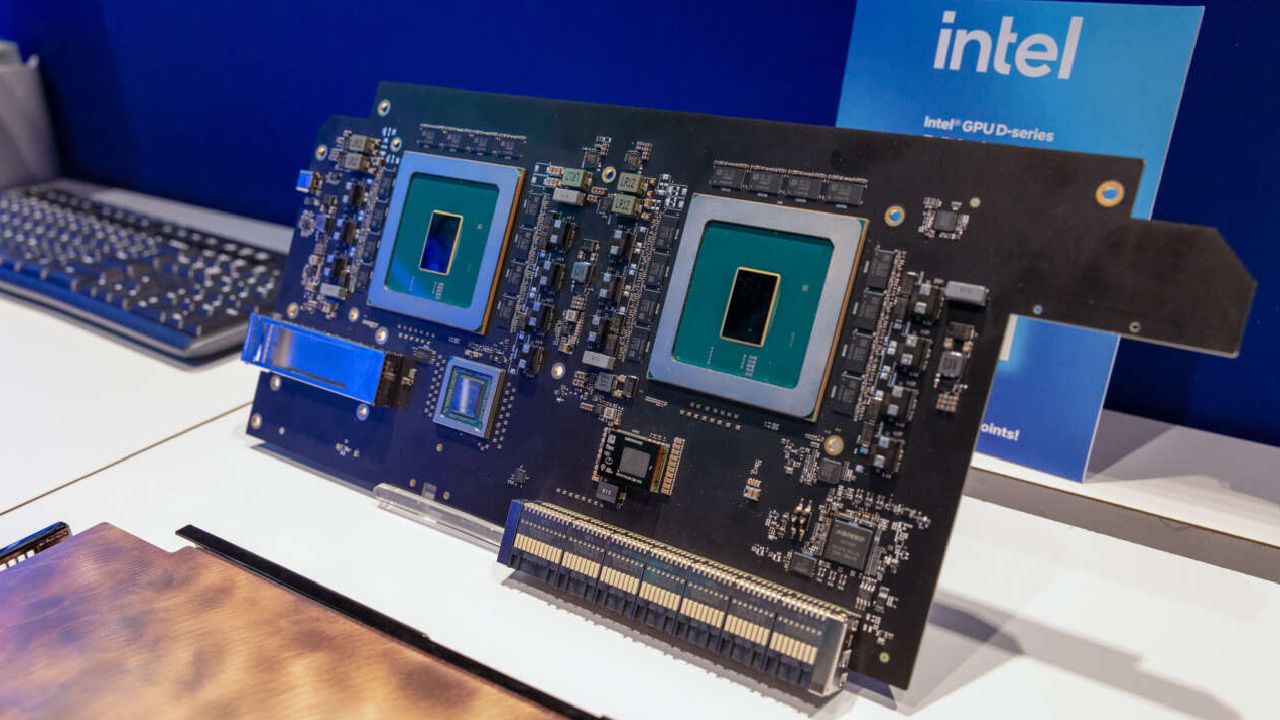
Xe3P Architecture and Memory Engineering
The D270 features 32 Xe3P cores and 256 XMX matrix engines, supporting computing formats ranging from FP4 to FP64. Its defining characteristic is native, full-rate double-precision performance, with each Xe core supporting 64 FP64 fused multiply-add operations.
However, Intel's most interesting engineering decision concerns memory. Instead of relying on expensive HBM or GDDR7, Crescent Island uses 160 GB of LPDDR5X memory connected through a massive 1,280-bit interface. This configuration delivers 1.5 TB/s of bandwidth, while partner-designed cards can reportedly scale capacity up to 480 GB.
The entire configuration operates within a 350W TDP, uses standard air cooling, and relies on a PCIe 5.0 interface. This approach prioritizes capacity and deployment flexibility over maximum memory bandwidth. Although 1.5 TB/s cannot compete with the bandwidth available from high-end HBM accelerators, substantial memory capacity could benefit scientific simulations and inference workloads that need to keep large datasets resident on the GPU.
Avoiding HBM also gives Intel an alternative to the expensive memory packaging and supply constraints affecting high-end accelerators.
5.9x FP64 Performance: Intel's Biggest Advantage
Intel's SC26 financial modeling benchmarks demonstrate where Xe3P's architecture makes the biggest difference. The D270 reportedly achieved 5.9x higher throughput in European Monte Carlo simulations, 5.6x in European Black-Scholes, and 4.6x in Binomial pricing compared with the RTX PRO 6000 Blackwell Server Edition. American Monte Carlo showed a smaller but still substantial 1.92x advantage.
These results highlight the importance of native FP64 execution. Financial simulations frequently depend on double-precision calculations, making dedicated FP64 resources considerably more valuable than raw AI matrix throughput.
Power consumption strengthens Intel's argument. The D270 operates at 350W compared with NVIDIA's 600W accelerator, potentially delivering significantly better performance per watt in these particular workloads. However, these figures represent Intel's first-party results rather than independently verified benchmarks.
AI Inference Gains Are Much Smaller
The performance picture changes when moving from HPC to conventional AI inference. In Qwen3-30B-A3B FP8 testing, Intel reported 1.12x higher output token throughput than a single RTX PRO 6000 Blackwell. Meanwhile, Drex v2.0 reportedly delivered 29% lower latency on the D270.
These results are encouraging, but nowhere near the multi-fold improvements shown in financial modeling. That difference suggests Crescent Island's primary competitive advantage lies in specialized high-precision computing rather than overwhelming AI inference performance.
Benchmark conditions also deserve attention. Intel used its oneAPI software environment, while NVIDIA relied on CUDA-based software. The systems and testing environments weren't identical, making independent comparisons especially important.
The NVIDIA Comparison Has One Major Catch
The biggest qualification concerns Intel's choice of competitor. NVIDIA's RTX PRO 6000 Blackwell Server Edition is primarily a workstation and AI-focused accelerator, not a dedicated HPC flagship. Its FP64 capabilities are substantially less emphasized than those of NVIDIA's purpose-built data center accelerators, including the B200 and upcoming Rubin platform.
Consequently, Intel is comparing its full-rate FP64 architecture against a product whose architectural priorities lie elsewhere. The 5.9x advantage is meaningful within the tested workloads, but it does not establish that Crescent Island outperforms NVIDIA's flagship HPC hardware.
FAQ
Q. What is the Intel D270 Crescent Island GPU?
A. The Intel D270, codenamed Crescent Island, is a next-generation data center GPU powered by Intel's Xe3P architecture, designed for high-performance computing and AI inference workloads.
Q. How much faster is the Intel D270 than NVIDIA's RTX PRO 6000 Blackwell in FP64 workloads?
A. Intel claims up to 5.9x higher throughput in European Monte Carlo financial modeling benchmarks, although the results are based on first-party testing.
Q. How much memory does the Intel D270 Crescent Island GPU offer?
A. The standard configuration features 160GB of LPDDR5X memory with 1.5 TB/s bandwidth, while partner-designed configurations can reportedly scale up to 480GB.
Q. Does the Intel D270 outperform NVIDIA's dedicated HPC GPUs?
A. Not yet established. Intel's published comparisons use the RTX PRO 6000 Blackwell, a workstation and AI-focused GPU rather than NVIDIA's dedicated HPC accelerators such as the B200.
Senior Editor, NoobFeed
Gaming Hardware Updates
No Data.