
The Witch's Bakery Review
PC
A story-first bakery adventure where every croissant comes with a little care.
Reviewed by Asura Kagawa on Oct 14, 2026
The Witch's Bakery is Sunny Lab's first game, a studio Charlotte Gailledreau and Hugo Sahuquet started in 2022. Charlotte spent time at OBB and GI, while Hugo worked at Ubisoft and Asobo. Still, running their own company turned out to be a different kind of job, and the administrative, accounting, and legal work caught them off guard. They began development in 2023, after spending time building the universe and seeking funding.
The first question they asked themselves was which stories they wanted to tell and why, and that starting point shapes what you end up playing. The money side is worth knowing about too. Family and friends funded the prototype, at a time when investment was hard to find. A successful Kickstarter followed, along with a partnership with Silver Lining Interactive.
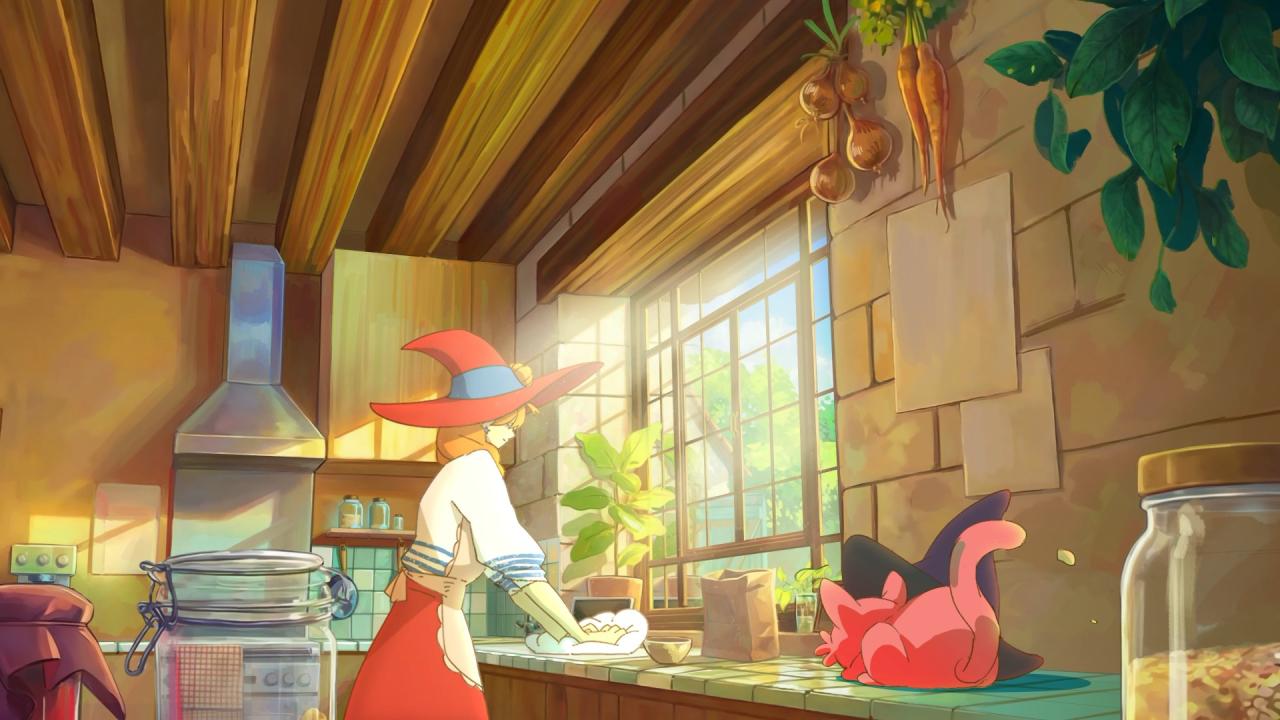
The mix of Paris, cooking, magic, and emotions comes from the creators' own interests.
The team also says it does not use generative AI. They describe the style as anime aesthetics blended with romantic impressionism and French art history, and say the story comes first, with the mechanics built to support it. The Witch's Bakery launched digitally on almost every major platform.
You play as Lunne, a young witch who moves to Paris to open her own bakery. She is a witch of the Heart, meaning she can step into people's hearts and heal their emotions with magic. She doesn't show up to save the world. She shows up to build a life, and that smaller scale is what makes the story work.
Lunne is energetic and enthusiastic, a bit like a golden retriever in a witch's hat, and she is joined by Orio, a magical companion who looks like a cat or a fox depending on who you ask. The two have a light, comic back-and-forth, and their bond anchors everything else.
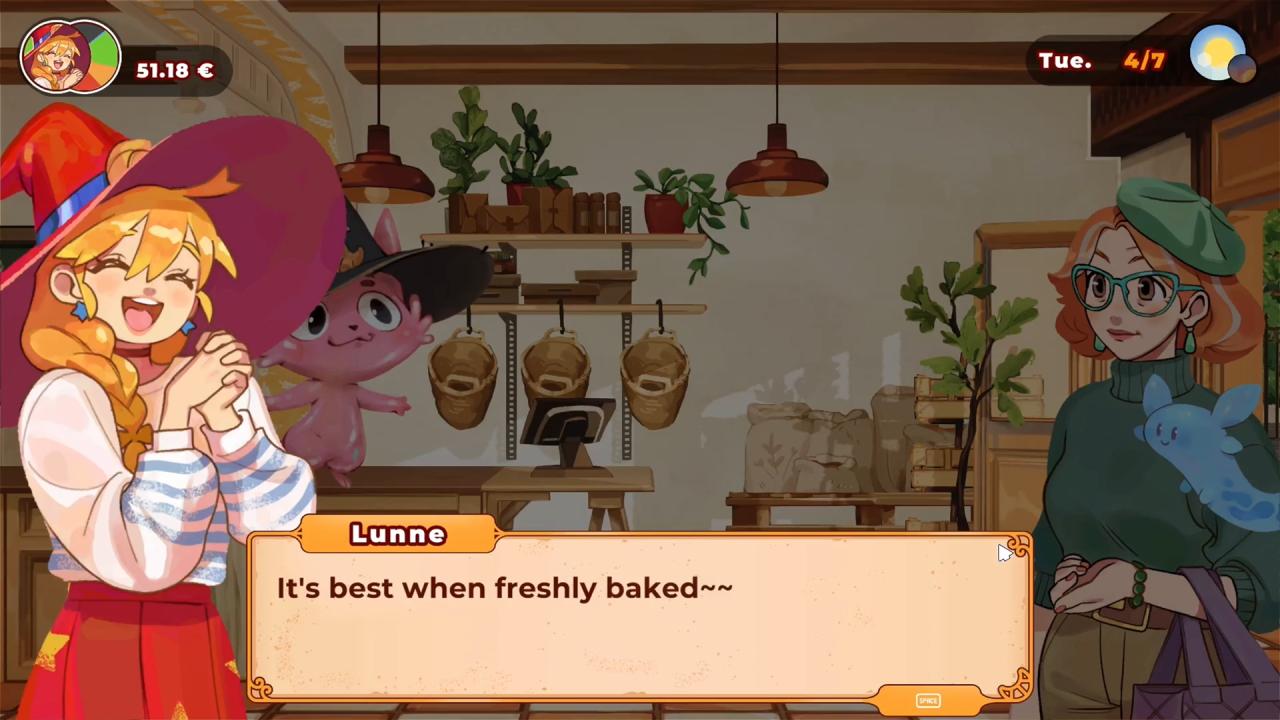
In The Witch's Bakery, the bakery is integral to the story rather than merely set beside it. Early on, you help a customer through their sadness by handing them a croissant, and that moment sums up the idea: making food for someone can be a way of caring for them. Around Lunne, you meet Estelle, Murembe, and a magical merchant named Galdari, as well as other regulars.
Estelle is an accountant in the business district, and Lunne ends up working with her on the bakery's books.
She is the second major person you try to help, and her regret takes the form of a large blue, jellyfish-like shape. One of the main characters uses a wheelchair, which is rare in a game and is handled naturally. There is also one romanceable character you can enter a relationship with. This includes optional intimate scenes.
Dialogue options let you shape how you get along with people, but the story itself is linear. Very little changes in the bigger picture, so if you want branching outcomes, this isn't the place. What you get instead is resolution. The story works through each character's trouble and wraps it up before moving on.
The tone stays gentle, though the subject matter is heavier than it looks. A content warning appears in the main menu and again when you start a new save, covering mentions of suicide, arachnophobia, violence and bullying, stress and burnout, the death of a side character, panic attacks, and optional sexual content.
The topics are handled with care, in a way that recalls Spiritfarer. You spend much of your time in conversations and character events, so know that The Witch's Bakery leans more toward narrative than management. Each day in The Witch's Bakery splits into three parts: daytime in the bakery, evening out in the city, and night back home. The bakery comes first.
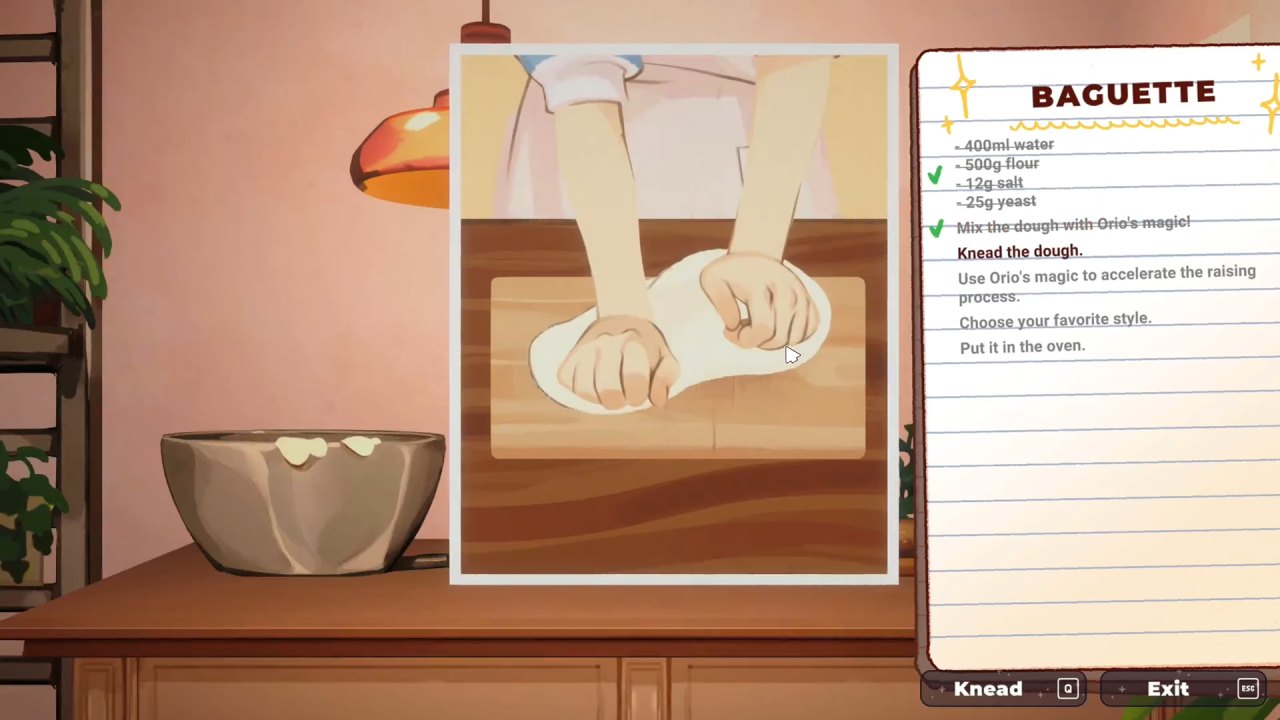
You make dough through short mini-games, while Orio bakes and sorts the treats into baskets.
That means you watch the dough supply, because Orio stops baking once it runs out. If one treat is selling better than the rest, you can prioritize it. A visible clock counts down to closing time, but with no sales targets, the pace stays relaxed. Greeting a customer gives you extra time to prepare their order. Customers have a limit to their patience, though it is forgiving.
You also walk back and forth between the dough station, the counter, and the baskets. As the story moves on, The Witch's Bakery asks a little more of you. You get more impatient customers, extra mini-games, helpful companions, more recipes, and eventually cakes join the bread. The shop side is basic, but it moves at a good pace.
Money arrives slowly, though, and you feel that most when you want to spend on decorations and outings. Early in the build, a bug can also get in the way. Orio may stop producing treats at the start of the day even when your dough counter shows plenty in stock, and restarting or prioritizing a treat doesn't help.
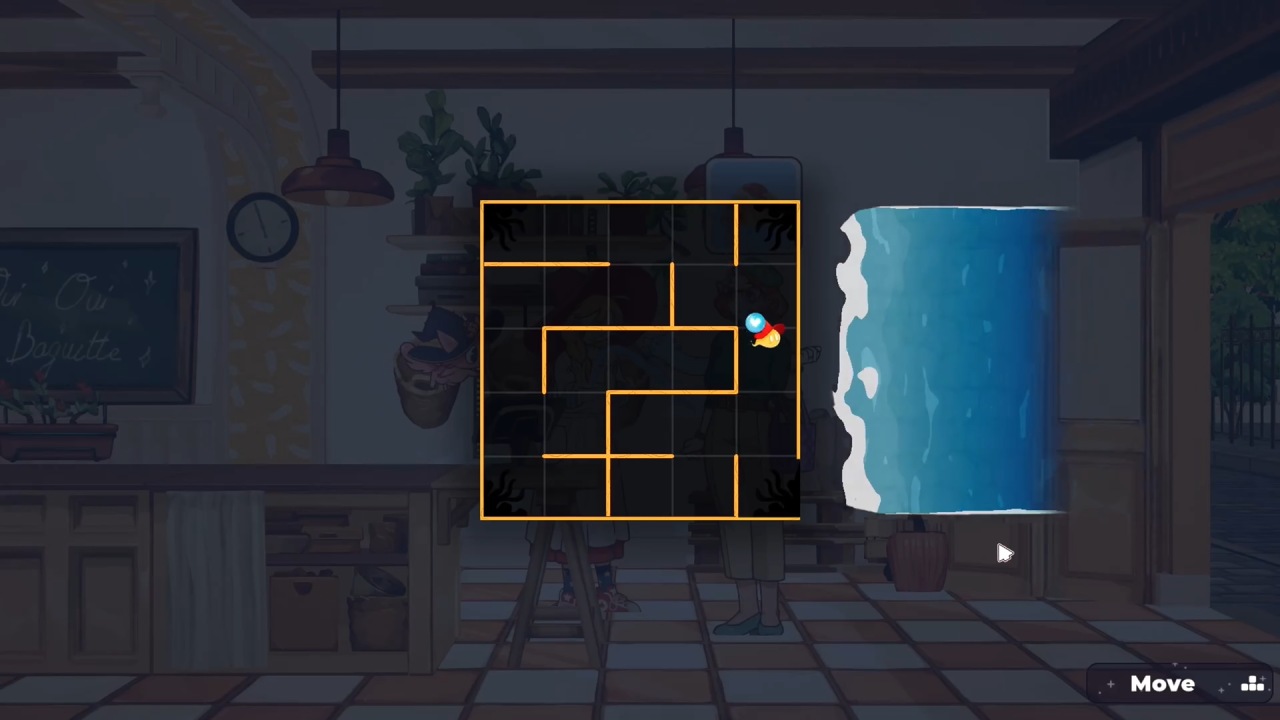
Your earnings drop, which stalls upgrades. Story orders are unaffected, since the needed treat always appears on the counter. The developers say they are aware of the bugs and that patches are coming. When a customer is having an emotional issue, you solve a small maze while handing over their order.
The mazes aren't hard, but each one adds a twist based on the emotion involved, like darkness, a tidal wave, or fire, and a wave of feeling disrupts your path. The bakery timer pauses while you work, so orders don't pile up behind you. The catch is repetition.
A short mechanic feels pleasant at first, but it can lose its pull when it repeats itself.
Heart palaces in The Witch's Bakery are the bigger version of that idea. Sometimes healing means being pulled directly into someone's heart to find the source of their pain. These are spaces where thoughts and emotions take physical form, and your goal is to guide a personified emotion back to the center while finding an ingredient for a special bread.
A single heart can take several trips. Estelle's sorrow is so large that you pass through multiple stages to find out what is holding her back, and each time you get blocked, you need to build the relationship further before you can go deeper. The puzzles in these places involve a lot of walking, a few simple challenges, and some that are harder than the mazes.
The metaphor behind the palaces is thoughtful. The problem is how often you get sent back. You enter a heart, learn that you need a little more, then repeat that a couple more times. After a while, it starts to feel stretched. The Witch's Bakery has no combat, so if you want fast reflexes, tense fights, or penalties for failing, you won't find them.
Once the shop closes at 6:00 P.M., the evening opens up.
An energy bar sits in the top-left corner, and every activity drains it. You can eat at a restaurant, visit the cinema, or invite a friend along, all of which help relationships grow. There is also a theater, a concert venue, and a park where you can sit on a bench to rest and recharge. A magical shop sells supplies and books that teach you skills, and a decoration shop lets you customize the bakery.
You can upgrade the plants, register and bread stand, add posters and a clock, and change the walls and floor. Mixing items from the Art Deco and Fantasy collections is especially satisfying. Each neighborhood has its own purpose: one has a cinema and a restaurant, another has furniture and magical shops, another has a park, and another has a business district.
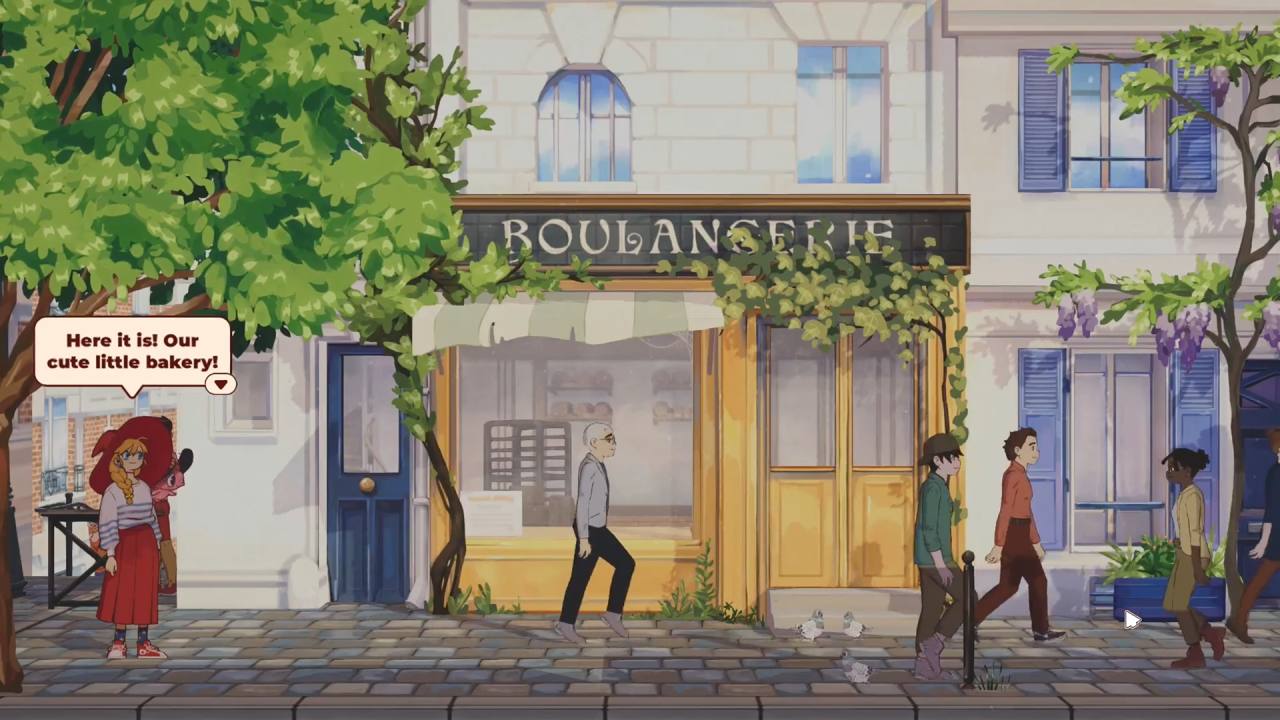
Moving around the city takes more effort than it should. Holding Shift speeds up your walk only slightly. Fast travel exists, but it isn't obvious at first, and you have to walk to the end of a scene before it lets you travel onward. A few small bugs show up here too. Customers sometimes stop at the bakery entrance instead of coming to the register, so you have to walk over to serve them.
One park scene cuts to a cutscene where Lunne and Orio are missing from the bench. Once, you were left in the street waiting for a conversation that never triggered. Training the twinkles refused to start even after you met all the requirements, and a few quest objectives remained in the codex after you completed them. Night is when the day winds down.
You climb to the rooftop for a view over Paris, then spend what energy you have left.
You can read the books you bought, head to the atelier to try new recipes, or look over your heart palette, which works like a loose skill tree. Practicing in the atelier uses a slightly more complex mini-game than the daytime ones, and once you finish, the recipe is added to your bakery menu. You also choose which variant to display in the shop. Then you go to bed and start again.
Progress in The Witch's Bakery comes from a few places. Spending energy on evening activities earns you small orbs of power; the more you collect, the more you level up your skills and your character. Books raise your heart palace level. Baking practice matters most day-to-day.
Each session takes you through levels two and three, and each level shortens bake time and raises a treat's value, meaning more money when the shop opens. You don't grind for experience in the usual sense, since there are no battles. Leveling is tied to routine, which fits the relaxed approach.
The heart palace skill tree doesn't let you unlock anything, and it would feel better if reaching a certain amount let you choose your own reward. Because money comes in slowly, upgrades and outings take patience. You also can't prepare dough before the shop opens, and a half-hour window would help, since your energy at night only stretches so far.
Visually, The Witch's Bakery is a pleasure to look at.
It opens with an animated intro that sets up the world. The art feels hand-drawn, like classic anime, and it's easy to compare it to Studio Ghibli, especially Kiki's Delivery Service. Cutscenes play like short animated clips, and the streets have a watercolor feel. The streets are layered, with foreground objects sitting in front of Lunne and Orio as they walk, adding depth.
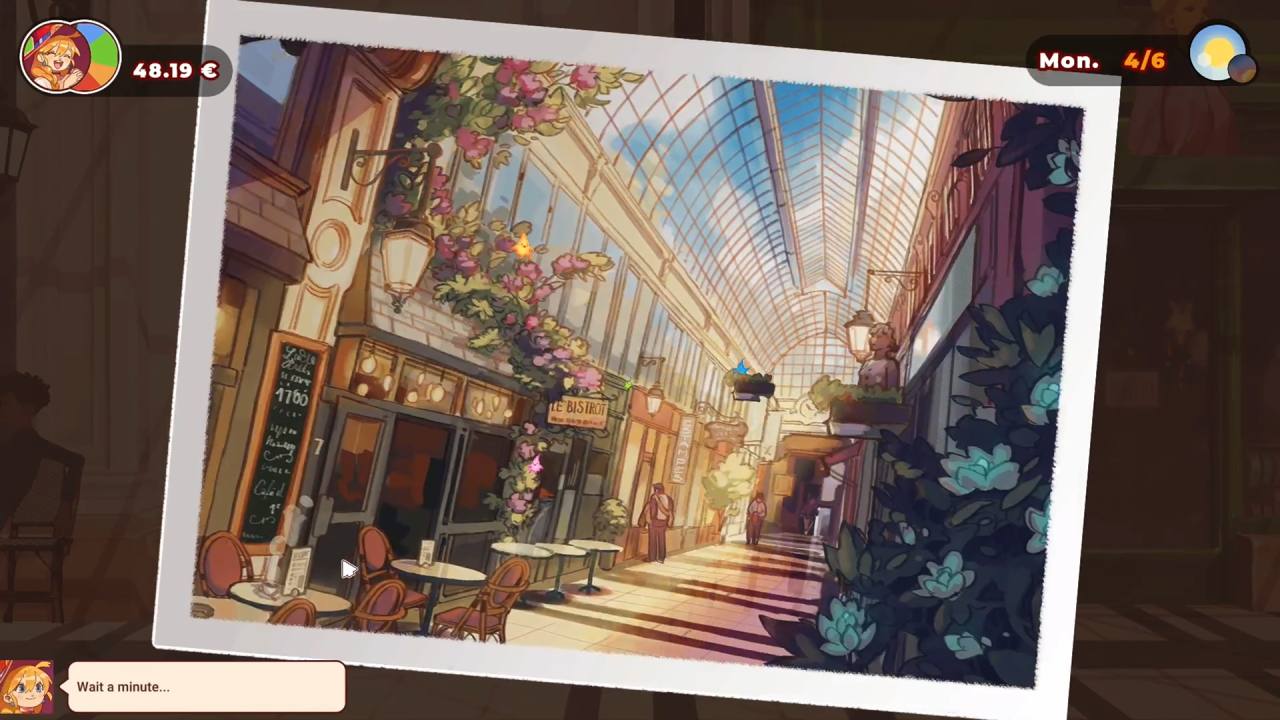
People move along the pavements, and you can see others inside the shops, so the city feels active rather than empty. Iconic Paris sights appear, and Art Deco details show up throughout. The game even features a statue honoring bakers somewhere. Lunne uses a smartphone, and colorful spirits are a common sight on the street.
The color palette stays warm, and objects, characters, and backgrounds work well together. The interface follows a 1990s style that stays readable and blends into the art. There are a couple of weak spots. Some secondary characters' animations don't always match Lunne's, and the line thickness varies. If you don't care for the 2D look, it may take a little time to adjust. Performance is smooth for the most part.
Moving between the bakery and the streets happens almost instantly, and input responds without delay. In one crowded neighborhood on a handheld setup, the frame rate can dip. Starting a new day is slower, since you can't skip the wake-up cutscene, which runs for about a minute every morning. Frequent load screens add to the wait.
The sound design in The Witch's Bakery supports all of this.
At night, you reach the rooftop, and Claude Debussy's Clair de Lune plays over the view of Paris. The wider soundtrack is soft and builds the sense of place. Playing with the audio muted works because essential dialogue and cues remain clear.
Dialogue is frustrating in another way. You can't actively skip it, and advancing a line often feels delayed or needs the same input twice. Because conversation takes up so much of The Witch's Bakery, you notice this often. The controls are a mixed bag. It includes controller support and remapping.
On keyboard and mouse, the default layout puts the main action on the space bar, which feels a little unnatural; since some moments let you use the mouse, it would make more sense to make that the main option. Pausing works well because the menu pauses tasks; you can save and resume where you left off, and the guidance helps you remember what you were doing.
The game has no setting to adjust difficulty or pressure. Explanations outside the bakery are thin, too. A full playthrough runs around 20 to 25 hours, depending on your playstyle and reading speed. The slow pacing is the biggest problem. There is a fine line between relaxing and stretching things out, and the walking, repeated heart palace visits, unskippable cutscenes, and load screens push it over that line in places.
Still, the strengths are clear.
You care about the people you help, the presentation holds together, and the way baking connects to caring for others gives The Witch's Bakery a personality many shop games lack. It suits you if you like a story-heavy game with plenty of reading and a slow pace. It isn't an action-adventure, even though the developers call it an RPG, and it isn't simply a bakery management game either.
The shop side makes up about a third of the experience, with the rest focused on relationships and energy management. If you want deep business systems, branching choices, or fast pacing, you will likely be bored within a few sessions. For everyone else, The Witch's Bakery is a warm, thoughtful way to spend your evenings.
Staff Writer, NoobFeed
Verdict
The Witch’s Bakery is a gentle, story-led adventure with lovely hand-drawn art and moving character moments. The slow pace, thin management, and early bugs hold it back, but patient story lovers will enjoy it.
80
Related News
No Data.