
AOC Q27G4ZD Review: The Best Budget 280hz QD OLED Monitor
Budget OLED monitor delivers impressive brightness, fast response times, and strong gaming clarity rivaling far more expensive flagship displays.
Hardware by Masaru Hoshino on Dec 03, 2025
The prices right now are beyond crazy. Two sticks of RAM cost the same as a new OLED monitor, which seems crazy on both sides. Memory prices are going through the roof, yet OLED monitors have never been this inexpensive.
AOC Q27G4ZD is the model in question. It is a 1440p QD OLED and is currently the least expensive OLED on the market. Despite the low price, it is far from the worst. In fact, it delivers performance that directly challenges flagship options at a much higher price.
Comparing Budget OLED to High-End OLED
We took this budget panel and placed it side by side with a flagship 1440p OLED from a major rival that launched only weeks ago, costing over $1,000. When comparing contrast, color, and overall image quality, the differences were surprisingly minimal.
If you can't see much difference, it's because there really isn't one most of the time. Sure, when it comes to pushing HDR, brightness, and refresh rates, the pricey models do pull ahead. However, static image quality still delivers that true OLED punch at every price point.
Unlike IPS monitors, where budget and enthusiast models look drastically different, OLED remains consistent across the board. Pixel response times are also identical across all OLED panels, regardless of price. Every OLED we test hits 0ms response time, including this one. We also measured display latency at 2.2ms, only +0.4ms off a perfect result for its refresh rate. That means input lag is extremely low.
Brightness Performance Exceeds Expectations
We expected great image quality and instant response times, but we did not expect such strong brightness from a budget OLED. Out of the box, it measured over 260nits. Switching to the user color temperature preset increased it to 275 nits while reducing color shift.
That actually makes it brighter than many expensive OLED monitors we've tested. The brightness is also perfectly uniform and doesn't shift with the scene.
What Higher-End OLED Monitors Really Offer
When spending more money on an OLED monitor, the refresh rate is one of the biggest differences. Premium models reach 480Hz or even 540Hz at 1440p. Those speeds feel incredible in esports titles. The AOC model lists 240Hz, but it actually reaches 280Hz over DisplayPort, which is hard to complain about.
Even if you play a lot of esports games like Valorant, CS, or Overwatch and have a $400 budget, we'd still pick this 280Hz OLED over a 400Hz IPS or TN at the same price. The clarity, sharpness, and image quality of OLED easily outweigh the refresh rate advantage. For most players who enjoy large cinematic titles like Battlefield or Arc Raiders, those extreme refresh rates offer no benefit anyway.
.jpg)
HDR Performance and Its Differences
HDR quality is another area where premium OLEDs shine. We compared this AOC model to the most expensive 1440p OLED on the market, and yes, the difference was noticeable. The high-end model delivers brighter peaks and slightly more accurate colors. Hot spots and sparkles in HDR scenes pop more aggressively and feel more vivid.
But again, we compared a $400 monitor to an $1,100 one. You would expect a difference. That doesn't mean the AOC's HDR is bad. It is still extremely impressive on its own, and if you buy this monitor and don't at least try HDR mode, you are missing out.
Known QD OLED Limitations
QD OLED panels at 1440p share two common quirks. The first is raised black levels under high ambient light. If you play in a dimly lit room or mostly at night, this won't be an issue. But if you have bright windows behind you, you will notice it.
The second is color fringing on high-contrast edges, such as text on black backgrounds or UI borders. All 1440p QD OLEDs suffer from this. You eventually get used to it, and it's far less noticeable at normal viewing distances. It rarely appears in games and mainly shows up on desktops.
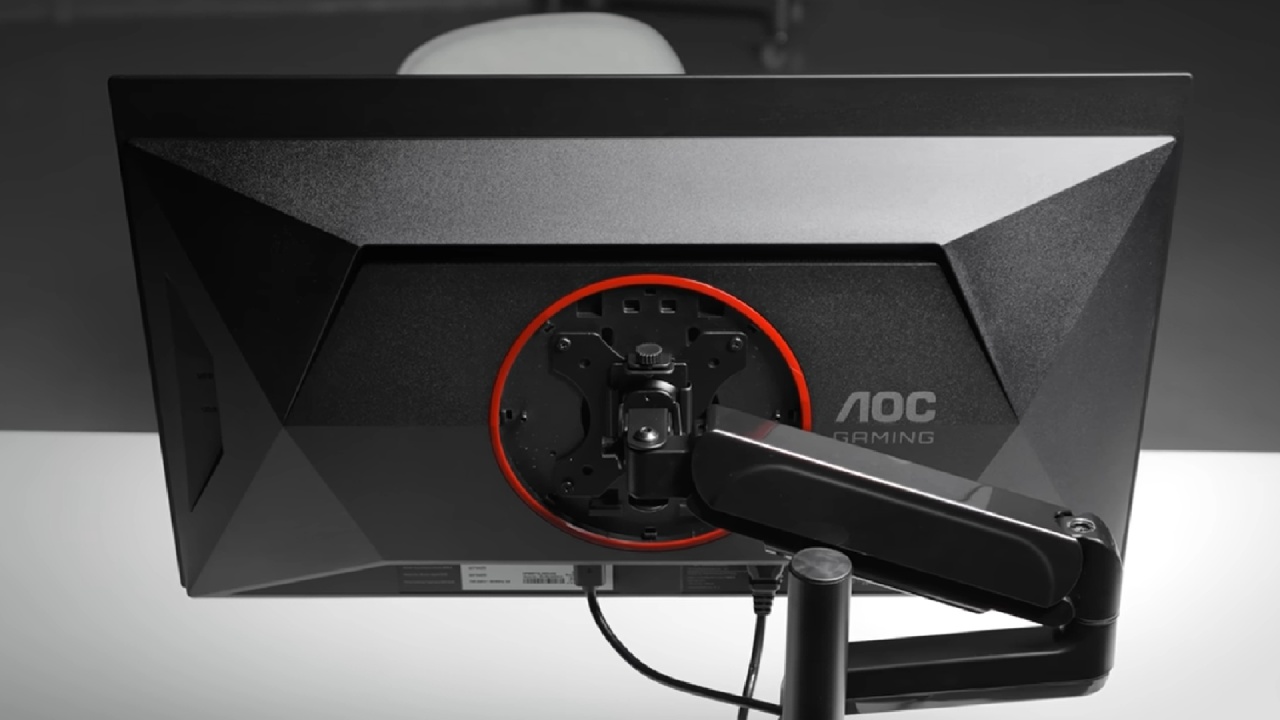
The stand is another downside. While it includes all the basic adjustments, it sticks out too far and takes up unnecessary desk space. We recommend switching to a cheap $20–$30 monitor arm.
Final Thoughts
Overall, we rank this budget OLED monitor highly. It isn't groundbreaking technology, but as a second-generation QD OLED panel, it delivers exceptional performance for the cost.
It's an amazing value to have a 280Hz QD OLED with great picture quality at $400. Upgrading your GPU will enhance settings and performance, but switching to an OLED panel will transform the look and feel of your games. This inexpensive model can transform your whole setup, even though it has certain faults.
Also, check our other Monitor articles:
- ASUS ROG Strix XG27AQWMG Review: 280Hz 1440p OLED Gaming Performance
- Samsung Odyssey OLED G81SF Review 2025: Ultimate 32-Inch QD-OLED Gaming Monitor
- Adaptive Sync Explained: FreeSync vs. G-Sync for Modern Gaming Monitors
- Gigabyte MO27Q2 QD OLED Review: Performance, HDR, and Gaming Experience
- ASUS ROG Swift PG27UCDM Review: Blazing Fast 240hz 4K OLED Performance
Editor, NoobFeed
Gaming Hardware Updates
No Data.