
Sintopia Preview: Bureaucracy Meets Unholy Fun
A management simulator that never loses sight of its playful evil concept.
Preview by Adiba Manha on Aug 08, 2025
With Sintopia, Piraknights, a tough independent studio from the charming French town of Aix-les-Bains, demonstrates that underworld management can be just as engaging as a well-designed corporate simulator, with a little more brimstone and a hint of diabolical flair.
Sintopia invites you to take on the role of CEO of Hell itself and guide doomed souls through a bureaucratic maze of agony. It was published by Team17, the company behind cult blockbusters like Date Everything! and Blasphemous.
.jpg)
Originating from a smart mash-up of management sim ideas (think of the lighthearted tone of Two Point Hospital) with the automation focus of Factorio and the fiendish mechanics of Dungeon Keeper, the game offers a distinctively devilish experience that is simultaneously familiar and fiendishly new.
In Sintopia, you are in charge of both the hellish apparatus of perpetual punishment and the gullible lives of the sentient Humus, who inhabit the Overworld and go about their daily lives completely oblivious to the fact that their ultimate suffering provides the funding for your underworld empire.
These chickpea-like humanoids labor under the rule of a king chosen at random, whose character attributes—whether they be technological ingenuity, gluttony, or belligerent aggression—determine the cultural and economic priorities of their small universe.
It feels like a sinister ballet of cause and effect to watch these Mortals go about their lives, naturally creating sin via pride, envy, sloth, and other things, then causing their premature death with strategically placed candles or well-timed lightning strikes.
You are responsible for processing the large number of souls that arrive at Hell's gates, each carrying a unique combination of the seven deadly sins, and extracting as much moral debt as possible to fill your coffers with Purgadollars.
Building and growing by careful planning your Hell-scape, personnel management, and the prudent application of a small number of potent spells is the central loop of Sintopia. You start by creating structures like Soul Punishment chambers that remove random sins or specialized facilities that target certain moral flaws, as well as paths to direct recently condemned souls to various penalties.
Employing professionals from a variety of backgrounds, such as engineers, processors, and mentors, guarantees that your business operates smoothly. However, you must remember to provide break rooms and other necessary amenities for your employees or risk a sharp decline in output.
.jpg)
A clever layer of strategic depth is added by the dual-realm mechanic, which allows you to fine-tune Hell itself while indirectly influencing the Overworld to produce suitable sinners. For example, a well-timed Push spell in Hell can start a chain reaction of destruction to meet sudden influxes of unruly souls, while a well-placed fire in the mortal realm can funnel new candidates into your infinite queue.
Despite lacking conventional combat, puzzle-like difficulties arise from juggling the flow of resources, staff morale, and sin categories under duress in Sintopia. Here, the "combat" is guiding waves of souls through either manually operated or automated pain machines, then adjusting the setup when outbreaks of a particular kind of sin threaten to overrun your system.
Environmental factors like barbarian attacks, zombie incursions, and demonic uprisings are introduced in every new level or scenario, forcing you to reassess your design quickly. Although advanced powers like Fire and Lightning appear later to aid in adaptation, the Push spell functions as both a movement ability and a catalyst for environmental upheaval, demonstrating the game's faith in your ability to solve these emergent problems using the same blunt-force tools it provides.
Solving these logistical puzzles feels deeply satisfying when you nudge the machinery just right, though the blunt nature of your tools can sometimes backfire, nuking half your facility when you meant only to redirect a single imp. The interconnection of the systems is elegantly displayed by the puzzle-tactics framework, but because it relies heavily on broad-stroke spells, precision control is sometimes foregone in favor of spectacle.
Sometimes, a well-meaning intervention can mistakenly set your processing quarters on fire or bring zombies pouring through your sin-extraction lines, leaving you unsatisfied. Sintopia's approach can feel imprecise if you prefer surgical micromanagement over massive theatrical demolition, but that unpredictability is part of the charm—no two playthroughs feel the same.
.jpg)
However, as you refine your infernal layout, the emergent "aha" moments—when you see a line of souls queue flawlessly through a circuit of specialized punishers before funneling back to the graveyard—bring tremendous joy.
Sintopia uses a meta-currency called Prestige Points, which is obtained by fulfilling optional Challenge Mode mandates that put special restrictions and objectives on your run, in place of a conventional experience system.
When you successfully balance sin-balancing goals or automation-focused instructions, you get Prestige, which opens up Boons, which are demonic blessings from the seven deadly sins themselves. Strong bonuses and some colorfully harsh penalties are granted by each boon, which encourages you to try out different combinations, such as Mammon's Money Laundering, which boosts your early-game economy at the expense of postponing research into basic staff facilities.
Long-term motivation that sustains your interest beyond your initial run through Hell's lesson is added by this cycle of gaining Prestige through organized tasks and then using it to personalize later runs. Mastering the hellish meta-game is more important than grinding hero levels, and each point you win feels like a hard-won step toward creating your own unique brand of bureaucratic damnation.
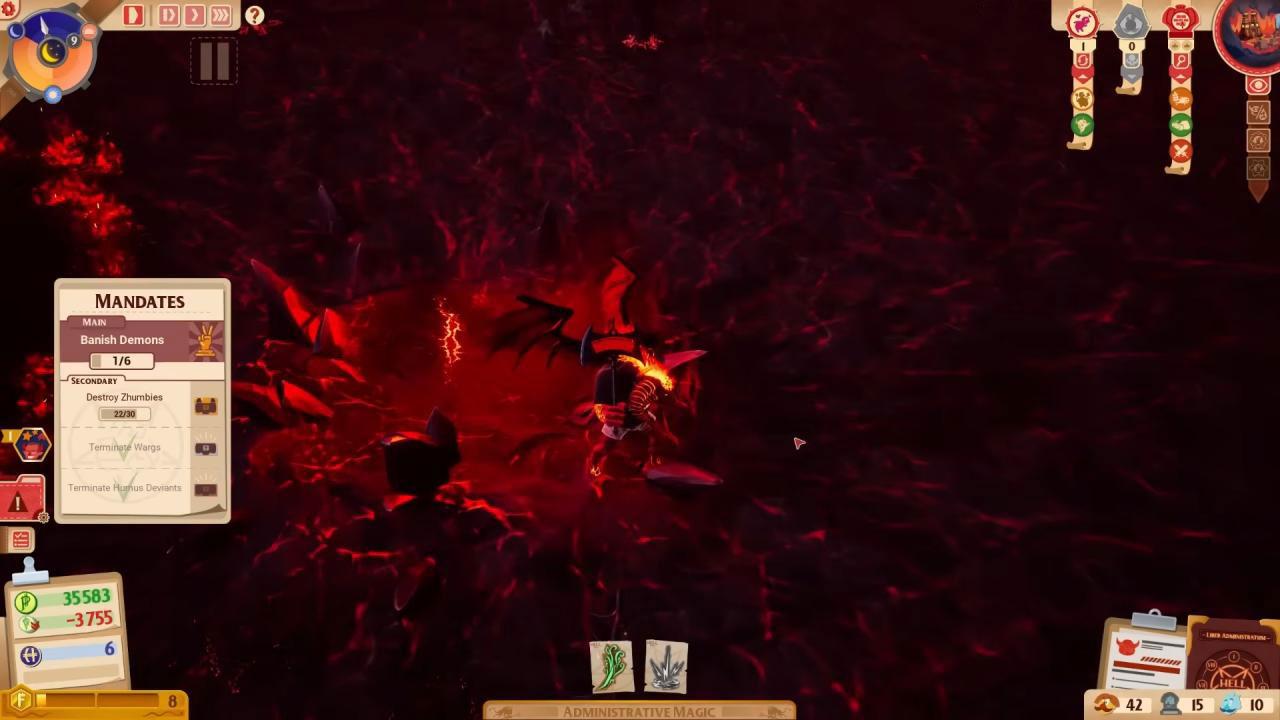
Sintopia's cartoonish, stylized visual style highlights its humorous take on endless torment. Large horns, small demon flags, and humorously wide torture cells are among the amusing decorations that adorn the buildings, transforming your dominion into a tableau brimming with personality.
You may zoom in on a single Humu's wide, nervous eyes as they trudge toward a conveyor of torture, or you can enjoy expansive views of your underworld empire thanks to the full 360° camera control and vast zoom range. Even high-end GPUs can be taxed by turning up the graphics settings to their highest level, despite the simplistic visual style.
.jpg)
This is a testament to the intricate models, particle effects, and lighting that make this hellish playground come to life. Performance hiccups are rare, and when they occur, they never detract significantly from the overall spectacle of watching your hellish bureaucracy in action.
Instead of falling into gloomy dirges, Sintopia's soundtrack is surprisingly cheerful and melodious, suiting the dev office meets hell vibe. As you supervise groups of sinners, the tracks provide a lively background that loops smoothly without being annoying.
While spoken lines from workers and customers give your underworld employees tremendous character, ambient sounds like the hum of machinery, imps' mumbled cackles, and distant screams of anguish highlight the game's tongue-in-cheek tone. The sound design perfectly balances atmospheric flavor that furthers the idea of Hell as a busy, although morally dubious, workplace with utilitarian feedback—alert noises for staff concern or sin-processing completions.
Sintopia's attention to detail extends beyond its main visual aesthetic and soundtrack to its user interface and ambient effects, which further engross you in Hell's workings. You can spend more time planning your evil empire and less time searching for information, thanks to the menus and tooltips' clear iconography and sharp rendering, which merge in perfectly with the infernal atmosphere.
Every screen has a sense of life thanks to subtle animations, such as the flicker of torchlight along cavern walls, drifting embers from your sin furnaces, and the soft sway of hanging chains. On the audio side, dynamic mixing makes sure that urgent alerts cut through the upbeat background score without ever feeling jarring.
The spatial placement of sound effects—whether it's the distant clang of a barbarian raid echoing through your corridors or the quiet hum of an overworked staff break room—gives your domain a tactile sense of scale. Together, these multi-layered sensory elements transform Sintopia from a simple management simulation into a vividly rendered underworld playground that will delightfully engross you.
With its funny graphics, well-paced tutorials, and a wide variety of obstacles that increase its repeat value, the game is a devilish office simulator where you must extract every last Purgadollar from guilty souls. Even if its broad-stroke spells may cause unanticipated turmoil, those very unpredictable elements contribute to innumerable unforgettable moments.
Sintopia proves that even in Hell, there is space for sound management—and a dash of mischief—and offers an experience that is equal parts wickedly brilliant and endlessly enjoyable, regardless of your familiarity with the genre or level of skill with bureaucratic simulations. With its unique blend of emergent puzzle mechanisms, dual-realm strategy, and a satisfying meta-progression loop, Sintopia never loses sight of its playful evil concept.
Editor, NoobFeed
Latest Articles
No Data.