
Gigabyte MO27Q28GR Review: Glossy OLED Upgrade
Gigabyte introduces glossy tandem W-OLED option for MO27Q28GR offering deeper blacks sharper visuals and identical hardware performance as matte variant.
Hardware by Tanvir Kabbo on Apr 17, 2026
The most recent generation of OLED gaming monitors is still improving display coating and user experience, providing buyers with more options than ever. Among the most prominent tendencies is the increased popularity of glossy panels, particularly among those who want to have a stronger contrast and more vivid images.
In reaction to this change, Gigabyte has launched a glossy version of its already popular 27-inch 1440p 280Hz OLED display, providing customers with a direct option between a matte and glossy finish without altering the underlying hardware.
.jpg)
Overview of the Gigabyte MO27Q28GR
We are briefly reviewing the Gigabyte MO27Q28GR, this new version was introduced at CES 2026 and will be quite similar to the non-R version.
The only significant alteration here is that the matte screen coating has been replaced with a glossy screen coating, but extensive testing has been done to make sure that is the only difference.
Deploying a glossy version of this monitor is the result of user feedback. The glossy finish on OLED monitors is popular with many users, and Gigabyte has taken action. The tandem W-OLED panel that LG Display produces to make these monitors is available in both matte and glossy versions of the 27-inch 1440p 280Hz panel. Gigabyte is merely offering the two choices in an otherwise the same package, and no tailor-made changes.
An example is ASUS, which has the glossy panel in its XG27AQWMG and does not provide a matte option. It should be mentioned that branding terms vary among manufacturers. Gigabyte calls the finish real black glossy, and ASUS calls it true black glossy, but they are merely marketing names of the same LG Display implementation.
There is no actual difference between them. The glossy ASUS and Gigabyte models appear the same, and Gigabyte has glossy and matte models at the same price.
Matte vs Glossy: Which is better?
Whether to use matte or glossy coating is purely a matter of choice. No one right decision exists, and the most appropriate decision is based on the environment and setup.
Matte finishes are more effective in light rooms or areas where the lighting is not controllable. Glossy coatings, on the other hand, are better suited for dimmer environments or spaces where lighting can be optimized.
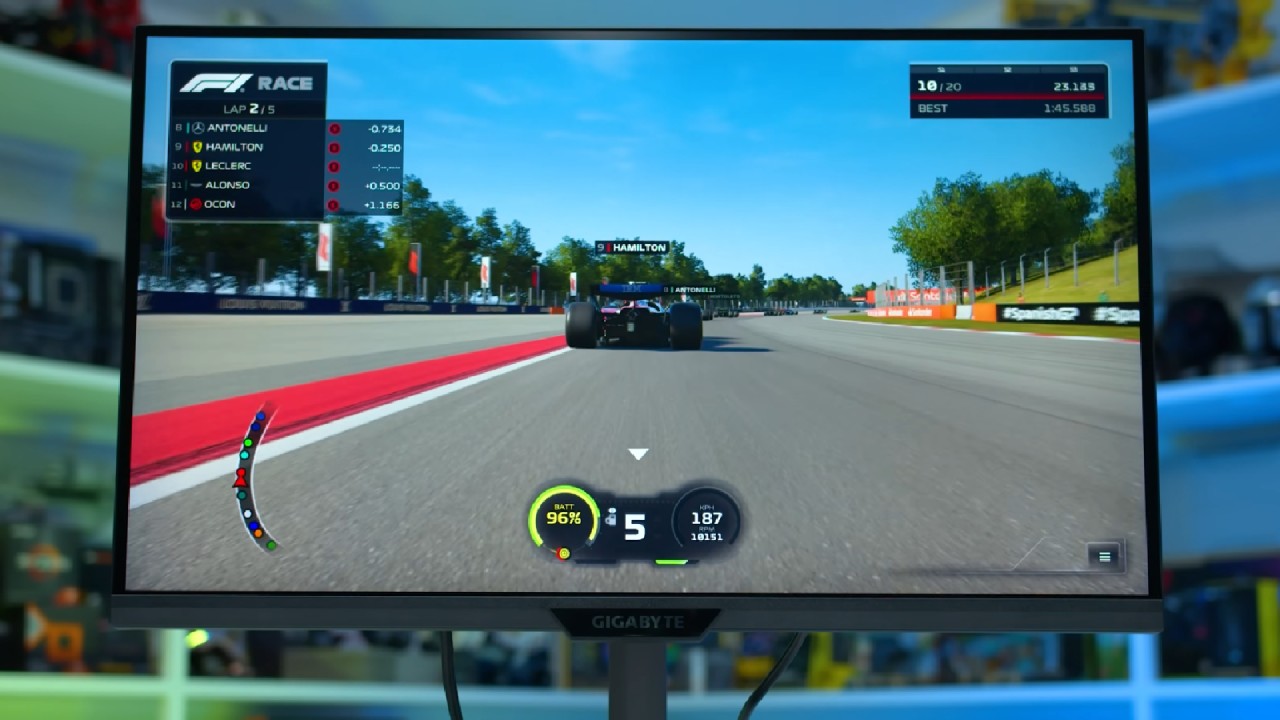
The main benefit of a glossy finish is that it does not scatter the incoming light. Rather than diffusing environmental light over the panel and making the image less clear, it creates isolated reflections with little effect on the rest of the image.
This assists in maintaining black levels and perceived depth. This, however, comes at the expense of higher reflectivity. The screen is mirror-polished, and bright reflections are easily seen, particularly when watching darker material.
The other advantage of glossy panels is that there is no coating grain. Matte finishes add a slight layer of grain to diffuse light, which may slightly diminish sharpness and clarity. Glossy panels do not have this problem, and the images are sharper, especially when reading text. In cases where reflections are controllable or can be reduced, the glossy finish tends to provide a more pleasing visual experience with darker blacks and enhanced clarity.
In some cases, matte finishes are still beneficial. They absorb incoming light, which causes a lot of visible reflections and removes the mirror effect. This renders them suitable for installations where there are direct sources of light, like windows facing the display. Although this diffusion has a slight effect on clarity, it is effective in eliminating distracting reflections.
Gigabyte now offers both options. Those who prefer matte can choose the MO27Q28G, while those who prefer glossy can opt for the MO27Q28GR. In the past, one had to change brands to get a glossy finish, like switching to ASUS, but this is no longer the case.
HDR Performance and Hypernits Feature
Beyond the screen coating, the two models are mostly the same. During CES, Gigabyte introduced a new HDR feature called Hypernits. Nevertheless, this is not the only feature of the GR model. With firmware version F-07 released in February 2026, Hypernits is also available on the matte G model.
Hypernits enhances brightness and saturation of some HDR scenes, but it is not a very precise mode. Generally speaking, the performance of the two models in terms of HDR is quite similar in terms of accuracy and EOTF tracking. The HDR modes available are the same, and performance in these modes is virtually similar.
The standard HDR mode with the APL stabilizer set to high is still the preferred setting. This arrangement offers maximum brightness without much loss of accuracy. Nevertheless, the tuning limitations are similar in both models. There is some over-brightening in darker scenes for elements above 80nits, resulting in a noticeable bump in the EOTF curve. Although it is not as severe as problems observed in other types of panels, it is not ideal.
SDR Accuracy and Brightness Differences
The matte version is a little more accurate than the glossy model in SDR performance. The glossy model has a good white balance and good Rec. 709 gamut emulation, but worse gamma performance, leading to a higher delta E. The matte version has above-average calibration, whereas the glossy model is in the average category, but still very usable.
A more noticeable difference is found in brightness. The matte model is a little brighter in both SDR and HDR content. The glossy version of SDR post-calibration is 325nits, and the matte version is 368nits, which is a 13% improvement. This difference may be due to panel variance or minor tuning differences.
The matte version is once again brighter in HDR testing. It goes up to 1500nits versus 1300 nits on the glossy model in some synthetic tests. The matte model is brighter at a 10% window size by 10% and in real scene tests by up to 17% with a geometric mean. These variations are beyond what is normally anticipated of panel variance.
Nevertheless, the difference in brightness is not a significant issue. A 13% increase in SDR brightness does not significantly impact real-world usage. The glossy model's brightness is comparable to other implementations of the same panel, such as ASUS models.
Performance and Features
Beyond coating, accuracy, and brightness variations, the two models are the same. There is no difference in motion performance between a 280Hz and a 30Hz refresh rate. The input lag is the same, and the design, the quality of the build, and the choice of ports are the same.
Gray Banding and Panel Variance
One of the most frequent issues with tandem W-OLED panels is gray banding in dark gray material. This is a problem with the panel technology, in that all units will have some degree of banding, whether the model is glossy or matte.
The extent of this problem differs greatly across units. There are those that exhibit visible banding and those that do not. In other instances, the problem can be minimized by running several panel compensation cycles.
This inconsistency results in a panel lottery, with users potentially having to replace their unit several times to get a satisfactory one. Preferably, this variability would be eradicated through quality control improvements.
The unit under test exhibits a small gray banding after about 70 hours of operation and seven automatic pixel cleaning cycles. Although it is not flawless in comparison with QD-OLED panels, the performance is decent and does not distract during the gaming process, even in dark HDR scenes.
Final Thoughts
The Gigabyte MO27Q28GR is priced the same as the matte version, and the choice is simply a matter of coating preference. At the same price, no one has to compromise on cost.
Although there are slight variations in accuracy and brightness, they are not so pronounced as to give a strong preference to one model over the other. The glossy version will be more visually pleasing to most users because of the sharper image and darker perceived blacks.
The fact that they have provided matte and glossy versions of the same monitor is a good gesture, as it gives the user a choice without necessarily having to change brands. It is not the ultimate best 1440p 280Hz OLED monitor on the market, but it is a solid contender in the expanding range of tandem W-OLED displays.
Senior Editor, NoobFeed
Gaming Hardware Updates
No Data.