
Hotel Architect Review
PC
A hotel management sim that lets you freely build and customize hotels and manage detailed systems with expanding upgrades and features.
Reviewed by Adeela Tas on May 14, 2026
Hotel Architect appears to be just another building sim game at first, yet after several hours, it reveals itself to be more ambitious and complex than it initially seems. The game is ultimately a simulation in which each decision influences the hotel's overall management. Each guest expects certain facilities, employees want higher salaries, critics evaluate the hotel's overall quality, and financial ruin may result if the hotel expands too quickly.
In the end, the game never stops changing, which perhaps makes the title so captivating and addictive, and it is easy to lose oneself in it. The key feature of Hotel Architect is its incredible freedom during construction. The game does not impose any restrictions on layout design or the location of different rooms.
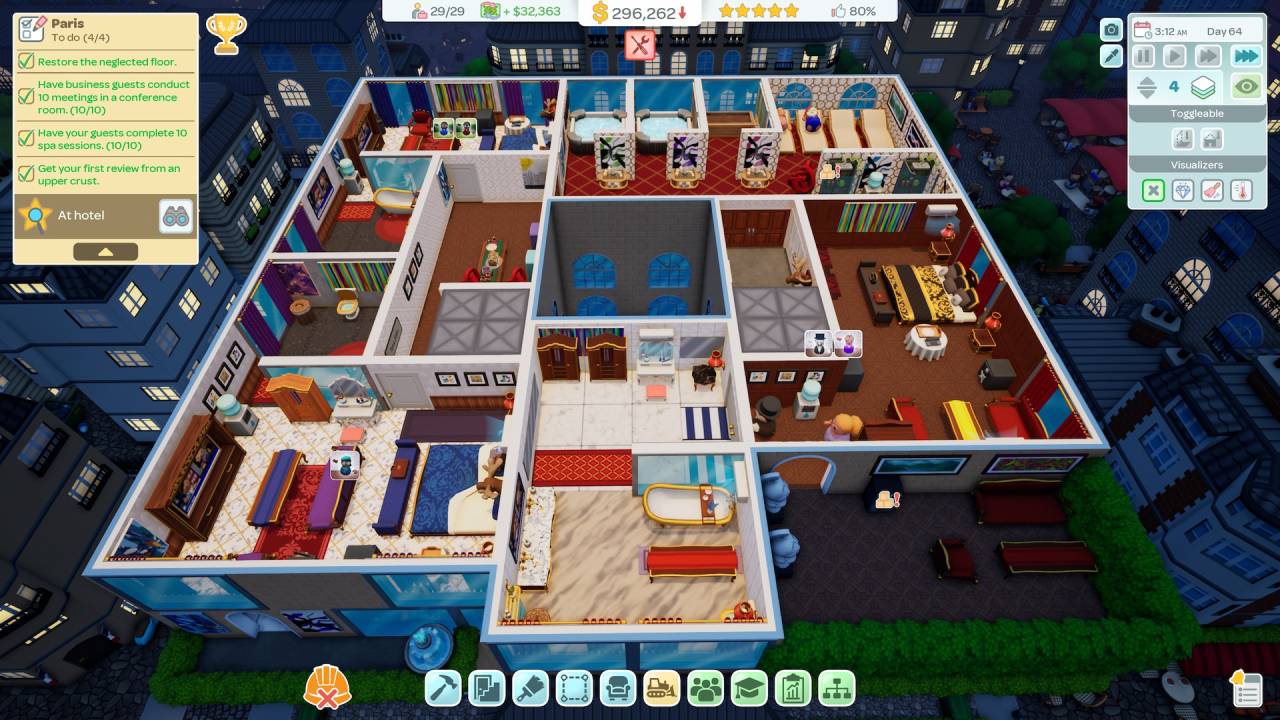
It does not matter whether bedrooms are placed in one row or scattered around the building, whether the hallways are spacious and convenient or narrow and convoluted. It does not even matter whether the hotel is realistic or bizarre. This freedom allows players to create unique and distinctive hotels.
The gameplay loop is built around multitasking.
One will involve remodeling guest rooms, while the other will involve recruiting staff, improving entertainment ratings, managing finances, or attracting new guests. There will always be something else that needs to be dealt with, but Hotel Architect typically ensures that such systems remain fun because everything ties back to the overall hotel experience. It does not become tedious; it becomes a continuous process of expanding and solving problems.
Campaign mode provides context for all of these systems. Different maps will provide different environmental factors and different managerial challenges. Some maps will feel easy, whereas others will begin by putting your hotel into a financial bind right off the bat. Deserts call for considerations regarding heat, snowy areas shift guest expectations, and some scenarios revolve around surviving financially before even thinking about expanding.
Among the memorable scenarios that one can encounter in the game, there is a case where bankruptcy threatens the hotel even before the campaign starts. This means that costs are too high and income is very low, and the player's primary goal is to reduce expenditures in every possible way. The first step involves reducing workers' salaries, removing unnecessary decorations, and firing excess personnel to keep the hotel afloat.
At the same time, the sandbox aspect of the game still plays a much greater role than anything else. Players can construct any sort of hotel they want, and the game does not limit their creativity in any way. While some people focus on making hotels highly profitable through effective layout design, others enjoy building chaotic hotels with funny hallways and rooms placed randomly throughout.
Building rooms remains satisfying throughout most of the experience because there are so many combinations to experiment with.
Different guests have varying needs according to the target customers. Couples need bigger rooms with several beds and matching furniture. More sophisticated features are expected from business travelers. Rich guests ultimately ask for luxuries, meals, entertainment, and special facilities before choosing to stay in the hotel.
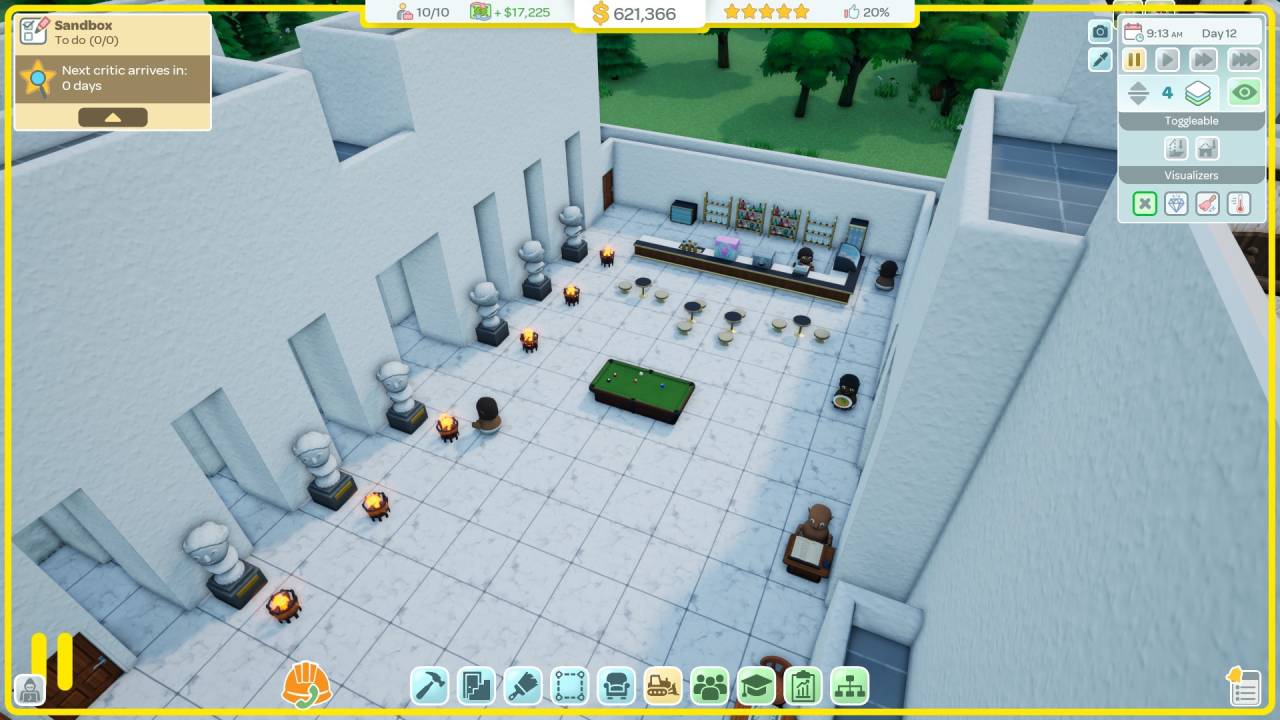
This guest development sequence makes Hotel Architect feel like progress is being made in building the hotel. Hotels start with standard rooms with simple designs but gradually grow into huge hotels with fitness centers, spas, bars, meeting rooms, restaurants, and entertainment zones. One of the most enjoyable aspects of the game is watching the hotel gradually grow into a bustling establishment.
On the other hand, progress also marks the point where Hotel Architect splits opinions the most. According to earlier reviews, Hotel Architect was significantly faster at allowing players to progress in the game. In those days, critics would provide several upgrade points at once that could be used to upgrade rooms and furniture. This progression through the game made it possible to introduce new elements quickly, which was a huge help to experimenters.
Nowadays, however, progress seems to work rather slowly in Hotel Architect. The game's reliance on tiers makes progress significantly slower. Instead of unlocking fun items and new elements, the player will have to spend their points by unlocking different limits that allow them to continue building, such as building limits, elevators, trash bins, loans, or increasing the number of workers. Despite being useful, they may be too slow to use.
This slower pacing changes the overall feel of Hotel Architect quite a bit.
Some users will enjoy the extended progression path, as it makes the campaign more structured and thus prolongs the lifespan of each individual game attempt. However, some people may find the early hours of the game too restrictive, as most room types and creative possibilities are locked behind the campaign levels for an excessively long period.
It is also noticeable how the new version of Hotel Architect relies on loans as its defining feature. Without them, expansions become very hard to achieve, especially under certain difficulties. On the one hand, the inclusion of financial loans is justified for running a business. On the other hand, this feature can push some players to the edge since the game forces the use of loans.
Even with its flaws, Hotel Architect has an excellent gameplay loop that makes players feel there's still something left to do. Expanding room capacities, improving ratings, creating new entertainment, and acquiring customers who spend more money in their room – all of these aspects intertwine beautifully in a gameplay experience.
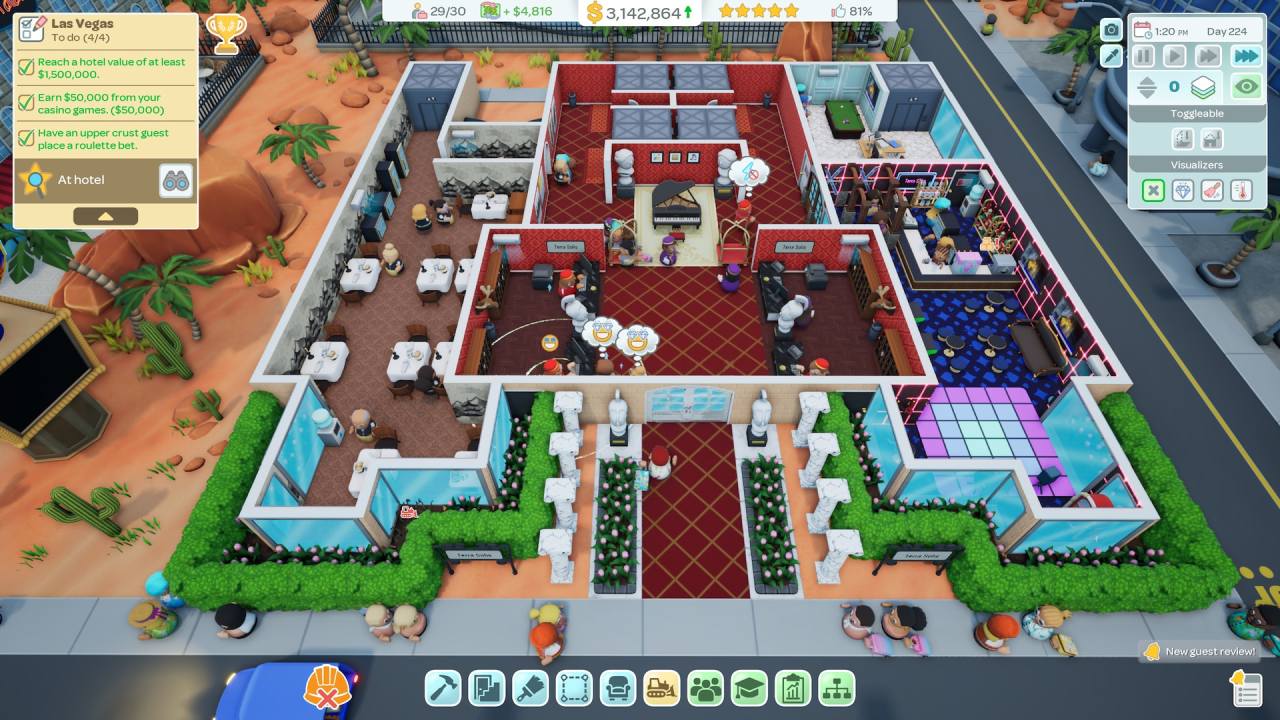
The critic system adds another layer to that progression.
Critics frequently visit hotel facilities and analyze their experiences to determine whether there is any reason to reward or penalize them. However, it can be difficult to understand what causes people's dissatisfaction, as they often leave negative reviews without explaining the reasons. Thus, rather than viewing guest requests as challenges, the systems occasionally seem confusing.
Business guests are an excellent illustration of this phenomenon. It often happens that even if guests receive all the requested items within their rooms, they still claim that some facilities are missing or complain about insufficient entertainment. Some guest algorithms require further improvement due to unmet requirements. Fortunately, such cases rarely turn out to be critical.
Technical issues also pop up from time to time while working on building rooms. A relatively common bug occurs with zone mapping tools, particularly when placing a large number of floor items at once. This includes gym rooms where zones fail to be detected when too many floor mats are placed. It is likely that the cursor is not detecting the tiles correctly, so the entire section needs to be redone to proceed with room creation.
Outside of those bugs, Hotel Architect actually performs surprisingly well.
Even large hotels packed with people, decorations, and construction sites function efficiently as their scale increases. Where most simulation games tend to suffer from poor optimization as complexity increases, Hotel Architect does a great job managing larger builds.
As for graphics, this game is less realistic and opts for an animated visual style, which works well for the kind of gaming experience. The game's character animation is highly expressive without being overly flashy. The presence of guests roaming the corridors, employees transporting equipment, and workers moving about the rooms gives the hotel environment life.
Customization is definitely one of the most powerful features of Hotel Architect. There are plenty of items for decoration, wallpaper options, furniture types, and layouts once progression systems start unlocking. The hotels can look completely different depending on their chosen style. In some cases, hotels are as luxurious as possible, with fancy designs, whereas other buildings could be compared to enormous entertainment parks full of various furniture and weird architecture.
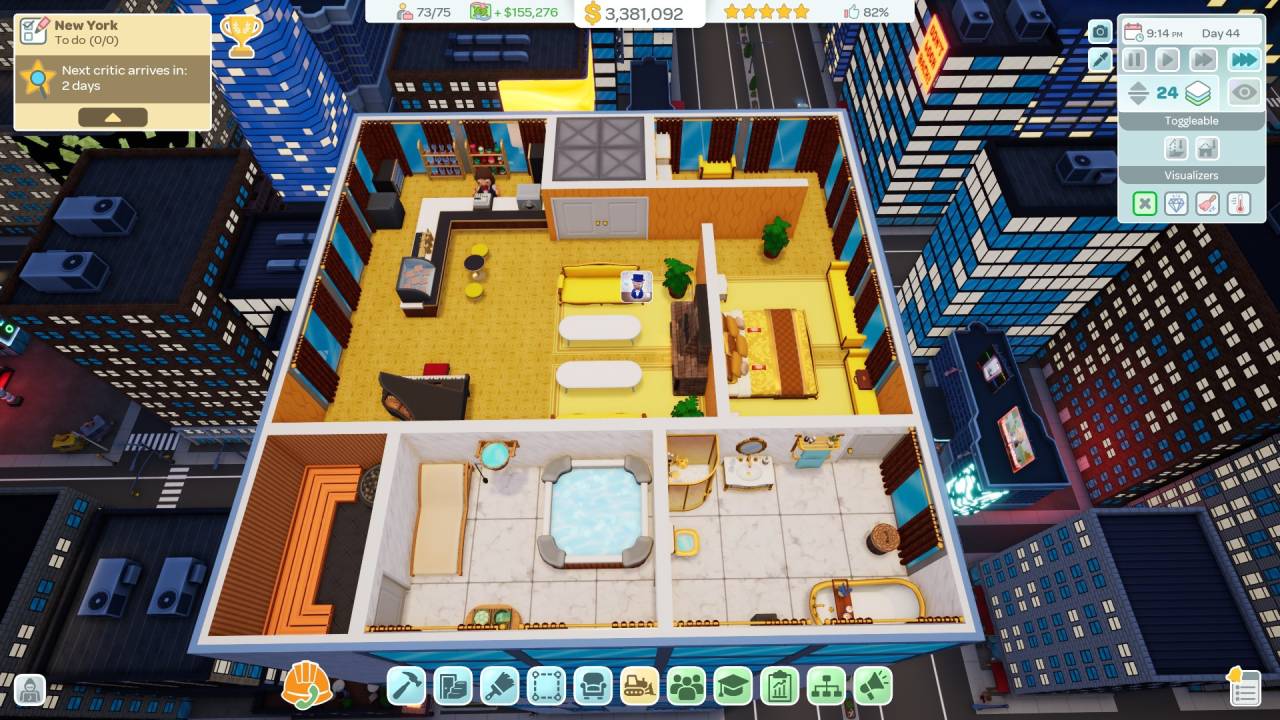
The new balcony systems introduced to the game provide additional possibilities for creative hotel development. With outdoor dining zones, patio bars, elevated passages, and stacked structures, the hotels are becoming more dynamic and lively than ever. It is possible to add balconies to any part of the building, creating multi-level outdoor zones and unique architectural structures. Despite no significant changes in the mechanics of the game, the visual creativity is increasing drastically.
The art direction also remains consistent across all assets and decorations.
This is important because many management sims struggle when thousands of objects appear on-screen. Yet Hotel Architect has managed to maintain a certain coherence even as its hotels get highly customized.
The audio is quite straightforward yet works perfectly with the rest of the elements. Background noises are added effectively to create an ambient environment, all menus are easily legible, and one of the most impressive parts of the game's audio is its tutorial. While many other management games tend to bombard players with lengthy tutorials, Hotel Architect does it much better with voice acting.
This is extremely helpful, since the game might prove very daunting at first. There are so many different systems working concurrently, and especially as all of them start intertwining with each other, starting from the operation of restaurants, entertainment options, employees, and guests' development.
In this regard, the tutorial does a pretty good job helping one get acquainted with the mechanics involved. However, there is still work to be done with the interface: some icons are quite small, and other prompts might fade into the background during hectic gameplay.
Staff management becomes increasingly important as hotels grow larger.
With enough experience, employees can develop skills that boost their productivity, but some mechanics related to employee leveling feel excessive. The aging system is an example since it will eventually compel employees to retire unless they use their skill slots to upgrade their longevity skills. This may be logical, but it can become tedious over an extended period of gameplay.
Another source of frustration is wage management. Employees will frequently ask for wage increases, particularly in difficult modes, and maintaining a balance between employee happiness and economic stability becomes one of the more challenging aspects later on in the game.
However, these issues also form the very appeal of Hotel Architect. It is impossible for hotels to be truly stable since there will always be something wrong with the establishment. From financial crises, critics' visits, customer complaints, staff shortages, issues with entertainment, and expansion-related expenses, the player will always have something to deal with, ensuring that the management process does not become repetitive too soon.
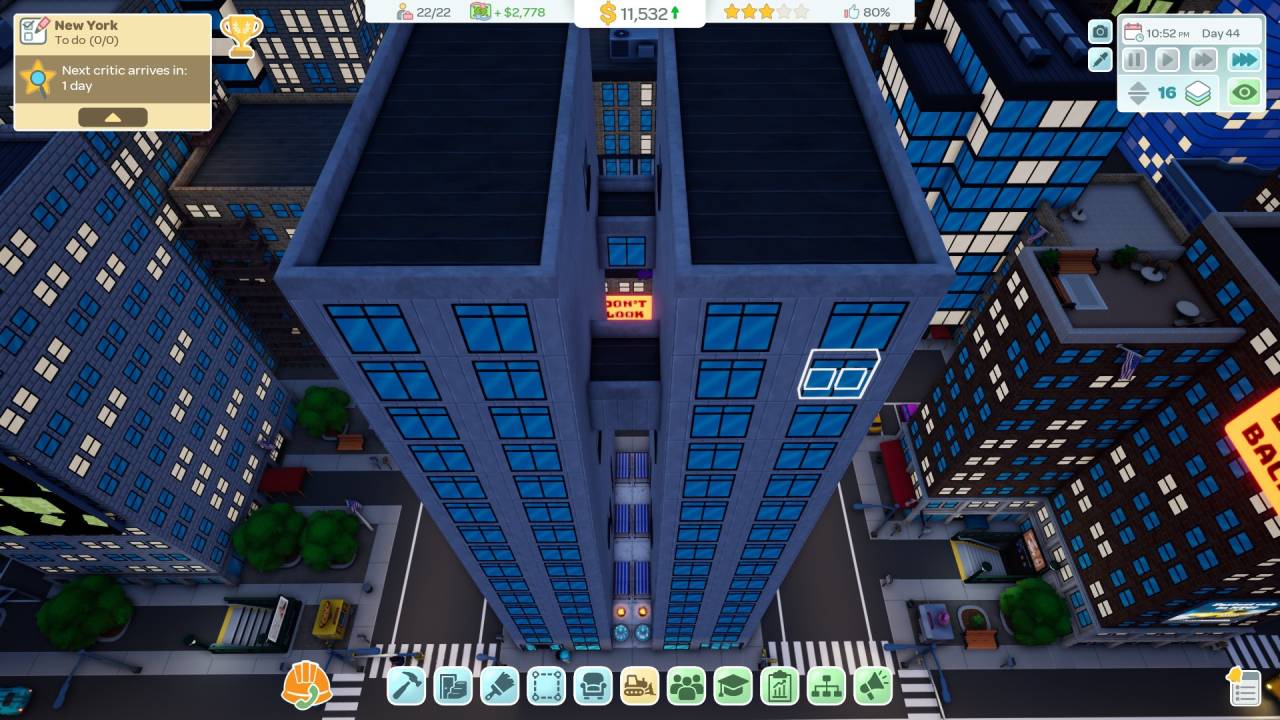
It is exactly the freedom to try something new that keeps Hotel Architect so entertaining. Depending on their preference, one can either develop a hotel using only the most logical approach to achieve maximum efficiency, or build an insane labyrinth of a building because it would be entertaining to see guests walking through such a hedge maze.
There is also a clear sense that Hotel Architect still has room to grow.
There are enormous creative possibilities in the current framework, and with further developments, there can definitely be more room types, guest types, decorations, seasonality, and special attributes for hotels in the future. Currently, there is enough material available in the systems to enjoy extensive play, yet the scope for more content later is very clear.
Hotel Architect perfectly reflects a constant drive towards achieving great results. Gradually, hotels turn from small, rather basic buildings into large complexes of entertainment, offering many different restaurants, luxurious rooms, bars, fitness centers, outdoor patios, and advanced guest systems. Even when this process slows down or some mechanics become annoying, the enjoyment comes from watching the building develop.
Hotel Architect is not without its flaws; the rate at which items are unlocked can become somewhat tedious, some guest systems may require tweaking, and certain aspects of the game's management can feel tedious rather than difficult. But beneath all that lies an enjoyable management simulator that recognizes the enjoyment of creative construction systems.
Editor, NoobFeed
Verdict
Hotel Architect is a creative and fun hotel management experience with solid sandbox systems, satisfying customization, and addictive progression loops, even if slower unlock pacing and balancing issues sometimes hold back its best ideas.
85
Related News
No Data.