

AMD Ryzen 7 9700X CPU Review: Zen 5 Unleashed
Zen 5 architecture in Ryzen 7 9700X offers incremental single-core performance improvements and similar multicore throughput to its predecessor.
Hardware by Katmin on Aug 06, 2025
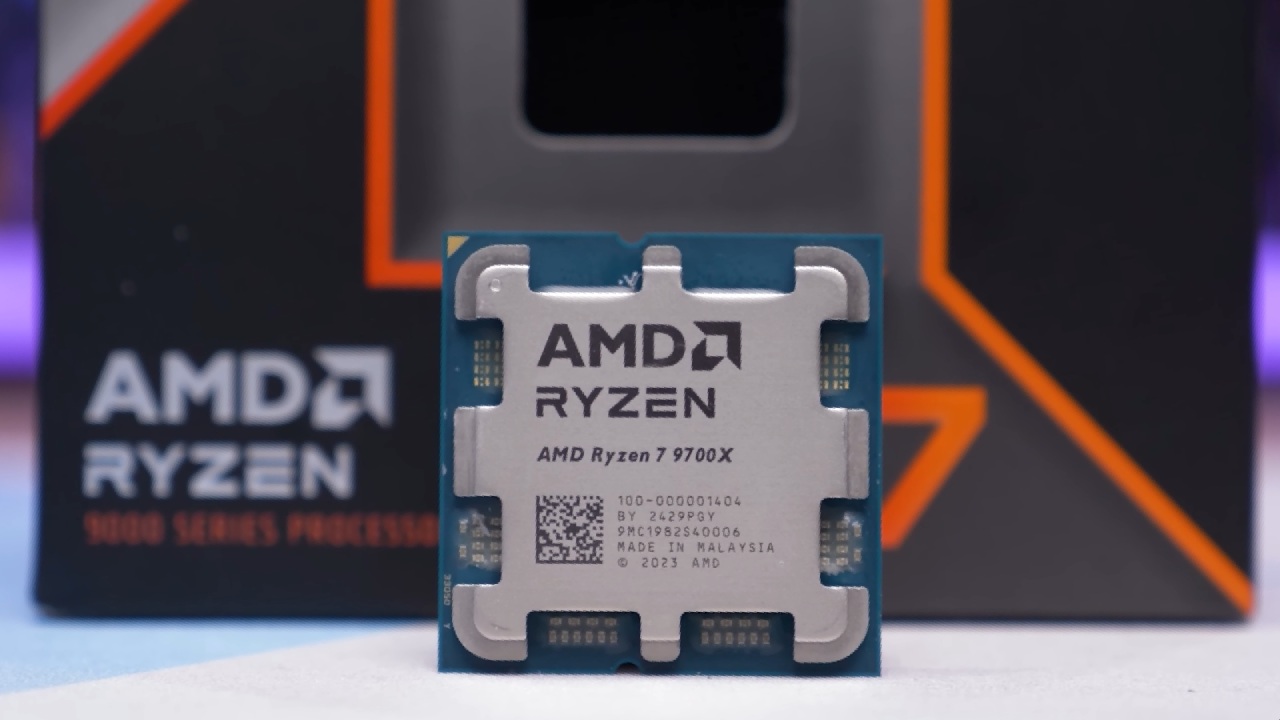
AMD's Ryzen 7 9700X arrives as an 8-core, 16-thread Zen 5 "Bas" CPU, intended to succeed Ryzen 7 7700X. Priced at $360-10% below the original MSRP of 7700X yet 24% above its current retail price, 9700X promises a 16% IPC uplift while maintaining nearly identical clock speeds.
We've analyzed its architecture, real-world performance across applications and games, power consumption, and cost-effectiveness.
Specifications and Architecture
Ryzen 7 9700X operates between 3.8 GHz and up to 5.5 GHz under a 65 W TDP, featuring 8 MB of L2 cache (1 MB per core) and a shared 32 MB of L3 cache. AMD specifies a maximum safe operating temperature (TJ Max) of 95°, allowing the processor to run continuously at that level without risk of damage.
While there was speculation about higher memory support, AMD clarifies that DDR5-6000 is ideal, with a 1:1 ratio between memory and fabric clocks—exceeding an fclk of 2000 MHz risks decoupling and stability issues, so you'll get the best performance by pairing a quality DDR5-6000 kit with this CPU.
Test System and Methodology
We tested 9700X on a modern AM5 platform using a high-quality DDR5-6000 memory kit to ensure that fclk and memory clocks ran in perfect sync. To provide context, we compared its results to both Ryzen 7 7700X and Intel's Core i5-14600K and Core i7-14700K across synthetic benchmarks, productivity applications, and a diverse selection of games.
Power consumption was recorded at the wall during full-load Cinebench runs and gaming sessions, giving you a clear picture of real-world efficiency.
Productivity Performance
In Cinebench R23 multicore testing, 9700X delivers a mere 2% uplift over 7700X, leaving it still behind Core i5-14600K in heavily threaded workloads.
However, when focusing on single-thread performance, we observed a 10% improvement, which can translate into snappier performance in lightly threaded tasks or applications that favor high single-core clocks.
Under full-load Cinebench, total system draw falls to 221 W-27 W (11%) less than 7700X, which demonstrates modest gains in efficiency.
In compression tests using 7-Zip, though, 9700X trails its predecessor by 3% in compression and 1.5% in decompression, suggesting that the IPC improvements do not always translate into real-world gains.
Rendering with Blender Open Data yielded identical results at 129 samples/minute for both CPUs, while the Corona 1.0 benchmark ran 11% quicker on 9700X.
Photoshop performance showed a 3% bump and Premiere Pro a 6% uplift, indicating that content creators might appreciate some of the incremental advantages in creative workflows.

Gaming Performance
Across thirteen modern titles, the average gaming uplift of 9700X over 7700X is a modest 3%. In Baldur's Gate 3, we saw a 2% increase from 113 fps to 115 fps, whereas The Last of Us Part I performed 3% slower on the new CPU.
Cyberpunk 2077: Phantom Liberty registered a 2% boost, but Hogwarts Legacy showed no measurable improvement. In Assetto Corsa Competizione, 9700X delivered an 18% increase in 1% lows, matching Core i9-14900K in those scenarios and demonstrating that certain GPU-bound, high-frame environments can benefit from the improved fabric architecture.
Spider-Man Remastered gained 5%, Homeworld 3 saw a 3% jump to match average frame rates of 14900K while offering superior 1% lows, and A Plague Tale: Requiem enjoyed a similar 3% uplift. Counter-Strike 2 favored Zen 5 design in ultra-high-frame testing, but Starfield ran 4% slower,
Horizon Forbidden West remained essentially unchanged, and Hitman 3 improved by only 1% (from 238 fps to 241 fps). Watch Dogs: Legion showed negligible differences.
Finally, power draw during gaming scenarios fell by just 16 W (3%) compared to 7700X, with more demanding scenes like The Last of Us seeing a 23 W (4%) reduction in total system usage.
Precision Boost Overdrive (PBO)
When we enabled PBO, multicore Cinebench scores climbed by 9% at the cost of a 25% increase in system power draw. In gaming, you'll see at best a 4% uplift, though most titles hover around a 2% gain, illustrating that PBO's headroom is limited under real-world workloads.
Cost-Per-Frame Analysis
At a price of $360, Ryzen 7 9700X sits 24% above the current street price of 7700X but delivers only a 3% average gaming improvement. When factoring in CPU cost per frame, 9700X ends up costing 21% more per fps than 7700X and 11% more than Ryzen 7 7800X3D.
Even after including a quality motherboard and 32 GB memory kit, you're paying 11% more per frame than you would with 7700X and over 100% more per frame than with 7800X3D, making it hard to justify unless you specifically need the small generational gains.

Final Thoughts
After extensive testing with AMD, our results appear accurate within a 12% margin of their internal figures. Despite the promises of Zen 5 Base, Ryzen 7 9700X offers only incremental performance improvements over 7700X while commanding a significant price premium.
If you're planning a new build or upgrade today, you'll find far better value in 7700X or 7800X3D, both of which deliver more compelling performance-per-dollar for gaming and productivity alike.
Check Our Other AMD articles:
- AMD Ryzen 9 9950X3D Review: Setting The Standard For 2025 Gaming CPU
- AMD Ryzen 7 9800X3D Review: 3D V-Cache Goes God Mode with Stunning Gaming Performance
- AMD RX 9070 Performance Review: Thermals, Clocks, and Real-World FPS
- AMD Ryzen 5 7600 Review: Best Budget Gaming CPU of 2025?
- AMD Radeon RX 7800 XT Review: RDNA 3 Power For Midrange Gaming
- Sapphire NITRO+ AMD Radeon RX 9070 XT Review: The Ultimate 4K Gaming GPU
- AMD Ryzen 7 7800X3D: Delivers Gaming Performance Far Beyond Expectations
- AMD Ryzen 9 7900X Review: Powering the AM5 Era with DDR5 & PCIe 5.0
- ASRock Radeon RX 7800 XT Challenger OC Review: Best Price-to-Performance GPU of 2025
- Intel Core i9‑14900K vs. AMD Ryzen 7 7800X3D: Power Profiles & Gaming Benchmarks
Senior Editor, NoobFeed
Latest Articles
No Data.