
Skill vs. Luck: The Online Games That Make Both Matter
Other by Aisaka Taiga on Apr 01, 2026
The most interesting skill vs luck online games rarely sit at either extreme. They live in the tension between control and uncertainty: the clean execution of a perfect dodge, the messy improvisation of a bad item roll, the relief of drawing the one card that keeps a run alive. That balance is not an accident. It is one of the oldest and most reliable tools in game design.
Some games strip randomness down to almost nothing and ask you to win through timing, knowledge, and discipline alone. Others lean into variance and make surprise the whole point. Most of the titles people stay with for years fall somewhere between those poles. They give you enough agency to matter and enough unpredictability to stay alive. That is where design gets interesting.
The Skill End: Where Outcome Follows Decision
Pure skill design is not really about difficulty. It is about determinism. What makes online games skill-based is the simple fact that outcomes follow decisions with minimal noise between the two.
You lose because you misread a position, mistimed an input, or chose the wrong line. You win because you did the opposite. The game does not rescue you, nor does it sabotage you.
Chess: Pure Legibility
Chess is the obvious example. Online or offline, there is no hidden role behind a move. A weak position is self-inflicted. A strong one is built. That clarity is why chess remains so addictive even after centuries of analysis. Every loss can be traced. Every improvement can be measured.
Bloodborne: Harsh but Readable
Bloodborne sits close to that end of the spectrum as well, even if it is wrapped in gothic chaos and panic. Its combat loop feels harsh because it is brutally legible. Enemy pressure, spacing, stamina management, animation commitment, recovery frames — all of it pushes responsibility back onto the player.
When a fight collapses, the reason is usually visible. You got greedy. You panicked. You rolled early. That kind of clarity is exhausting, but it is also why mastery in Bloodborne feels earned instead of granted.
CS2 and Valorant: Technique Over Fortune
Competitive shooters live nearby. CS2 and Valorant are not mathematically pure in the way chess is, but high-level play still rewards repeatable execution far more than fortune. Spray patterns, recoil control, positioning, map knowledge, utility timing — skilled players shrink randomness by turning technique into routine.
The result is a category where the agency dominates. That is satisfying for a while. It is also why so many players eventually drift toward games that leave a little more room for chaos.
The Middle Ground: Roguelikes and Built-In Variance
Roguelikes are where modern games most openly stage the argument between skill and luck. They do not hide randomness; they build around it. But good ones never treat variance as a replacement for design. They use it as pressure. The player still has to interpret the run, adapt the plan, and squeeze value out of whatever the game hands over.
Dead Cells: Visible Variance
Dead Cells is a clean example because the randomness is visible but not overwhelming. Weapon pools shift, item access changes, and route choices alter what a run becomes, and biome progression never feels fully scripted.
Yet the reason people talk about Dead Cells builds at all is that the skill layer remains intact. If builds exist, then decision-making exists. You are not merely receiving random tools. You are evaluating them, shaping them, and adjusting your rhythm around them.
Hades: Luck That Bends to Knowledge
Hades works in a similar way. Boons arrive through a randomized system, but experienced players can still steer a run with surprisingly high consistency. They understand which gods can patch a weak opening, which upgrades scale, which defensive tools buy time, and which route choices are worth the trade. The luck is real, but it is not sovereign.
That same spectrum — from pure RNG to genuine decision-making — maps cleanly onto card-based and casino formats. Reading online casino reviews for the Canadian market is one way to see how platforms position their game mix: slot-heavy catalogs sit at the variance end, while blackjack and poker tables carry a much stronger skill component. The design logic is the same one Hades uses — the question is just how far the dial has been turned.
Balatro: Tension as the Game
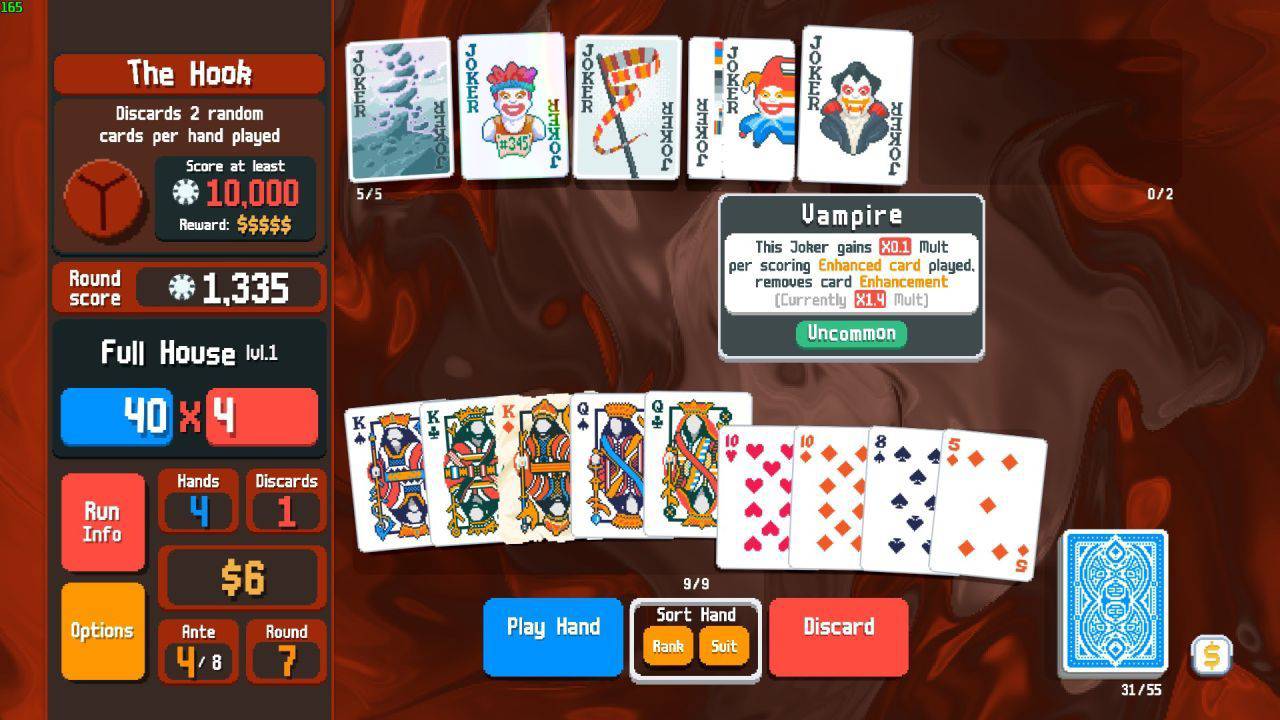
Balatro made this entire design conversation mainstream because it stripped the tension down to its essentials. Poker-hand probability gives the run its uncertainty.
Joker stacking, sequencing, economy choices, and deck-shaping give the player room to impose structure on that uncertainty. That is why the game landed so hard. It did not merely include the skill-versus-luck tension. It made that tension the whole game.
XCOM 2: Probability Is Not a Promise
XCOM 2, meanwhile, shows the sharper side of the same principle. The notorious 90% miss is not a broken moment. It is a design statement. It reminds the player that probability is not a promise.
The game uses variance to create dread, overcommitment, and improvisation. In roguelikes and adjacent systems, skill is not the removal of chance. It is the ability to exploit chance better than the next person.
.jpg)
Card Systems, Slots, and the Formal Spectrum
Once you get from Balatro to broader card design, the underlying mechanics become easier to read. Draw variance, hand probability, sequencing, and risk management are not abstract ideas.
They are the grammar of the format. Slay the Spire proves the point from the deckbuilder side: the draw introduces uncertainty, but the skill expression lives in drafting, trimming, upgrade priority, and route planning. The randomness matters. The decisions matter more.
That is also why online casino games strategy is a real design topic rather than empty label text. Long before modern roguelikes made variance fashionable again, card tables and machine-based formats had already formalized the spectrum between pure chance and measurable decision-making.
Slots and Baccarat: The Variance End
Start at the far end and the picture is simple. Slots are almost entirely about random number generation. The player can choose session length, pace, and maybe volatility if the format exposes it, but the actual outcome engine does not care how clever you are.
Baccarat sits closer to the middle in terms of math but not in terms of agency. It has a relatively low house edge on the banker side, yet very little room for meaningful player expression.
Blackjack and Poker: Where Decisions Matter
Blackjack changes the equation. Basic strategy materially improves the expected outcome because the player is making repeated decisions inside a known ruleset. Poker pushes that even further. Over a short stretch, variance can bully anyone.
Over a long enough sample, stronger judgment, discipline, and information processing separate one player from another. In Canada’s regulated market, licensed platforms carry that whole spread in one place: pure variance at one end, decision-heavy formats at the other.
What the Balance Reveals About Your Playstyle
If You Prefer Control
Preferences on this spectrum usually say something useful about how you like games to feel. Players drawn to deterministic systems tend to value mastery loops.
They want the cause-and-effect to remain visible. They want improvement to come from study, repetition, and cleaner execution. A loss should sting, but it should also be readable.
If You Prefer Chaos
Players who lean toward high-variance systems often want something else: novelty, improvisation, and the emotional charge of not fully knowing what the next ten minutes will look like. That is not a lesser preference. It is just a different appetite. Surprise is one of the oldest pleasures in play.
Most people do not actually live at either pole. They settle in the middle, where good systems usually live anyway. Too much determinism can feel clinical. Too much randomness can feel hollow. Durable games are those that let luck create friction without erasing authorship.
The full spectrum matters because it explains why different games create different kinds of attachment. Chess keeps you because every mistake is yours.
Bloodborne keeps you because pressure sharpens responsibility. Dead Cells and Hades keep you because adaptation becomes a skill in its own right. Balatro keeps you because probability and planning never stop arguing.
The Dial
Skill versus luck is not a flaw for designers to solve. It is a dial to tune. Move it too far in one direction and the game becomes sterile or arbitrary. Find the right balance and you get the thing players remember most: an experience surprising enough to stay tense and fair enough to stay meaningful.
Moderator, NoobFeed
Latest Articles
No Data.