
Ryzen AI Halo—How AMD's Local AI Box Stacks Up Against DGX Spark
AMD packages the Ryzen AI Max+395 chip into a first-party mini PC aimed directly at local AI developers.
Hardware by Shinji Okazaki on Jul 08, 2026
Compact desktop machines built for local AI work have become one of the more interesting categories in PC hardware, and AMD has now entered that space with a first-party mini PC of its own. Rather than leaving the Ryzen AI Max+395 chip to third-party manufacturers, AMD has packaged it into a dedicated developer platform aimed squarely at the audience that Nvidia's DGX Spark helped create.
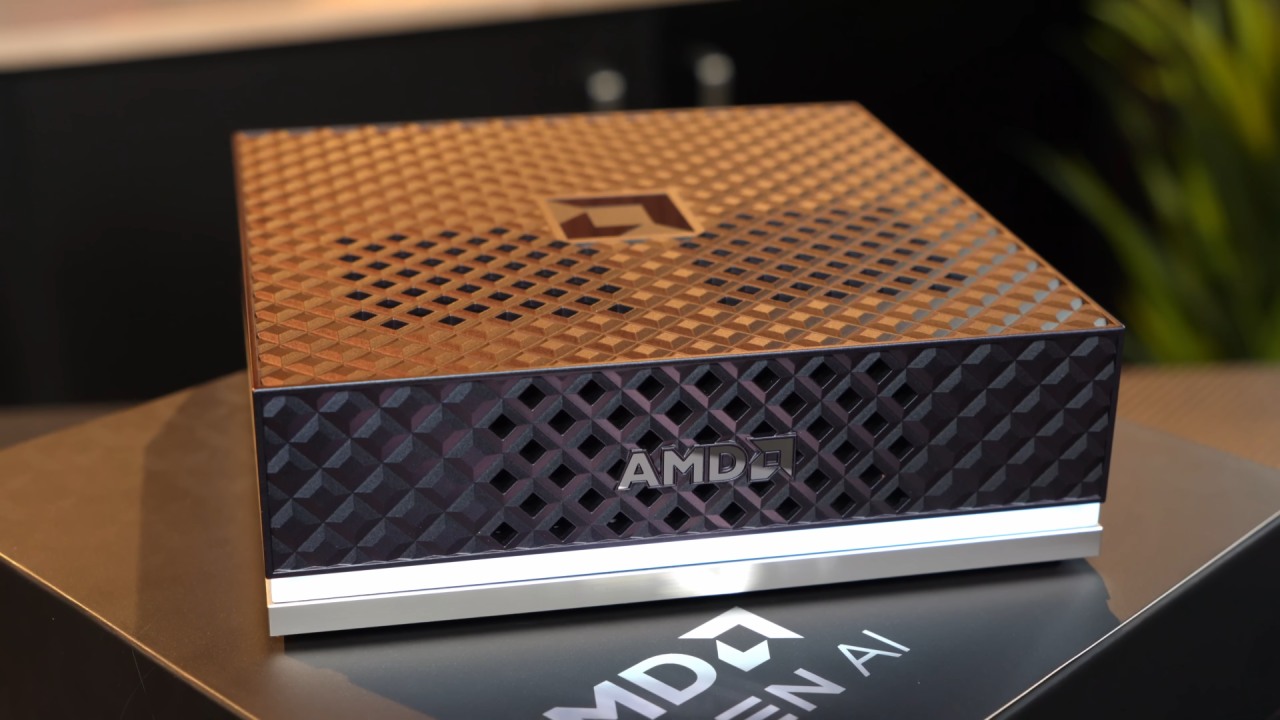
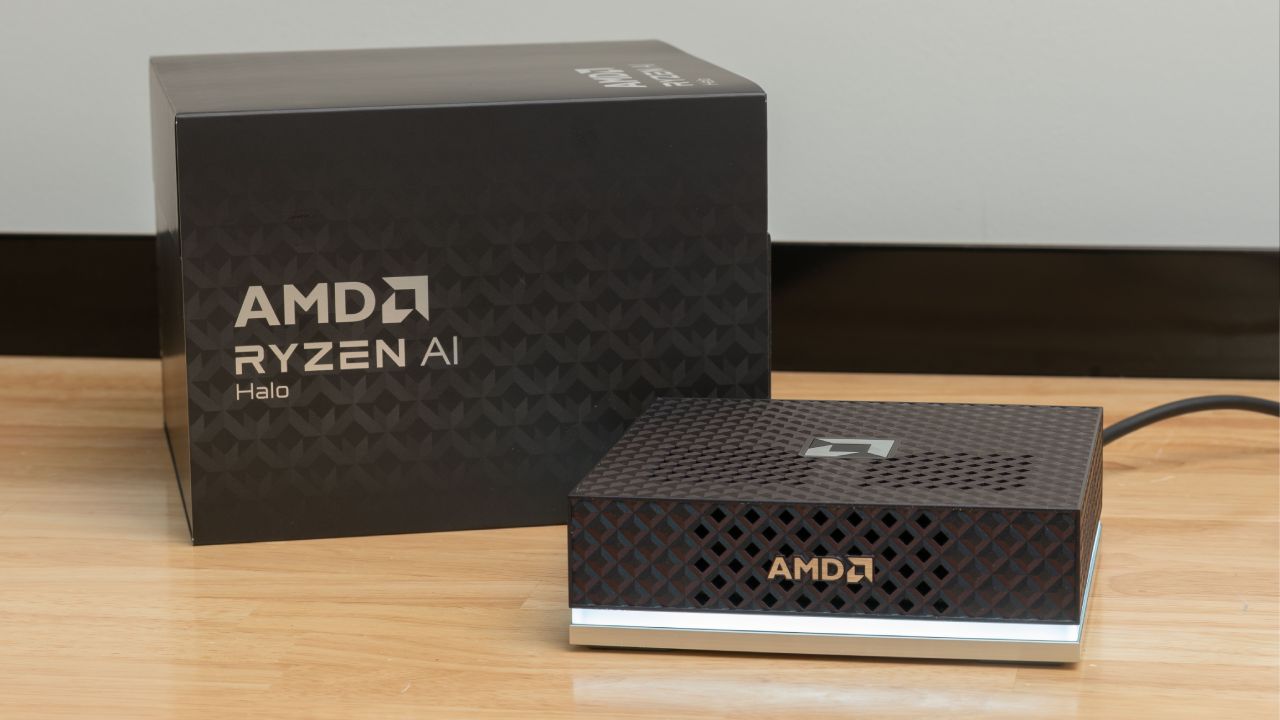
The device is small, high-priced, and positioned as a turnkey alternative to building a local AI rig from scratch. The unit ships in a super small form factor with a purple gradient finish and an AMD logo set into the top panel. Two intake vents sit up top, blending into the design at most angles, and a light bar wraps around the front and sides of the chassis, stopping short of the back panel.
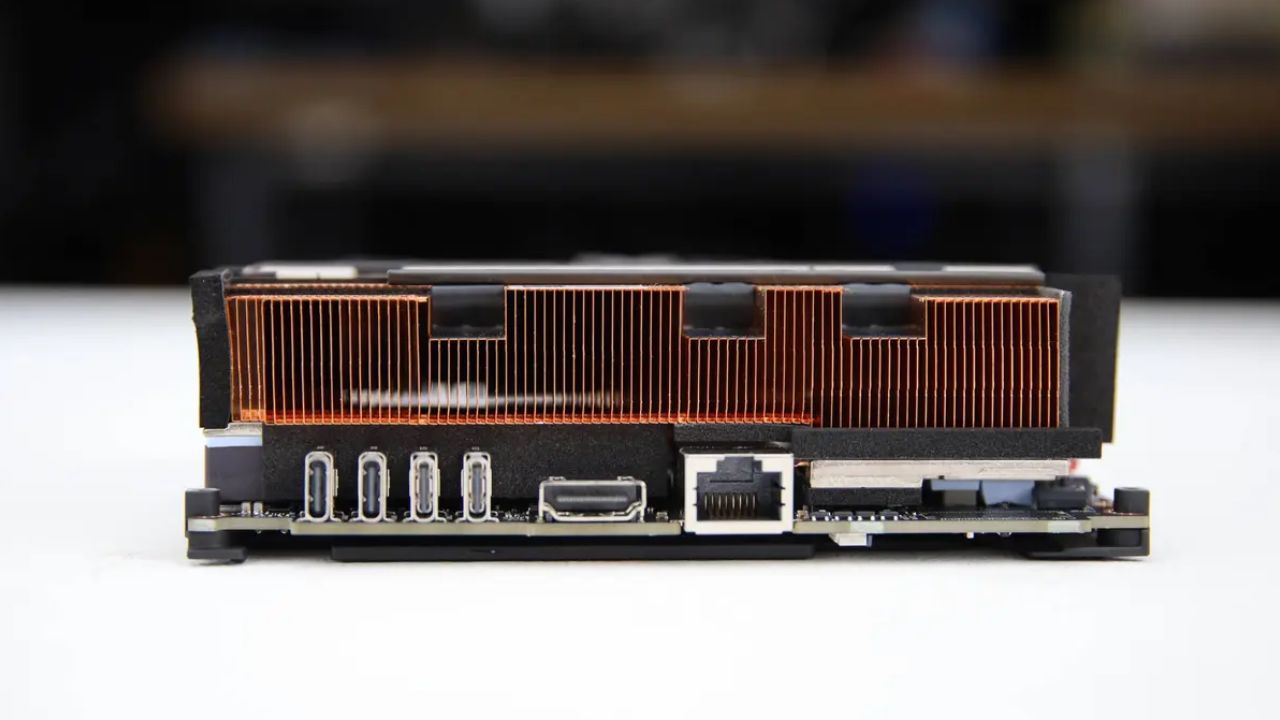
The sides are largely bare, but the rear houses a 10 Gb Ethernet port, a full-size HDMI output, three USB Type-C ports, a separate USB Type-C input for power, and the power button.
A single missing feature stands out here: there is no full-size USB port anywhere on the unit, not even a basic USB 2.0 connector, which would have been a welcome inclusion. Inside the box alongside the machine, buyers get a user manual and a 240W USB Type-C power supply.
Specifications And The Coming Upgrade
The model currently shipping is powered by the Ryzen AI Max+395, with 16 cores, 32 threads, 80MB of cache, and a boost clock of up to 5.1 GHz. Graphics come from the Radeon 860S, built on RDNA 3.5, with 40 compute units and a clock speed of up to 2900 MHz.
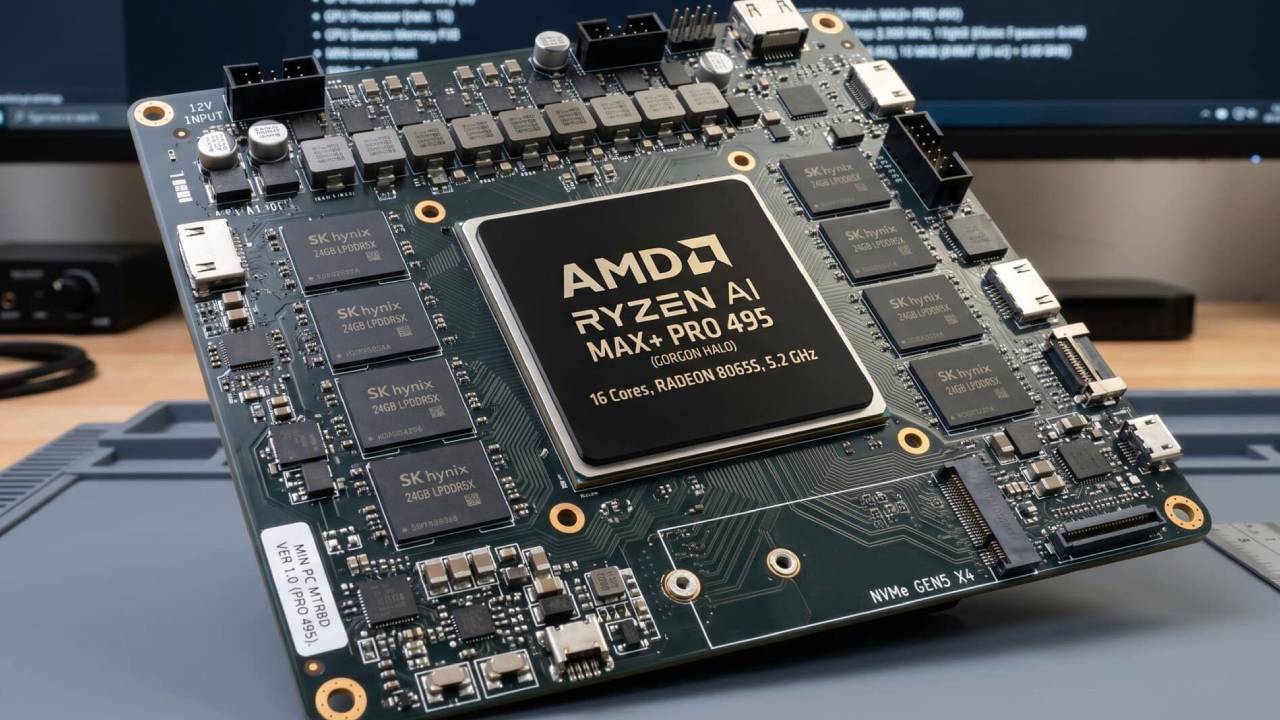
Both Windows 11 and Linux are supported, though the review unit arrived pre-installed with Windows 11. A second model has also been announced, built around the Ryzen AI Max+ Pro 495. It keeps the same 16 cores and 32 threads but steps up to an 8065SIG GPU that boosts to 3GHz, a CPU boost of 5.2GHz, and support for up to 192GB of RAM.
AMD positions the platform as an AI development machine designed to run continuously, with built-in remote access and a suite of preloaded software, effectively making it a turnkey AI mini PC. The system pairs that with 128GB of unified memory running at 8000MT/s and a 2TB M.2 SSD that also functions as a self-encrypting drive.
With 128GB of unified memory on board, only around 32GB is typically left for the system itself once a large share gets handed to the iGPU. Dedicating memory to the 8060S is straightforward: in AMD's own software, under performance tuning, the allocation can be set anywhere from half a gigabyte to 96GB, or left to auto-assign the ceiling.
Setting aside 96GB for graphics makes sense for workloads that lean on the GPU, whether that means running large language models or gaming. Checking the actual power draw under load, a CPU stress test pushed the chip to a boost of 140W before settling into a sustained TDP of around 130W in performance mode, a number that holds up well against most reports online, which point to a baseline closer to 120W.
Pre-Installed Software And The Developer Center
The machine arrives with a collection of pre-installed applications, including ComfyUI and LM Studio, and it centers everything around the AMD Ryzen AI Developer Center, which launches automatically on boot. From its main menu, we can browse playbooks that walk through various use cases and can be filtered by operating system.
A sync feature checks for software updates for tools such as the Lemonade server, NodeJS, PyTorch, ComfyUI, ComfyUI Desktop, LM Studio, Python, and Visual Studio Code. A remote access section also displays the machine's IP address, making it simple to connect to the system over that 10 GbE port once it is set up and running.
Image generation through ComfyUI, tested with Z Image Turbo, ran smoothly on the 8060S, producing clean 1024x1024 output while pushing the iGPU close to its limit.
Turning to raw compute, Cinebench R24 puts the chip's single-core score at 113, matching Apple's M1 Max and topping every other machine in that comparison. Multi-core performance shows an even larger gap, reaching 1865 against 1625 for the M1 Ultra, a result that aligns with what 16 cores and 32 threads should deliver.
For local language models, GLM 4.7 Flash, a 30-billion-parameter model, produced around 64 tokens per second, while FI 3.5, run in a hybrid setup that splits work between the iGPU and NPU, reached about 60 tokens per second. Results scale down from there depending on model size, and while none of this touches a dedicated high-end GPU, the output is strong for a small local machine running entirely on its own.
Comparing Token Generation Against The DGX Spark
Running the same class of models against Nvidia's DGX Spark and an Apple M4 Pro tells a more layered story. Token generation, which is bound by memory bandwidth, favors the Spark and the M4 Pro slightly, since both carry 273GB/s of bandwidth against 256GB/s here, and that shows up in the numbers: 26.4 tokens per second on the Spark, 24.6 on this machine, and 33.8 on the M4 Pro.
It becomes noticeable in compute-heavy tasks like large context dumps, image generation, or video generation, where the Spark managed close to 2.9 iterations per second in a stable diffusion test against roughly 1.3 here, and a five-second video clip that took about five and a half minutes on the Spark stretched to around 75 minutes on this system.
AMD's own marketing shows this machine beating the Spark in token generation across several models, from GLM Flash 30B up to 14% faster to Quen 3.635B up to 4% faster. Those figures are worth taking at face value only in context, since AMD leaves prefill out of the comparison entirely, and that is precisely the metric where the Spark holds a clear lead.
The image generation comparisons on the same page are measured against an Apple M4 Pro rather than the Spark, which aligns with the Spark actually winning image generation by roughly two to one and video generation by an even wider margin. None of this makes the numbers false, but it does mean the picture is more complete once both sides of the comparison are accounted for.
Pricing In Context
At $4000, the retail price matches what Nvidia charged for the DGX Spark at launch, and on the surface, that invites comparisons to overpricing. Looking across the rest of the market shows a different pattern: a 128GB Framework Desktop configuration, once expansion is factored in, lands in roughly the same range, and other small-form-factor machines built around the same Ryzen AI Max+395 chip have drifted up toward $4000 over the past year as well.
NVIDIA's own pricing for the Spark has moved during that time, too, starting near $4000, rising to $4699 for a stretch, dropping back down, and settling around $4500 more recently, which complicates any tokens-per-dollar comparison drawn from a single snapshot in time.
Framed against where the rest of the market already sits, the price here looks less like AMD charging a premium and more like AMD matching where competitors have already landed.
That flexibility comes with a small tradeoff in operating temperature, even though peak power draw between the two systems lies in a similar range. A built-in NPU rated at 50 TOPS adds another point of separation, since it can run alongside the CPU and GPU rather than replacing either.
Software support for it remains limited industry-wide, but tools like the Lemonade server, included out of the box, already support a hybrid setup that splits prefill work to the NPU and decoding to the GPU, and a fully NPU-only pass on a small model completed while drawing only around 50W.
Measured at the wall with a kilowatt meter, and with the system set to high-performance mode throughout, idle power draw came in at 9.6W, 4K video playback pulled 14.2W, and AAA gaming at 1440p averaged around 176W.
This figure fluctuates depending on the title.
Average APU temperature during that same gaming testing sat around 78°C, with a peak of 92°C recorded, numbers that are unremarkable for a mobile chip pushed to 140W inside a compact chassis. Performance here holds up well for a chip that has been on the market for some time, and the form factor makes a stronger impression than the raw numbers alone would suggest.
Against the DGX Spark, the tradeoffs are clear rather than one-sided: the Spark holds a real lead in prefill, compute-heavy image work, and video generation, while this machine keeps pace on everyday token generation, brings more memory bandwidth value at a similar price point, and adds the flexibility of native x86 software support along with a choice between Windows and Linux.
For chatting with models, running agents inside an editor, or working through the Lemonade, ComfyUI, and LM Studio stack that ships pre-installed, that tradeoff lands in a comfortable spot. Pricing will remain the biggest hurdle for anyone outside the audience this is built for. Still, for developers who know what they need and want to move recurring AI subscription costs into a single piece of hardware, the value case is there.
Editor, NoobFeed
Gaming Hardware Updates
No Data.