
Hell Clock Review
PC
A furious, grimly righteous ARPG that spins past its flaws.
Reviewed by Maisie Scott on Jul 26, 2025
Hell Clock stands out among the crowded field of independent ARPGs as a unique and ferocious anomaly. This vicious gem, developed by Rogue Snail, is notable not just for its skill in gameplay but also for its uncommon fusion of kinetic ambition with historical realism. While many roguelikes borrow the framework of Diablo or Hades, few have the nerve to anchor themselves in a real, harrowing event like the War of Canudos.
Fewer still manage to turn that history into a righteous call to arms, wrapped in knives, lightning, vengeful ghosts, and slick mechanical finesse. Hell Clock steps confidently into that space, offering something uniquely smart, deliberately dumb, unapologetically stylish, and deeply, righteously angry.

It's easy to assume Hell Clock is just another genre mashup, a Diablo-clone with procedural generation and some Hades-style pacing. But that impression quickly unravels as the game reveals its intentions. It earns its stripes with sincerity and unrelenting momentum.
At the center is Pajeú, a grieving man who has lost his mentor to the Brazilian Republic's cruelty, his mentor's soul now condemned to the underworld. You take control of Pajeú and descend, again and again, into demon-infested hellscapes, slicing through enemies and corrupted spirits with a growing arsenal of sharpened vengeance, all while the titular Hell Clock ticks ominously.
Set against the sobering historical backdrop of the 1897 Canudos Massacre, where thousands of civilians were slaughtered in Brazil by the newly formed republic, the game channels this history not through somber cutscenes but through raw, seething rage. This is not a tale of subtlety or compromise.
Hell Clock is less about nuance and more about righteous fury; it's Superman versus the KKK, with electrified knives. The anger is justified and embedded in every layer. When a ghost laments, "God made us all not equal. My brain's smaller and I was born to suffer," the game's thesis hits like a sledgehammer. The emotional core is remarkably powerful, even though character development may suffer in favor of pure pace.
The three primary components of gameplay are long-term meta evolution, fast-paced real-time combat, and build-crafting. After leveling up or defeating a predetermined number of adversaries, randomized skill upgrades are awarded at the start of each run. These seem minor at first, but grow in importance as you learn how the systems overlap.
With every run, you optimize. Pajeú becomes an engine of destruction, knife-spin attacks, lightning-blade combos, dodge dashes, lifesteal buffs, all transforming each descent into hell into a tightly choreographed, stylish dance of death.
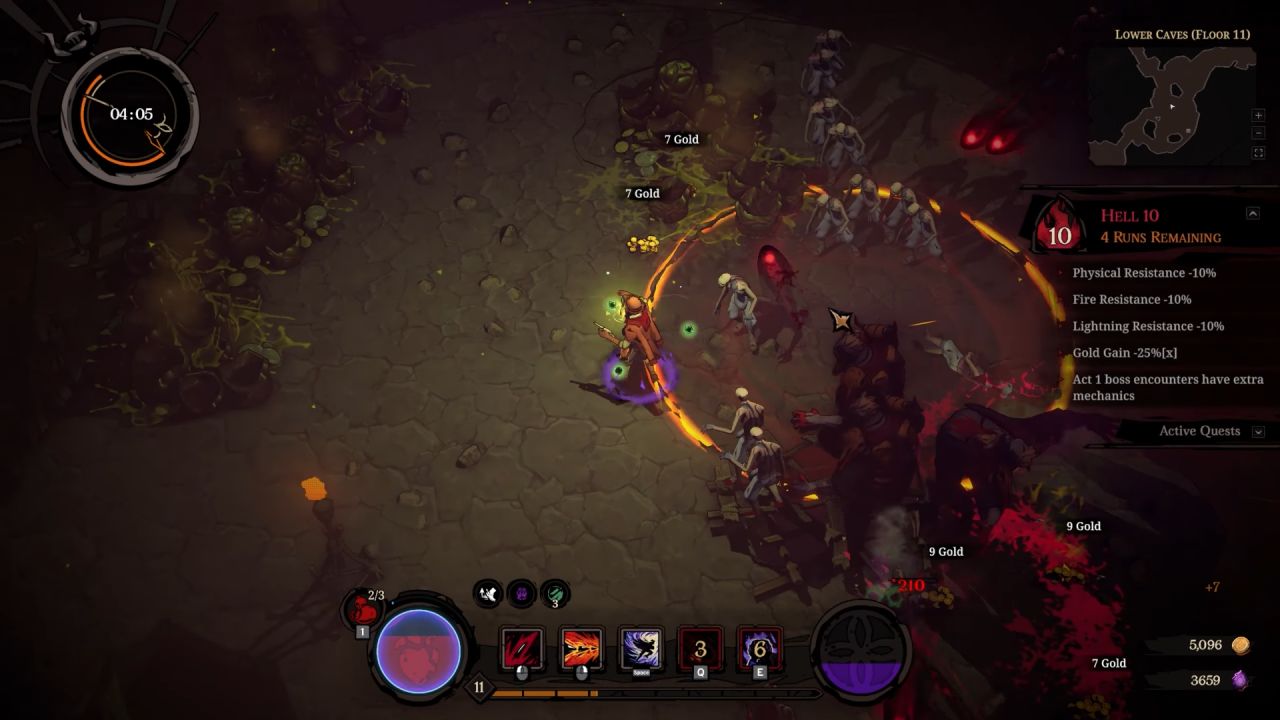
There's a joy in every encounter, especially with the knife spin ability. So carefree and ruthlessly effective, it almost becomes a joke, why do anything else when spinning shreds everything? It's so satisfying that pausing to snap a screenshot feels like a chore.
As your powers grow, the screen fills with carnage, lightning arcs, and satisfying damage ticks, all stacking beautifully thanks to the generous trinket and skill economy. Add a 30% AOE buff or 50% lightning bonus, and even small attacks become spectacular displays of controlled chaos.
Though marketed as a roguelike, Hell Clock feels closer to a traditional ARPG with rogue-inspired pacing. Most real growth happens between runs. After each outing, you return to your hub, where permanent upgrades await.
You can buy equipment that improves elemental resistances, lowers cooldowns, or boosts health. Since the shop is always changing, every time you visit, you have the opportunity to improve your construction. One notable pillar that provides strong passive boosts suited to particular abilities or tactics is the relic system.
A sprawling skill tree deepens this meta-progression. You're encouraged to invest thoughtfully in combinations that grant meaningful upgrades. For fans of theory-crafting, Hell Clock delivers. You might build around chain lightning, or focus on lifesteal and damage reflection.
One test build centered around a summon ability, enhanced by relics that boosted spell damage per summon and spawned extra minions when using abilities. What started as a test became a synergistic powerhouse. That rabbit hole of design is where Hell Clock shines.
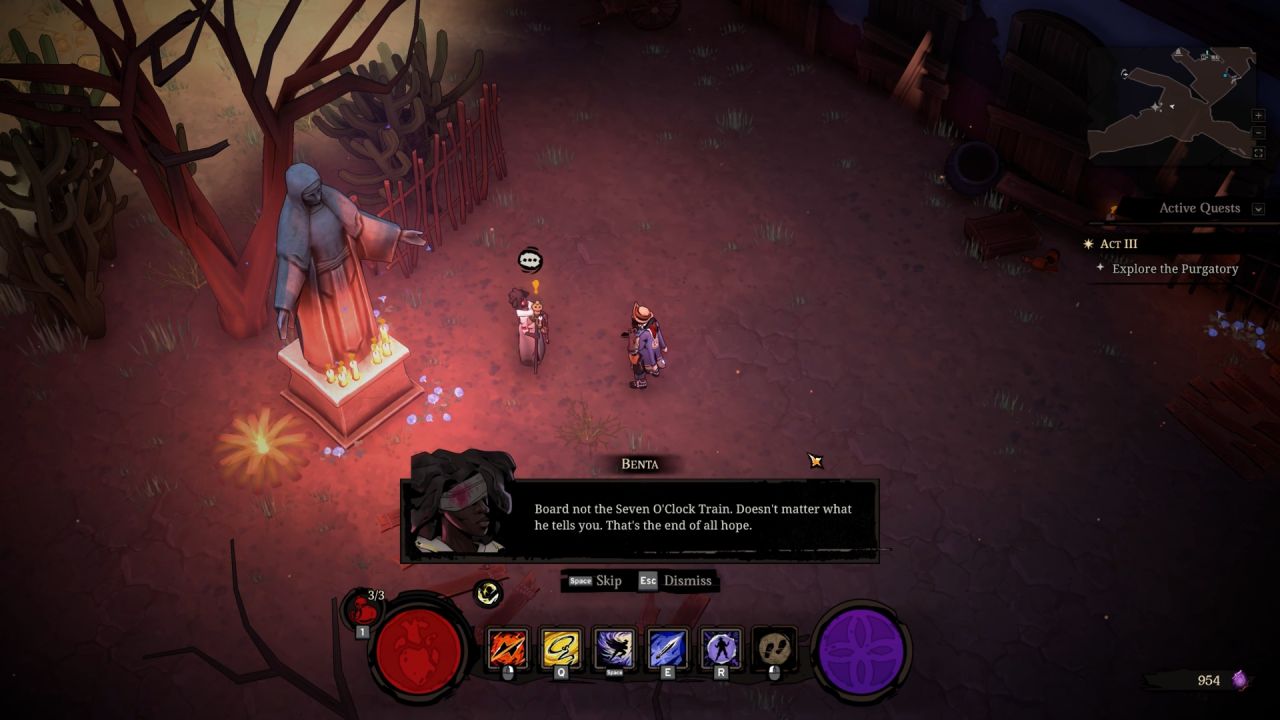
This variety fuels endless creativity. Whether you prefer speed builds, crowd control, status effects, or summoners, the systems flex to accommodate. And it's not just about making a functional build, it's about discovering one that clicks and devastates everything in your path.
The process of refining and exploiting these systems keeps you coming back. That said, Hell Clock isn't without stumbles. When stripped of its build depth, core combat can feel flat. If you rush upgrades or ignore systems, the result is little more than frantic clicking and potion-chugging.
This is where comparisons to Hades sting; Hades offers satisfying combat regardless of build, while Hell Clock leans harder on its underlying systems. Without those, the experience becomes chaotic in a less rewarding way.
The Hell Clock mechanic itself is one of the game's more divisive features. It's a run-ending timer that counts down as you play. Killing bosses extends it, and it can be upgraded, but it often feels more like a pacing limiter than a compelling system.
You upgrade it not out of joy or strategy, but just to survive longer. It's one of the rare points where Hell Clock prioritizes restriction over freedom, clashing with the rest of the game's creative energy. The item economy also has rough spots. For every powerful relic, there's one that's too niche or too weak to be useful in most builds.
Worse, the game loves handing out duplicates, making some upgrade paths feel stagnant. This bloats the relic pool, and while it encourages improvisation, it often dilutes your choices. Getting a relic that only enhances a skill you've never used and never will is always disappointing.
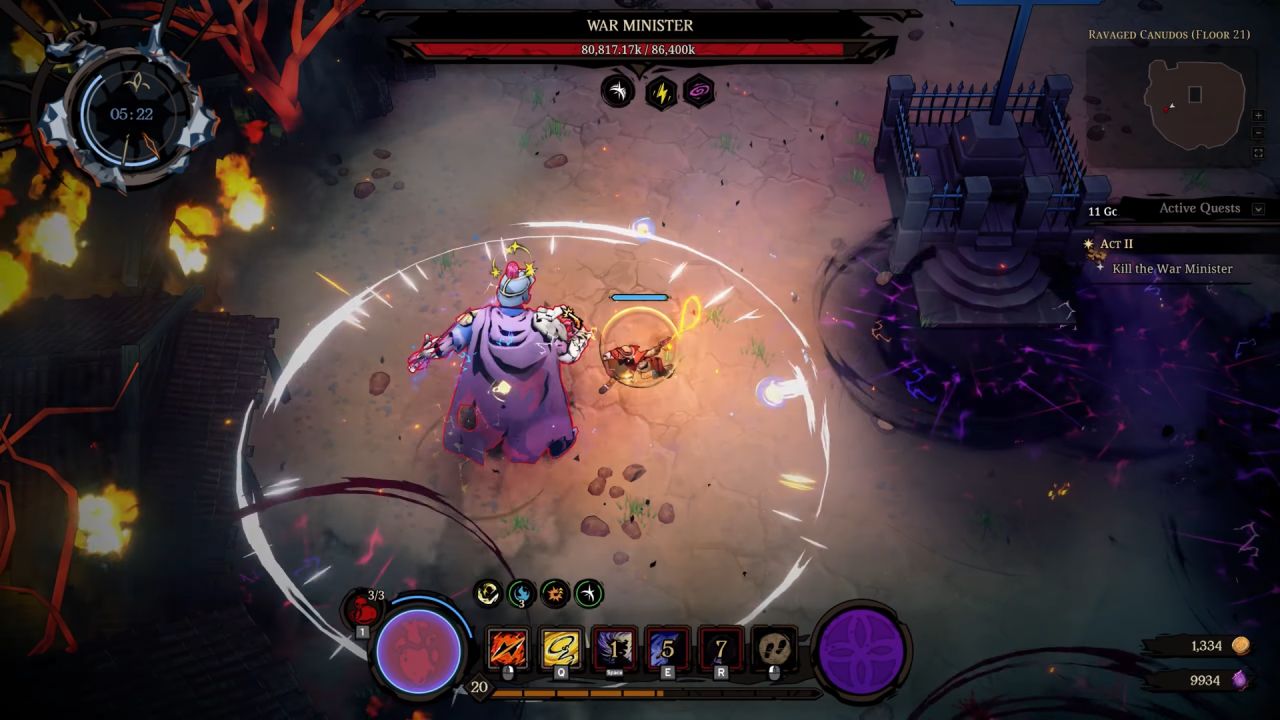
Nevertheless, Hell Clock is captivating in spite of these shortcomings. Pajeú gains power with each new relic, stat boost, or skill point. With enough improvements, he turns into a furious hurricane that spins through crowds with lightning, blades, and retribution.
This is a powerful dream with emotional weight, not mindless mayhem. You are more than simply strong. You're right. You're angry for a reason, and every kill feels earned. The visuals reinforce this tone perfectly. Grim, pulpy, and full of hellish charm, Hell Clock evokes Diablo's candle-lit dungeons and cursed catacombs but adds its own flair.
Environments are richly detailed without clutter. Character animations exaggerate motion just enough to sell both action and absurdity. Small touches, like flickering torches or twitching enemies, lend personality to every space. It's dark, but never dull.
Sound design is equally strong. Whispers echo, weapons clash with weight, and spells burst with satisfying force. The soundtrack is a slow-burning dread machine, harsh, distorted, haunted. At times, it nods to Diablo, but always with a Brazilian gothic edge. The pain and rage that underlie the game's themes are conveyed through the soundtrack.
Ultimately, Hell Clock is a cohesive cyclone of contrasts. Wildly fantastical yet rooted in history. Tragic, yet in its confusion, frequently amusing. It's fair but punishing if you're ready to learn. Whether it's a missing synergy, an unconsidered relic combo, or a novel tactic that completely changes your strategy, every run feels like a new invitation to explore.
Yes, there are a few things that could be tightened. A balanced pass would be beneficial for the relic economy. Perhaps the clock mechanism may never feel natural. There are always certain builds that are better than others. However, none of these lessens the impact of Hell Clock.
It transcends being just another independent ARPG during those ideal moments, when ghosts encourage you, your blades spin like a blender, and lightning bursts across the screen. It turns into a declaration. It's hardly the Möbius strip Wotsit of ARPGs, but Hell Clock isn't just another Jesus Dorito, either.
It's a smart, emotionally charged, and explosively expressive action RPG that spins with righteous fury and creative depth. If you love theory-crafting, relentless combat loops, and setting hell on fire with purpose, Hell Clock absolutely deserves a place in your library before your time runs out.
Editor, NoobFeed
Verdict
Hell Clock is a fierce and stylish ARPG that channels historical rage into chaotic, satisfying action. While some systems could use polish, its depth, momentum, and unapologetic attitude make it a hellish ride worth taking.
83
Related News
No Data.