
AMD FSR 4 INT8 Leak Reveals Massive Upscaling Potential for Consoles and Older GPUs
AMD’s FSR4 INT8 leak introduces a new version of the upscaler with expanded GPU compatibility and improved efficiency.
Hardware by Tanvir Kabbo on Oct 18, 2025
Crazy things can happen in the gaming world, and AMD's latest move proves it once again. Recently, AMD released the source code for its FSR 4 machine learning-based upscaler on GitHub, and in doing so made an unexpected mistake—uploading a version of FSR 4 that supports older GPUs, not just RDNA 4.
This alternate variant uses INT8 machine learning instructions instead of the FP8 rendition used in the official FSR 4 release, instantly giving the technology far greater compatibility and flexibility across hardware.
FSR 4 INT8 on Steam Deck and Older GPUs
Using INT8 instructions opened up new possibilities, as demonstrated by running FSR 4 on the Steam Deck in Remedy's Control. Running at 720p with FSR 4 Balanced Mode enabled used the same ray-traced reflection settings as the console versions of the game.
This development prompted an interesting thought—could FSR 4 INT8 potentially be used on today's consoles, such as the Xbox Series X or S? The Steam Deck handles it impressively, and since those consoles share AMD-based architectures, the possibility seems viable.
However, it's unlikely that the base PlayStation 5 supports INT8 machine learning instructions, unlike its upcoming Pro model, which will ship with an enhanced version of FSR 4. To test the limits, we ran FSR 4 INT8 on the Radeon RX 5700 XT—a GPU that, like the PS5, lacks ML support.
At 1440p, the result was clear: FSR 4 INT8 doesn't fall back gracefully for non-ML GPUs. Unlike Intel's XeSS, there's no compatibility layer here. Still, it's a fascinating experiment nonetheless.
Image Quality and Version Differences
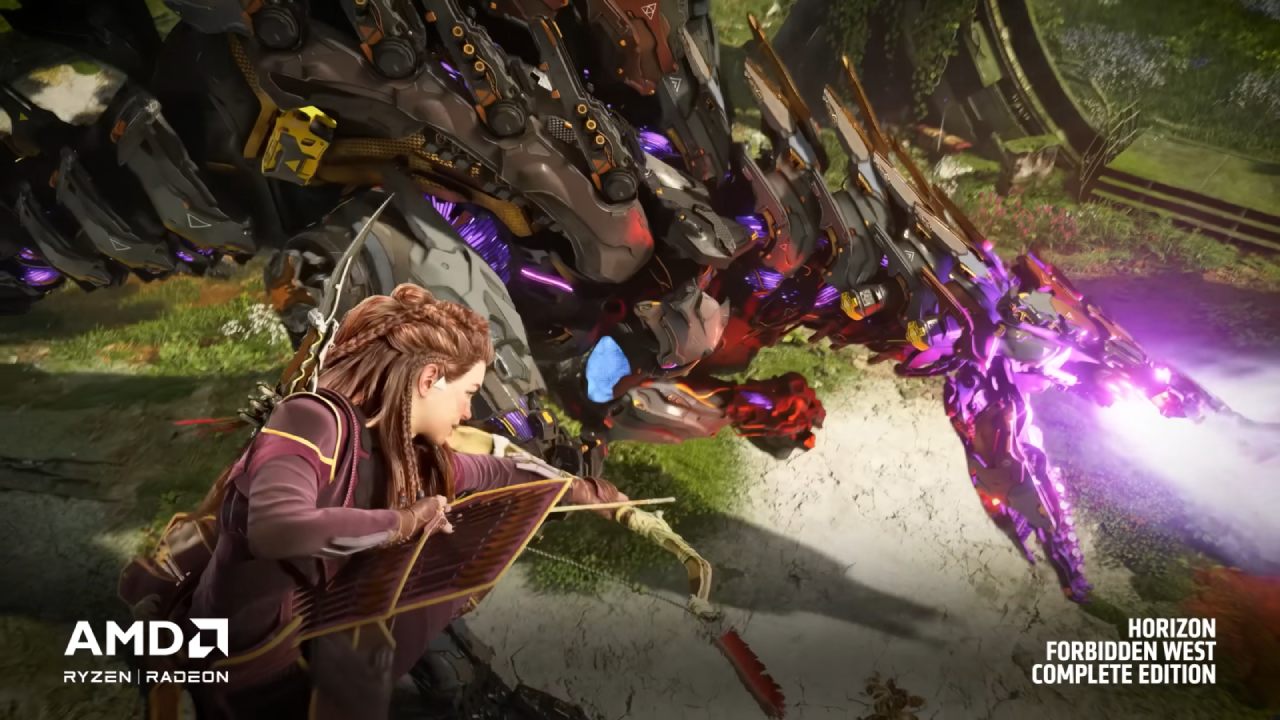
Since the release was unofficial, many uncertainties remain. Is this final code or an early internal version? We've praised the FP8 version of FSR 4 for its impressive visual quality on RDNA 4 hardware, but does the INT8 variant hold up? To find out, we tested Horizon Forbidden West at 4K resolution.
The full FP8 FSR 4 on RDNA 4 GPUs like the 9070 XT clearly produced the cleanest upscale. The INT8 version on a 7900 XTX, while close, exhibited reduced anti-aliasing quality and more temporal artifacts. RDNA 2 results were comparable to RDNA 3 with older drivers. Still, newer drivers introduced visual inconsistencies—fortunately,, fixable by reverting to older versions.
Clearly, the INT8 version doesn't match FP8 in visual fidelity, possibly because it's an older or lower-quality fallback build. Without official clarification from AMD, it's hard to know for sure.
Performance Costs and Efficiency Analysis
We then examined the performance impact of FSR 4 INT8 on mid-tier hardware like the RX 7700 XT, which better reflects current console performance. Running Horizon Forbidden West at 1440p high settings with parallax occlusion enabled, FSR 4 in performance mode achieved a 28% uplift over native 4K rendering.
However, Intel's XeSS ran 15% faster, and FSR 3 provided a 29% gain—outperforming FSR 4.
At 720p on Steam Deck, the performance gap widened. FSR 4 offered only a 16% improvement over native rendering, while XeSS achieved 33% and FSR 3 delivered an impressive 44.6% increase. The additional processing time required by FSR 4 averaged around 4.8ms on top of FSR 3's existing hit—an indication that the new algorithm is quite heavy.
Dropping quality modes didn't help much either. Moving from Quality to Balanced only netted a 7% gain, while Performance Mode yielded 14.5% more, totaling a 25% lead over native rendering—hardly transformative, given the computational cost.
FSR 4 in Real Gameplay Scenarios
We also tested Control with ray tracing enabled on the Steam Deck using FSR 4 Balanced Mode. This allowed console-quality visual settings at 30 fps, while maintaining medium RT effects with reasonable stability.
Compared to native 720p, FSR 4 Balanced increased performance by 85%, which offset the demanding ray tracing workload. Interestingly, FSR 4 was just 4% faster than FSR 3 in this case, hinting that performance benefits vary heavily by title.
Testing on Handheld RDNA 3 Hardware
Asus ROG Ally X and other AMD Z1 Extreme-powered handhelds have RDNA 3.5 GPUs that support FSR 4. FSR3 was again better than FSR4 in Cyberpunk 2077 at 720p and 30W TDP, with a 24% boost compared to FSR4's 7.7% boost. The margin stayed huge, even in performance mode, with FSR 3 operating 15% quicker.
At 1080p, FSR 4's results become more interesting because the image quality improved but the latency stayed high. The method obviously puts image quality first, competing with DLSS on desktops instead than optimizing for mobile or devices with less power.
Console Prospects and Next-Gen Implications
The speculation around FSR 4 on Xbox consoles is particularly interesting. Given that Series X features full RDNA 2 capabilities, there's no fundamental reason it couldn't run FSR 4. Certain titles, like Alan Wake 2, already demonstrate how lowering input resolution can maintain image quality while improving performance slightly.
However, since the PlayStation 5 lacks ML support, cross-platform developers are unlikely to widely adopt FSR 4 on consoles. That said, integration within Microsoft's GDK could lead to Series X/S support as preparation for next-gen systems.
Sony, on the other hand, will debut an enhanced FSR 4 variant as part of its PlayStation Super Resolution (PSSR) system on PS5 Pro, targeting roughly 2.2ms of processing overhead—far less than the 4.8ms seen on PC tests.
Final Thoughts
Perhaps the most fascinating detail is that FSR 4 INT8 isn't AMD-exclusive. Any GPU supporting INT8 operations can theoretically run it, regardless of vendor. When comparing the RX7700 XT and Nvidia RTX5060 Ti at native 4K, Nvidia had a slight 5.6% edge.
But with FSR 4 Performance Mode enabled, AMD's card delivered a 39% uplift compared to Nvidia's 23%. However, once Nvidia switched to DLSS Performance Mode, it surged 36% ahead of FSR 4, demonstrating the ongoing dominance of Nvidia's AI upscaling solutions.
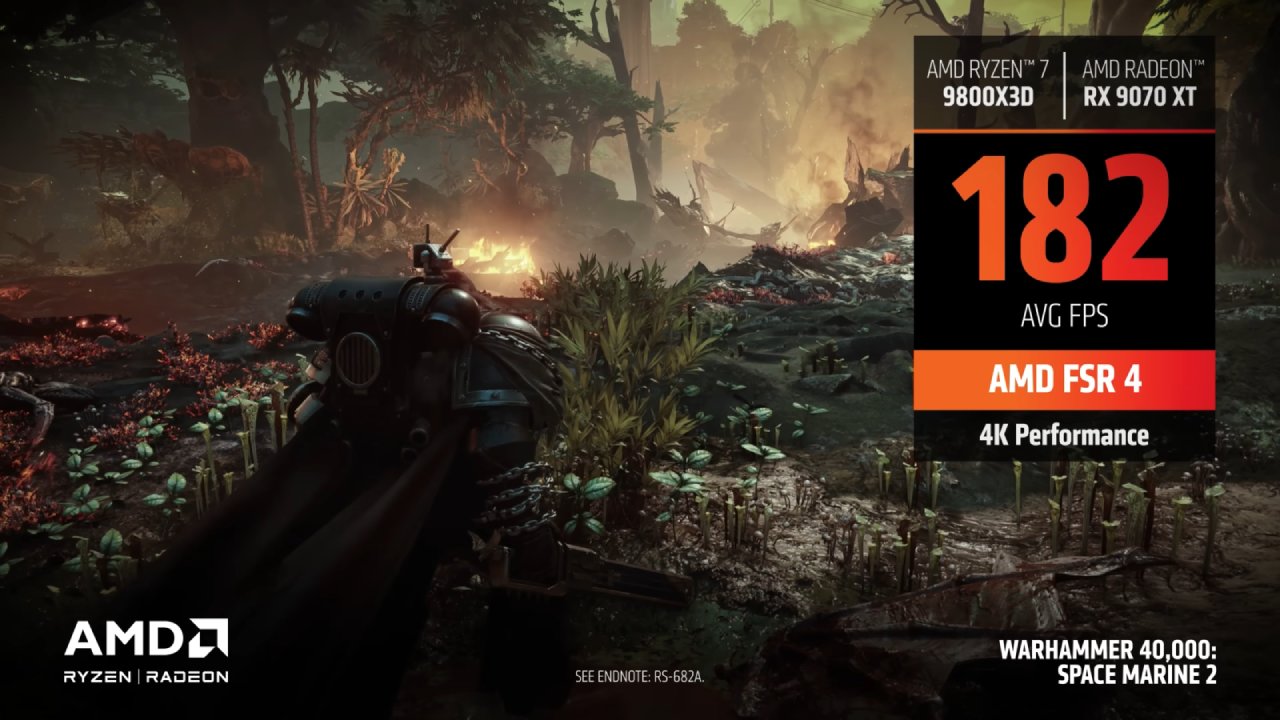
Overall, even if this version of FSR 4 INT8 turns out to be an early preview, it highlights how far AMD's open-source technology has come. FSR 4 is a big step forward for real-time rendering since it promises broad compatibility and machine learning-driven upscaling across platforms, from PCs to handhelds and consoles.
Also, Check Our Other Upscaling Articles:
- FSR vs. XeSS vs. DLSS: Best Upscaling Technology for Gaming in 2025
- FSR 4 vs. DLSS 4 at 4K: A Detailed Comparison
- FSR 4 vs. DLSS 4 in 1440p Gaming: Visual Fidelity and Frame-Rate Uplift Analysis
- DLSS 4 Ray Reconstruction: Elevating Ray Traced Visuals with AI
- DLSS 4 vs. DLSS 3: How Transformer‑Based Upscaling Sharply Outpaces the Old AI Model
- AI Upscaling on PS5 Pro: Can PSSR Finally Match DLSS?
- DLSS 4 Balanced vs. Performance: Striking the Perfect FPS and Image Quality Balance
Senior Editor, NoobFeed
Gaming Hardware Updates
No Data.