

AMD Radeon RX 9070 XT Roundup: PowerColor Reaper Tested
Compact form and practical design define the PowerColor Reaper’s approach to efficient 9070 XT performance.
Hardware by RereRara on Oct 16, 2025
A few months ago, a roundup of the Radeon RX 9070 XT was conducted, covering 14 different models. Unfortunately, one popular model was missing—the PowerColor Reaper. At the time, it was unavailable and not in production due to high demand for the 9070 XT series.
Manufacturers focused on their higher-end models to improve margins, making the Reaper nearly impossible to obtain. Now that supply matches demand, the base models are back in production, and the PowerColor Reaper is back on the market as one of the most affordable options.

With the Reaper back on sale, we were finally able to secure one and add it to our data set. Alongside it, we also received another intriguing 9070 XT variant—the Gravastar x Yeston Mercury Nova OC.
Gravastar, known for its unconventional product designs, collaborated with Yeston to produce one of the most unique-looking 9070 XTs available. Yeston has built a reputation for anime-inspired, vibrant GPU aesthetics, and this collaboration certainly reflects that boldness.
Gravastar x Yeston Mercury Nova OC RX 9070 XT
The Mercury Nova OC is currently priced around $900 in the US, making it the most expensive 9070 XT on the market. At the same time, most other models range between $700 and $750. It even costs more than the Nitro+, Aorus Elite, and Red Devil models, making its price difficult to justify at first glance. However, pricing can shift, so what does this premium model actually offer?
Visually, the Mercury Nova OC stands out due to its "3D bionic skeleton" fan shroud, crafted from plastic and finished with metallic paint. While it feels a bit cheap up close, the RGB lighting effects elevate its appearance significantly when powered on.
The card includes a cable for direct RGB control through your motherboard. It features a dark gray aluminum backplate etched with flowing lines that match the design's futuristic theme. Interestingly, the PCB is white—likely repurposed from another Yeston product.
On the rear, you'll find two switches—one to toggle LED lighting and another for dual BIOS functionality. The card uses three 8-pin power connectors and provides three DisplayPort outputs alongside one HDMI port. Measuring 332mm long, 140mm tall, and 68mm wide, it's quite large but not overly heavy at 1535g.
However, it does not come with a GPU support bracket or stand, which is disappointing given the price. Overall, the Mercury Nova OC's have a bold appearance that makes it eye-catching to people who like and enjoy stylish PC builds.
PowerColor Reaper RX 9070 XT
The PowerColor Reaper is quite the opposite—affordable, compact, and simple. It is priced around $700 in the US, and 9the 070 XTs is the cheapest one available. Although it does not have RGB lighting, dual BIOS, and other premium features, that's entirely intentional.
The Reaper's design focuses on simplicity and compactness, measuring only 291mm long, 111mm tall, and 40mm wide. It's the only dual-slot 9070 XT we've come across, weighing just 995g.
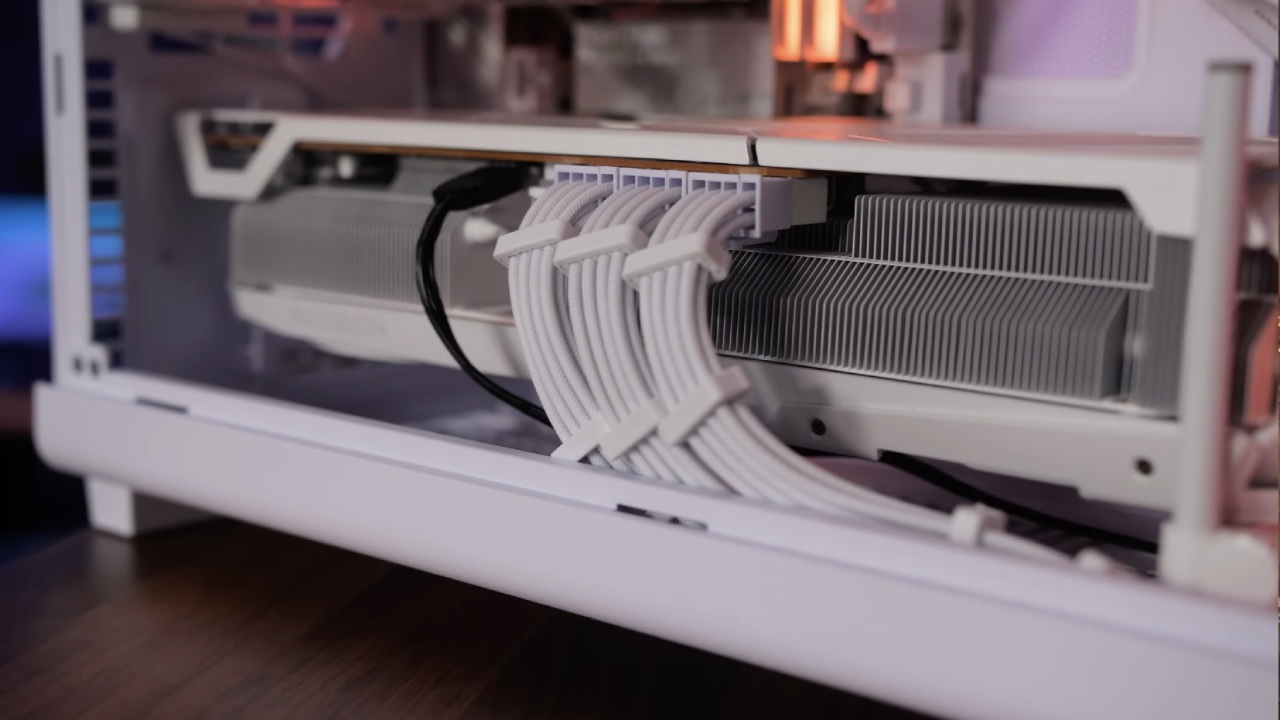
Even though it has a small footprint, it comes with three fans and an aluminum backplate with a pass-through area. It uses two 8-pin connectors, and the standard display configuration includes three DisplayPort and one HDMI port.
The Reaper's key appeal lies in delivering full 9070 XT performance in an impressively compact, quiet form factor—something many small-form-factor builders will appreciate.
Gigabyte Gaming OC Second Sample Update
Following the previous roundup, Gigabyte reached out regarding the Gaming OC's underwhelming thermal results, suggesting our review unit might have been faulty. They requested the card back for internal testing and sent us a brand-new retail sample.
Upon retesting, the results were nearly identical, confirming our initial findings. The new unit ran 5% hotter on the GPU core but 2% cooler at the hotspot, with minor variations in memory and VRM temperatures.
Fan speeds were slightly lower, as were the average core clocks, showing around a 5% variance overall—typical for retail samples. The Gaming OC works fine, but compared to competitors, it runs hotter and louder.
Test System & Methodology
After 1 hour of looping the F125 benchmark at 4K resolution, thermal testing was done. The system has a Ryzen 7 9800X3D processor, in an Antec Flux Pro case with a 360mm AIO cooler mounted at the top. The room temperature was kept steady and maintained at 21 °C throughout testing.

Thermal Performance
Average GPU Temperature:
The PowerColor Reaper reached a peak of 61° at 1,400 RPM, which is good for its small size and 304W TBP rating. On the other hand, the Mercury Nova OC reached 65°, making it the warmest among the tested cards, but stayed quiet thanks to its steady fan speed.
GPU Hotspot Temperature:
The Reaper temperature hit 81°, an amazing result for such a small card. But the Mercury Nova OC was slightly warmer, though still respectable. The Red Devil performed a little better at higher clock speeds.
Memory Temperature:
Both the Reaper and Mercury Nova OC used Samsung memory and peaked at 82°, which is a fine result. In comparison, most top-performing cards sat around 74–75°, while the Sapphire Pulse reached 90°, given that it was also using Samsung chips.
VRM Temperature:
Here, the Reaper ran hotter at 87°, still safe within the limits but notably higher than the Asus Prime (73°) and Gigabyte Gaming OC (59°). The Mercury Nova OC performed best here, maintaining its VRAM at 66°.
Power Consumption
The 9070 XT cards usually come in four power levels: 304W, 317W, 330W, and 340W. Both the PowerColor Reaper and Mercury Nova OC operate at 304W. While the Mercury Nova OC landed in the middle range, the Reaper turns out to be one of the most power-efficient cards.
Noise-Normalized Testing
After noise normalization, the Mercury Nova OC performed to a mid-range position, while the Reaper was only 1° warmer. The Mercury Nova OC's GPU hotspot reached 72°, only 4° above the best-performing card. The Reaper matched the Red Devil at 75°, which is good considering it used less power.
For memory temperatures, the Mercury Nova OC reached 68°, and the Reaper followed closely at 74°. VRM temperatures also favored the Mercury Nova OC at 56°, which is excellent.
Gaming Performance
Both the Reaper and the Mercury Nova OC performed consistently within their power and clock-speed limits. There were no surprises as each card performed as expected within its design constraints.
Final Thoughts
After testing 14 variations of the Radeon RX 9070 XT, it's clear there aren't really any bad options. Still, some are a bit newer than others. The Gigabyte Gaming OC remains unremarkable but serviceable. The Gravastar x Yeston Mercury Nova OC is a solid, quiet performer with strong build quality and distinctive aesthetics. Still, given its high price, it makes sense if someone really loves how it looks.
On the other hand, the PowerColor Reaper is an easy recommendation. It's one of the most affordable 9070 XTs on the market, thanks to its impressive cooling and quiet operation in a compact dual-slot design. It may lack premium extras, but it focuses on performance, practicality, and value. For those seeking a compact yet capable 9070 XT, then Reaper is one of the smartest choices out there.
Also, check our other AMD articles:
- AMD Ryzen 9 9950X3D Review: Setting The Standard For 2025 Gaming CPU
- AMD Ryzen 7 9800X3D Review: 3D V-Cache Goes God Mode with Stunning Gaming Performance
- AMD RX 9070 Performance Review: Thermals, Clocks, and Real-World FPS
- AMD Ryzen 5 7600 Review: Best Budget Gaming CPU of 2025?
- AMD Radeon RX 7800 XT Review: RDNA 3 Power For Midrange Gaming
- Sapphire NITRO+ AMD Radeon RX 9070 XT Review: The Ultimate 4K Gaming GPU
- AMD Ryzen 7 7800X3D: Delivers Gaming Performance Far Beyond Expectations
- AMD Ryzen 9 7900X Review: Powering the AM5 Era with DDR5 & PCIe 5.0
- ASRock Radeon RX 7800 XT Challenger OC Review: Best Price-to-Performance GPU of 2025
- Intel Core i9‑14900K vs. AMD Ryzen 7 7800X3D: Power Profiles & Gaming Benchmarks
Contributor, NoobFeed
Latest Articles
No Data.