
PEAK Beginner's Guide | Gameplay Tips and Tricks
Here's an easy guide for beginners.
Game Guide by Subaiyta Jahan on Oct 12, 2025
This guide will walk you through a complete PEAK route, covering every region from the shores to the summit.
This guide will also explain how to manage stamina and handle environmental hazards. As well as use strategies to progress efficiently. The focus is on surviving and collecting useful items.
.jpg)
Getting Started
The most important element in PEAK is stamina. Keeping the stamina bar as green as possible allows for longer and safer climbs.
As the journey begins, ignore most items on the right side of the screen unless you are aiming for achievements. Instead, focus on essentials, such as the backpack and the items scattered along the path.
Bandages will heal fall damage, and food such as trail mix will restore stamina and hunger. Cooking food whenever possible will increase its effectiveness by about 66%. This will provide more stamina recovery. You can also crack open coconuts to cook for easy energy boosts early on.
Food and healing supplies can possibly be kept in the backpack, and climbing equipment can be kept on the quick bar for easier access. It's important to look for luggage, as it often contains packaged food, bandages, and other essential survival gear.
.jpg)
Climbing Tips and Movement
For easy progress, start by looking for bridges and rock structures that can be climbed. Use the "bounce-pull" technique for challenging climbs: one person crouches while the other climbs on top, leaps, and hauls the companion up. Although early climbs do not require much equipment, ropes can also aid others to reach higher regions.
Gather as many objects as you can while exploring. Before eating, it's important to examine the item carefully, as some foods and mushrooms can be deadly. When in doubt, antidotes or poison resistance guidelines can be helpful.
Campfires and Statues
There is a statue and a campfire at the top of each main part. Statues can either restore legendary items if no one has died, or restore fallen friends if someone has. As a checkpoint, the campfire enables players to relax, prepare meals, and replenish their energy. Food should always be prepared before continuing, since it will provide free stamina with no drawbacks.
Tropics Region
Poison risks and unpredictable weather are well-known in the tropics. You have to avoid climbing when it's raining since damp surfaces make it almost impossible to climb.
Avoid gassy plants and exploding bushes as well, since they can produce poison clouds or knockbacks that take a few minutes to clear.
You can safely set off explosions at a distance by throwing anything toward a bush. Curative mushrooms or antidotes can be used to cure poisoning. Additionally, ticks may develop and inflict poison damage unless they are removed, which can be accomplished by turning or ascending swiftly or by another person.
You have to create new climbing routes by using tree branches and vines. There are usually several ways up, so if one seems too tough, try going left or right. Even though stepping on thorns results in little poison damage, it might occasionally be a good way to advance.
Powerful tools should not be wasted here. Small tools and ropes are helpful, but advanced gear like the chain gun should be reserved for later areas. Using bandages or medkits to treat injured teammates is important to preventing deaths.
.jpg)
Alpines Region
Freezing winds and frost are affecting the mountain region. Long periods of exposure or standing on ice will result in freezing debuffs. Sheltering behind boulders helps block wind, and portable stoves, lamps, or heating packs can be used to keep warm.
To avoid fall damage, slide down while clinging to the wall if your stamina runs low during a climb. To safely go down, simply hold forward and press the climb button.
Even when your stamina is almost gone, you can still reach safe areas with quick techniques like dashing (Shift) and climbing bursts (Space + click).
If your health starts to deteriorate, look for napberries near the mountain's base. They temporarily put you to sleep but restore your health completely.
Caldera Region
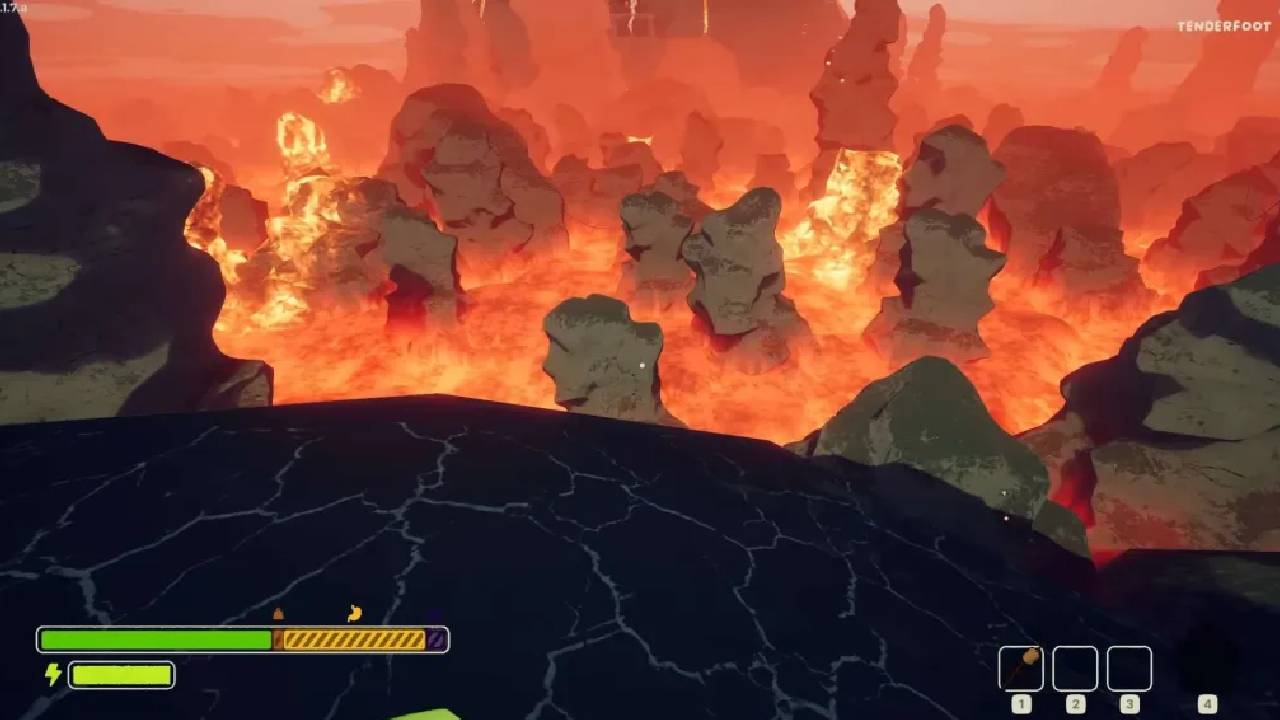
Despite its deadly appearance, the caldera is often considered the game's most entertaining feature. This region is dominated by lava ponds and flaming rocks. Stepping on hot pebbles can result in burn damage that quickly heals, since they shift between safe and searing states.
Although it won't kill you right away, lava itself can cause slight burn damage if you move through it carefully. Plan the path, scout the region first, and then take the necessary steps.
Here, eggs are a quick food source that can be cooked by tossing them into the lava or onto hot surfaces. For safer and quicker travel, chains can be used throughout the area.
The Kiln (Final Region)
Preparation is necessary for the last and most difficult section. Every piece of recovered equipment becomes necessary, particularly the chain gun. When climbing the sharpest cliffs, this tool is essential. For strength, it's important to utilize energy drinks, lollipops, and stamina enhancers wisely.
Due to a lack of fresh food or luggage, the climb becomes a race against hunger. Don't hurry; move efficiently instead. Resting places are little ledges; stoop to keep your balance and prevent falls.
The difference between success and failure will be achieved by applying previous strategies, such as bounce-pull teamwork and smart resource use. To alert the helicopter for extraction, light a flare when you reach the peak.
PEAK blends clever climbing technique, teamwork, and survival. The secrets to success include controlling endurance, preparing meals, making good use of tools, and adjusting to various situations.
From poison and freezing to fire and starvation, each location has unique difficulties, but with preparation and perseverance, the ascent becomes a fulfilling experience.
Climbing is only one aspect of reaching the peak; another is learning to survive in the harshest environments nature.
Also, check out other guides:
- PEAK Guide | The 5 Biomes to Conquer
- PEAK Guide | Difficulty Levels: From Tenderfoot to Ascent 7
- PEAK Guide | How to Pass Every Level Easily
- PEAK Guide | Complete Breakdown of Every Item
- PEAK Guide | How to Boost Morale
- PEAK Guide | How to Do Advanced Climbing Easily
- PEAK Guide | How to Unlock Every Customization
Contributor, NoobFeed
Latest Articles
No Data.