
Steam Deck 2 Rumored RDNA 3.5 Chip Could Deliver 2x Performance at 15W
Steam Deck 2’s rumored RDNA 3.5 chip could deliver major performance gains while remaining constrained by memory bandwidth and power.
Handheld by Tanvir Kabbo on Oct 06, 2026
The rumored Steam Deck 2 chip is becoming increasingly credible, with recent information aligning with details that have been circulating for months. The proposed design reportedly features 12 CU of RDNA 3.5, 9600 MT/s memory, and hardware-accelerated FSR 4.
While theoretical numbers suggest the chip could approach 3x the original Steam Deck’s performance, power and memory bandwidth constraints make that figure unlikely within a 15W power envelope.
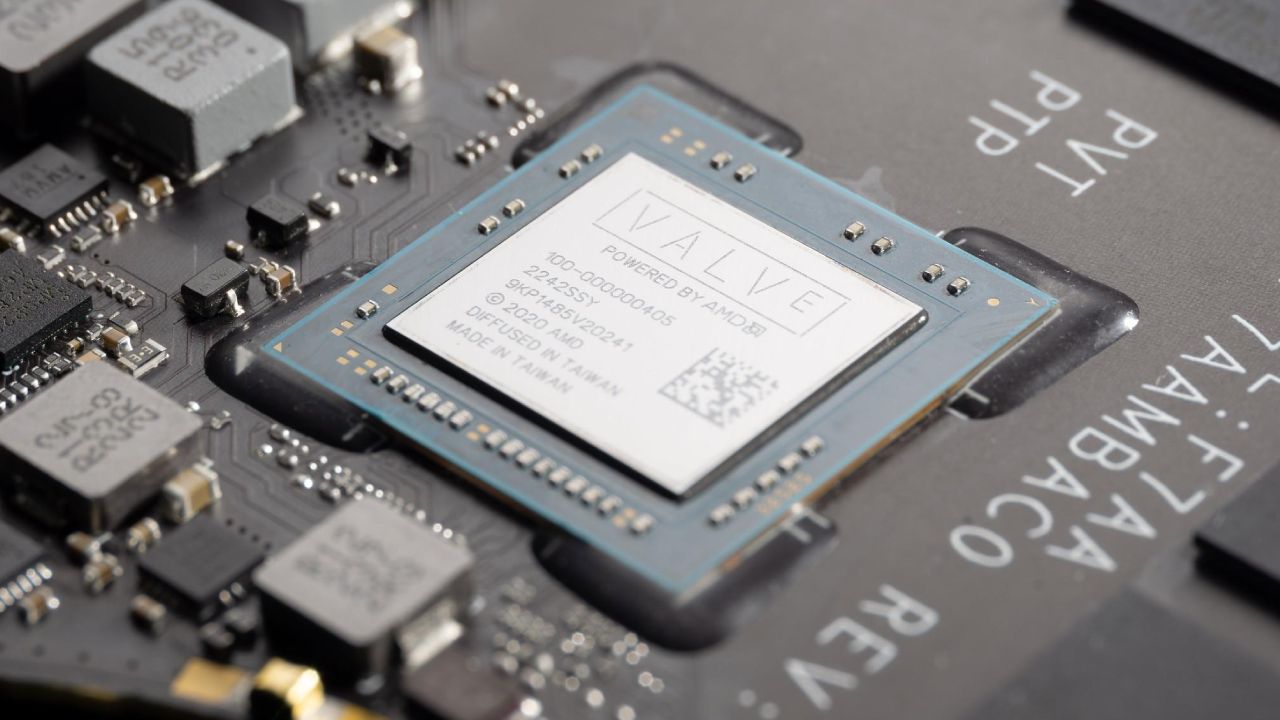
Steam Deck 2’s Rumored Chip
The information being discussed now lines up with what was heard back in February. Initially, the chip was reportedly set to have 16 RDNA 3.5 CUs, but it has since been reduced to 12. That actually makes more sense given the reported 9600MT/s memory bandwidth.
The expectation is that this design could generally provide around a 2x performance increase within 15W. The numbers suggest it can deliver 3x the performance of the Steam Deck, but that would require significantly more power. It remains to be seen whether that could happen when the device is docked and connected to mains power, assuming the thermal solution can keep up.
Why RDNA 3.5 is Disappointing
The biggest disappointment is that the chip does not appear to be using RDNA 5. RDNA 5 would provide significantly better ray-tracing performance, as well as better teraflop performance and memory bandwidth. We can do more with less memory bandwidth on RDNA 5.
The rumored chip will still be constrained by memory bandwidth, especially when GPU clocks are pushed aggressively. That makes the situation disappointing, though not necessarily terrible. If Valve can get really good pricing on the chip, perhaps around $700-$800 for the device, the performance could still make sense compared with competing hardware.
Compute and Memory Bandwidth
The original Steam Deck uses 8 CUs at 1.6 GHz with RDNA 2 and LPDDR5 memory running at 5500 MT/s over a 128-bit interface. That provides 88GB/s of memory bandwidth and about 1.638 TFLOPS of theoretical compute.
The rumored Steam Deck 2 chip is expected to feature 12 CUs running at around 3.2 GHz. With 9600 MT/s across a 128-bit interface, it would provide 153.6 GB/s of memory bandwidth, representing roughly a 75% increase in memory throughput.
Actual compute performance is around 4.915 TFLOPS, so Valve could describe it as a 4.9 TFLOPS design. If the GPU were driven to its theoretical limits, it could approach 3x the Steam Deck’s performance. However, that wouldn't happen within the same power budget.
The original Steam Deck has around 53.7 GB/s per teraflop of compute, while the rumored design falls to around 31.3 GB/s per teraflop. That is similar to the balance seen with the Radeon RX 7900 XTX, although that GPU has Infinity Cache. If the rumored chip has some form of cache, the dynamic could change.
.jpg)
Ray Tracing Could Be the Weakness
Ray tracing is where the rumored configuration becomes less exciting, because the chip isn't moving to RDNA 5. On RDNA 2 and RDNA 3, ray tracing accelerators are associated with individual CUs. Going to 16 CUs would therefore have provided a small bump in ray tracing performance, particularly at lower clock frequencies.
Instead, the rumored design reportedly uses 12 CUs to make the die smaller, which is essentially a cost-saving decision. The maximum theoretical ray-tracing performance could be around 4.5x that of the original Steam Deck, but realistically, power constraints could place it closer to the 2-3x range.
That becomes particularly disappointing when compared with RDNA 5, which is expected to deliver an order-of-magnitude improvement over RDNA 2 in ray tracing. The Steam Deck 2 should still benefit from RDNA 4’s machine learning capabilities, reportedly backported to enable hardware-accelerated FSR 4, but it won't get RDNA 5’s newer machine learning capabilities.
Memory Bandwidth is the Real Limitation
The HX370, which is effectively the same GPU configuration as the Z2E, provides a useful real-world example. At 1 GHz, performance is around 28 fps. Increasing the GPU to 1.2 GHz yields roughly a 10% performance increase, while 1.5 GHz reaches around 35 fps.
At 2 GHz, the performance increase is minor, indicating that the system is becoming bandwidth-bound. Pushing the GPU to 2.5 GHz can actually reduce performance because it consumes more of the 35W power budget, leaving less power for the CPU, uncore, and memory controller.
Forcing the GPU to 3.1GHz makes the problem even clearer. Package power rises to around 53W, GPU memory drops to 400 MHz, and CPU clocks fall to around 600 MHz. The GPU consumes almost the entire power budget, but reduced memory bandwidth prevents it from delivering proportional performance.
At 2.2 GHz, the system performs much better. GPU memory returns to 1GHz, providing the full 8000MT/s memory speed, while performance reaches around 39-40fps and CPU clocks return to around 2.5-3.2GHz.

What to Expect From Steam Deck 2
The expected result is a clean 2x improvement at 15W compared with the original Steam Deck, using Zen 6 and RDNA 3.5 even without upscaling. With FSR 4 and newer CPU cores, 1080p gaming at around 120 fps could become a reasonable target in some games. When docked, the system could further increase its power limits and clock speeds. A 32GB shared-memory configuration could also provide additional flexibility.
Overall, the Steam Deck 2 could still be a very capable handheld. The lack of RDNA 5 is disappointing, particularly for future ray tracing workloads, but RDNA 3.5, FSR 4, Zen 6, and substantially higher memory bandwidth should still deliver a major upgrade. If Valve can keep pricing competitive, the compromises may be much easier to accept.
Senior Editor, NoobFeed
Latest Articles
No Data.