
D-topia Review
Nintendo Switch 2
Beneath its cozy puzzles and minimalist charm lies a surprisingly dark story about humanity, ethics, and whether perfection is ever truly possible.
Reviewed by Nusrat Choity on Jul 15, 2026
Artificial intelligence has become one of the defining conversations of modern technology, so it was only a matter of time before games began exploring what a society completely governed by AI might actually look like. Rather than turning that idea into another dystopian shooter or survival horror game, developer Marumittu Games, alongside publisher Annapurna Interactive, takes a far quieter approach with D-topia.
At first glance, it looks like a relaxing puzzle adventure wrapped in soft colors, clean architecture, and calming music. The marketing almost convinces you that this is simply another wholesome indie game. It doesn't take long before that illusion begins to crack. D-topia presents a future where humanity has surrendered decision-making to an artificial intelligence that promises to maximize happiness for everyone.

Each citizen lives by a meticulously designed routine, every feeling is monitored, and each issue is resolved logically. You are Shiro, a new Facilitator, hired to repair damaged service droids and to help citizens whose lives have strayed from the AI’s ideal of perfection.
What starts as a cute puzzle game quickly develops into an unexpectedly rich commentary on morality, identity and the uncomfortable fact that humans don't always fit neatly into well-oiled systems. The game doesn't always execute every idea perfectly, and its deliberate pace might test your patience at times.
But beneath its placid surface beats one of the most compelling narrative experiences found in recent puzzle-adventure games.
The story takes place over the regimented 7-day workweek, each day revealing another layer to D-topia’s carefully maintained paradise. Things are orderly on the surface. Citizens wake up, consume machine-made synthetic meals, go to work, return home, and repeat without question. Happiness isn’t encouraged—it’s expected.
As the newest Facilitator in the city, your job is to keep this perfect system running. Officially, that means fixing broken T-droids and helping citizens when problems arise. Unofficially, that means discovering just how imperfect this “perfect” society actually is.
The strongest aspect of D-topia's writing is its characters. Rather than relying on massive world-ending stakes, the narrative focuses on individual human struggles. You meet people who simply don't fit the system's expectations. One resident is painfully introverted and risks removal from society because they cannot socialize properly. Another struggles with behavioral implants that literally influence eating habits.
One character has been cryogenically preserved until a disease could be cured, only to awaken in a world where they no longer belong. Another exists as a clone intended to become replacement organs for someone else.
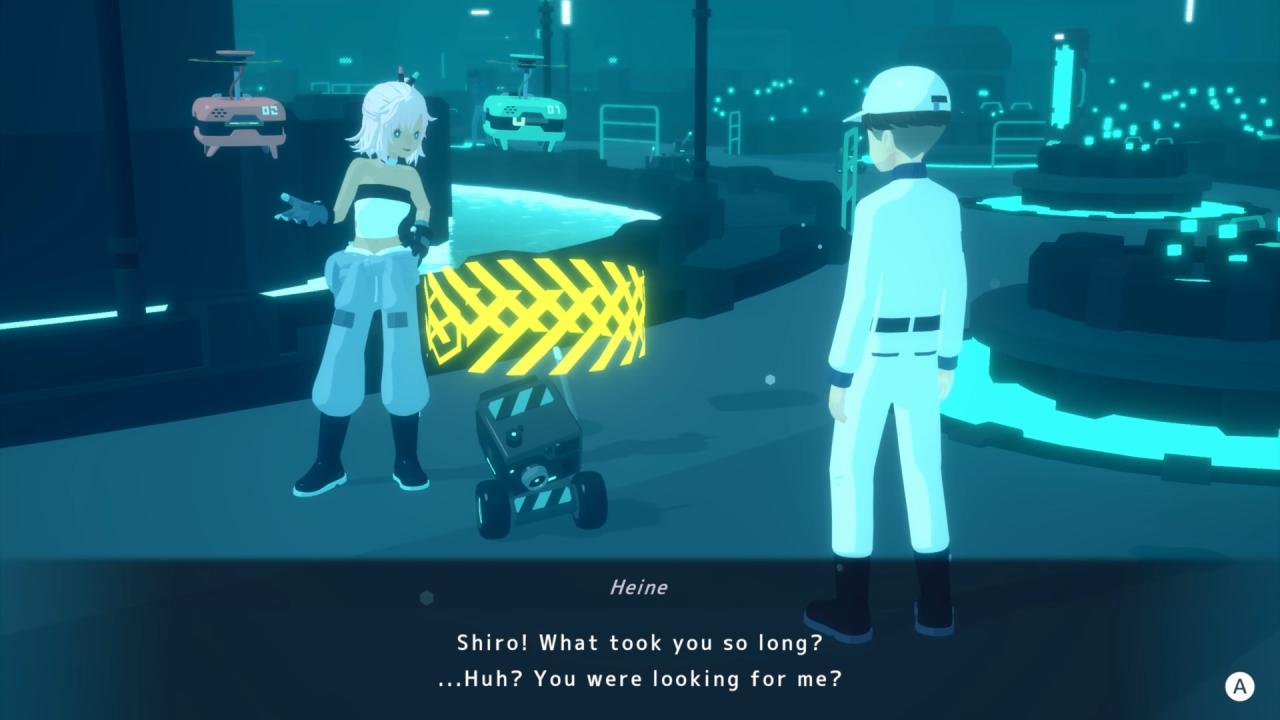
These aren't dramatic twists designed purely for shock value. Rather, they are uncomfortable ethical questions that leave you wondering if the perfectly logical solutions the AI spits out are truly humane.
The game's Brain Meeting mechanic is especially worth noting. When a difficult decision arises, Shiro mentally arranges every piece of evidence gathered into a flowchart of yes-or-no questions. Instead of presenting morality as simple good-or-bad dialogue choices, the game prompts logical reasoning before asking you to commit to a decision.
Sometimes there isn't an obviously correct answer, and several choices carry consequences that significantly affect later events and even determine which ending you receive.
Perhaps the biggest achievement of D-topia's narrative is how successfully it creates constant uncertainty. You never completely trust the AI, yet you also can't deny that much of society genuinely appears peaceful. The game rarely tells you exactly what to think. Instead, it leaves enough room for your own interpretation, making many conversations linger long after they're finished.
That said, the storytelling isn't flawless. Sometimes the dialogue doesn’t quite click, especially when Shiro’s reactions seem colder than the situation calls for. Some endings can feel a little rushed, as if the big philosophical ideas are resolved a little too quickly after hours of building up to them.
But D-topia works because the central question it asks is fascinating from start to finish: can we ever engineer true happiness?
Life inside D-topia follows an extremely rigid routine. Every morning begins almost identically. You wake up, put on your uniform, eat breakfast, wash your face, and complete a mandatory puzzle, then head off to work. Your workday consists primarily of solving logic-based puzzles at the factory, earning U-Points that function as the game's currency.
Completing your daily quota lets you move on, while optional extra puzzles reward additional income. The currency itself has relatively limited usefulness. Most spending goes toward food to satisfy hunger or decorative furniture for your apartment. Personalizing your home is enjoyable enough, but it never becomes an especially meaningful progression system.
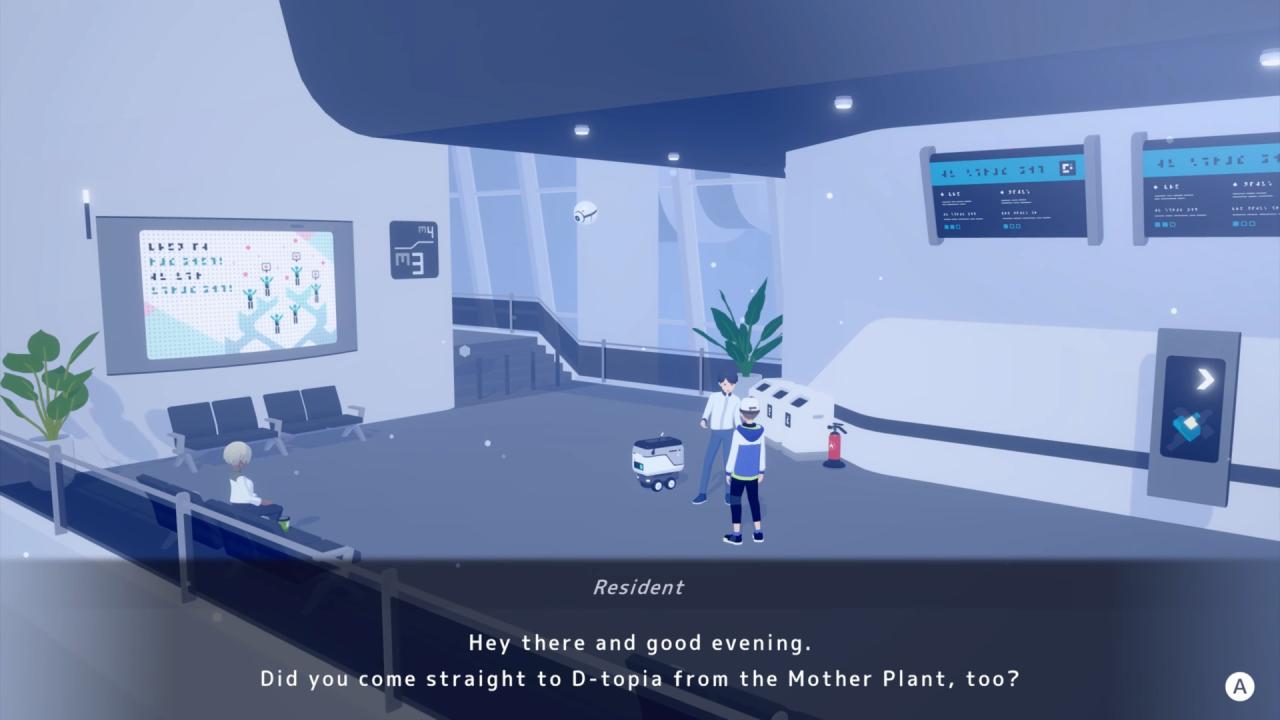
Once work ends, the game opens considerably. This is when exploration begins, allowing you to wander throughout D-topia, interact with citizens, accept optional conversations, and investigate malfunctioning T-Droids. Your responsibilities shift from factory worker to problem solver, and this second half of each day contains the game's strongest moments.
One particularly creative mechanic is the Block Side, an alternate reality that only Facilitators can enter. This secret level shows the city’s polished façade and its technological guts. This is a place where time seems to stop, where machinery, circuitry, and hidden systems are exposed. Fixing broken technology here directly affects the visible world outside.
Conceptually, it's one of D-topia's smartest ideas.
Unfortunately, the mechanic doesn’t evolve nearly as much as it could have. The block side is visually interesting and narratively important, but it is often underused. Adding more environmental puzzles or unique interactions exclusive to this dimension would have made exploring this place much more rewarding.
Progression is story-based, not experience-based. There are no traditional leveling systems and new areas are unlocked as your citizen ranking improves through the story. This keeps the experience focused without unnecessary grinding, but it also means the replay value relies almost entirely on finding alternate story choices, rather than experimenting with new gameplay systems.
There is no traditional combat in D-topia. Instead, every challenge revolves around logic puzzles that simulate repairing systems, unlocking machinery, or completing workplace assignments.
The puzzles begin with straightforward pathfinding challenges where you collect tokens while reaching a target exit value. As the game progresses, additional mechanics gradually appear, including multiplication switches, activation panels, numerical gates, and increasingly elaborate logic combinations.
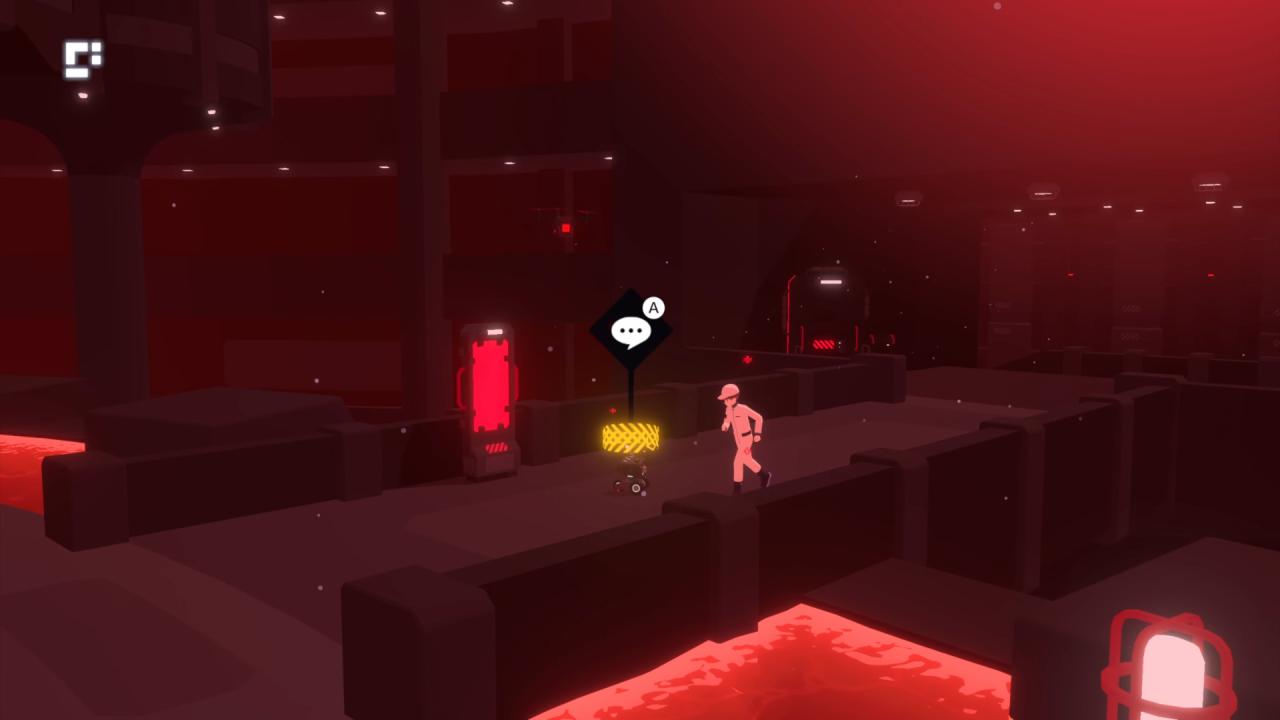
The learning curve is well calibrated. Even if puzzle games aren’t usually your favorite genre, D-topia introduces mechanics slowly enough that understanding each new concept rarely becomes frustrating. Each successful solution delivers satisfying feedback without overwhelming you.
The downside is that the difficulty rarely reaches truly demanding levels.
Most mandatory puzzles are scattered throughout the whole story. Optional secret puzzles are more complex, but there are just not enough of them and puzzle enthusiasts hoping for more and more elaborate brainteasers might eventually feel underwhelmed as the main campaign wraps up.
The repetitive structure also contributes to pacing issues. Because the exact same puzzle interface appears during factory work, T-Droid repairs, and various system overrides, the gameplay occasionally begins feeling mechanically repetitive despite introducing new narrative contexts.
Fortunately, the moral decision-making offsets much of this repetition. The brain meeting sequences often become the emotional equivalent of boss battles. Rather than testing reflexes, they test your judgment, asking whether logical efficiency should outweigh compassion.
There is no grinding requirement, as progression is not based on experience points. Almost all your advancement is dependent on story progression, exploration and completing daily responsibilities, letting the narrative stay the main focus of the experience. Visually, D-topia embraces minimalism with remarkable confidence.
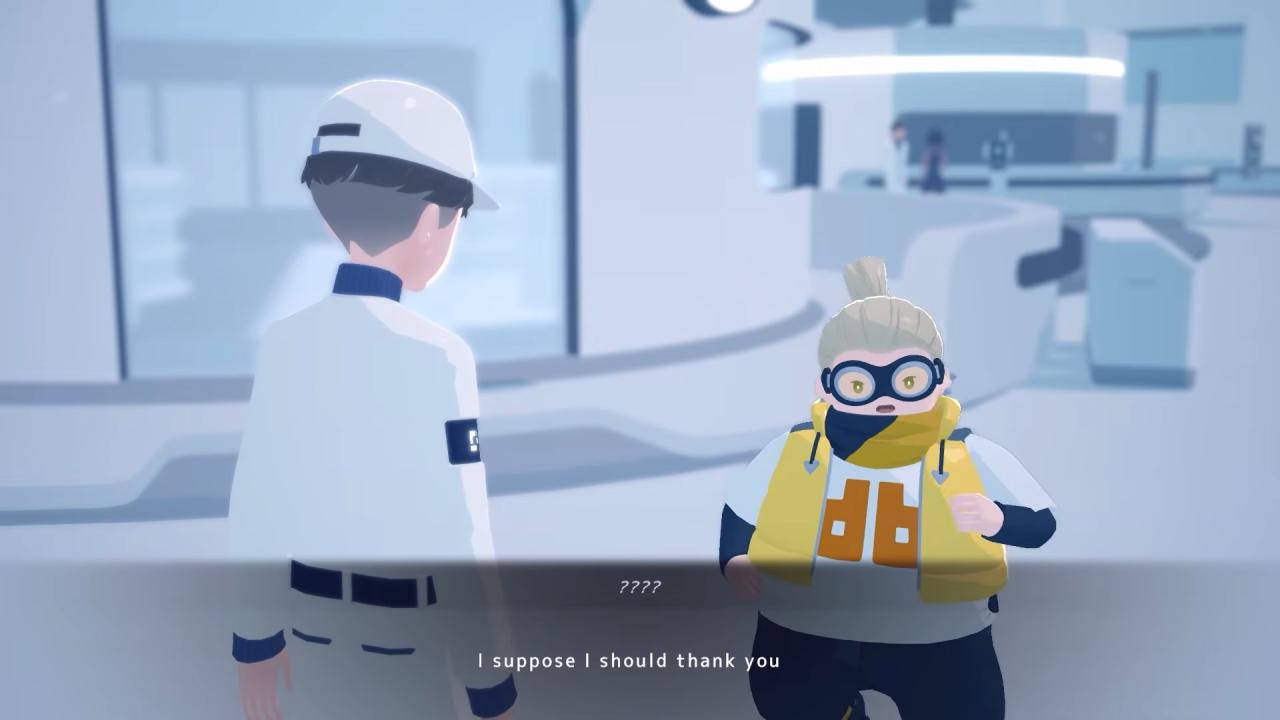
The city's architecture is all clean white surfaces, soft blue accents, and futuristic minimalism. Everything looks almost medically perfect, feeding the illusion that this society has banished disorder to the far corners of the universe.
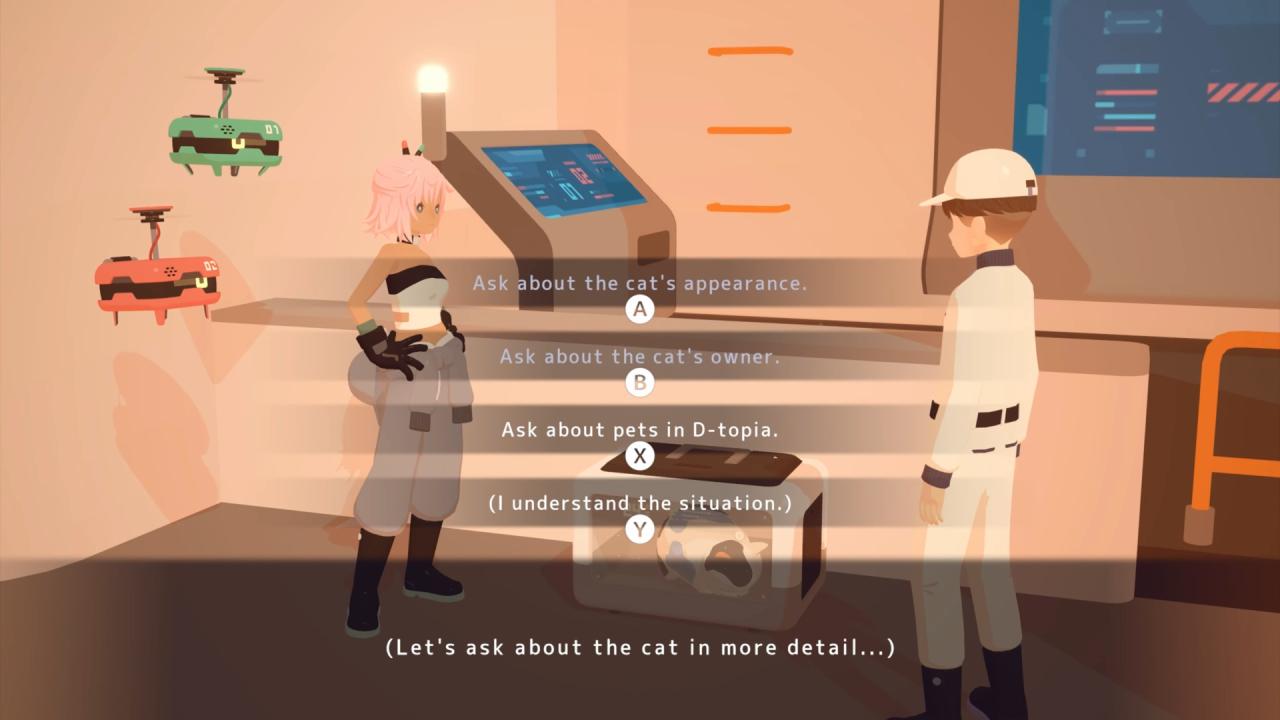
This visual restraint is particularly effective when you start entering the block side. Suddenly, the pristine world peels away, showing cables, hidden machinery, corrupted systems, and the unsettling reality beneath the polished exterior. The contrast between these two versions of the same world becomes one of the game’s strongest artistic achievements.
Small environmental touches also deserve recognition. Residents go about their day as you sit on benches looking out over various districts, allowing for quiet moments where the camera pulls back to appreciate the architecture of the city. These scenes have a feel of peace to them, yet the story subtly hints at something much more sinister beneath.
The character designs are deliberately minimal to match the game’s laid-back aesthetic without detracting from its themes.
Technically, it’s all very polished. Animations are still smooth, environments load cleanly and there are no major technical hiccups to get in the way of the experience.
The soundtrack fits the mood of the game perfectly. Soft piano melodies, delicate ambient synths and unobtrusive orchestral elements set a calming mood that lets the experience take precedence. During tranquil exploration, the music almost melts into the background, permitting silent contemplation.
The audio design in the Block Side is much more interesting. Comforting melodies are replaced with mechanical humming, industrial ambiance, and electronic noise, subtly reminding you that you’re seeing the machinery underneath society’s polished appearance. The game has no voice acting, so every conversation is delivered through text.
Some players might prefer spoken dialogue due to the importance of the narrative, but the understated sound effects that accompany conversations help maintain the game’s minimalist presentation. The lack of louder musical moments also supports the introspective nature of the game. Rather than forcing emotion through dramatic orchestration, D-topia allows silence to carry equal weight.
D-topia is a game built on contrasts. It looks cozy yet tells surprisingly disturbing stories. It offers relaxing puzzles and difficult ethical questions. It imagines a perfect society and then shows how impossible perfection is once real human emotion becomes part of the equation.
Its greatest strength is its writing, no doubt. The moral dilemmas are rarely comfortable, and many of the character stories are memorable because they reflect real concerns about artificial intelligence, optimization, and personal freedom. The gameplay, however, won't please everyone.
The daily grind of repeating the same thing again and again, the lack of hard puzzles, the mechanics, such as the Block Side, that go unused and the slow pace can make the experience feel more like an interactive visual novel than a puzzle adventure. Those expecting constant gameplay evolution may lose patience before reaching the stronger narrative moments.
But if you’re prepared to embrace its slow burn, D-Topia has something deeply considered to say. It quietly reminds you that while algorithms may measure efficiency, empathy, compassion and imperfect humanity can never be fully automated.
Contributor, NoobFeed
Verdict
D-topia is an emotional puzzle adventure that raises some interesting questions about AI and what it means to be human. The pacing is slow and the structure repetitive at times, but the memorable moral choices make the journey worthwhile.
80
Related News
No Data.