
Dancing Line Review
PC
Cheetah Technology brings a nostalgic mobile icon to the big screen, but forgets to leave the mobile baggage behind.
Reviewed by Elme Dhee on Jun 02, 2026
The story of Dancing Line is one of the wildest rides in mobile gaming. Its sudden arrival on Steam is a massive deal for the rhythm community. Originally launched in 2016, it quickly became a global phenomenon. It ruled the golden era of minimalist phone games. It stood out by matching simple taps with beautiful, reactive musical mazes.
But that massive popularity was cut short. In 2020, Google removed the publisher’s entire library due to severe violations of its ad policies. This threw Dancing Line into digital limbo. For years, the game got zero updates. Servers died, and music licenses expired. Fans were left completely in the dark, mourning a lost classic.

Bringing the title to Steam is a massive rescue mission. The original developers teamed up to rebuild and relicense the game as a standalone PC experience. This isn't just a quick mobile port. It tries to turn a casual arcade game into a premium, high-fidelity experience built for a monitor and keyboard.
For old-school players, this release is pure nostalgia. It lets you play classic levels with uncompressed, crisp audio. For new players, it's a perfect entry point into a legendary series. By moving away from a free-to-play mobile setup, the game challenges the notion of how casual titles fit into hardcore gaming spaces. It bridges the gap between phone screens and desktop power.
The PC version makes it clear it isn't just a lazy emulated app. It also isn't trying to be a brutally complex rhythm game like Osu! or DJMax. Instead, it sits right in the middle. It constantly shifts its mood depending on what a track needs from you. That constant push and pull defines the whole experience.
One minute you're drifting through a peaceful piano ballad. You take in the view and click to a gentle tempo. The next second, the game throws you into high-speed chaos. The senses are completely taken over by rapid zig-zags, disappearing paths, and heavy synth tracks. This split identity shapes everything you do. It doesn't always land perfectly due to its messy history, but it creates a rhythm-runner that feels complete yet deeply conflicted.
The game drops you into an abstract journey, proving how much story you can tell without a single word of text.
Dancing Line doesn't have a traditional plot. There are no cutscenes, dialogue choices, or text boxes. Instead, it relies entirely on deeply atmospheric environmental storytelling. The narrative of each level unfolds through the world's shifting geometry and the music's emotional highs.
The game acts as a journey through abstract human emotions and natural landscapes. Take the classic level "The Winter." It starts in a bare, frozen wasteland with a lonely, sad piano melody. As you successfully hit your turns, the world literally builds itself around you. Trees are frozen, geometric blizzards are swirling, and the music turns into a massive orchestral piece. The environment is the storyteller, changing colors, lighting, and shapes to match the song's mood.
This narrative depth gets even better in levels with conceptual themes. “The Desert” and “The Autumn” are maps made in a minimalist style to chart major changes. These maps show the passage of time, the change of seasons, or a descent into chaotic industrial landscapes. In a stage like “The Earth”, the visuals are environmentally themed. The map ranges from bright green fields to dark, metallic, labyrinthine structures.
As the path builds up in real time before your eyes, it feels like exploring a wild world. The line itself becomes the protagonist. It's a lone traveler navigating an ever-shifting, unpredictable universe. Every milestone you hit unlocks a new chapter of visual wonder. By relying solely on sight and sound, the game triggers genuine emotional responses that closely match those of heavily scripted story games.
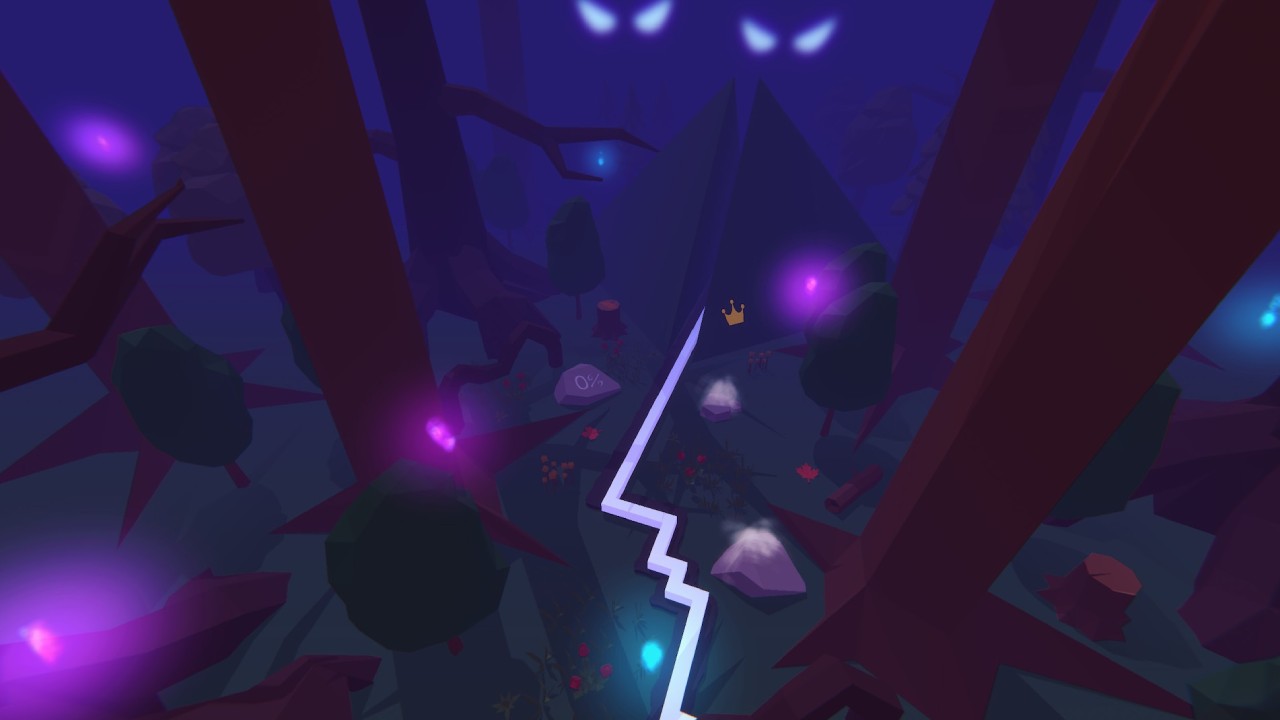
The gameplay forces you to shift between your senses, masking a brutal difficulty ceiling behind a single button.
The core loop of Dancing Line is a masterclass in minimalist design. Its simple mechanics hide an incredibly great difficulty ceiling. You control a single, constantly moving line. It speeds forward through a 3D grid at a fixed pace. There are no directional keys, jump buttons, or camera controls.
You play the entire game with just one input: a mouse click or a keyboard tap. Every single press turns the line by 90 degrees instantly. The line cuts left or right, depending on the path's layout. Your main goal is to guide this line from the start to the final 100% archway without crashing. The room for error is zero. Hitting a wall or turning slightly off the edge means an instant game over.
What sets this apart from standard runner games is how perfectly your clicks sync with the soundtrack. Every single obstacle, blind corner, and crumbling bridge is mapped to a specific beat or note. This creates a flawless mechanical loop. The soundtrack acts as a literal audio blueprint for the level's physical shape.
Early on, you'll rely heavily on your eyes. You try to time your clicks based on the path appearing ahead. But the game intentionally uses weird camera angles, lens flares, and fast-spawning blocks to mess with your vision. To win, you have to stop playing with your eyes and start playing with your ears. You turn your keyboard into a drum. Every successful turn hits a note in the song, locking you into a perfect flow-state.
You will notice immediately how much the game pushes you to replay levels, turning familiar tracks into tight spatial puzzles.
The level design acts as a fast-paced, rhythmic puzzle-solving experience. It puts your spatial awareness and memory to the ultimate test. The real puzzle is figuring out the patterns of the moving world. As your line moves, the terrain constructs itself in real-time. Paths drop from the sky, rise from dark pits, or slide in sideways.
The game sets up intense spatial traps. It uses tight zig-zag hallways that require lightning-fast, back-to-back clicks. It throws deceptive open spaces at you where the safe path is invisible until the absolute last millisecond. You have to learn the developers' visual language. You learn to guess whether a sudden silence in the music means a long straight sprint or a nightmare sequence of tight corners.
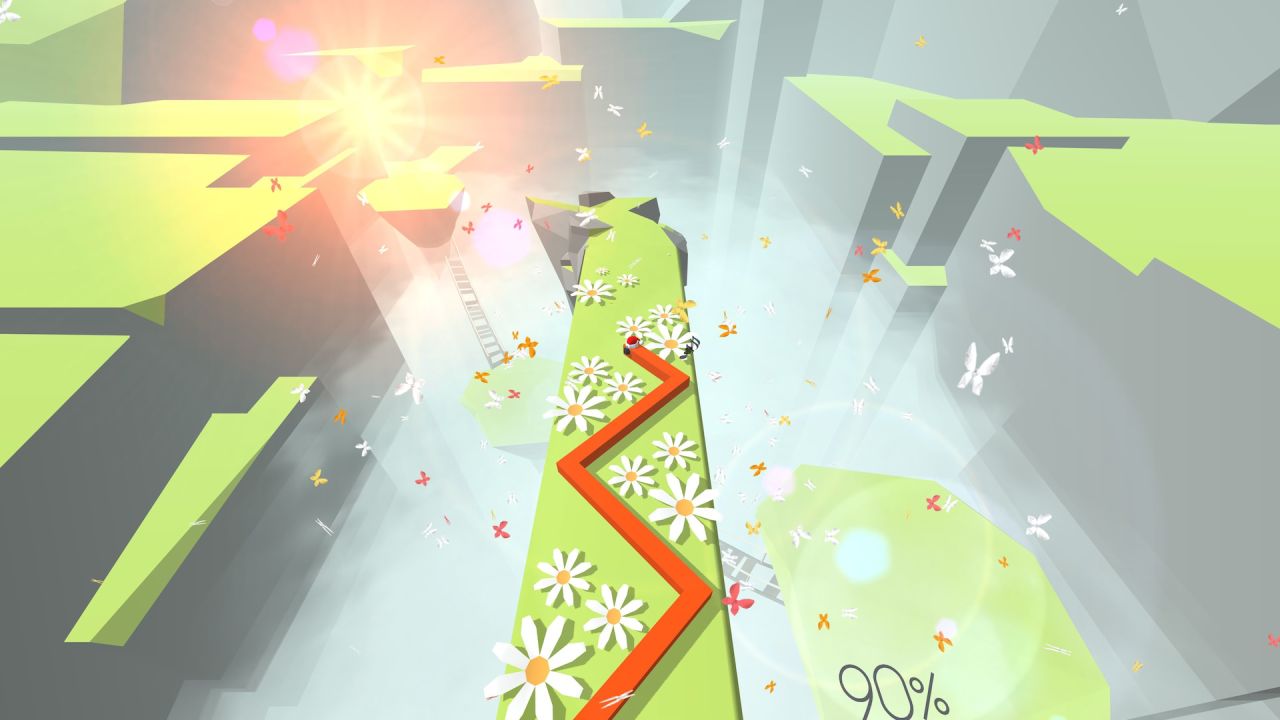
This rhythmic puzzle setup has amazing strengths but also exposes major flaws. On the plus side, the design is incredibly rewarding. It gives you a genuine feeling of physical mastery. Beating a brutal section feels like solving a high-stakes puzzle under a ticking clock. You get a massive rush of dopamine when muscle memory finally carries you through.
However, the dark side of this puzzle mechanic is how much it forces you to rely on trial and error. Many levels feature blind drops or sudden visual blocks. It is physically impossible to react to these on your first try, no matter how insane your reflexes are.
The game often breaks its own rhythm rules just to make things harder. Its odd hurdles or camera-shift routes are obfuscating, forcing you into a vicious cycle of crashing, memorizing the flaw, restarting, and trying again. It can feel deeply unfair to casual players who just want the music to be an honest guide.
Unlocking new maps and skins should be rewarding, but the port brings over a frustrating free-to-play gating mechanic.
Progression systems are supposed to keep a game fun for the long haul, but this is exactly where the Steam port completely fails. Clearing challenges in the main campaign is supposed to unlock new stages, cool cosmetic line skins, and checkpoints. These rewards are designed to make you want to replay tracks to perfect your runs or test your limits on harder modes.
A progression mode should give a game endless replay value. You are supposed to replay these musical maps to completely master them. Instead, the devs made the baffling choice to keep the mobile version's annoying, restrictive stamina system.
You have paid upfront, real money for this game on Steam. Yet, the game still hits you with an artificial energy gate. It limits how many times you can crash before locking you out with a real-world countdown timer. It turns awesome levels into annoying chores rather than fun challenges.
It tests your patience with mobile monetization models rather than your actual rhythm skills. Instead of feeling like an upgrade to a classic, the mobile grind completely ruins your flow state. It forces you to watch your remaining energy instead of letting you play the game you bought freely.
The presentation is surprisingly clean, swapping between simple grids and detailed cinematic views that look great on a big monitor.
The visual side of Dancing Line on Steam is a massive step up from the phone version. It expands the game from a cramped, vertical view to a wide, cinematic landscape. Using a low-poly, minimalist 3D look, the game relies on clean shapes, bright colors, and smooth lighting to build its vibe.

Moving to a native 16:9 widescreen layout changes the game's entire feel. The worlds feel incredibly massive. You can finally appreciate wide horizons, distant buildings, and complex environmental shifts that used to get cut off by phone borders. The engine allows for sharp lines, fluid animations, and neat effects, such as falling leaves in ‘The Autumn’ or glowing crystals in ‘The Earth’.
However, this resolution boost reveals weaknesses in the original art. Many of these maps were built for tiny, low-res phone screens. Stretching them across a massive 1080p or 4K monitor reveals a noticeable lack of detail in the background. Some levels feel empty, hollow, and sterile on a large display. The minimalist look can sometimes cross the line into lazy or unfinished.
On top of that, the PC port has real optimization issues. Many user reviews report bugs in which the game freezes or drops frames when changing resolutions. It also acts up badly if you try to Alt-Tab out of fullscreen mode. While the camera angles are beautifully dynamic, a sudden technical hiccup can ruin a perfect run. The visual port still needs serious work to feel right on PC hardware.
The audio track is the undisputed star of the show, delivering a pristine mix that acts as the game's actual heartbeat.
The best part about Dancing Line has to be its audio design. It has an amazing library of original tracks that are setting a gold standard for the rhythm genre. The game spans a wide range of musical genres, including classical piano solos, massive cinematic orchestral pieces, high-energy EDM, and traditional folk music.
Famous composers and indie artists created tracks that are not just background noise. They are the actual lifeblood of the gameplay. Steam’s audio quality is perfect. It uses uncompressed files that let every sharp piano key, heavy bass drop, and soft violin swell ring out beautifully through your headphones or speakers.
The sound design is legendary for reacting to you in real time; the audio mix shifts as you progress through the level. If you're on a calm, straight path, the music stays light and quiet. The second the path narrows or a massive trap approaches, the music layers in new tracks. It adds heavy drums, urgent strings, or digital beats to warn you that things are getting real.
The sound effects when your line turns, or grabs gems, are tuned to match the key and speed of the current song. It makes you feel like you're playing a live instrument. The only real letdown on Steam is the greedy choice to sell parts of this iconic soundtrack as separate day-one DLC, which feels like a blow since you already paid for the base game.

When the final track ends, you're left with a brilliant rhythm game trapped inside a lazy desktop port.
Dancing Line is at its absolute best when it embraces its unique identity. It doesn't try to be a brutally complex PC rhythm sandbox, but it also isn't a mindless phone runner. It loops beautifully between both worlds, creating an addictive rhythm that feels totally unique in modern arcade design.
You get to experience a mobile classic stretched across a massive desktop monitor. Some moments are slow and careful as you map out the track in your head. Others are loud, chaotic, and lightning-fast. Most sit right in the sweet spot in between. That constant shift in musical themes keeps you hooked, even when the annoying mobile energy gates slow you down.
By the time you finish your session, it's clear this game understands audio-visual harmony better than almost anything else on the market. It bypasses over-complicated mechanics to deliver pure charm, intense tension, and split-second improvisation.
It is an amazing artistic achievement that remains deeply frustrating to play. It is trapped between a brilliant core loop and unoptimized mobile chains. If the devs listen to the community, fix the technical stutters, and delete the stamina limits, Dancing Line could be an essential PC rhythm title. Until then, it's a flawed but beautiful relic, playing an incredible song for a community that desperately wants to love it.
Editor, NoobFeed
Verdict
Dancing Line on Steam is an audio-visual masterpiece held back by its mobile heritage. The music synchronization is pure magic, but technical bugs and a stripped UI keep it from greatness.
70
Related News
No Data.