
Forensics: Crime Scene Detective Review
PC
A systematic forensic simulator emphasizes evidence collection over detective work, providing a believable routine with a good number of interesting mechanics.
Reviewed by Tahmid Mahi on Jul 13, 2026
Forensics: Crime Scene Detective is a niche that few games have explored. Instead of putting you in the shoes of a detective chasing suspects, interrogating witnesses, or piecing together conspiracy boards covered in strings and photographs, it asks you to perform the quieter work that happens after the crime has already taken place.
Your responsibility isn't to solve the mystery yourself but to gather, preserve, and analyze every piece of evidence before handing it over to investigators. Every fingerprint, blood sample, photograph, and digital device you recover is part of a much larger investigation, even if the final conclusions are left to law enforcement and not you.
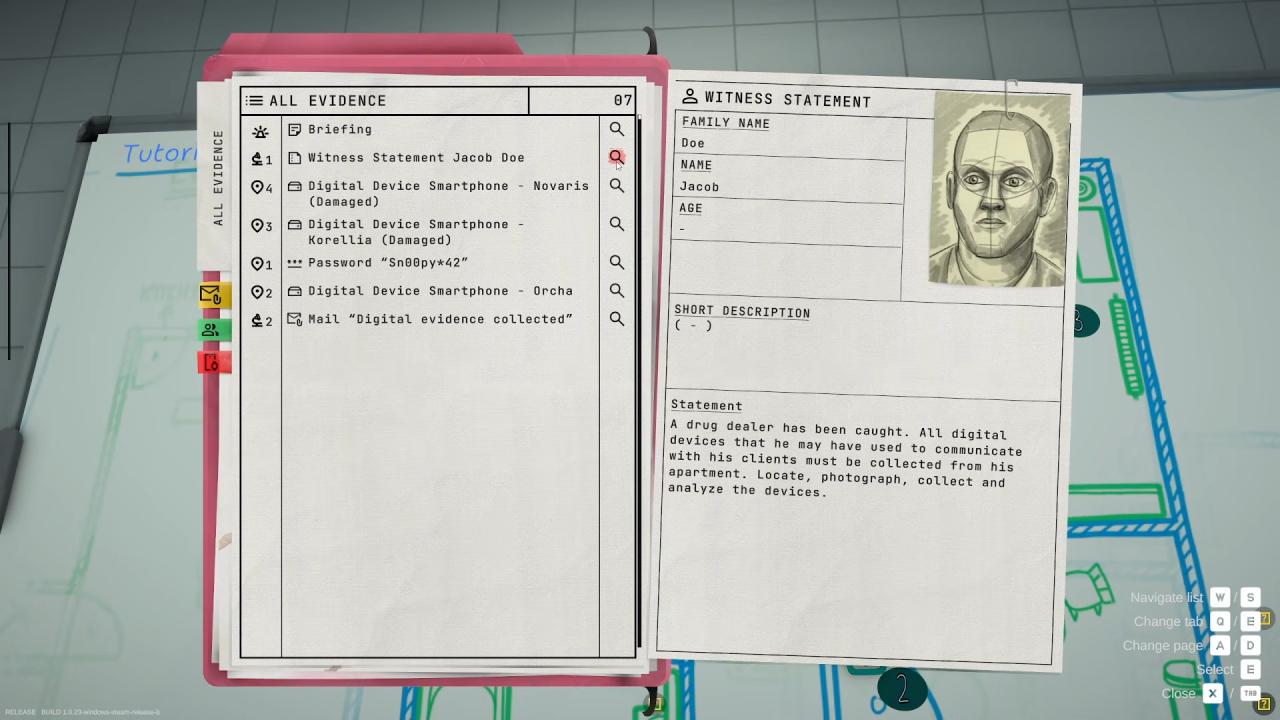
Developed by Binary Impact and Alchemical Works and published by Aerosoft, the game was created in cooperation with Germany's Rhineland-Palatinate State Office of Criminal Investigation. That partnership helped ground its investigative mechanics and forensic procedures in real-world law enforcement practices.
You can tell that they worked together on this whole experience, basing the gameplay on real forensic procedures and tools.
Rather than a pursuit of cinematic moments, the developers are going for authenticity in recreating the day-to-day routine of a forensic investigator. It’s not a sequel, and it doesn’t attempt to imitate the classic detective story. Instead, it discovers its voice by focusing almost exclusively on the science of crime scene investigation.
The narrative takes a deliberately restrained approach. Instead of following one large interconnected storyline, the narrative presents individual cases inspired by realistic criminal investigations. Each assignment sends you to a new location, whether that's an apartment, a hotel room, a basement, or a bar, where something suspicious has happened.
Your task is simply to document the scene, collect evidence, process it back at the laboratory, and send your findings to investigators. The success of every case depends on how well you examine the environment, document your findings, and handle each piece of evidence to maintain its integrity.
That means the story largely unfolds through case files, emails, and responses from law enforcement after you analyze your evidence. You don’t interrogate suspects or accuse anyone of committing the crime. Once your work is complete, detectives and prosecutors will take it from there.
You’ll get periodic updates that explain how your work helped the investigation. Sometimes your evidence points to a suspect; sometimes it clears someone completely. The game keeps reminding you that not every bloody scene is a murder and that appearances can be deceiving.
This design choice is going to split players. If you want shocking twists, memorable characters, and satisfying courtroom-style reveals, you may find the storytelling too distant. If you are a realism fan, however, the game does manage to present the role of a forensic investigator, rather than straying into areas belonging to detectives.
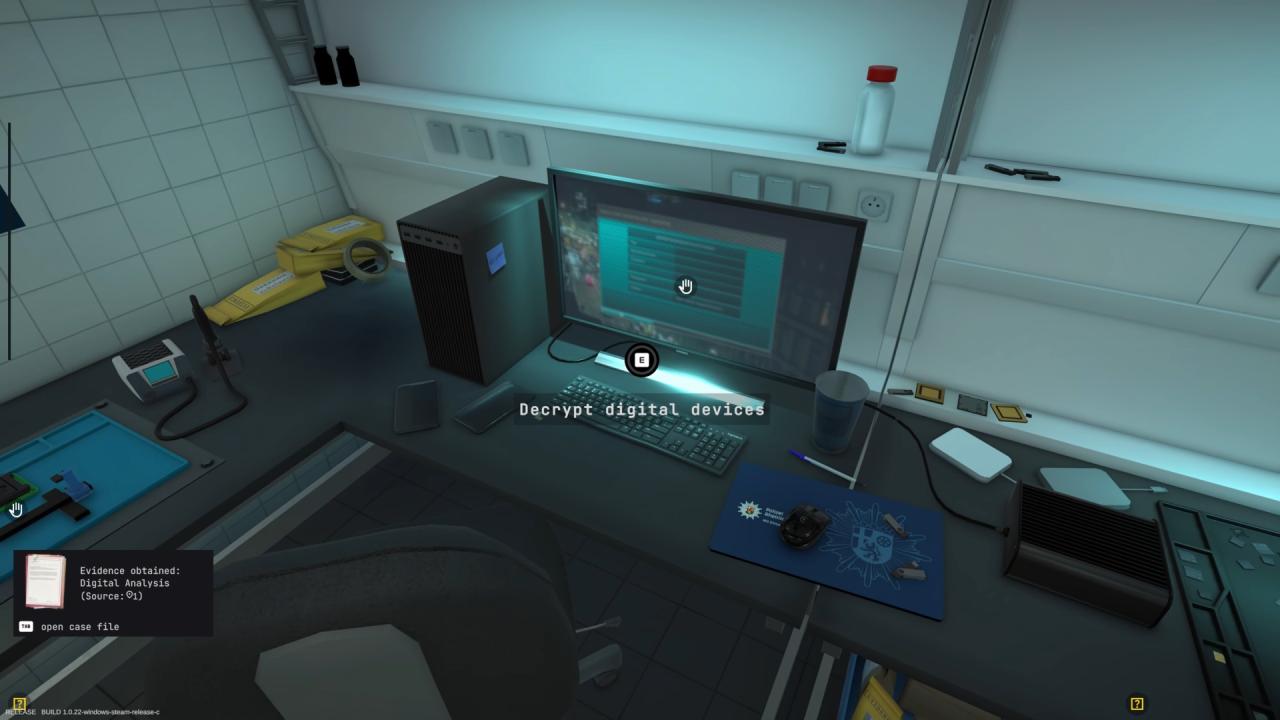
The game is divided into two distinct phases that are constantly feeding into each other.
First, you go to the crime scene, take pictures, and gather evidence. Once your fieldwork is complete, you go back to your forensic lab, where you need to use special equipment to process each item you picked up. Once you have finished both stages, you can submit your results and proceed to the next assignment.
Every investigation starts with selecting a case before traveling directly to the location. At the entrance sits your equipment case, which contains every tool you'll need. Unlike many investigation games, you can only carry one item at a time. That means every action becomes deliberate.
You may begin by scanning the environment, identifying potential evidence, searching for fingerprints with a UV flashlight, placing numbered evidence markers beside important objects, photographing each item correctly, collecting samples, and returning every tool before picking up another. It generates a consistent workflow that reflects real forensic processes, but also requires a lot of backtracking.
Collecting evidence is only one part of the process. Once you return to the laboratory, the game opens up several different forensic disciplines. Blood samples are analyzed for DNA comparisons, fingerprints are matched against known records, damaged electronic devices are repaired to recover stored information, and firearms evidence is examined through ballistic analysis.
Rather than presenting a single investigation mechanic, the game spreads its systems across multiple specialized workstations, making every case feel like a combination of different forensic jobs. Different stations have different processes, so you obtain a better picture of how discrete forensic methods fit together.
As the cases become more complex, the workload increases noticeably.
Early missions isolate mechanics to help you learn them individually, but later investigations combine multiple types of evidence into a single case. You may find yourself cataloging dozens of fingerprints from several individuals while processing digital devices, analyzing DNA, and reconstructing bullet trajectories.
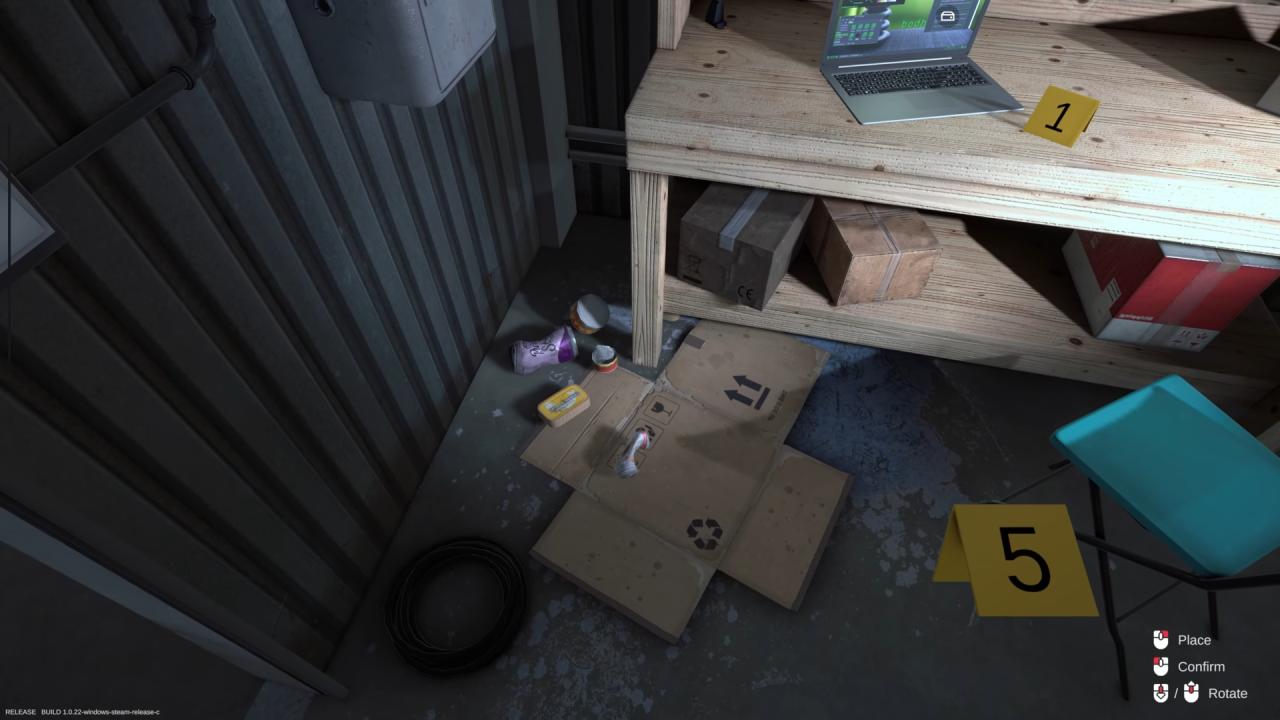
Forensics: Crime Scene Detective rarely tells you exactly what you've missed, which means thorough observation becomes part of the challenge. Not finding a fingerprint or missing a small piece of evidence will affect your final score. Careless handling can destroy valuable evidence forever.
Things start to fall into place, and it feels a little bit slower, but it’s comforting to get into a routine. Every picture is instantly uploaded to your official case file, evidence is systematically organized into reports, and every successful analysis contributes to a growing collection of professional forensic work.
There is no fighting in Forensics: Crime Scene Detective. All challenges are based on forensic procedures, presented as interactive mini-games. Use ultraviolet light to reveal fingerprints, then apply fingerprint powder and carefully lift with adhesive tape. Swabs are taken for DNA samples and later analyzed in the laboratory.
To record the shot, you need trajectory rods, laser alignment, aerosol spray, and cameras in the right positions. Digital evidence includes recovery of encrypted data, removal of damaged memory chips using controlled heat, and information extraction without destruction of hardware.
Some of these are more about precision than speed.
If you overheat a memory chip, you could destroy the evidence forever. If you apply fingerprint powder incorrectly, you could get poor-quality prints. If you rush evidence collection, you could end up with insufficient usable material for proper analysis. Matching fingerprints involves carefully comparing loops, junctions, and ridge endings, not just clicking on a highlighted answer.
These mechanics are some of the game's biggest strengths because they make you feel like you are actually doing forensic work, not solving traditional puzzles. But they also show the game’s rougher edges. Frequent trips back to your equipment case to change tools greatly hinder investigations, especially when documenting multiple pieces of evidence.
Likewise, other environments feature frustratingly restrictive movement, invisible walls, and awkward positioning that make lining up certain tools more frustrating than it should be. Sometimes lighting options are limited, making dark areas difficult to inspect.
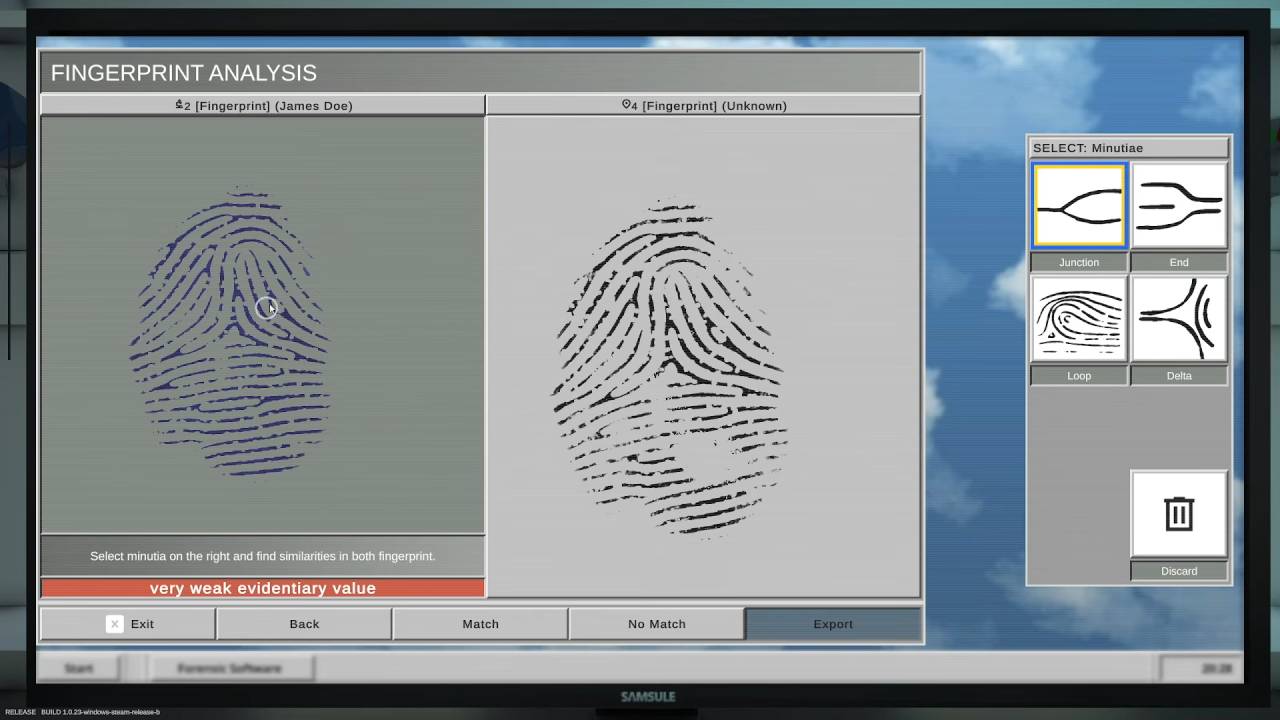
Nor does the Forensics: Crime Scene Detective provide constant progression markers. This approach adds to the immersion by forcing you to look cautiously at every scene, but it can get frustrating when a tiny missed fingerprint stops you from completing a case fully. Some fingerprint-like detailed simulations will appreciate this approach, while others will find the lack of guidance too demanding.
There’s no XP system or character progression in the traditional sense.
Rather than gaining experience points or unlocking new powers by leveling, progress is made by learning more and more complex forensic procedures and taking on bigger investigations. As more mechanics are added, your understanding of the systems is the main way you progress. The key to success is much more about learning the tools than numerical upgrades.
Visually, the game doesn’t aim for spectacle but functional realism. Crime scenes are minimal with little environmental detail and simple lighting. Some places manage to create an unsettling atmosphere in their quiet presentation, but others feel sparse and a bit lifeless. There’s no background activity, and the assets are fairly simple; the lighting is baked.
There are also some technical issues in Forensics: Crime Scene Detective with exploration. Walls are invisible and can interfere with placing equipment, crouching feels constricting, and darker areas sometimes become difficult to traverse because there aren’t enough available light sources. These problems don’t fully disqualify the investigation process but can throw off the otherwise methodical tempo.
Audio provides you with a stronger impression.
The ambient sounds and environmental effects help to reinforce the lonely nature of forensic work. The soundtrack is subtle without being distracting. The tools' interactivity provides satisfying feedback when collecting evidence, making each procedure feel grounded. The sound design is restrained and fits the game's realistic direction, even though it doesn’t try to create heavy horror or thriller elements.
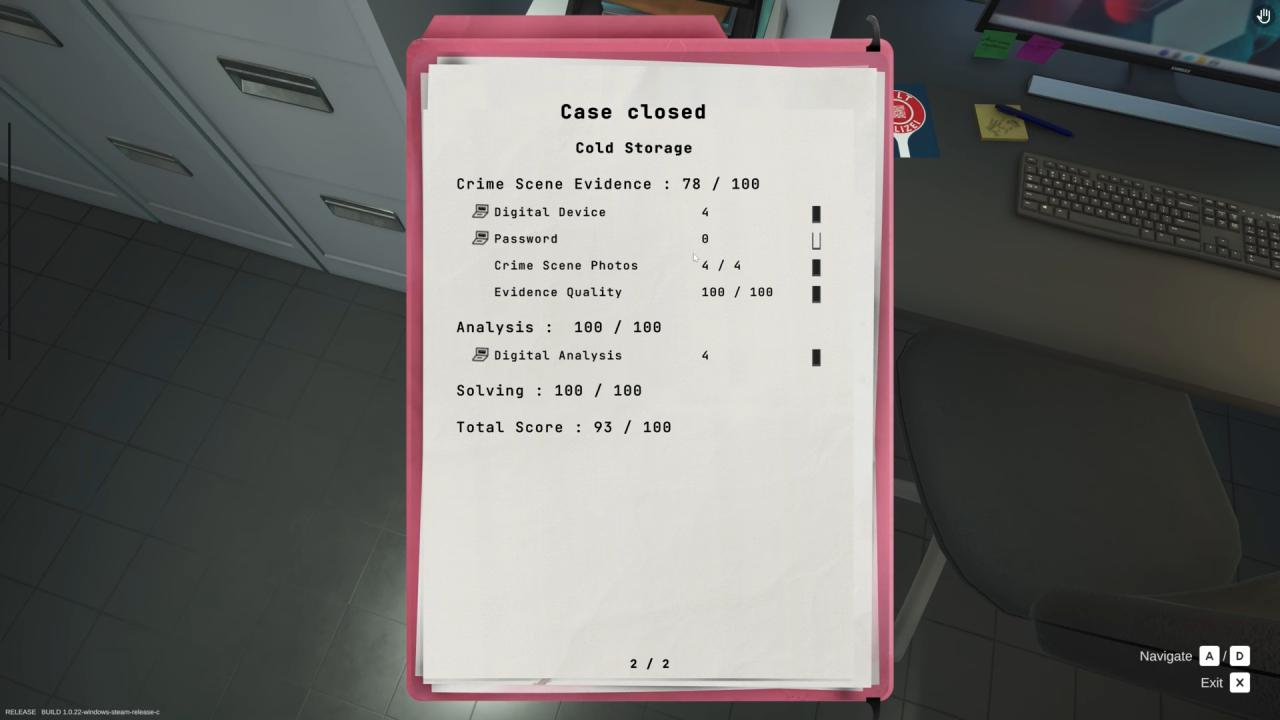
Forensics: Crime Scene Detective remains exactly as it was meant to be. Rather than attempting to be another detective adventure, it focuses on the careful gathering, preservation, and analysis of evidence. This decision gives the game a unique identity within the simulation genre, especially for those interested in realistic forensic procedures.
Once you get into its groove, the detailed mechanics of investigation, realistic lab work, and structured processing of evidence are rewarding. Players seeking a faster-paced mystery may grow tired of the repetitive trips to the tool case, occasional technical frustrations, limited environmental variety, and the lack of traditional detective gameplay.
Forensics: Crime Scene Detective is a refreshing change of pace for those who prefer a slow, methodical simulation that rewards patience and precision rather than action. It's not for everyone out there looking to solve crimes in dramatic fashion, but as a forensic simulator, it largely succeeds in delivering what it sets out to do.
Editor, NoobFeed
Verdict
Forensics: Crime Scene Detective is a simulator that prioritizes realistic evidence collection, not detective drama. It’s a methodical game that rewards your efforts, but the repetitive tool management and technical limitations can sometimes be dull.
55
Related News
No Data.