
Underkeep Beginner's Guide | Tips and Tricks
Game Guide by Amaya on Nov 14, 2026
Underkeep is an old-school, party-based dungeon crawler where preparation, exploration, and tactical combat are essential to surviving your adventure. Whether you're new to grid-based RPGs or want to make your first expedition easier, understanding how to manage your party, conserve resources, and approach battles will make a significant difference.
Build a Balanced Party
One of the first decisions you'll make in Underkeep is creating your party. You can choose four adventurers, each with their own race, class, abilities, and equipment.
Instead of choosing four characters that specialize in the same type of combat, build a balanced team. Different classes bring different strengths, and mixing offensive, defensive, and support abilities will make your party more versatile.
Consider the following when creating your team:
- Frontline fighters: Use durable characters who can withstand incoming attacks and deal damage with melee weapons.
- Ranged attackers: Include characters who can attack enemies from a distance using bows, crossbows, and other ranged weapons.
- Spellcasters: Magic provides additional offensive options and can help your party deal with different encounters.
- Support characters: Healing, defensive abilities, and other useful skills can keep your party alive during difficult battles.
You don't need a character dedicated to every role, but avoid leaving your party without a reliable way to handle different enemy types.
A good beginner-friendly combination is Warrior, Paladin, Wizard, and Voidcaller. This gives you two frontline characters, a dedicated damage-focused spellcaster, and a character who can heal and protect the party. It's also one of the more forgiving starting combinations.
Understand Each Class's Role
Underkeep has seven classes, and understanding their strengths will help you decide how to spend skill points.
- Warrior: A frontline fighter who specializes in physical damage, weapon abilities, taunts, and party buffs.
- Paladin: A defensive fighter who can heal allies, build Zeal through attacks, and deal additional damage to Undead and Demons.
- Thief: A fast melee attacker who specializes in critical hits, evasion, and damage-over-time effects such as Bleed and Poison.
- Ranger: A ranged damage dealer who uses bows and other ranged weapons to attack enemies from the back row.
- Wizard: A spellcaster who uses Fire, Ice, and Lightning magic to deal damage and control enemies.
- Voidcaller: A support-focused spellcaster who provides healing, barriers, debuffs, and useful party buffs.
- Blood Mage: A spellcaster who uses blood magic, Bleed effects, and abilities that consume bones or health.
If you're unfamiliar with RPG character building, start with Warrior, Paladin, Wizard, and Voidcaller. Experiment with Thief, Ranger, and Blood Mage once you're more comfortable with the combat system.
Pay Attention to Your Party Formation
Your party's formation is important because not every character can attack enemies from every position.
Underkeep uses front and back rows. Warriors, Paladins, and Thieves are primarily frontline classes, while Rangers, Wizards, Voidcallers, and Blood Mages are designed to operate from the back.
Keep your melee fighters in front, and your ranged attackers and spellcasters behind them.
One key detail is that characters in the back row normally can't attack with regular melee weapons. Weapons with the Reach property are an exception, but you shouldn't rely on them when building your starting party.
Equip your back-row characters with appropriate weapons, such as bows, crossbows, slings, or magical equipment.
Learn How Turn-Based Combat Works
Combat in Underkeep rewards preparation more than constantly attacking. Each character has opportunities to perform actions during a round, so think carefully about what you want everyone to do before committing.
Here are some important combat tips:
- Focus on dangerous enemies: Instead of spreading your damage across every opponent, concentrate on eliminating the biggest threats.
- Use status effects: Bleed, Poison, Burn, Freeze, and Blind can provide significant advantages during difficult encounters.
- Protect injured characters: Use defensive abilities and healing before an important party member gets knocked out.
- Use special abilities strategically: Powerful skills often consume Stamina, Mana, or other resources. Don't waste them when a regular attack will do.
- Pay attention to positioning: Make sure your frontline characters can handle incoming attacks while your backline provides support.
One important mechanic to remember: once a character acts, your party cannot move again until the round ends. This means you should decide whether you need to reposition or retreat before attacking.
Also take advantage of abilities labeled as free actions. These do not consume a character's normal turn, allowing you to activate them before performing another action.
Save Your Potions for Difficult Encounters
Potions are extremely useful in Underkeep, especially when exploring unfamiliar areas.
Fortunately, drinking a potion or using an item directly from your inventory does not consume a character's combat action. This makes potions particularly valuable because you can restore health or replenish resources without sacrificing an attack.
However, don't waste your entire supply during easy encounters.
Keep different types of potions available for emergencies, including:
- Health potions for restoring HP.
- Mana potions for replenishing magical resources.
- Stamina potions for physical abilities.
- Cure Poison potions for removing Poison.
Other restorative potions for dealing with status effects.
Check your party's condition before entering a dangerous area. Having a few restorative items on hand can keep an otherwise manageable encounter from becoming a disaster.
Collect Food Whenever You Find It
Food is one of the most important resources in Underkeep because it allows your party to rest.
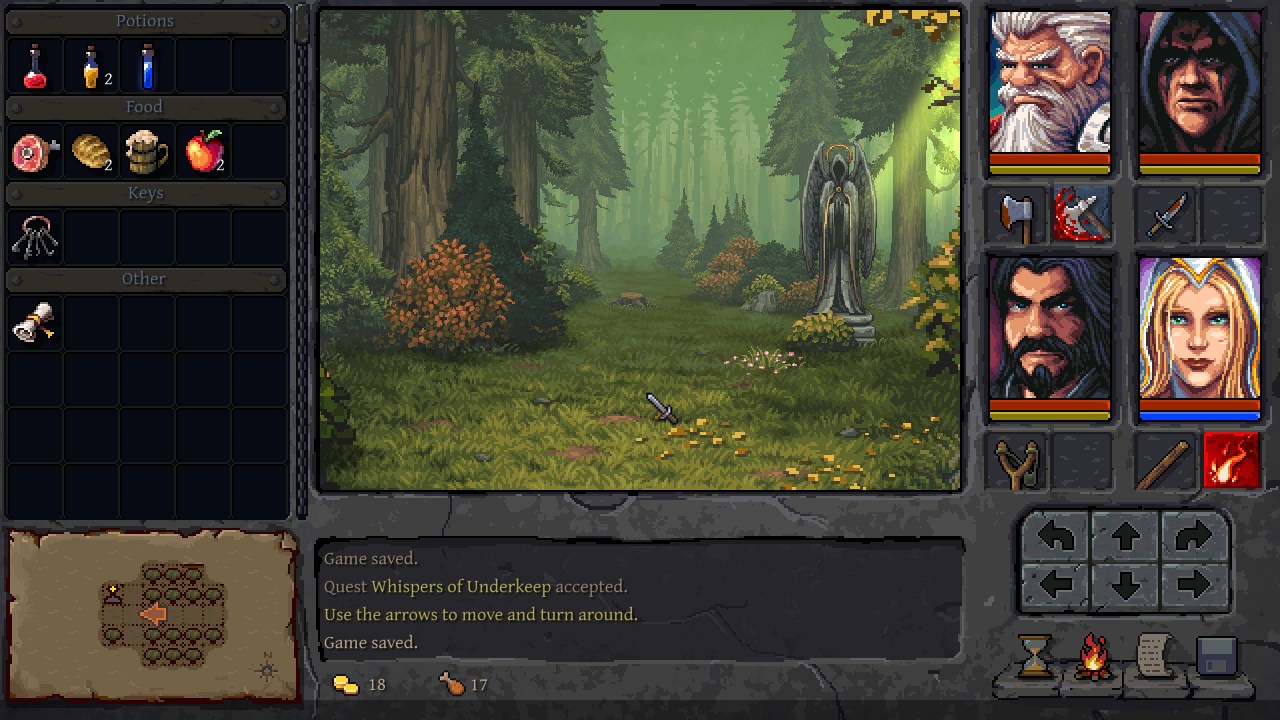
Resting restores HP, Mana, and Stamina for your entire party, but it consumes food. If you run out, you'll lose an important way of recovering between encounters.
Make it a habit to collect every food item you find while exploring. Apples, berries, bread, and other edible items can become extremely valuable when you're running low on resources.
You can also prepare certain meals using the Mortar and Pestle. Cooking stews and toast is another way to make use of the ingredients you collect.
Beginner tip: Don't waste food. Always consider whether you have enough supplies to recover after your next encounter.
Rest Before Difficult Battles
Resting is one of the easiest ways to prepare your party for challenging encounters.
Before entering an area where you expect enemies, check everyone's HP, Mana, and Stamina. If your party is already weakened, consider resting before continuing.
There are a few things you should remember:
- Resting restores resources for the entire party.
- Resting consumes food automatically.
- You cannot rest while enemies are nearby.
- Digging up graves also consumes food.
Resting while affected by Disease wastes food without restoring your resources.
Try to rest before entering dangerous areas rather than waiting until your entire party is nearly defeated.
Explore Every Room and Look for Hidden Secrets
Exploration is a major part of Underkeep. The game features handcrafted dungeons with hidden passages, secret areas, puzzles, and optional encounters.
Don't rush through corridors just because you know where the exit is. Plenty of reasons exist to investigate areas that initially seem unimportant.
Look out for:
- Suspicious walls that might conceal secret passages.
- Garbage piles and hollow trees that can contain hidden items.
- Alcoves and tombstones that may require specific objects.
- Breakable objects that might hide useful supplies.
- Pressure plates and objects you can push to activate mechanisms.
- Locked chests that require additional tools.
If you reach a dead end, inspect the surrounding walls before turning around. Some hidden passages are easy to overlook.
You should also interact with characters and objects whenever possible. Talking to locals can reveal useful information, while interacting with environmental objects may unlock new routes or discoveries.
Use Your Map and Mark Important Locations
Underkeep features an automapping system that helps you navigate its handcrafted dungeons.
You can open the map using M. It displays important locations, including doors, treasures, statues, pressure plates, teleporters, and other points of interest.
The game also allows you to place custom notes on your map. This is particularly useful when you discover something that you cannot access yet.
For example, mark locations containing:
- Locked doors and chests.
- Rocks that require stronger tools.
- Suspicious walls.
- Unsolved puzzles.
- Areas that require specific items.
You can return to these locations later instead of wasting time trying to figure out where you found them.
Activate Every Portal Stone
Portal Stones are extremely useful for traveling between previously discovered locations.
Whenever you find one, activate it. Once activated, you can use it for fast travel, making it much easier to revisit earlier areas.
This is especially useful when you find a locked chest or inaccessible passage but don't have the equipment to open it.
Instead of forgetting its location, activate nearby Portal Stones and mark the location on your map. You can return once you have the required tools.
Collect and Upgrade Your Equipment
Equipment upgrades are essential as you progress through Underkeep. Stronger weapons and armor improve your characters' effectiveness and make difficult encounters easier.
Regularly check your inventory and compare newly discovered equipment with what your characters are currently wearing.
However, don't automatically equip an item just because it has a higher number. Pay attention to its additional properties, requirements, and bonuses.
Some equipment provides benefits such as:
- Increased elemental resistance.
- Additional critical hit chance.
- Improved evasion.
- Increased damage against particular enemy types.
- Bonuses to specific character attributes.
Also check whether a character meets the requirements for a particular weapon or piece of armor.
Visit merchants whenever you return to a settlement. They can offer useful upgrades, especially when your current equipment starts to feel less effective.
Don't Spend All Your Gold
Gold is a shared resource, so you should think carefully before spending it.
Although buying better equipment is important, always keep some gold available for emergencies.
One particularly important reason to save money is that you can revive fallen characters at Revival Statues. However, reviving them costs gold.
Selling unnecessary valuables, such as certain gems and ores, can help you build up your reserves.
Avoid spending everything on minor equipment upgrades. Having enough money to revive a fallen party member can be much more valuable than purchasing a slightly stronger weapon.
Invest Your Skill Points Carefully
As your characters level up, they receive skill points you can invest in different abilities.
Each character receives one skill point per level, and individual skills can generally be upgraded up to five times.
Read ability descriptions before investing points, because some skills require specific weapons or character levels.
For example:
- Warriors have weapon-specific abilities that work with swords, axes, and maces.
- Paladins build Zeal through successful basic attacks and spend it on powerful abilities.
- Thieves benefit from combining Bleed and Poison with critical-hit abilities.
- Rangers can mark dangerous enemies to increase the damage they receive.
- Wizards can use different elemental attacks depending on the encounter.
- Voidcallers provide healing and defensive support.
- Blood Mages use bones or health to fuel their blood magic.
Beginner tip: Don't invest skill points without considering your equipment. Some abilities require particular weapon types, meaning you might not be able to use them effectively with your current loadout.
Also, remember that active skills and passive skills work differently. Active skills need to be selected in the ability slot, while passive skills provide their benefits automatically.
Use the Mortar and Pestle for Alchemy
Alchemy lets you craft useful consumables using ingredients you discover throughout your adventure.
You can find ingredients such as mushrooms, flowers, berries, and monster parts while exploring.
Once you have the necessary ingredients and recipes, use the Mortar and Pestle to craft different items.
Some useful recipes to look out for include:
- Healing Potions.
- Mana Potions.
- Stamina Potions.
- Cure Poison.
- Frostvein, which cures Burn and Freeze.
- Thunderwake, which cures Stun and Paralyze.
- Mindwell, which restores health and mana.
- Resurrection Potions.
Experimenting with ingredients can also help you discover new recipes. Incorrect combinations fail without consuming the ingredients, so experimenting is relatively safe.
Collect ingredients whenever you encounter them. Having access to different potions can make a significant difference during longer dungeon expeditions.
Final Thoughts
Focus on building a balanced party, learning how different classes work, and managing your food and restorative items. Take your time exploring each dungeon, activate Portal Stones, and mark locations that you cannot access immediately.
Most importantly, remember that preparation is just as important as combat. A well-equipped party with enough supplies will have a much easier time surviving the dangers hidden beneath Underkeep.
FAQ
Q. How many classes are available in Underkeep?
A. There are seven classes: Warrior, Paladin, Thief, Ranger, Wizard, Voidcaller, and Blood Mage.
Q. Can you change the difficulty in Underkeep?
A. Yes. You can change the difficulty during your playthrough, so you don't need to restart if you're struggling with a particular encounter.
Q. Can you revive dead characters in Underkeep?
A. Yes. You can revive fallen characters at Revival Statues, but it costs gold.
Q. What is the best beginner party in Underkeep?
A. Warrior, Paladin, Wizard, and Voidcaller make a good beginner party. This combination provides frontline defense, healing, magical damage, and support abilities.
Q. Does Underkeep have fast travel?
A. Yes. You can activate Portal Stones and use them to travel between previously activated locations.
Editor, NoobFeed
Latest Articles
No Data.