
Apex Neural Rendering Challenges NVIDIA DLSS With 2.4x Faster Frame Generation
Apex Neural Rendering challenges NVIDIA's DLSS dominance with faster frame generation, reduced memory consumption, and unprecedented cross-vendor GPU compatibility.
Hardware by Masaru Hoshino on Nov 13, 2026
NVIDIA has spent years building a commanding position in AI-powered gaming technologies, with DLSS becoming one of the biggest selling points of its GeForce RTX graphics cards. However, Apex Compute is now attempting to challenge that dominance with a considerably more open alternative.
Its Apex Neural Rendering (ANR) technology promises faster frame generation, significantly lower VRAM consumption, and compatibility with graphics cards from NVIDIA, AMD, Intel, and even Apple.
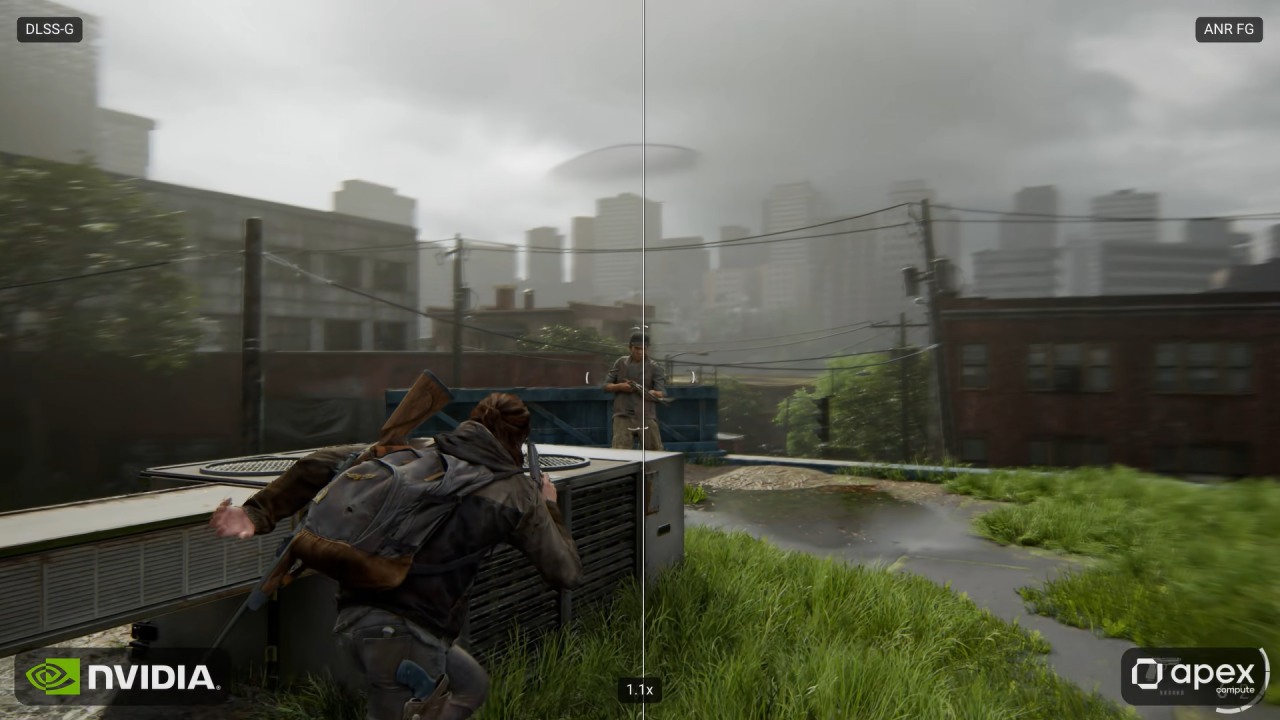
According to a new report and performance data released by Apex Compute, ANR could offer up to 2.4x faster frame generation while consuming 62% less VRAM than NVIDIA's DLSS Frame Generation in the company's internal testing. More importantly, the technology isn't designed around a single GPU manufacturer's hardware ecosystem, potentially opening advanced AI rendering features to millions of gamers with older graphics cards.
Apex Neural Rendering Takes Aim at NVIDIA DLSS
Apex Compute is developing ANR as a three-part rendering suite covering Frame Generation, Super Resolution, and Ray Reconstruction. Rather than concentrating on a single feature, the company appears interested in building an alternative to NVIDIA's broader AI rendering ecosystem.
Frame Generation is the first component to become accessible, currently available in beta through OptiScaler integration. This is particularly interesting because OptiScaler already provides a middleware route for experimenting with different upscaling and frame generation technologies across supported games.
Super Resolution is another part of the roadmap, while Ray Reconstruction remains in training and is expected to arrive later. If Apex can pull off all three components, ANR might be a more full-fledged DLSS alternative rather than just another frame generation effort.
RTX 5090 Benchmarks Show Promising Results
Apex Compute's internal 4K testing on NVIDIA's GeForce RTX 5090 produces some impressive numbers. In 2X Frame Generation mode, ANR reportedly requires just 1.01 ms per generated frame, compared with 1.26 ms for DLSS Frame Generation. That gap widens in 4X mode, where ANR is at 0.61 ms compared to DLSS FG's 0.82 ms.
In some instances, Apex claims it can create frames up to 2.4x faster. However, these results shouldn't be taken as a general advantage across all games or hardware configurations. But frame generation overhead is only one piece of the whole experience, and real gains depend on the rendering workload, the implementation, and the underlying GPU's speed.
The RAM numbers are arguably more interesting. Apparently, ANR uses only 214 MB of VRAM at 4K, while DLSS Frame Generation uses 562 MB. That's about 62% less VRAM, potentially leaving more memory for demanding textures, ray tracing, and other graphical workloads.
Even more surprising, Apex claims its neural network weights occupy only 0.17 MB. That is an exceptionally small footprint for a neural rendering solution, though the model weights alone don't represent the technology's full memory requirements.
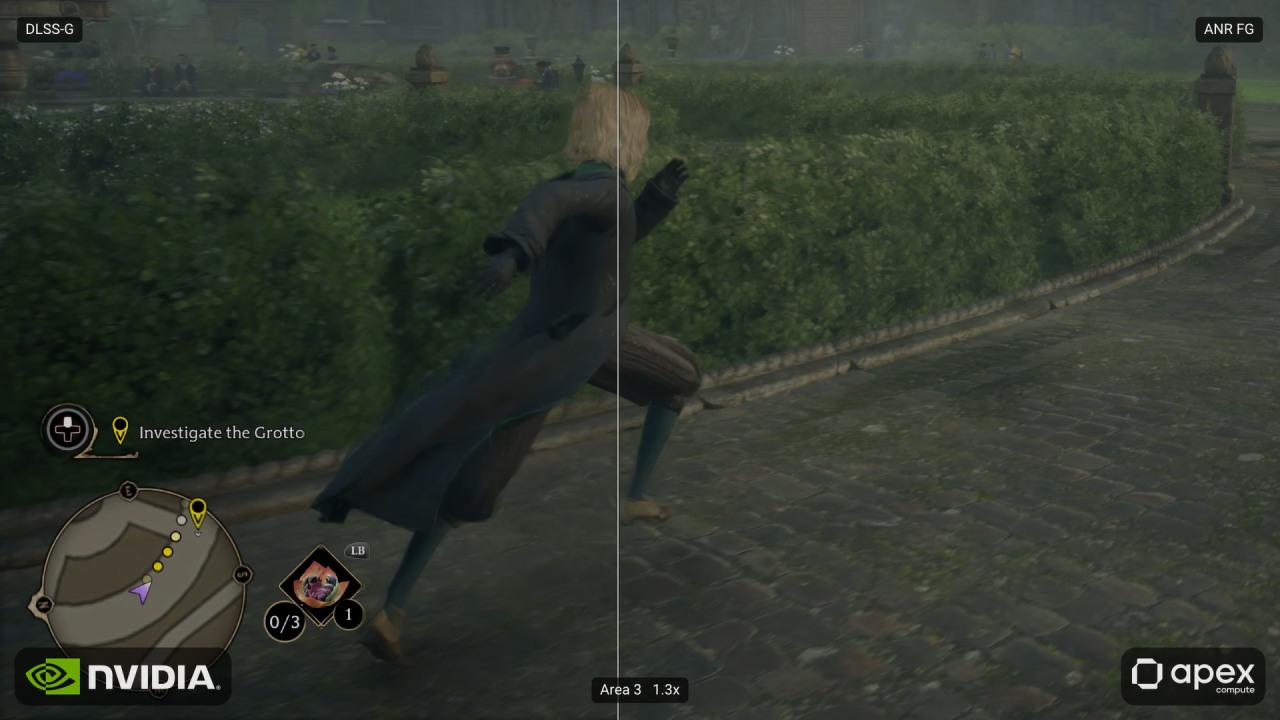
Apex also reports better results across CGVQM-5, ColorVideoVDP, and PSNR video quality benchmarks, with its claimed advantage extending from 2X through 6X multi-frame generation. These measurements are encouraging, but independent image-quality comparisons will be necessary to establish whether those advantages translate into visibly better gaming experiences.
A Lifeline for Older and Handheld GPUs
ANR's biggest potential advantage might not be its performance on an RTX 5090. Instead, it promises to bring modern AI rendering capabilities to hardware that NVIDIA's latest technologies largely leave behind.
Apex claims compatibility with NVIDIA GeForce GTX 16-series and RTX 20, 30, 40, and 50-series graphics cards. AMD support reportedly covers Radeon RX 5000, 6000, 7000, and 9000-series GPUs, as well as the Steam Deck. Intel Arc A-series and B-series graphics cards are also included, with Apple Silicon M1 and newer processors completing the compatibility list.
Support across Windows, Linux, SteamOS through Proton, and macOS would make ANR particularly interesting for gamers outside the traditional GeForce ecosystem. For GTX 16-series owners, this could provide access to frame generation without upgrading their entire graphics card. Radeon RX 5000 and RX 6000 users could also benefit from more rendering options beyond their GPU maker's software ecosystem.
Another potentially big target is the Steam Deck. Handheld gaming often works under severe power, thermal, and memory constraints. A lightweight frame generation method could bring more flexibility, assuming it can keep latency and visual stability within acceptable limits.
FAQ
Q. What is Apex Neural Rendering (ANR)?
A. Apex Neural Rendering is an AI-powered rendering suite developed by Apex Compute to compete with NVIDIA DLSS. It includes Frame Generation, Super Resolution, and Ray Reconstruction, with support for GPUs from NVIDIA, AMD, Intel, and Apple.
Q. How much faster is Apex Neural Rendering compared to NVIDIA DLSS?
A. According to Apex Compute's internal benchmarks, ANR delivers up to 2.4x faster frame generation in specific scenarios. At 4K on an RTX 5090, it reportedly achieves 1.01 ms frame times in 2X mode and 0.61 ms in 4X mode.
Q. Does Apex Neural Rendering use less VRAM than DLSS Frame Generation?
A. Yes. Apex claims ANR uses 214 MB of VRAM at 4K, compared to 562 MB for DLSS Frame Generation, about 62% less.
Q. Which graphics cards support Apex Neural Rendering?
A. ANR reportedly supports NVIDIA GTX 16-series and RTX GPUs, AMD Radeon RX 5000 through RX 9000-series, Intel Arc A-series and B-series, and Apple Silicon M1 or newer. It also targets the Steam Deck and supports Windows, Linux, SteamOS through Proton, and macOS.
Editor, NoobFeed
Gaming Hardware Updates
No Data.