
ADATA XPG Lancer RGB DDR5 6000 Review: Overclocking, Performance, and Gaming Benchmarks
Understand DDR5 6000 memory timings, clock speeds, and latency for optimal performance in gaming setups.
Hardware by Tanisha Aria on Jan 01, 2026
At first, I wanted to say no when ADATA contacted Kit Guru to offer a review of the XPG Lancer RGB DDR5 6000 memory. Lately, DDR5 prices have gone up a lot, making them seem like expensive things that you can't buy.
ADATA, on the other hand, sent a screenshot showing that this DDR5 6000 memory could be overclocked to DDR5 10,000, a significant speed gain. I was interested in the possible outcomes, so I chose to look more closely.
.jpg)
Speed and Timings
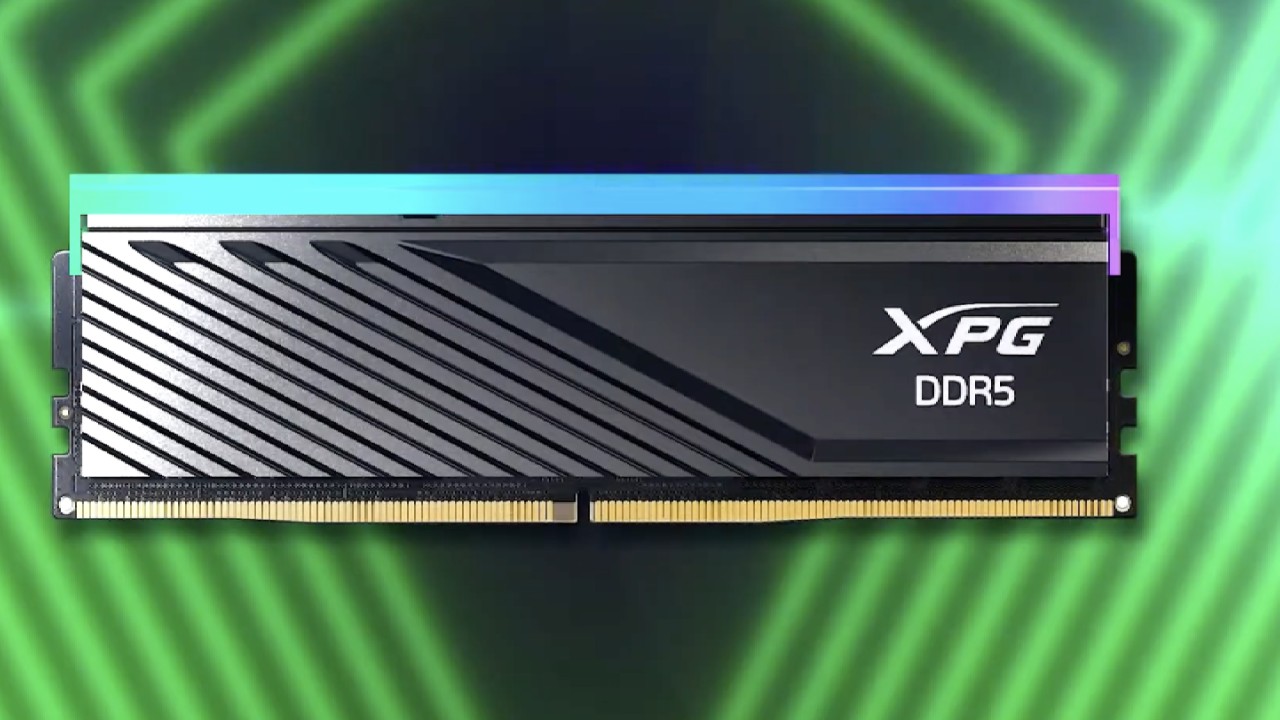
XPG is an ADATA brand focused on gaming and extreme performance. The XPG Lancer RGB DDR5 6000 has a simple, nice-looking design. It might not look like much, but it's still cool. It looks even better when the RGB lighting is on. Important information is on the back of the card. It reads DDR5 6000 CL30 40 40.
For clarification, "6000" in DDR5 6000 refers to megatransfers, not megahertz. It makes 6,000 megadownloads at the actual clock speed of 3,000 MHz. The last three numbers (30, 40, 40) show latency. Here, a smaller number indicates faster, more responsive memory.
The Lancer RGB uses eight SK Hynix MDI chips under the heat spreader, with the PMIC managing power in the middle. The layouts are almost identical to those of a GSkill Trident Z5 Neo DDR5 6000 module. The back is mostly idle, and all of the working parts are on the other side.
The XPG heat spreader is made of metal and has a pad that sticks to itself. On top is a light-bar diffuser, and the thermal pad goes over the memory chips, ensuring the PMIC fits. This system is similar to GSkill's because it moves heat from the PMIC to the aluminum spreader.
The way they look is a little different, but the way they work is mostly the same. The XPG Lancer RGB DDR5 6000 was tested against the GSkill Trident Z5 Neo DDR5 6000 and the GSkill Trident Z5 Royal Neo DDR5 8000 to check their Performance.
Test System and Comparison Setup
We used a Gigabyte X870e Aorus Pro X3D motherboard with a Ryzen 7 9800X 3D CPU, considered one of the best gaming processors, to test the memory. A Fantex Glacia 1360 was used for cooling, and a CIC Vertex GX1200 1200W gold-rated PSU provided the power.
An MSI RTX 4090 Ventus 3X was used as the graphics card. Every memory kit had two channels with two 16GB modules, for a total of 32 GB.
Memory Speeds and Timings Performance
The XPG DDR5 4800 got a score of 17,970 on Geekbench 6 multicore at 1.10V with timings of 40 39 39 77 116, starting with normal settings. When EXPO was turned on, the speed increased to 6000, the times were tightened to 30, 40, 76, and 116, and the score increased to 19,048 at 1.40V.
The AI overclocking tool on the motherboard was used to get the memory up to 6200 without changing the timings. This led to a small boost in score.
At 6400, a wider schedule led to worse Performance, showing that speed alone does not lead to better Performance. As long as it was at 6400MHz, making the times tighter led to a big boost in Performance, and even more gains were seen at 6600 and 6800MHz.
Past 7200 MHz, the returns started to decrease. Optimizing for 7200MHz with tight timings yielded slightly slower results than EXPO at a higher voltage. This shows that a good mix of speed and latency is very important for top Performance.
The performance changes are hard to notice when comparing the GSkill Trident Z5 Neo DDR5 6000 to the Royal Neo DDR5 8000. In terms of raw scores, the GSkill Royal Neo DDR5 8000 is the best. The XPG DDR5 6800–7200 with improved timings is right behind it.
Benchmark Performance
Cinebench 2024 Multicore
The XPG DDR5 7200 with tight timings did very well, beating one DDR5 7200 setting and coming in just behind the GSkill Royal Neo DDR5 8000. In general, a small range of results was observed across different memory settings.
7-Zip's Performance
In memory tests, a loss of data had little effect, but in the compression tests, it showed a greater difference. The XPG DDR5 7200 with tight timings worked better than DDR5 6000 and EXPO settings. This shows that memory timing can make a difference.
AIDA64 Memory Copy and Bandwidth
The XPG DDR5 7200 had the second-lowest memory speed, just above the GSkill DDR5 8000. In memory copy tests, the XPG DDR5 7200 beat the GSkill Royal Neo DDR5 8000, which was not expected. This shows that more efficient times can be better than higher clock speeds.
Gaming Performance
In several games at 1080p and 1440p, including Cyberpunk 2077, Far Cry 6, Assassin's Creed Mirage, and Total War: Pharaoh, changes in memory had a small effect on average frame rates.
The XPG DDR5 7200 with tight timings often placed second and reduced 1% low FPS by 4 to 6 frames compared to EXPO settings, which can make a big difference in how smooth the game is. The XPG DDR5 6000 EXPO worked well, but the standard DDR5 4800 seemed much slower.
Pricing Considerations
The memory price still changes all the time. In November, when we first looked into XPG Lancer RGB, a similar Lancer Blade RGB kit on Amazon cost £200. Prices have been rising very quickly today. In the United States, a 64GB DDR5 6400 kit costs $670, so memory is expensive. For 64GB sets, high-performance DDR5 kits are almost $2,000.
RGB Lighting
The XPG Lancer RGB lighting looks good and is similar to the GSkill Trident Z5 Neo RGB. However, the memory from GSkill Trident Z5 Royal Neo or Corsair Vengeance RGB has fancier lighting that the XPG Lancer RGB can't quite match.
Final Thoughts
With SK Hynix MDI chips, the ADATA XPG Lancer RGB DDR5 6000 delivers high speed and reliable performance. Overclocking can give you a little more Performance, but EXPO settings will give you stable speeds right out of the box. Its main problem is its price; it is too expensive for most buyers at current market prices.
If you have to pay retail prices right now, almost all DDR5 options are too expensive, which is why we rate them badly in that context. But if you can get the kit at a good price, around $150–$200 for 32GB 6000, it's a good buy. It rates an 8 out of 10 for speed and value. When optimal, memory performance is great, but timing and speed must be in sync for the best results.
Also, check our other hardware articles:
- AMD Ryzen 9 9950X3D Review: Setting The Standard For 2025 Gaming CPU
- Amazon Luna 2025 Review: Is Prime Gaming's Cloud Service Your Go-To For Casual Fun?
- AMD RX 9070 XT Review: AMD's RDNA 4 Champion for 1440p Gaming
- GeForce Now Ultimate: Ditching Your Gaming PC For Cloud RTX 4080 Power?
- NVIDIA GeForce RTX 5080 Review (2025): Still A 4K Gaming Powerhouse?
- Intel Core Ultra 9 285K Review And Performance Breakdown (2025)
- AMD Ryzen 7 9800X3D Review: 3D V-Cache Goes God Mode with Stunning Gaming Performance
- Intel Core Ultra 9 285K vs AMD Ryzen 7 9800X3D: In-Depth Gaming Performance and Benchmark Comparison
- NVIDIA GeForce RTX 5080 Super Performance In Cyberpunk 2077: Path Tracing & DLSS 4.0 Tested
- AMD Radeon RX 9070 XT In Cyberpunk 2077: Ray Tracing & FSR 4.0 Tested
- Intel Arc B580 Review: The $250 GPU Revolutionizing 1440p Gaming
- Intel Arc B570 Vs. B580: Value, Specs, And Real-World Gaming Performance
- RTX 5090 Laptop Vs. M4 Max MacBook Pro: Ultimate Raw Performance Vs. Battery Endurance
- Intel Arc b580 Vs. RTX 4060: Game Performance And Value Analysis
- RTX5090 Hell Is Us Demo 4K Ultra Benchmark: DLSS Vs. Native Performance Guide
- NVIDIA RTX 5070 Review: Mid-Range Muscle or Marketing Hype?
- Nintendo Switch 2 Review: Handheld Performance, Features & Value Breakdown
- RTX 5070 Ti Review: Performance, Thermals & Power Efficiency Tested
- Samsung Odyssey OLED G81SF Review 2025: Ultimate 32-Inch QD-OLED Gaming Monitor
- AMD RX 9070 Performance Review: Thermals, Clocks, and Real-World FPS
- AMD Ryzen 5 7600 Review: Best Budget Gaming CPU of 2025?
- AMD Radeon RX 7800 XT Review: RDNA 3 Power For Midrange Gaming
- Asus ROG RTX 5090 Astral OC Vs. Founders Edition: The 4K Gaming Benchmark
- Intel Core i5-13400F Gaming Performance: Still Worth It in 2025?
- ASUS GeForce RTX 5090 LC Liquid Cooled GPU Review: Unmatched Silence & Speed
- ASUS ROG Ally X Handheld Review: Double the Battery, Double the Comfort
- Lenovo Legion Go S Review: The Ultimate Steam Deck 2 Alternative
- Sapphire NITRO+ AMD Radeon RX 9070 XT Review: The Ultimate 4K Gaming GPU
- Alienware 16 Area 51 Review: The Ultimate 2025 Gaming Laptop
- Alienware Area-51 Review: Unmatched 4K, Thermal, and Acoustic Performance
- AMD Ryzen 7 7800X3D: Delivers Gaming Performance Far Beyond Expectations
- AMD Ryzen 9 7900X Review: Powering the AM5 Era with DDR5 & PCIe 5.0
- Intel Core i9‑14900K vs. AMD Ryzen 7 7800X3D: Power Profiles & Gaming Benchmarks
- Intel Core i9 14900K: Specs, Benchmarks, and Competitor Comparison
- ASRock Radeon RX 7800 XT Challenger OC Review: Best Price-to-Performance GPU of 2025
Contributor, NoobFeed
Gaming Hardware Updates
No Data.