
AMD Strix Halo Challenges NVIDIA RTX 5090 With 128GB Shared Memory
AMD's Strix Halo architecture combines powerful integrated graphics and massive shared memory to challenge the traditional need for dedicated GPUs.
Hardware by Masaru Hoshino on Nov 10, 2026
For decades, dedicated graphics cards have been the gold standard for high-performance computing, pushing demanding games, professional applications, and artificial intelligence tasks. AMD, however, is challenging this established approach with its Ryzen AI Max platform, built on the Strix Halo architecture.
AMD shows that demanding graphics and AI workloads don't always need a separate graphics card, combining powerful integrated graphics with a vast pool of shared memory. The biggest advantage is memory capacity, not raw performance. AMD's latest architecture can run certain AI models that even NVIDIA's flagship consumer graphics card can't fit in its onboard memory.
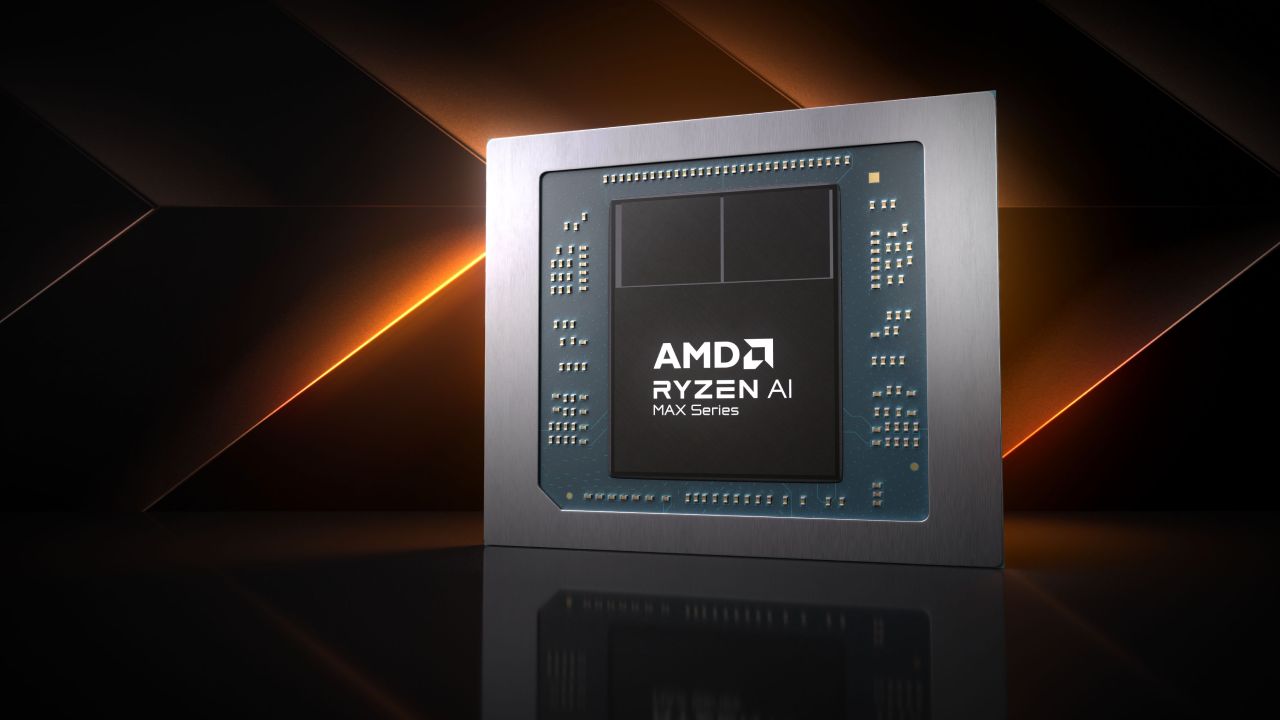
AMD Strix Halo Introduces a Different Memory Architecture
Traditional integrated graphics have struggled because they share relatively slow system memory with the processor while offering limited graphics resources. Dedicated graphics cards don't face this challenge because they have an independent processor and high-speed VRAM. However, its memory capacity is a drawback when demanding applications need more space than it provides.
For example, the NVIDIA RTX 5090 comes with 32GB of VRAM. That sounds substantial, but a 70-billion-parameter AI model compressed to 8-bit precision requires approximately 70GB just to store its weights.
AMD's Strix Halo approaches this problem differently. Announced at CES 2025, the architecture combines up to 16 Zen 5 processor cores, a 50 TOPS neural processing unit, and Radeon 8060S integrated graphics with 40 compute units and 2,560 shader cores.
Its biggest advantage is support for up to 128GB of shared memory connected through a 256-bit interface operating at 8,000MT/s. This delivers about 256GB/s of bandwidth, while Windows can allocate up to 96GB to the graphics engine. Unlike traditional graphics cards, the processor and integrated graphics access the same memory pool without transferring data across PCI Express.
Ryzen AI Max Delivers Impressive Gaming Performance
AMD initially claimed that its flagship Ryzen AI Max outperformed NVIDIA's mobile RTX 4070 across 17 games running at 1080p high settings. Independent testing produced more modest results but still demonstrated impressive performance. Hardware Unboxed measured about 39 fps in Cyberpunk 2077 at 1600p with maximum settings, compared with around 37 fps from a laptop RTX 4070.
Other synthetic benchmarks placed the integrated graphics closer to a laptop RTX 4060. Overall, Strix Halo delivers performance somewhere between an RTX 4060 and RTX 4070 laptop GPU, depending on the game and power configuration.
Its power efficiency is another advantage. The processor runs on a 55W default power budget, though full systems can reach about 120W. By comparison, some gaming laptops with a dedicated RTX 4060 GPU consume around 170W.
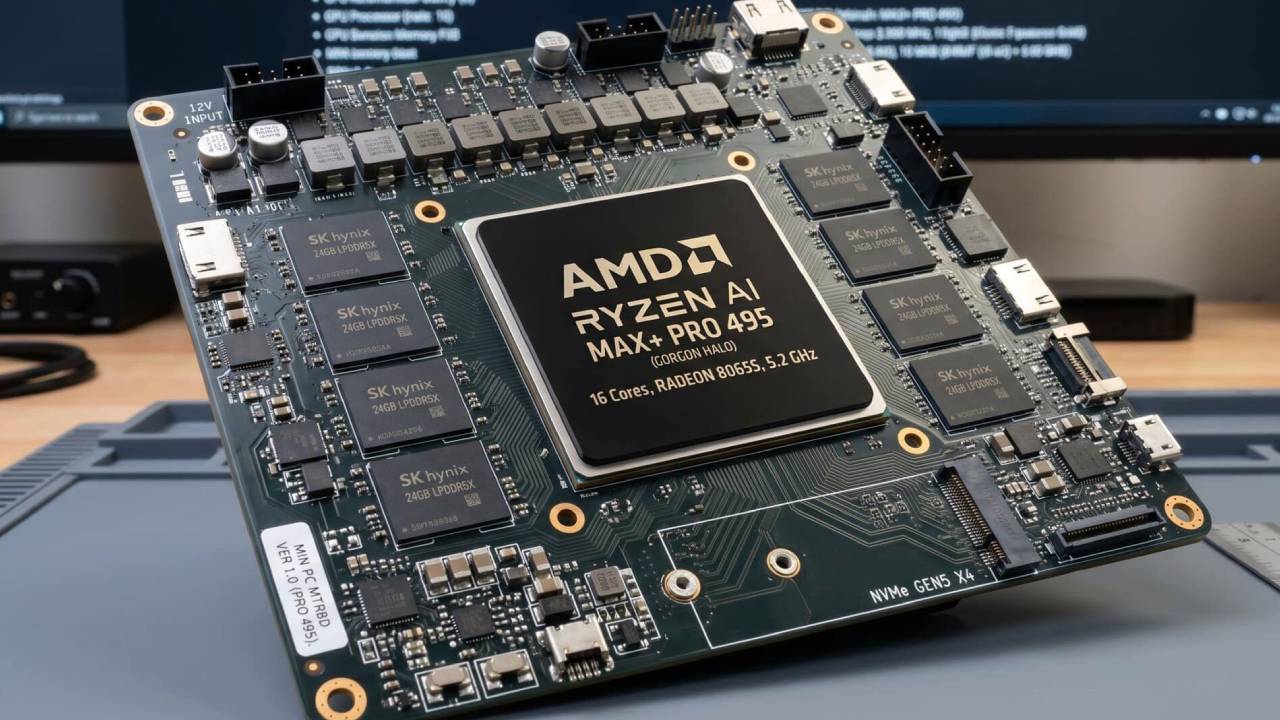
Local AI Models Give AMD a Major Advantage
Gaming is not where Strix Halo becomes particularly interesting. Its shared-memory architecture lets users run AI models that cannot fit in a single consumer graphics card's VRAM. A 70-billion-parameter model requiring approximately 70GB can comfortably operate on a 128GB Strix Halo system. Reviewers have reported generation speeds around 30–35 tokens per second on models exceeding 24GB.
AMD also offers the Ryzen AI Halo developer system featuring a Ryzen AI Max+ 395 and 128GB memory, starting at $3,999. However, dedicated graphics cards remain considerably faster when models fit within their VRAM. The RTX 5090 delivers 1,792GB/s of memory bandwidth, approximately seven times Strix Halo's theoretical 256GB/s.
So, the RTX 5090 still has the edge for speedier AI generation, rapid processing, and heavy graphics workloads. The upside of Strix Halo is that it can run larger models.
Gorgon Halo Could Expand Shared Memory Further
AMD's rumored Ryzen AI Max 400 series, codenamed Gorgon Halo, takes it a step further. Memory capacity grows from 128GB to 192GB, with up to 160GB available to integrated graphics. Memory improvements could also increase bandwidth to approximately 273GB/s. AMD claims the platform can run AI models with more than 300 billion parameters locally.
However, these configurations could be costly due to memory price increases and shortages. The memory is built into the processor package, meaning users can't change it later like traditional desktop components. Another issue is software compatibility. While CUDA, NVIDIA's AI ecosystem, is much more mature than AMD's ROCm platform, some AI applications still require additional configuration.
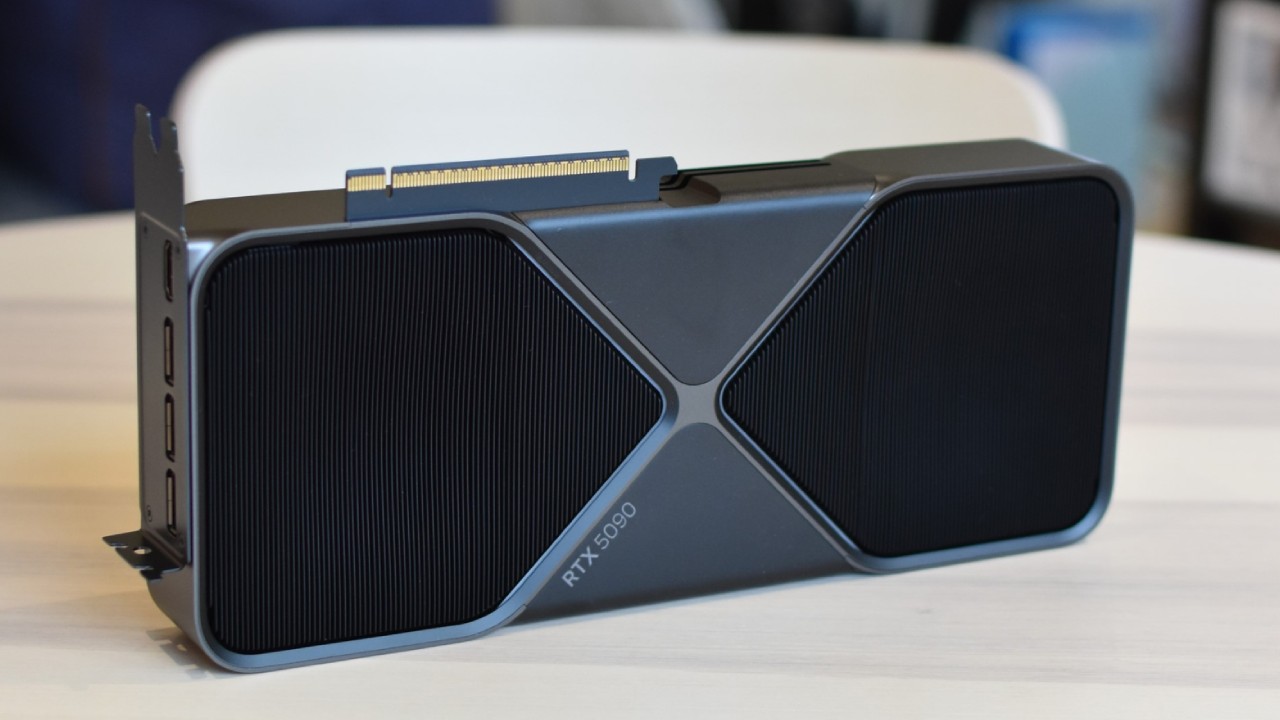
Dedicated Graphics Cards Are Not Obsolete Yet
AMD's upcoming Medusa Halo architecture is rumored to feature Zen 6 cores and LPDDR6 memory, which might provide a large bandwidth boost. These parameters have not been validated by AMD. Ultimately, Ryzen AI Max doesn't replace dedicated graphics cards. NVIDIA GPUs continue to offer the best gaming performance, AI processing and training, and CUDA-dependent applications.
Yet AMD has challenged an idea that has governed PC hardware for about 25 years. Serious graphics and increasingly large local AI models no longer automatically require a separate graphics card. Dedicated GPUs aren't disappearing, but their role could become more specialized as integrated graphics and shared-memory architectures keep improving.
FAQ
Q. What is AMD Ryzen AI Max (Strix Halo)?
A. AMD Ryzen AI Max, codenamed Strix Halo, is a processor platform featuring up to 16 Zen 5 cores, Radeon 8060S integrated graphics, and up to 128GB of shared memory for demanding gaming and AI workloads.
Q. Can AMD Ryzen AI Max run AI models that an RTX 5090 cannot?
A. Yes. Its 128GB shared memory can accommodate AI models that exceed the RTX 5090's 32GB VRAM, including certain 70-billion-parameter models.
Q. Is AMD Strix Halo faster than Nvidia RTX 5090?
A. No. The RTX 5090 offers significantly higher memory bandwidth and better performance when AI models fit within its VRAM. Strix Halo's main advantage is its larger shared memory capacity.
Q. Will AMD Ryzen AI Max make dedicated graphics cards obsolete?
A. No. Dedicated graphics cards remain better for maximum gaming performance, AI model training, and faster processing. However, Strix Halo demonstrates that powerful integrated graphics can handle increasingly demanding workloads without a separate GPU.
Editor, NoobFeed
Gaming Hardware Updates
No Data.