
AMDLSS5 2.5 Boosts AMD GPU Neural Rendering by 60% With 6x Frame Generation
AMDLSS5 2.5 introduces faster Vulkan neural processing, reduced VRAM usage, and up to 6x Frame Generation across supported Radeon GPUs.
Hardware by Masaru Hoshino on Nov 21, 2026
Community-driven GPU modding continues to challenge the boundaries between AMD and NVIDIA graphics technologies. The latest example is AMDLSS5 2.5, a major update that adds a new Vulkan neural engine, boosts rendering performance, and delivers up to 6x Frame Generation on supported AMD Radeon graphics cards. The project aims to replicate some of NVIDIA's DLSS 5-style neural rendering techniques on Radeon hardware.
This lets enthusiasts experiment with AI graphics capabilities without requiring official AMD implementations. This version is particularly interesting for Radeon owners as it combines architectural enhancements with increased game compatibility. Rather than focusing exclusively on image upscaling, the developers are building a broader neural rendering solution that improves performance while adding generated frames.
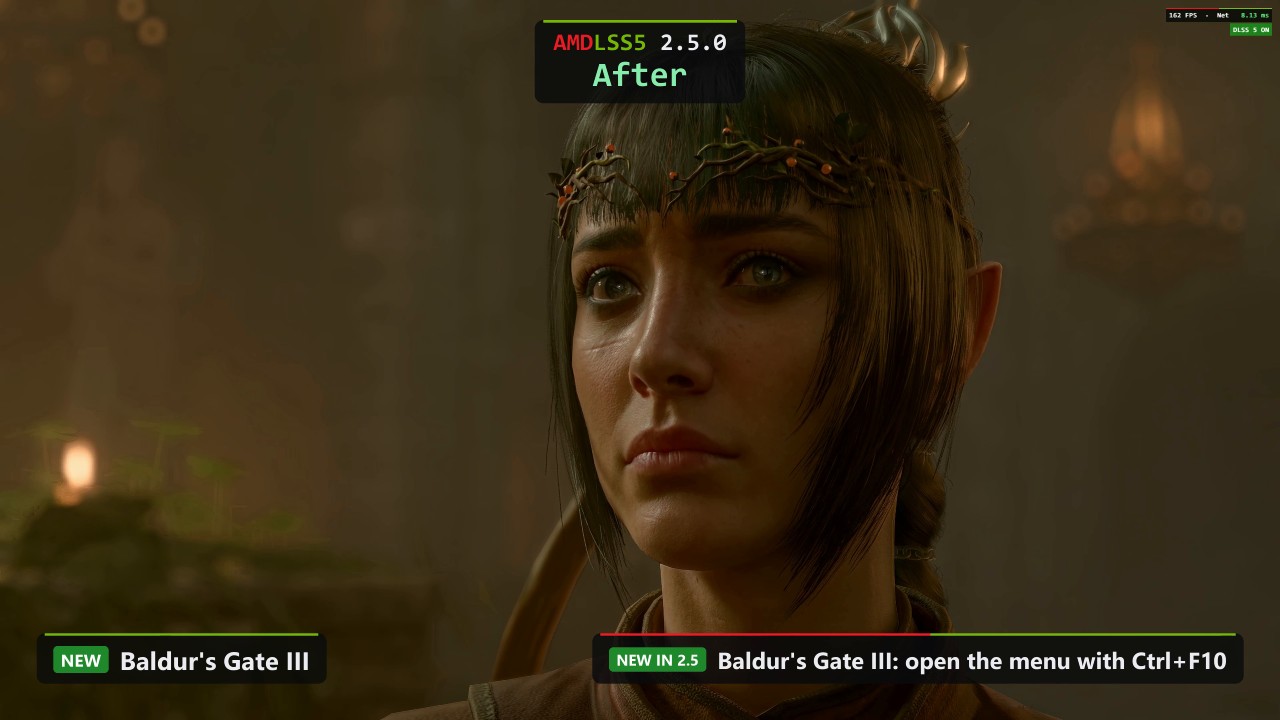
AMDLSS5 2.5 Introduces a Faster Vulkan Neural Engine
The biggest architectural change is the transition to a new Vulkan-based neural engine built on developer Mochizuki's DLSSNR-AMD runtime. According to the reported figures, this overhaul makes neural network processing up to 60% faster compared with the previous implementation.
The performance improvements extend beyond neural processing speed. Testing in Resident Evil Requiem on an RX 9070 XT reportedly shows about 10% higher overall in-game frame rates than AMDLSS5 2.0. The difference matters because faster neural inference does not automatically translate into an equivalent increase in gaming performance. The neural network represents only one component of the complete rendering pipeline.
Version 2.5 also reduces VRAM consumption by approximately 500MB. This could be particularly useful for 12GB and 16GB Radeon graphics cards running demanding games with high-resolution textures and advanced visual effects. Recovering half a gigabyte of memory gives the game more room for rendering resources and could reduce memory pressure in particularly demanding scenes.
Neural Apex Adds Up to 6x Frame Generation
The other major addition is Neural Apex Frame Generation, developed by Apex Compute. Integrated into AMDLSS5 2.5, the technology allows Radeon users to inject 2x to 6x Frame Generation, including in games that lack native frame generation support.
This is an ambitious development because it could extend frame generation to titles developers never designed around such technology. Instead of waiting for individual games to receive dedicated FSR or DLSS implementations, users can experiment with additional generated frames through the modification.
However, generated frame rates should not be confused with actual rendering performance. Producing up to six displayed frames for every traditionally rendered frame does not mean the GPU processes six times as much game simulation or input data. The experience still depends largely on base frame rates, latency, and frame pacing. Thus, lower frame generation multipliers can provide a more consistent experience in rapidly moving games.
Expanded Game Support and Radeon Compatibility
AMDLSS5 2.5 also adds official compatibility profiles for several major PC titles, including Baldur's Gate 3, Microsoft Flight Simulator 2024, The Last of Us Part I, and Batman: Arkham City.
The additions span a broad spectrum of rendering tasks, from the challenging surroundings of Microsoft Flight Simulator 2024 to the memory-intensive visuals of The Last of Us Part I. The update now includes in-menu neural network resolution scaling, letting users change the processing resolution from 540p to 1440p without leaving the game.
Hardware support now includes RDNA 4 graphics cards such as RX 9070 XT, RX 9070, RX 9070 GRE, and RX 9060 XT 16GB. The RX 7800 XT is also supported, while additional RDNA 3-based RX 7000 series cards remain in beta.
Visual Limitations and Modding Trade-Offs
Despite its improvements, AMDLSS5 2.5 remains an unofficial post-process neural modification rather than a native game-engine implementation. Users must disable sharpening in in-game FSR or XeSS upscalers to prevent flickering from conflicting image-processing effects.
Fast-paced scenarios can also cause single-frame warping artifacts, such as during fast camera motion and complex object transitions. These constraints make aggressive frame generation settings less desirable for competitive gaming, where responsiveness and visual consistency are more important than headline frame rates.
FAQ
Q. What is AMDLSS5 2.5?
A. AMDLSS5 2.5 is an unofficial community-developed modification that brings DLSS 5-style neural rendering and advanced frame generation features to supported AMD Radeon GPUs.
Q. How much faster is AMDLSS5 2.5 compared to version 2.0?
A. AMDLSS5 2.5 reportedly delivers up to 60% faster neural network processing, approximately 10% higher overall in-game frame rates in Resident Evil Requiem on the RX 9070 XT, and around 500MB lower VRAM consumption.
Q. Does AMDLSS5 2.5 support 6x Frame Generation?
A. Yes. The update integrates Neural Apex Frame Generation by Apex Compute, allowing users to enable 2x to 6x frame generation in supported games, including titles without native frame generation support.
Q. Which AMD Radeon GPUs support AMDLSS5 2.5?
A. The mod supports RDNA 4 graphics cards, including the RX 9070 XT, RX 9070, RX 9070 GRE, and RX 9060 XT 16GB, alongside the RX 7800 XT. Additional RDNA 3 graphics cards remain in beta.
Editor, NoobFeed
Gaming Hardware Updates
No Data.