
Best Budget and High-End GPUs: Complete Performance Guide
Current GPU pricing has stabilized across most models, allowing buyers to access performance improvements at reasonable cost points.
Hardware by Masaru Hoshino on Nov 27, 2025
The current GPU market has reached one of its most stable points in the past year, with most current-generation GPUs finally matching their MSRPs.
Pricing and availability are better than they've been in a long time, even though DRAM pricing remains a problem, and the generation as a whole hasn't lived up to expectations. With that in mind, it's time to wrap up the 2025 GPU market and evaluate the best options across all price categories.
Budget GPUs: Under $300
The most affordable discrete GPU options available right now come with plenty of caveats, and several are simply not worth buying. The RTX 3050 6GB at $180 is still a weak offering, and AMD's RX 6500 XT 4GB at $210 remains one of the worst GPUs released in recent years.
Things improve significantly with Intel's Arc B570, priced at $210, offering 10GB of VRAM despite not being the fastest card on the market. The RX 7600 is still floating around at $240, but the B580 at $250 is a far better buy. The RTX 3060 is hanging on at $250 as well, but the newer RTX 5050 at the same price doesn't offer enough value to be compelling. Meanwhile, the RTX 5060 and RX 9060 XT 8GB can both be found for $280.
The B580 is around 15% faster than the B570 and offers 2GB more VRAM, though it costs almost 20% more. Either model works for budget builds, but the B580 is generally the better long-term option at $250. It outperforms the RX 7600 and RTX 3060 and offers performance similar to the RTX 5060.
The RX 9060 XT 8GB, however, delivers 15–20% more performance than the B580 while costing just 12% more. Despite its limited 8GB of VRAM, it maintains strong performance and supports FSR 4. For this price category, the RX 9060 XT 8GB stands out as the best value option under $300, with the B580 remaining a strong alternative.
Mid-Range GPUs: $300–$500
In this price bracket, only two GPUs are truly worth considering: the RX 9060 XT 16GB and the RTX 5060 Ti 16GB. Each has a confusing and inferior 8GB counterpart sold under the same name, a frustrating reminder that major GPU makers continue to underserve consumers.
The RX 9060 XT is priced at $350, while the RTX 5060 Ti sells for $430, making it 23% more expensive for around 9% more performance at 1440p. Both perform similarly with upscaling enabled (FSR 4 vs DLSS 4). The RTX 5060 Ti only meaningfully pulls ahead in heavy ray tracing workloads, but its performance there remains limited overall.
Given its lower pricing, competitive upscaling quality, and 16GB of VRAM, the RX 9060 XT 16GB is the better overall value pick in this range.
Upper Mid-Range GPUs: $500–$600
The contenders here are the RX 9070 and the RTX 5070, both currently priced at $540. In a 23-game benchmark, the RX 9070 was around 13% faster at 1440p, whether running at native settings or with upscaling.
The RX 9070 offers stronger cost-per-frame value and includes 16GB VRAM, which is now the minimum we expect when spending over $400 on a GPU. Meanwhile, the RTX 5070 has only 12GB of VRAM. Still, it benefits from DLSS 4 quality and better fallback upscaling when FSR 4 or DLSS 4 aren't supported. It is also slightly faster in ray-traced titles, though the limited VRAM restricts its future performance potential.
The RTX 5070 and RX 9070 are very evenly matched overall, so it comes down to pricing in your region. However, with equal pricing and the expectation of keeping the GPU for several years, the RX 9070 is the smarter long-term investment thanks to its 16GB VRAM and consistent performance across a wider range of titles.
High-End GPUs: $600–$1,000
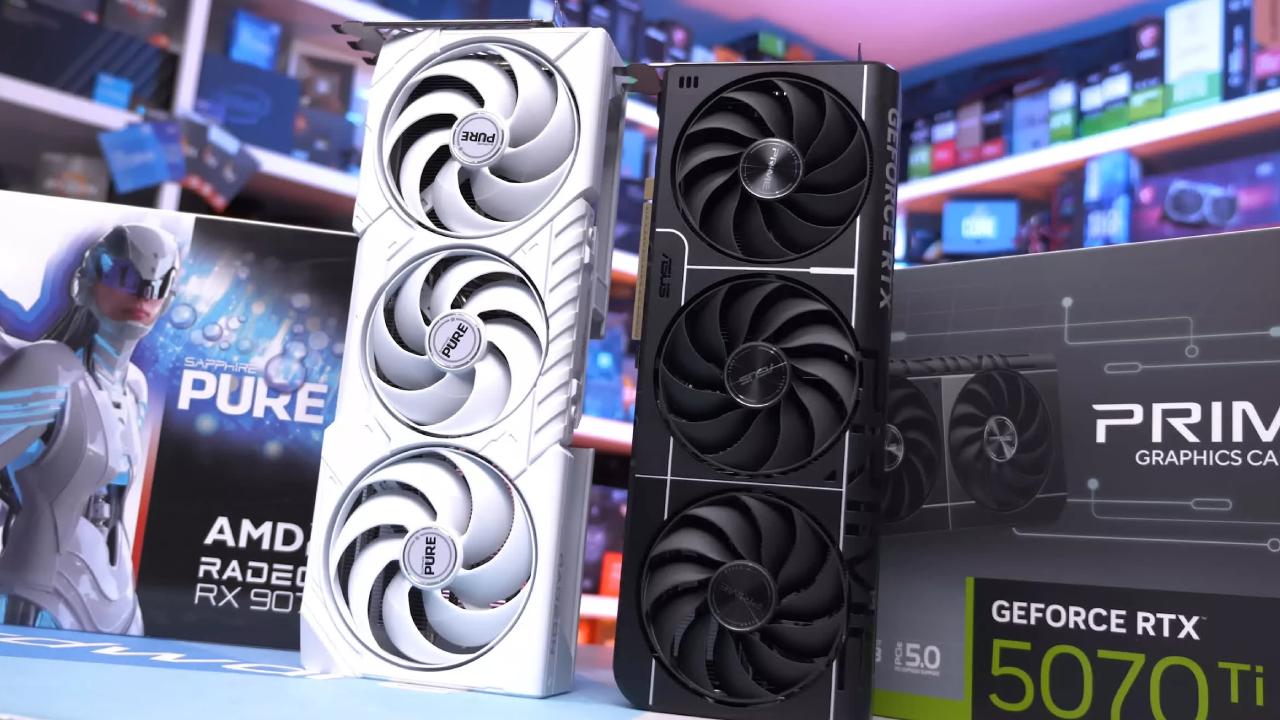
The RX 9070 XT has recently reached its $600 MSRP, making it one of the most compelling GPUs of 2025. AMD has warned of upcoming price increases, so if you can find one near MSRP, grab it sooner rather than later.
At this price, the RX 9070 XT comfortably outperforms the RTX 5070 Ti, which costs 25% more and offers only marginal ray tracing benefits. Both GPUs feature 16GB VRAM and strong upscaling support, but at current pricing, the RX 9070 XT is the clear winner.
The RTX 5080, on the other hand, remains one of the least well-positioned GPUs of the generation. With an MSRP of $1,000, it offers only a 15% performance uplift over the RTX 5070 Ti while costing 33% more. It is nearly 70% more expensive than the RX 9070 XT while delivering less than 20% additional performance. The value simply isn't there.
Flagship Tier: $1,000+
The RTX 5090 stands alone in the flagship category. With an MSRP of $2,000 and street prices often above $2,800, it is reserved for buyers with money to spare.
No current AMD GPU comes close to it in performance, efficiency, or feature support. If cost is not a concern, the RTX 5090 remains the definitive high-end option.
Final Thoughts
Even though this generation has some drawbacks and the 8GB models still have VRAM issues, the 2025 GPU market is better, especially in the lower price ranges. It's a good thing that the Intel Arc B580 finally dropped to $250, and the RX 9060 XT coming in below MSRP is also good for budget builds. The biggest highlight, however, is the RX 9060 XT 16GB at $350, offering strong performance with long-term viability.
The RX 9070 XT is probably the best offer right now at $600, especially when you compare it to its predecessor, the RTX 4070 Ti Super, which came out almost two years ago at $800.
Because DRAM prices are rising and demand from AI sectors is increasing, prices are expected to remain high. AMD has already talked about these cost challenges within the company. Now might be the perfect moment to update if you've been waiting for the appropriate time. Prices are about to go up again.
Also, check our other NVIDIA articles below:
- NVIDIA GeForce RTX 5080 Review (2025): Still A 4K Gaming Powerhouse?
- RTX 5090 Performance Testing In GTA 5 – 1080p, 1440p, and 4K Max Settings Benchmark
- NVIDIA RTX 5070 Review: Mid-Range Muscle or Marketing Hype?
- RTX 5070 Ti Review: Performance, Thermals & Power Efficiency Tested
- ASUS ROG Astral RTX 5090 OC Edition Review: 32GB GDDR7 & 4K Gaming Benchmark
- ASUS GeForce RTX 5090 LC Liquid Cooled GPU Review: Unmatched Silence & Speed
- MSI GeForce RTX 5090 32GB SUPRIM SOC Review: Power Efficiency, Cooling, and Gaming Performance
- INNO3D RTX 5060 Ti 16 GB X2 Review: Gaming Benchmarks, Temps, and Power Efficiency
- HP Omen 45L Review: RTX 5090 Performance, Thermals, and Value Analysis
- ASUS TUF Gaming GeForce RTX 5060 Ti Review: DLSS 4, Power Efficiency, and Gaming
- ASUS Prime RTX 5060 Ti OC 16GB Review: DLSS 4, Ray Tracing, & Thermals Tested
- NVIDIA GeForce RTX 5060 Review: Specs, Gaming, and Cost per Frame
- MSI GeForce RTX 5090 GAMING TRIO OC Review: A Monster Power GPU
Editor, NoobFeed
Gaming Hardware Updates
No Data.