
Gaming CPU Performance in Battlefield 6: Why Core Performance Beats Core Count
Modern gaming performance depends more on CPU architecture and single-core strength than on the raw number of processor cores available.
Hardware by Masaru Hoshino on Aug 28, 2025
For years, there has been debate over whether 6-core CPUs are still suitable for gaming or if gamers should upgrade to 8, 12, or even 16-core CPUs to future-proof their computers. Many claims suggest that 6 cores are no longer sufficient, while some argue that even 8-core CPUs may not be a smart purchase these days.
With Battlefield 6 being one of the most demanding titles, especially in multiplayer conquest mode, it provides the perfect scenario to revisit the classic 6-core versus 8-core battle.
Core Utilization in Battlefield 6
We've addressed misconceptions about CPU core counts before. Although many believe that Battlefield 6 can heavily utilize 16 cores, it does not necessarily require 16 cores to run effectively. The game simply scales well with higher core counts, spreading the workload across all available threads.
However, that does not mean a 16-core processor will outperform a 6-core CPU of the same generation in every scenario. For instance, if a Ryzen 9 5950X (16-core) shows 50% utilization in Battlefield 6, then a 6-core or 8-core CPU with stronger individual cores can still perform just as well. What truly matters is overall CPU performance rather than the sheer number of cores.
There are situations where 6-core CPUs, such as the Ryzen 5 7600X, outperform older 16-core chips like the 5950X due to architectural improvements. Individual core performance is often more important than raw core count.
CPU Architecture and Latency
When comparing CPUs of the same generation, additional cores can help, but not always significantly. For example, the Ryzen 7 5800X is typically faster than the Ryzen 5 5600X because both use a single CCD, resulting in minimal latency.
However, when moving up to 12-core or 16-core parts, such as the Ryzen 9 5900X, latency between CCDs can cause performance penalties, reducing or eliminating the advantage of having more cores.
So, while an 8-core may be faster than a 6-core model, the performance gain is rarely proportional to the 33% increase in cores. Games often bottleneck on primary threads, limiting the benefits of extra cores.
Zen 5: Ryzen 9600X vs 9700X
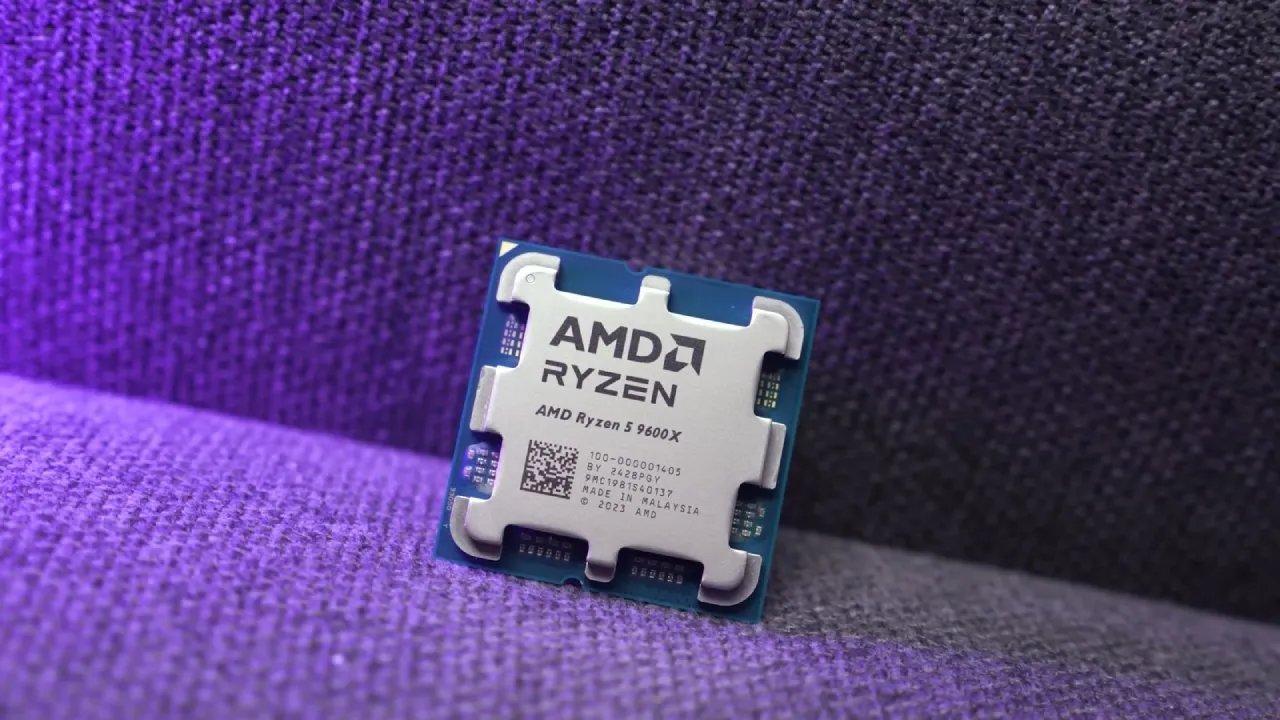
Testing the current Zen 5 lineup, we compared Ryzen 5 9600X (6-core) and Ryzen 7 9700X (8-core), both locked at 5.4 GHz with DDR5-6000 CL30 memory, and paired with an RTX 5090.
At 1080p low settings, 9600X averaged 161 fps, while 9700X managed 168 fps, just 4% faster. The 1% lows were nearly identical. At 1440p, results were similar with only a 4% difference.
Switching to ultra settings widened the gap slightly. At 1080p ultra, 9700X was 9% faster on average, with 10% stronger 1% lows. At 1440p ultra, the results repeated with around a 9% gain. While faster, the 8-core advantage still does not match the increase in cores or price.
Zen 3: Ryzen 5600X vs 5800X
Moving back to Zen 3, Ryzen 5 5600X (6-core) and Ryzen 7 5800X (8-core) were tested at 4.7 GHz with DDR4-3600 CL14 memory. At 1080p low, the 5800X was just 5% faster, while at 1440p low, it was 8% faster. Ultra settings at both resolutions delivered similar margins, never exceeding 8%.
Interestingly, the Ryzen 5 7600X (Zen 4, 6-core) was nearly 40% faster than the Ryzen 7 5800X, despite having fewer cores, proving again that core performance trumps core count.
Zen+: Ryzen 2600X vs 2700X
Things shift with older CPUs. Testing the Ryzen 5 2600X (6-core) and the Ryzen 7 2700X (8-core) revealed significantly larger differences. At 1080p low, the 2700X was 20% faster with 25% better 1% lows, maintaining performance above 60 fps, whereas the 2600X dropped below 50 fps.
At 1440p low, the margin shrank to 14%. Ultra settings once again demonstrated the 2700X with 15-20% higher performance, depending on the resolution. For older CPUs, the jump from 6 to 8 cores had a much bigger impact.
Historical Perspective on Cores
Back in the Intel Coffee Lake era, Core i7-8700K (6-core) often outperformed AMD's 8-core Ryzen 7 2700X due to stronger single-core speed, even though the AMD chip had 33% more cores. In simulated future-proof tests where cores were disabled, 8700K still came out ahead unless Ryzen had twice as many cores fully utilized.
This illustrates a consistent truth: having more cores does not automatically mean better gaming performance. Processing power per core matters more.
Multitasking and Extra Cores
There's also been a long-standing belief that 8-core CPUs are better for multitasking while gaming, such as streaming, running Discord, or playing videos in the background.
However, we tested 6-core and 8-core CPUs in real-world settings and found little to no difference in gaming performance when multitasking.

Final Thoughts
According to the research, the difference between 6-core and 8-core CPUs in modern games is frequently negligible, especially with newer architectures, even though additional cores can yield slight benefits. Significant advantages only appear when revisiting much older CPUs, such as Zen+.
Value has always leaned toward 6-core models, as they deliver most of the performance at a lower cost. Ryzen 5 series has consistently offered the best balance of gaming power and affordability, proving that core performance is far more important than sheer core count.
Ryzen 7 2700X and other older CPUs still provide an incredibly playable experience, even in demanding titles like Battlefield 6.
The idea that having a large number of cores is necessary for future-proofing has been disproven by modern CPUs with fewer but more powerful cores, which are nevertheless more than capable of handling gaming.
Check Our Other Intel Chips Articles:
- Intel Core Ultra 9 285K Review And Performance Breakdown (2025)
- Intel Core Ultra 9 285K vs AMD Ryzen 7 9800X3D: In-Depth Gaming Performance and Benchmark Comparison
- Intel Core i5-13400F Gaming Performance: Still Worth It in 2025?
- Intel Core i9‑14900K vs. AMD Ryzen 7 7800X3D: Power Profiles & Gaming Benchmarks
- Intel Core i9 14900K: Specs, Benchmarks, and Competitor Comparison
- Intel Core Ultra 5 245K Review: Gaming, Productivity & Power Efficiency Tested
- Intel Core Ultra 9 285 K's iGPU Gaming: In-Depth Benchmarks & Analysis
- Intel vs. AMD Gaming Laptop: Performance, Thermals & Battery Life Compared
- AMD Ryzen 7 9800X3D vs.7800X3D vs. Intel Core Ultra 7 265K: Gaming, Thermals & Price Analysis
Editor, NoobFeed
Gaming Hardware Updates
No Data.