
Astral Throne II: Age of the Phoenix Review
PC
A prison break, a dead god's heart, and a map that keeps closing in.
Reviewed by Maisie Scott on Nov 27, 2026
Zero Sun Games is an indie studio out of Ontario, Canada. Their path to making tactical RPGs has been somewhat meandering. Their first game was Infinite Incantation, a papercraft bullet-heaven roguelike released in May 2023. Their next game was a turn-based tactics title called Astral Throne, which came out on Steam in February 2025.
Rather than patching the original game with massive updates, which would have substantially altered it, they built a new game from scratch. The first game remains unchanged, so you don't lose what you originally purchased. It's a roguelike strategy RPG in the vein of Hades and Final Fantasy Tactics: grid-based, turn-based battles in the manner of Fire Emblem, with a run-based structure and progression between runs.
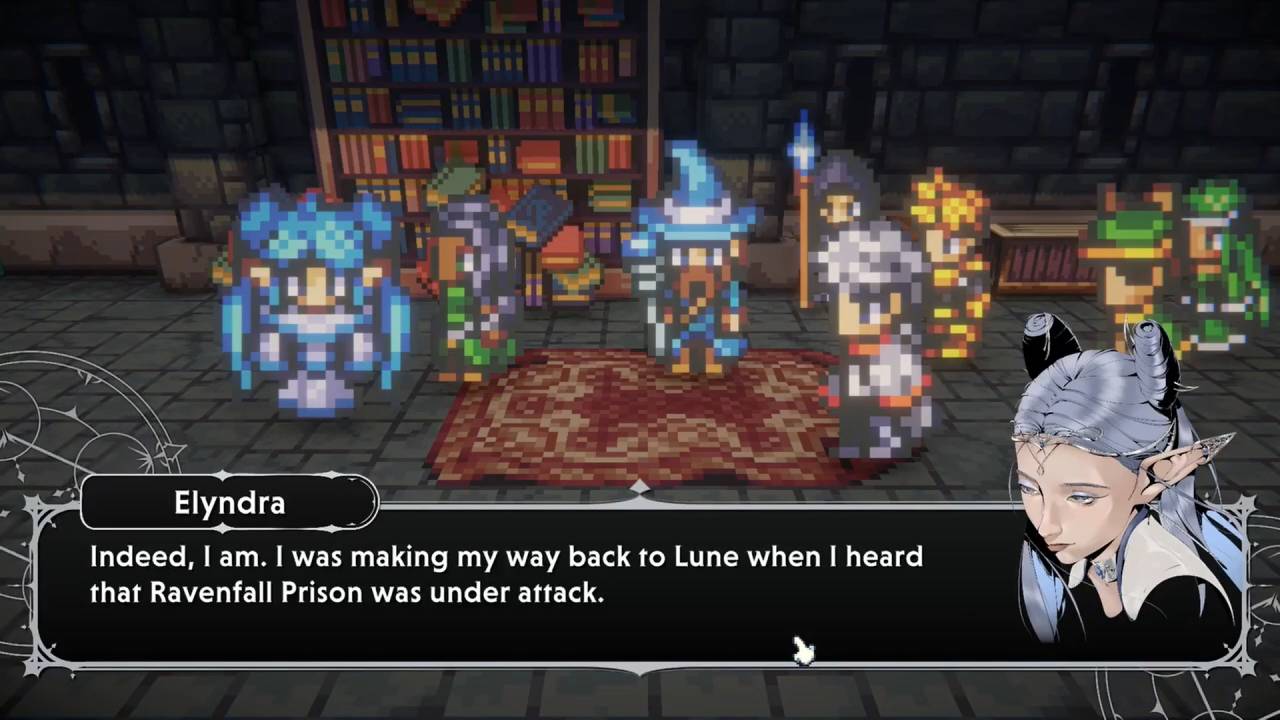
The tale of Astral Throne II: Age of the Phoenix begins in the shadow of a funeral.
Queen Wellia has died. The skies are dark, and King Kaius of Aventa is completely heartbroken. He's so heartbroken that he abandons all diplomacy. And when the Lon Imperium crosses into his territory, he turns to his strongest ally. You're the army's tactician, and after nearly two years of winning battles thought impossible, they call you the Phoenix General.
Chapter one sees you at the gates of Cauldrris Spire (the Lon capital) with one final fight to go. Kayrix's view is that you just went in and butchered the Lon throne room out of bloodlust. That the people of the Lon fear you more than the crown, and that your troops are loyal to you rather than to him.
When two of your most trusted officers defend you, they take that as proof. You're shackled in anti-magic restraints and sent to Ravenfall, the prison where people go to vanish. Two years pass in the dark. Early in the game, the cultists blow the walls of Ravenfall to bits as they're searching for the heart of Flexis, the dead god of darkness. You grab the keys, free yourself, and pull together a group of other prisoners.
Aaronwald, the Cinder Sentinel, was incarcerated for the very reason of having asked the king to free you. Rowan, the king's second son, lost both his title and his freedom for the same reason. Darth is a Recken alchemist and gambler who's always getting himself into trouble.
Scarlet, the young Phoenix, replenishes your power, and they all take a feather from her.
They travel through the Ambershade forest and the mountains to reach the capital of Aventa, avoiding the main roads. The forests have become strange because of magic left behind by Flexis; even though he may be dead, he is not forgotten. They are joined by a baby dragon named Ironclad, who tells them that King Kaius derives his supernatural strength from Draken shards.
Later, they end up in a Recken village where the Bloodweavers are attacking people without weapons. It's a prequel to the first game, and it's much more linear; it's the meta progression in the future. It has a lot of dialogue, more than you'd normally expect in a roguelike.
You'll be spending most of your time in Astral Throne II: Age of the Phoenix at the Phoenix Shrine (your home base). Between runs, you can browse a codex of units, skills, status effects, weapons, items, and shards, and chat with your companions to build your relationships.
The relationships do matter. The higher your relationship level with a companion, the more items and skills you'll unlock for future runs, and the more options you'll have in the barracks, where you can change a character's starting weapon, starting inventory, and, indeed, their class. When you're ready to go, use the sundial at the shrine to pick an act, select your squad, and decide how many shards you'd like to bring.
Each run in Astral Throne II: Age of the Phoenix is one act, unlike the first game's three-act structure.
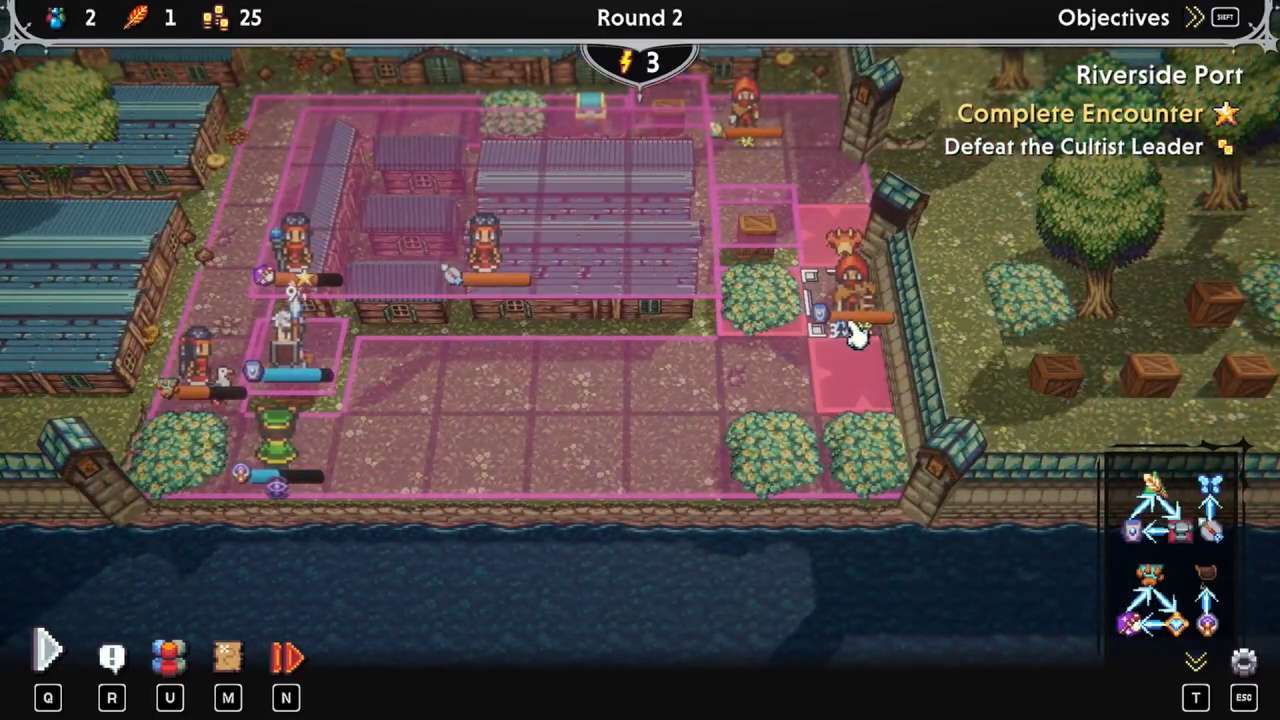
You start each run at level one with your party and an empty inventory, and then you move around a randomly generated world map. You can encounter all sorts of things nearby: skirmishes, elite fights, treasure rooms, campfires (for healing), blacksmiths, jewelers, workshops, an arena, and shops.
The only thing that stays the same in the shops is the shop itself, so if you go in and buy something, it will still be there when you come back. It's satisfying to find something useful in a chest, since the chest pool changes every run and there are hundreds of skills, weapons, and items to find.
An ever-present shrinking ring surrounds the map in Astral Throne II: Age of the Phoenix. Each move made on the map and each fight round brings the shrinking ring closer, and all encounters except for one that happen beyond the ring's boundaries will disappear. If the ring engulfs you mid-fight, you won't gain any experience or get any decent rewards from chests.
This soft timer mechanism adds a whole new layer to route planning. You have to decide whether visiting a particular store is worthwhile, given the ring approaching you. This creates a completely new feel compared to the previous one, where players had much more rigid turn restrictions; now players can take many more risks.
Recruitment is via phoenix feathers.
You get phoenix feathers from certain enemies and elite fights, and you use those to recruit units from your permanent roster. You can have up to 5 units in an elite fight, and 6 in a boss fight. Recruits join at a higher level, so they're not too weak when they arrive. The downside is that their skills are locked in at the time of recruitment, so you lose some of the flexibility in team building.
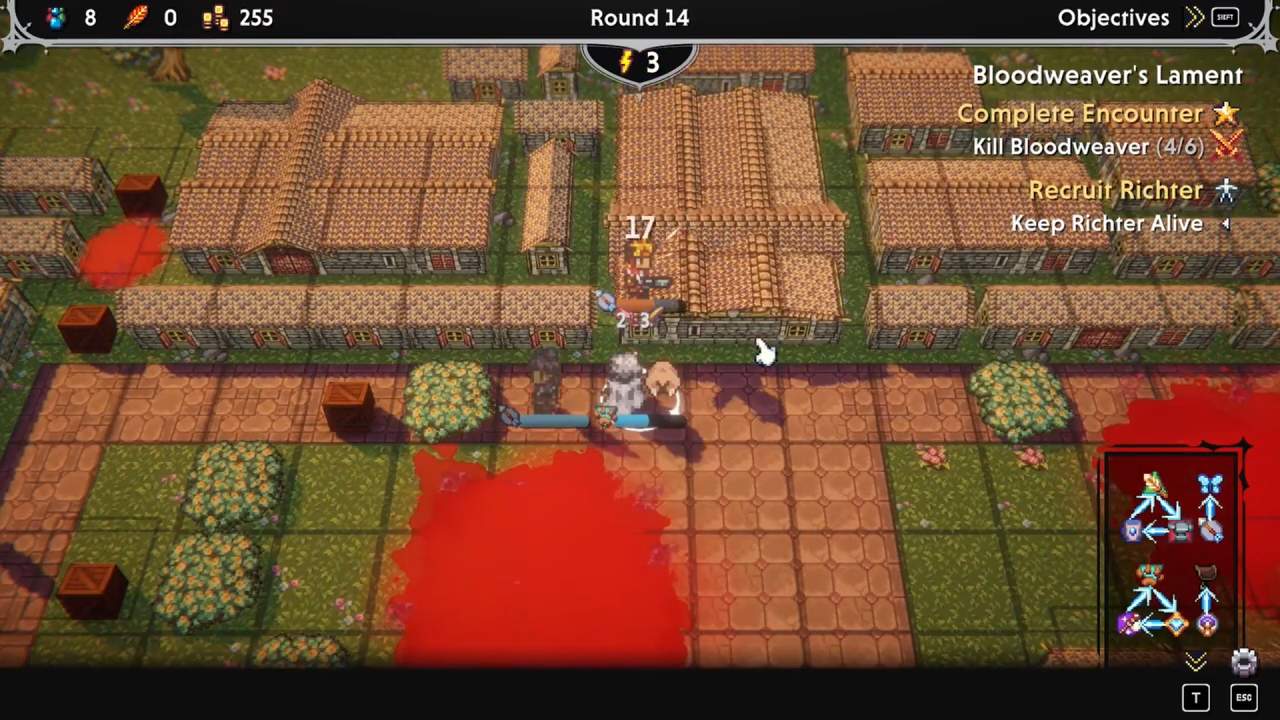
Caravans also come with additional equipment. Optional objectives also let you add another character to your roster if you complete them. Once everybody leaves, the objective is also over. Objectives come in a number of varieties and appear in the corner of the screen. An objective might mean beating up a certain enemy, killing a specified number, or reaching a particular tile on the battlefield.
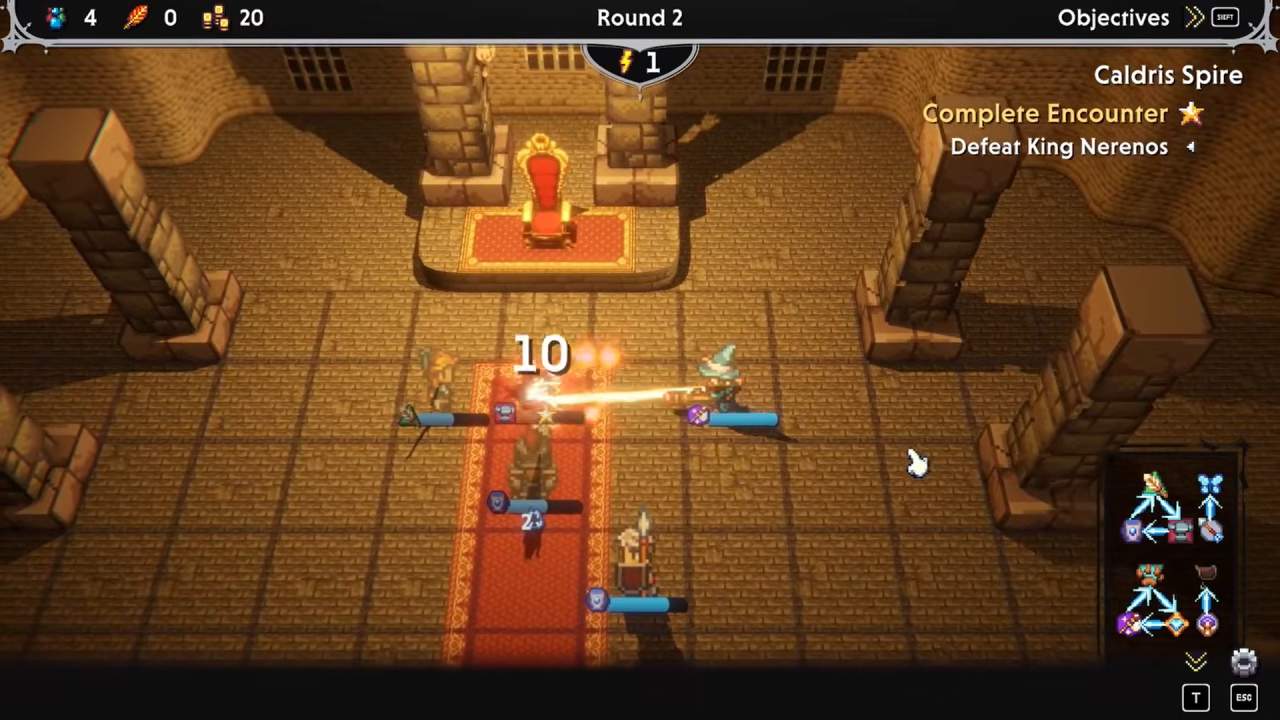
Weapon Triangle: Light weapons overpower heavy weapons; heavy weapons overpower shields; shields overpower light weapons. Magical Triangle: Familiar overcomes focus; focus overcomes staff, and staff overcomes familiar. Height is also significant. A character above can attack one more time.
If you have weapon advantage on top of high ground, the damage swings are huge. Positioning is absolutely everything in most fights. Bushes provide defense and evasion by making units harder to see, and some enemies have zones of control which will prevent you from moving.
Range overlays show who can attack who, and the tooltips tell you pretty much everything you hover over, so you don't get overwhelmed by tutorials at the beginning. Status effects are everywhere (hex, sigil marks, regen, overcharge, taunt, fragile, etc.) and they can stack.
A huge part of the strategy is working out which debuff will kill the boss and which buff will keep your frontliner alive.
You've got skills like oaths, which turn your counters into massive retaliations, and alchemist gambles, which produce random consumables, etc. Permadeath makes it a lot more intense. If a unit dies, they're out for the rest of the run. If one dies, another unit has three rounds to save them before they're sent back to the caravan. If your commander is killed, you lose the run and have to start again.
The encounters are all hand-crafted and varied enough that you don't feel repetition on replay. The boss fights also have extra objectives, e.g., kill six Bloodweavers whilst keeping your recruit Richter alive. The good stuff in Astral Throne II: Age of the Phoenix's combat far outweighs the bad.
There are a huge number of combinations of skills, weapons, and statuses, so you can really get creative with your builds. You could go in as a fairly tanky knight with a defensive weapon that blocks attacks, or as a gambling alchemist who creates your own resources as you go. The maps are shorter, and there are fewer units, so each fight is very quick.
However, some drawbacks stand out. First, a critical hit can happen at any time to an important unit, and it is unclear whether you can evade it or rely on luck to avoid it. In such a planning-oriented game with permanent unit losses, random hits feel very unfair when hit rates are in the 60s and even 70s.
The shrinking ring acts as a global timer, forcing you to rush and skip optional fights.
It's perfectly reasonable for fans of a more leisurely approach to want a way to turn that off, particularly because the original game had a raft of difficulty options. In this game, difficulty is tied to shards, and there's no option to turn it off. This is the shard system in Astral Throne II: Age of the Phoenix, one of its more interesting features.
You acquire shards while playing runs, and you need a specific quantity to start and complete an act. Wearing a shard modifies some rules; for instance, one growth shard increases both player and enemy levels by one point. With enough shards, you can run corrupted runs with achievements for acquiring 15 or 20 shards, respectively.
Experience in Astral Throne II: Age of the Phoenix works completely differently to most roguelites. You earn XP in combat and level up, and each level gives you a choice of three skills from different skill pools. Each character has a unique progression rate; a mage may quickly gain magic and dexterity, while a heavy knight may not gain either.
Since everything reverts to level one at the Phoenix Shrine and at the beginning of every round, you can't out-level the game. No permanent stat boosts are given for playing the game for a longer period of time. This game is designed so you win through strategy, not grinding.
Progress in Astral Throne II: Age of the Phoenix is purely horizontal.
As you play, you get higher relationship levels, new items in the loot pool, new weapon types (lances, for example), new skills (one of which copies debuffs), and access to more acts. The story also moves forward as you go through the acts. The downside, of course, is that the one-act run structure doesn't really eliminate the grinding, since you're still going back to the progression layer.
Some of the long-time fans will argue that the slow build-up of a varied roster over a long run was more satisfying, and that's absolutely a valid point. The sequel opts for the shorter, more focused run, and whether you like that or not is down to personal preference.
Visually, it's a 2.5D style with quite detailed sprites in a 3D environment. The first game had that very retro low-poly look akin to the PS1 and N64 tactics games, so this is a huge change. The map units are quite cartoonish, and the level-up and relationship-gain animations really add personality.
The portraits are much more complex, with a very realistic painted look that can be a bit jarring against the more cartoonish units on the grid. Some of the faces are a bit rough, and you can see the pixel portraits could have been more appealing. The interface has also been completely redesigned, and at first it can feel a bit large and cluttered, but it becomes much easier to use as you get used to it.
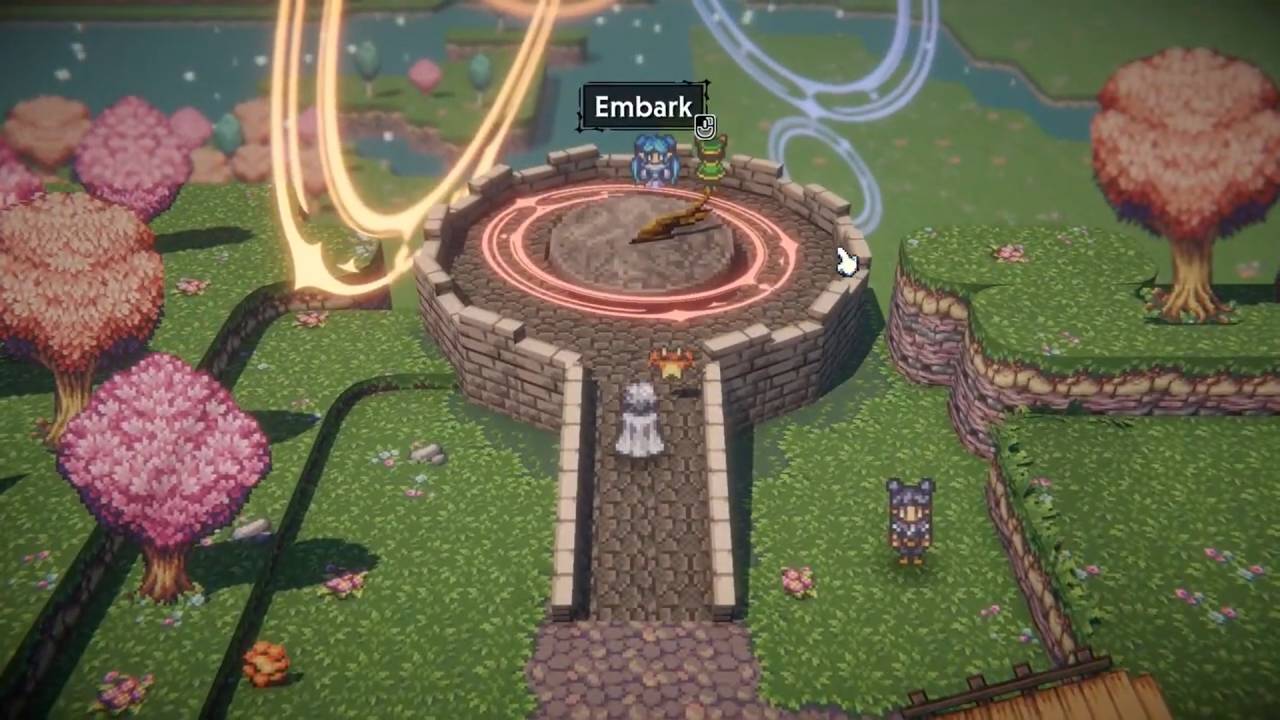
Audio is the most unobtrusive element of Astral Throne II: Age of the Phoenix.
The official soundtrack was released as a $9.99 add-on and includes tracks such as Ambershade Woods, A Rekkining, and Dark Forces. The dialogue is text only. The only audio accessibility option is custom volume controls. Astral Throne II: Age of the Phoenix really goes out of its way to reimagine the first game rather than do more of the same.
This has shorter campaigns, smaller maps, fewer units, an entirely new world map with lots more branching, and a controller-friendly interface. The shrinking ring is a lot more flexible than a turn limit, but it still encourages you to keep things quick.
The meta progression system is horizontal and matches the game narrative and supporting dialogue. Shards add variation, making each run feel unique. There are a few issues, such as random crits, a timer that would drive some players mad, and portraits that don't match the art style, but nothing breaks the experience.
If you're a fan of Fire Emblem or Tactics Ogre and want a game that makes good use of your time, Astral Throne II: Age of the Phoenix is an easy recommendation. If you're the sort of person who likes to go at a more leisurely pace, with long campaigns and lots of careful planning, you may find a few bits a little frustrating. It's not trying to please everyone, andthat'ss part of its appeal.
Editor, NoobFeed
Verdict
Smart, bite-sized tactical combat driven by horizontal progression and shard manipulation. The shrinking ring and crits may sting, but Fire Emblem fans will enjoy the game's depth.
74
Related News
No Data.