
The Binding of Isaac: Repentance+ Review
Nintendo Switch 2
The classic roguelike gets item descriptions, online co-op, and a bigger crowd.
Reviewed by Adeela Tas on Nov 12, 2026
The Binding of Isaac: Repentance+ arrives on November 19, 2026, for PS5, XBOX Series X/S, and Nintendo Switch 2, and it has a rich history. It began in 2011 as a Flash game by Edmund McMillen, and it became one of the titles that got indie developers interested in bolting roguelike systems onto familiar genres. In 2014, it was remade as Rebirth to reach consoles, followed by a steady run of major expansions: Afterbirth, Afterbirth+, and Repentance.
This newest release, handled by Nicalis, builds on it all. PC players have had The Binding of Isaac: Repentance+ for roughly two years, first as a beta and later as a free DLC for anyone who already owned Repentance. Consoles are only getting it now. Every earlier DLC is included, plus new additions: online co-op, item descriptions, balance changes, bug fixes, and a round of reworked items and mechanics.
The setup is dark, so it helps to know what you are walking into.
You play as Isaac, a young boy who lives with his mother in a house on a hill. One day, she hears a voice she takes to be God, and it tells her Isaac must be cleansed of sin. She locks him in his room. Then the voice returns and asks her to prove her devotion by sacrificing her son. Isaac notices a trapdoor in his room and drops into the basement, where he discovers what has been living under the house.
The premise borrows from the biblical tale of the same name, and if religious imagery bothers you, you should know that going in. Some of McMillen's own painful experiences are worked in as well, along with plenty of memes, odd references, and extra layers of monstrosity. One way to read it is that every route is Isaac trying to get away from his mother, with the fantastical parts acting as metaphors for how he sees the world.
Between floors, you get short visions that fill in his past. Some are funny, like Isaac thinking about himself, thinking in an endless loop. Some are embarrassing, like bullies barging in while he sits in a bathroom stall, or a gift wig turning into a reason for other kids to laugh at him. Others are sad, like his mother rejecting him or breaking his toys. They are brief and have no voice acting, but they can be enough to push some players away entirely.
Still, newer endings keep adding clarity, and there are now more than twenty to chase and piece together. Each run takes you down a series of floors, and each floor is made of connected rooms drawn from a pool of more than 20,000 layouts. The rooms are randomly picked, so the layout, the enemies, and the items change every time you start over.
Most rooms fit on a single screen, a design that clearly takes cues from the original Legend of Zelda, and you get locked in until every enemy is dead. Along the way, you will run into item rooms, shops, libraries, challenge rooms, deals with devils and angels, and plenty of hidden spots. Beat the boss at the end of a floor, and a path opens to the next one.
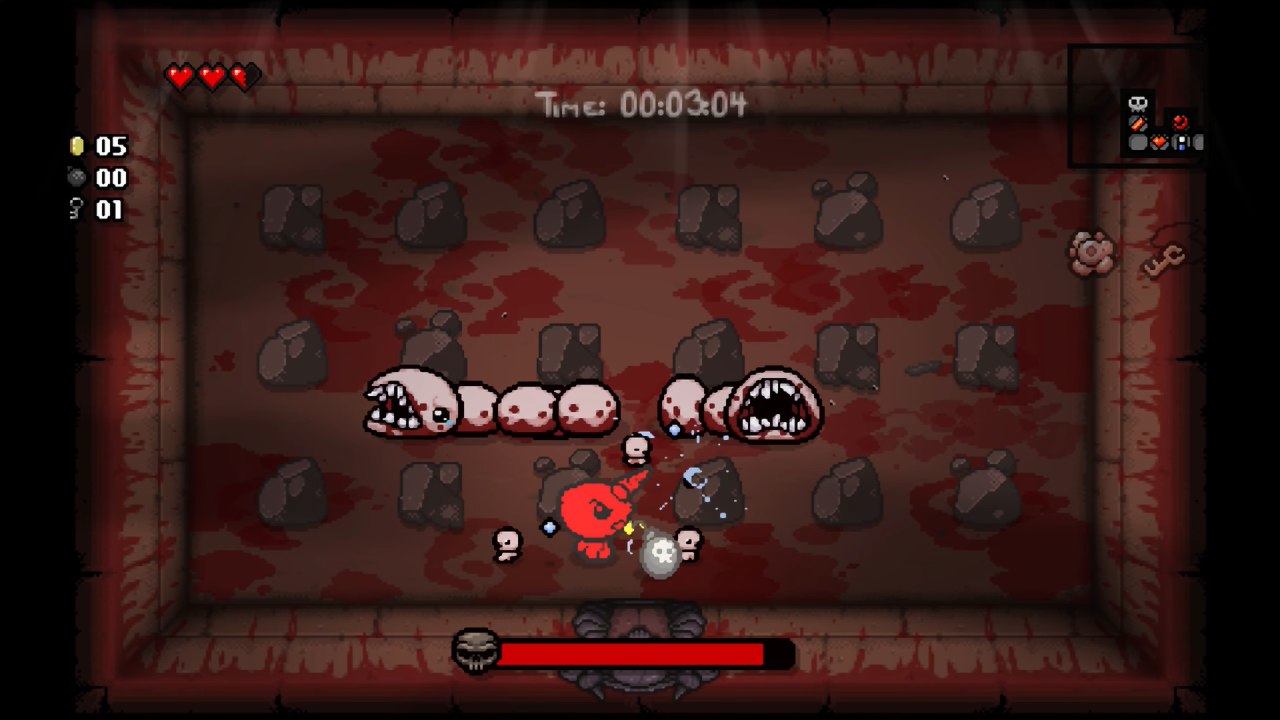
Your tools are simple. Isaac cries tears at enemies, you place bombs, and you pick up keys for doors and chests, plus coins for shops.
Bombs matter less for killing things and more for breaking rocks and weak walls, which uncovers extra items and new rooms. Oddly tinted rocks and secret rocks are worth blowing open because they often hide a small boost. Shops also have donation machines, and coins you drop in carry over between runs, eventually triggering unlocks at set milestones and giving you a pool of money to pull from later.
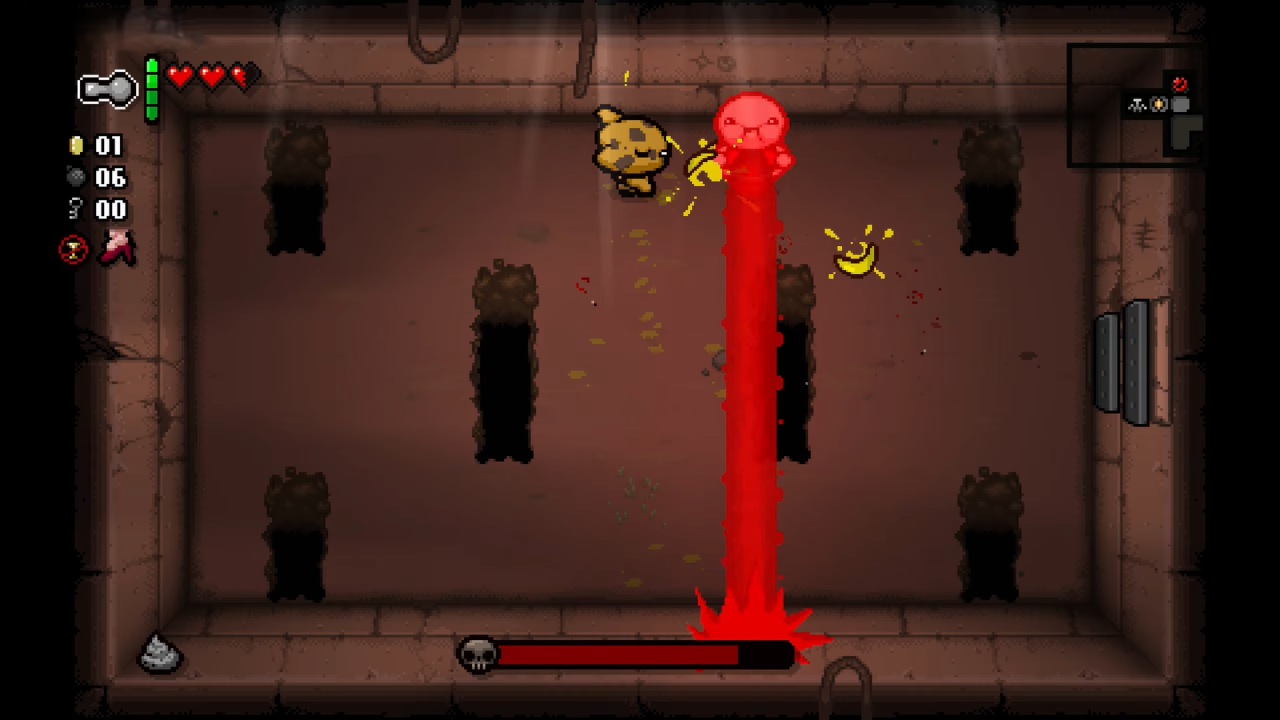
Die, and everything you gathered disappears.
Unlike many newer roguelikes, nothing you pick up in a run comes back with you. Health works in a few flavors, and it shapes how you play. Red hearts are the default, and you can refill them. Soul hearts and black hearts are different because once they are gone, they are gone for good. Deals with the Devil hand you unusually strong items in exchange for health containers, but taking red heart damage on a floor shuts that door.
The Binding of Isaac: Repentance+ also rewards strong play in other ways, such as clearing the Boss Rush in under twenty minutes. Combat in The Binding of Isaac: Repentance+ follows a twin-stick shooter setup. One stick moves you, and the face buttons set your firing direction, but only in the four cardinal directions. There is no dodge, so you rely on positioning and whatever you pick up.
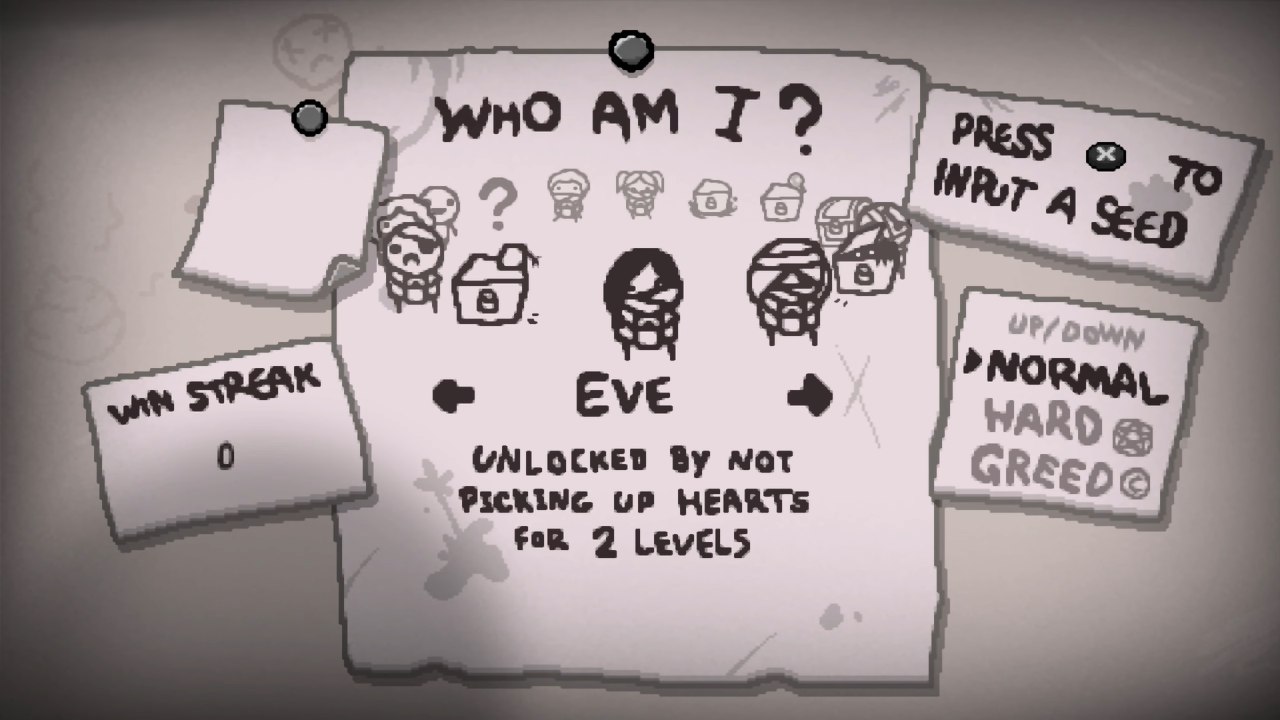
Some characters change that picture right away. Eve comes with the Whore of Babylon, a power-up that kicks in once you are at a low-health threshold. Azazel is a friendlier pick for newcomers, since he starts out flying and carries a strong short-range Brimstone attack. Items are where the combat really opens up. Some are simple, like raising your damage or fire rate. Others change how you shoot altogether.
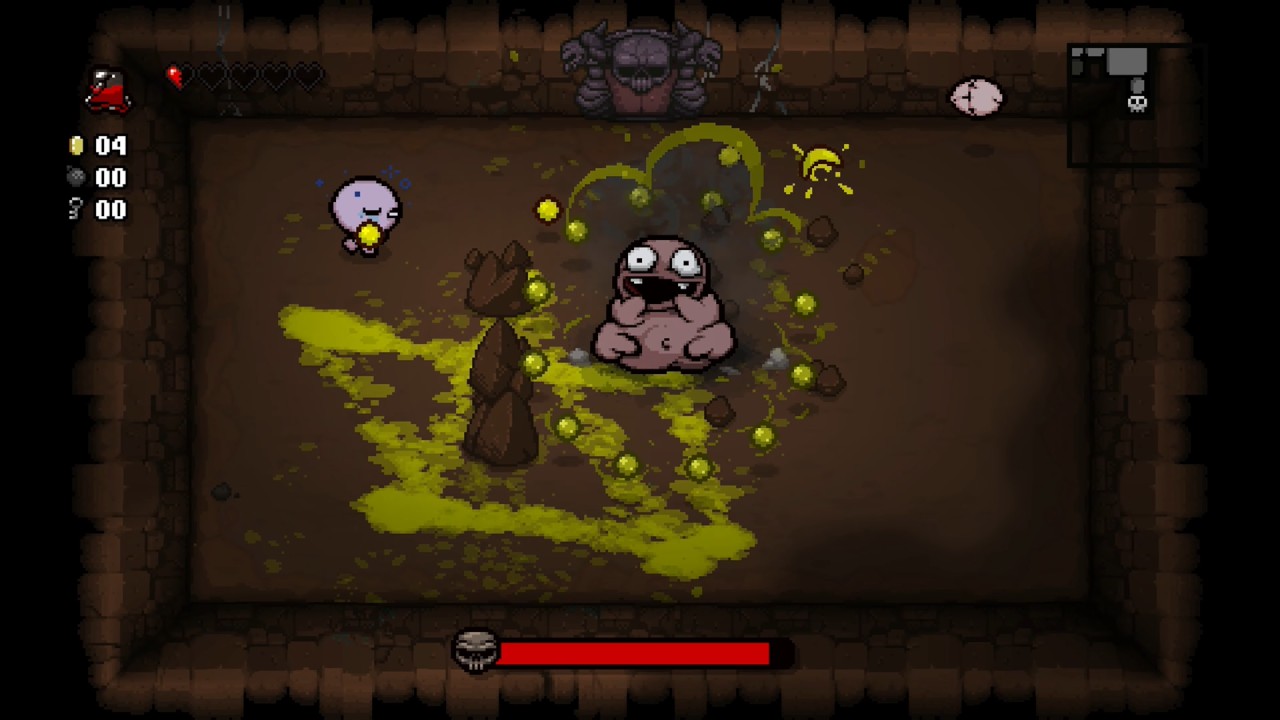
You can get curved shots, triple shots, or turn your tears into a thick stream of Brimstone. Tarot cards can open portals to secret rooms or send you into secret miniboss fights. Familiars follow you around, and one item leaves a slime trail that slows anyone who walks through it. Some carry real risk too. Bob's Brain explodes on impact and can hurt you if you stand too close. Trinkets, which are passive pickups, can swing a run just as much.
With over 700 items, they stack in strange, sometimes ridiculous ways, and finding new synergies is a big part of the fun, even after hundreds of hours. Balance is mostly solid. Enemy placement feels fair, since you rarely walk into a room and get ambushed on the spot. Bosses are tough without being cheap, and none of them feel like oversized sponges.
Item drops show up often, but not so often that you arrive at a fight overpowered. That said, a few bosses can feel unfair, and you will take the occasional cheap hit working through floors. Because so much depends on random chance, some runs also turn out fantastic while others feel doomed almost from the start.
Not every item explains itself, and that's another recurring headache.
Plenty of them are not intuitive, and picking up something that works against your current build can quietly ruin a run. For years, the fix was tabbing out to a wiki every few minutes. Not knowing what things do is part of the excitement in your first hours, but with this much content, it gets old fast.
The new item descriptions deal with that directly. Once you have picked something up before, its exact effect shows before you grab it again, whether it is a consumable, a trinket, or an item. You can also check what you are carrying from the pause screen, and the main menu has a glossary of sorts. After a long break, this alone saves you from a lot of regret.
The Binding of Isaac: Repentance+ also adjusts the balance of a handful of items. The Butter Bean recharge time drops to two seconds, Short Fuse adds 15 percent to bomb damage, and Evil Charm now protects you from some environmental hazards. No new items have been added, so returning players should not expect fresh content. Most of these tweaks are small enough that you will barely feel them unless you already know the old numbers well.
Progression is not about leveling up or grinding for experience. It comes from unlocking things. Every playable character has their own checklist of completion goals, from going a set number of rooms without healing to winning a run on Hard. Some unlockables require Hard mode, so you will need to take it on eventually. That gives you a reason to try the whole roster, because each character plays differently enough to change your approach.
Beyond the standard runs, there is plenty more to pick from.
Normal and Hard are the main difficulty options, and Greed Mode is a separate gauntlet that arrived with Afterbirth. In it, you earn currency from clearing waves of enemies and use it to power up. It is a decent pastime, though it tends to swing between too easy and too tough with little in between. Challenges add limits to a run, and you can try the daily run online or solo, but only once a day.
If you fail it, you have to wait until the next day. Online co-op is the headline feature of The Binding of Isaac: Repentance+, supporting up to four players online and locally. You can jump into the first open game, browse public lobbies using tags and settings, host a private game, or join a friend's session through the friends menu. Local play was already part of The Binding of Isaac: Repentance+ but capped at two players, so doubling that is a real step up.
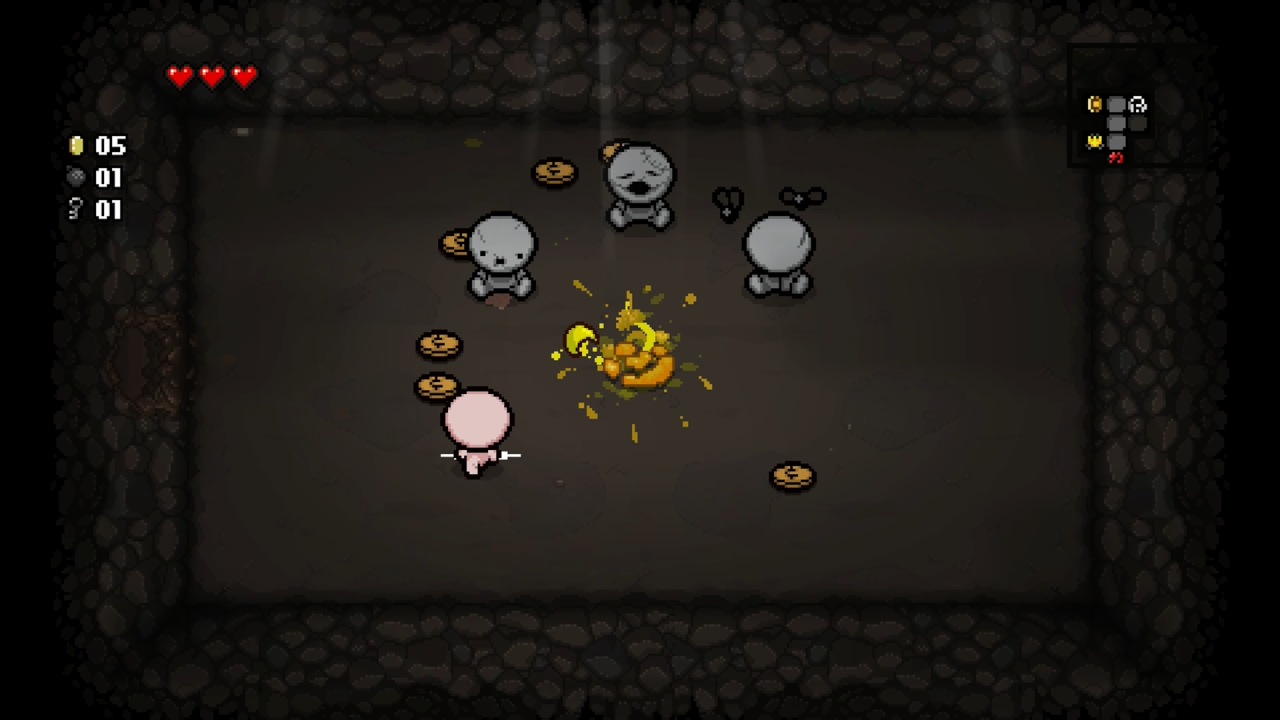
When everyone joins from the character select screen, each person picks a character from those already unlocked. Someone who joins midway comes in as a baby, which can shoot but cannot pick anything up or change rooms without the main player.
Co-op in The Binding of Isaac: Repentance+ changes how you think about a run.
Gold, bombs, keys, and pickups are shared, and so are the item pedestals in item rooms, which means the habit of grabbing everything you see stops working. You end up deciding who gets what and building around each other. Bosses still reward each player with an item, one after another. Entering a door works differently too, because the first person through drags everyone else along. It feels odd at first and could cause trouble with strangers, but it is manageable as long as you talk.
Mixing characters adds more strategy, and a flying character, for instance, can handle awkward rooms for the group. Dying in co-op is not the end of your session. You turn into a small ghost that can still move around, fire little tears, and reach spots in some rooms that are otherwise blocked off. Your damage drops to almost nothing, but the ghost can even be more useful than a living player when an item sits out of reach.
The group can spend currency to revive you, and you also come back automatically when the floor's boss goes down. That sidesteps a common problem in multiplayer games, where getting knocked out leaves you watching and slowly losing interest. To keep things balanced, bosses take 20 percent less damage with more players, and steamrolling a run by simply adding shooters does not work.
A successful run ends in a deathmatch between players, which works well as a light way to wind down.
A first clear with a friend can come after just a few attempts, and the whole mode turns The Binding of Isaac: Repentance+ into something close to a party game, equal parts funny and frustrating. There are some rough edges. With four players firing, the screen fills up with effects and projectiles, and tracking your own character gets difficult even with the colored outlines. Some rooms are cramped, which means you take more damage than you would alone.
You can make other players and their shots more opaque, which noticeably cleans up the view. You might feel small stutters and brief input delay that is measured in milliseconds, with the odd spike that is easier to notice. An in-game input lag setting helps. The PC beta had a reputation for lag and desync, and the console version feels far better, though early stutters may still be patched after launch.
Offline performance is steady. The Binding of Isaac: Repentance+ runs at a high frame rate, and on Switch 2 it is locked and holds up well. Saves from the original Switch version carry over, which matters a lot given how much there is to unlock. Cross-play and cross-saves are coming through patches, either on day one or soon after.
When they arrive, you will be able to match up across platforms and carry your progress between them.
Visually, The Binding of Isaac: Repentance+ stays simple on purpose. It looks like a cartoon sketched on a napkin, and the grotesque monster designs are what keep that style interesting. Cute shapes sit alongside gore and bathroom humor, and Isaac's face keeps changing as you collect items, which never gets tiresome. Hazards and pickups are easy to read in single-player.
Resolution is higher on Switch 2, though the art style makes that hard to spot unless you are counting pixels. Motion clarity on the console is only so-so, which shows a little more in 2D games, so a Steam Deck or similar handheld may look slightly cleaner. The dark tone and the visuals will turn some players off, but they are also what make The Binding of Isaac: Repentance+ stand out.
The audio holds up well. The sound effects, music, and voice work are all good, and the soundtrack is among the more memorable parts of the package. The one limit is the voice work, since you only hear two voices across all of The Binding of Isaac: Repentance+. It is also only available in English, and it is rated PEGI 16, so keep both in mind.
Price is where the hesitation comes in.
The digital copy costs $59.99, and the physical copy is $10 more, which is steep given its age and how often it gets discounted on Steam. If you already own the older Switch version, saves can move over, but upgrading to the Switch 2 edition costs extra. Owners of Repentance can pay around $10 for it, and players on the original Switch cannot upgrade at all. Buying the older versions separately comes to a similar total, so the new package is fair value, though it is not cheap for a late port. Taken as a whole,
The Binding of Isaac: Repentance+ is a strong way to experience a modern classic. The core loop stays addictive, the content goes on almost endlessly, and the added item descriptions solve a long-running annoyance. Online co-op is the real reason to pick it up now, since the other changes are small. If you have never touched the series, expect a steep learning curve and a lot to absorb. If you have played before, the cross-save support and the four-player option are good reasons to jump back in.
Editor, NoobFeed
Verdict
The Binding of Isaac: Repentance+ is a packed, replayable roguelike that now offers four-player online co-op, helpful item descriptions, and steady performance, though its balance tweaks are minor and the price is steep.
83
Related News
No Data.