
Eternal Palace Sakura Review
Nintendo Switch
A climb through a ghostly tower that gets harder the longer you linger.
Reviewed by Maisie Scott on Nov 03, 2026
Denneko Yuugi is an indie studio building a shared universe called Machina of the Planet Tree, and each game it releases connects to one larger story. Its earlier work leaned toward 2D, turn-based RPGs. Machina of the Planet Tree -Planet Ruler- features Retla as a character, while Machina of the Planet Tree -Unity Unions- brings in a different cast and runs on different systems.
Eternal Palace Sakura is where the studio shifts gears. You get a 3D action roguelite built around quick combat, customizable Arts and a Tension Gauge, and Retla finally takes the lead. The crowdfunding campaign reached 200 percent of its target, showing clear interest before launch.

It is priced at $12 on Switch, and a physical copy is available for anyone who likes having something on the shelf. A demo covers the first area and a boss fight, so you can test the feel before paying anything. The comparison that keeps coming up is Senran Kagura. You see it in the character design and how fights flow, and it stays with you throughout Eternal Palace Sakura.
The story is thin, and it helps to know that going in.
Retla, a cat-eared warrior, travels to Ouran, a faraway country in the east, after hearing rumors about a ghostly palace. The legend says that anyone who gets through every trial inside will be handed a relic of the gods. She finds the palace, walks through the entrance, and gets locked inside.
The only way out is to climb, floor after floor, through a labyrinth that keeps changing and is packed with Yokai. That is more or less all of it. The plot works as a frame that holds the gameplay together rather than a story that pulls you along, so if you want deep lore or branching dialogue, lower your expectations before you start.
Since every Denneko Yuugi title shares one universe, more of the lore may appear later or through the studio's other games. Retla is also the only playable character for now, though the earlier RPGs had extra party members, so more could arrive down the line.
The run structure is simple once you see it. You move through the palace one space at a time on a map that reveals itself as you go. Each space carries an icon that tells you what it does. Some just open a door, and others mark the stairs.
Your job is to explore rooms, climb the stairs, and reach the boss waiting on the final floor.
Fighting matters along the way because enemies drop EC, the currency you spend, along with Attributes that shape your build. The rooms come in a few types. Combat rooms are arenas with a set number of enemies, and when you clear one, you get a short pause before moving on.
Reward rooms hand out ranked Attributes, so you might pick up an A-rank perk that boosts your damage after a perfect dodge or a perfect block. Choice rooms let you rest and recover HP, but resting pushes up your Mugen Depth, and you feel that in the next fight.
Shrines can restore health or wipe out Mugen Depth. Sakura rooms let you pay with HP to clear stacks of the negative Depth Effects you have collected, and a cherry tree offers healing. Shops sell upgrades that change how fast Mugen Depth rises, raise your critical rate, te or add damage against elite enemies.
Floogenerateted procedurally, so layouts, shops, and enemy mixes change every run. The areas change too. After the opening dungeon,n you reach outdoor stretches and icy zones, and the second area, Riverside Frontier, is where Eternal Palace Sakura starts hitting back.
Enemies there deal much more damage and gain super armor, which punishes careless trading.
Saving has its own rules. You cannot save in the middle of a fight, and quitting out during a battle counts as an abandoned run. The only way to stop mid-run is the Save and Quit option, and it works only while you are standing on the map screen.
The menus offer resolution, borderless window, an FPS limit up to 120, a hide-UI setting, a camera reset, and an FPS counter. The game supports standard gamepads and English text. Combat is where you spend most of your time in Eternal Palace Sakura, and the basics are easy to pick up.
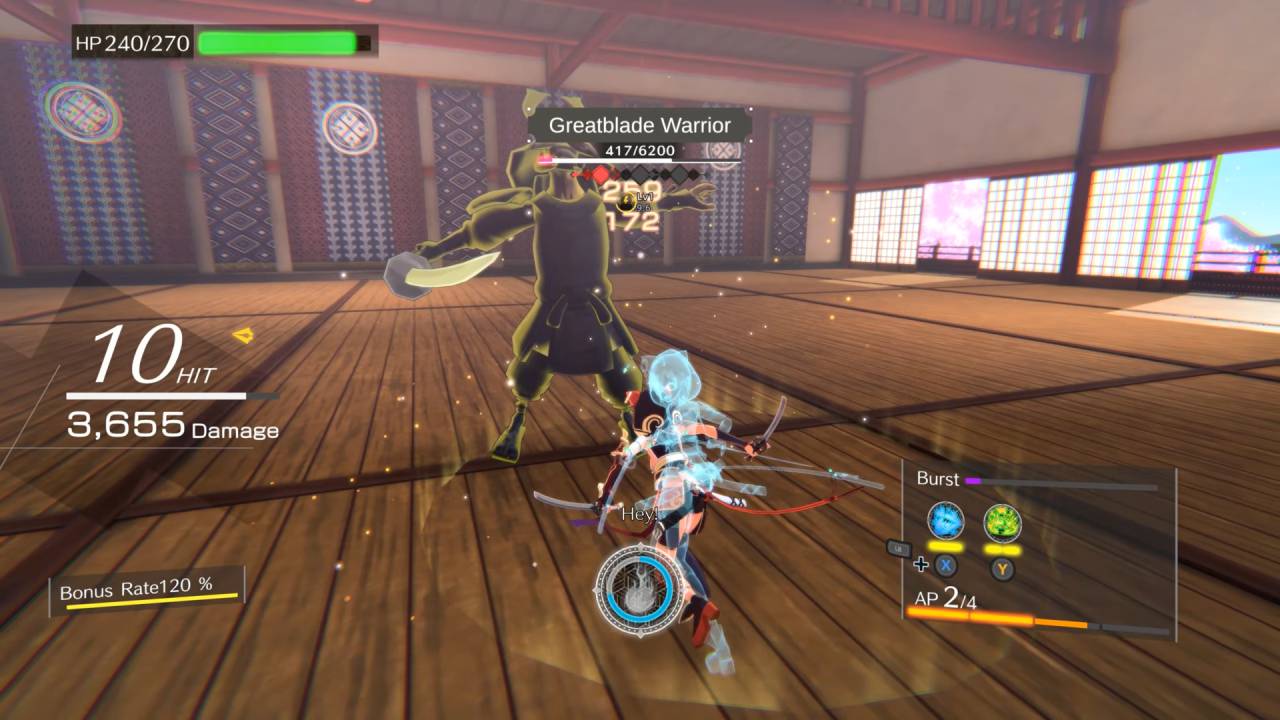
Retla fights with two blades, and you press the attack button repeatedly to string together basic combos, so the first few minutes feel natural. On top of that, you have light attacks, heavy attacks, and Arts, which are special moves tied to four buttons. You trigger them by combining a bumper with a trigger or a face button.

Normal attacks cancel into heavy attacks and Arts, heavy attacks cancel into Arts, and one Art can cancel into another. Landing hits inside the combo window raises the bonus rate faster; repeated elemental hits apply status ailments that stack up to level 5.
You pick your starting Arts before a run.
AP 2 launches Retla into the air and brings her down with a heavy strike that sends lightning damage around the impact point. Moon Bow throws wide slashes, Ice Rend sends a slash along the ground that cuts through several enemies, and Savage Claw delivers quick up-close strikes.
More Arts, such as Flame Kick and Wind Sphere Veil, unlock once you hit certain milestones. Since you can upgrade Arts during a run, you end up with a different fighting style each time. The Tension Gauge ties it together. Every hit fills it, and at 100 percent, Retla enters Overtension.
In that state, you gain AP much faster and can access Overarts, the game's strongest finishing moves, which can turn a bad fight around. The gauge charges through several levels before you can use it, so you decide whether to save it or spend it. It doesn't seem to carry over between floors, so holding it too long wastes it.
Defense gives you a few tools. The dodge covers backsteps, sidesteps, a nd a dash that carries you straight through enemies. A well-timed dodge counts as a Perfect Dodge, restoring AP and briefly slowing nearby enemies and projectiles. The barrier button works as a shield and as a parry.
Beyond the mechanics, the real question is which parts shine and which hold combat back.
A normal block holds until you take too much damage and the shield breaks, but a well-timed block is a Perfect Block, which restores AP, protects the shield, and sets up a counterattack. Blocking also fills the Burst Gauge, which you can spend on a Shield Burst that pushes enemies back when you get surrounded. Lock-on is mapped to RB, and the right stick rotates the camera.
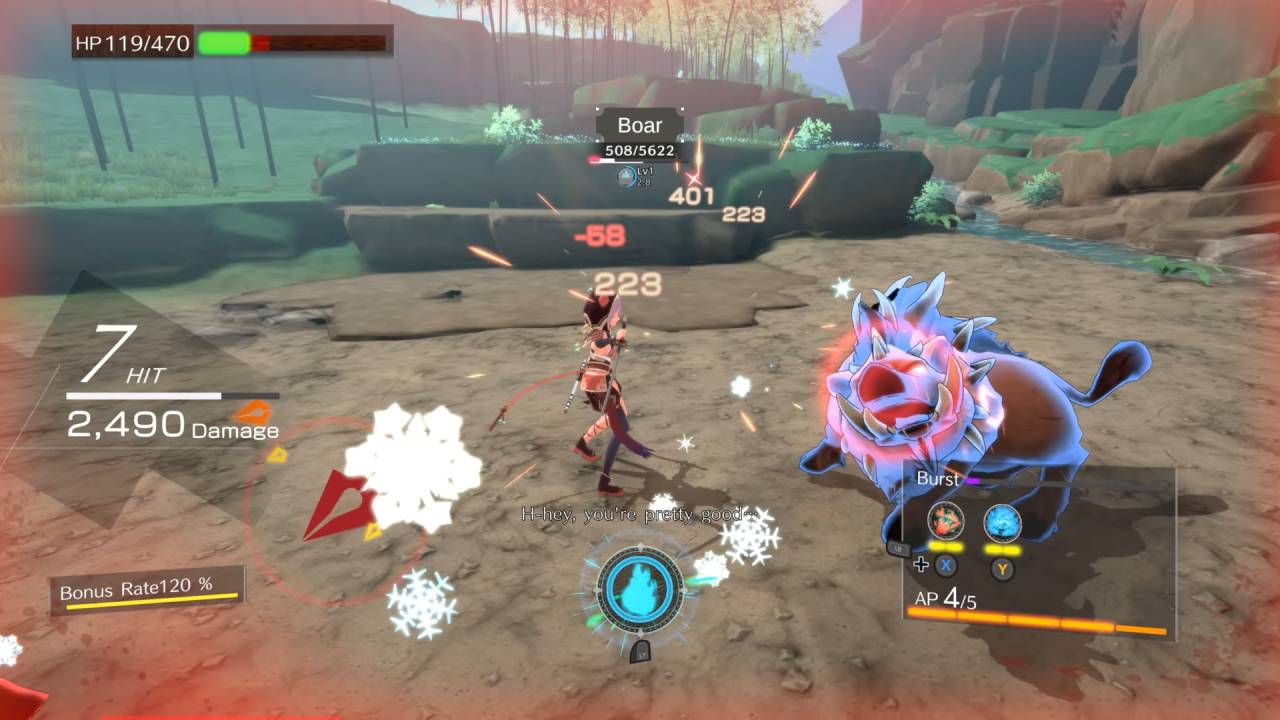
Most enemy hits come with a short visual warning, and bosses add pressure by demanding good spacing. A lot of Eternal Palace Sakura works well. The basic combos are easy to start with, and the Arts system gives you room to experiment.
Overtension gives every fight a point to build toward, and the choice to hold or spend the gauge keeps you thinking. The dodge options feel flexible, the lock-on helps in a crowded arena, and the Perfect Dodge and Perfect Block systems reward you for staying close to danger.
The loop can look repetitive early on, but it opens up as you unlock skills and reach new bosses. Eternal Palace Sakura has real problems too. The controls, especially the shield and dodge roll, can feel stiff and slightly delayed. The dash moves in the direction Retla faces instead of where the camera points, which causes awkward moments in a chaotic fight.
Attacks and Arts need you to stand almost on top of an enemy, and switching targets is harder than it should be, even with lock-on.
The camera angle is not ideal either, and some telegraphs are hard to read mid-fight. The design leans on memorizing patterns like a Souls-like, and a more traditional hack-and-slash approach would suit it better, though the memorization does give you a reason to replay.
Movement is limited compared with action roguelites like Hades or Curse of the Dead Gods. Retla has a dash but no jump and no aerial combos. For a swift warrior whose design hints at acrobatics, that feels like a missing piece, and if you enjoy the airborne style of Devil May Cry or Hi-Fi Rush, her mobility will likely disappoint. Frame pacing also stutters when many enemies crowd the screen, and bosses can bring occasional hiccups.
Progression in Eternal Palace Sakura works a little differently from a usual experience grind. Within a run, you collect Attributes, and there are more than 50 types. They raise your health and damage, unlock new actions,s and define your build. Rewards come from combat rooms, reward rooms, MS, and shops, and ranks go up to SS.
Early on, Attributes that add hits to your normal attack chain and raise critical rate give a real boost to survival. Beating the first area boss, a fast ninja commander who fights alongside regular enemies, rewards you with SS-rank Attributes, including ones that trigger status ailments with an explosion and ones that extend your normal attack chain.

When you die, Retla's level and the Attributes from that run reset, and you return to the bottom of the palace.
You do not come back empty-handed. The post-run screen shows your play time, the enemies you defeated, ted and the milestones you reached. Those milestones live in the Sakura Trials menu and make up the permanent side of progression.
Dealing a set amount of damage, building up Mugen Depth, or dying 20 times can unlock new Arts, higher starting HP, and new Art packs. That is the loop in practice: you fail, collect something, and try again on a slightly stronger foundation.
Mugen Depth shapes your whole approach to Eternal Palace Sakura. This meter rises with certain actions, including healing, retreating over map tiles you have already explored, and visiting certain rooms. The longer you spend acting on a floor, the stronger enemies become and the weaker you get.
Higher Depth scales enemy stats, applies random negative Depth Effects, and gives enemies their own upgrades. You lower the meter by paying HP at shrines and Sakura rooms, and some special Attributes give EC with every action while Depth climbs, a trade you have to weigh carefully.
In most roguelites, enemies stay fairly static from room to room, but here they respond to your choices on the map.
In practice, the balance can be harsh. Even a 40 percent heal from the cherry tree raised the Depth so much that the stronger enemies outweighed the benefit. The penalty for walking back over explored tiles was especially frustrating, since exploring is supposed to be a core part of a roguelite.
On the other side, a few good Art upgrades let Retla clear an entire room with one button press. The result swings between far too punishing and far too easy. A run that ends on floor three against an elite with heavy projectile telegraphs happens quickly.
In contrast, a later run with Moon Bow Void and Savage Claw, plus stacking damage, AP restoration, and critical chance, carries you through several floors of Riverside Frontier. Then a few chip hits from ranged archers leave Retla at critical health right before the boss, and walking in with almost no HP ends the run.
Visually, the character models in Eternal Palace Sakura look good, and Retla's anime design stands out. The environments change enough to keep the climb from feeling flat, moving from the opening dungeon to outdoor areas and icy zones.
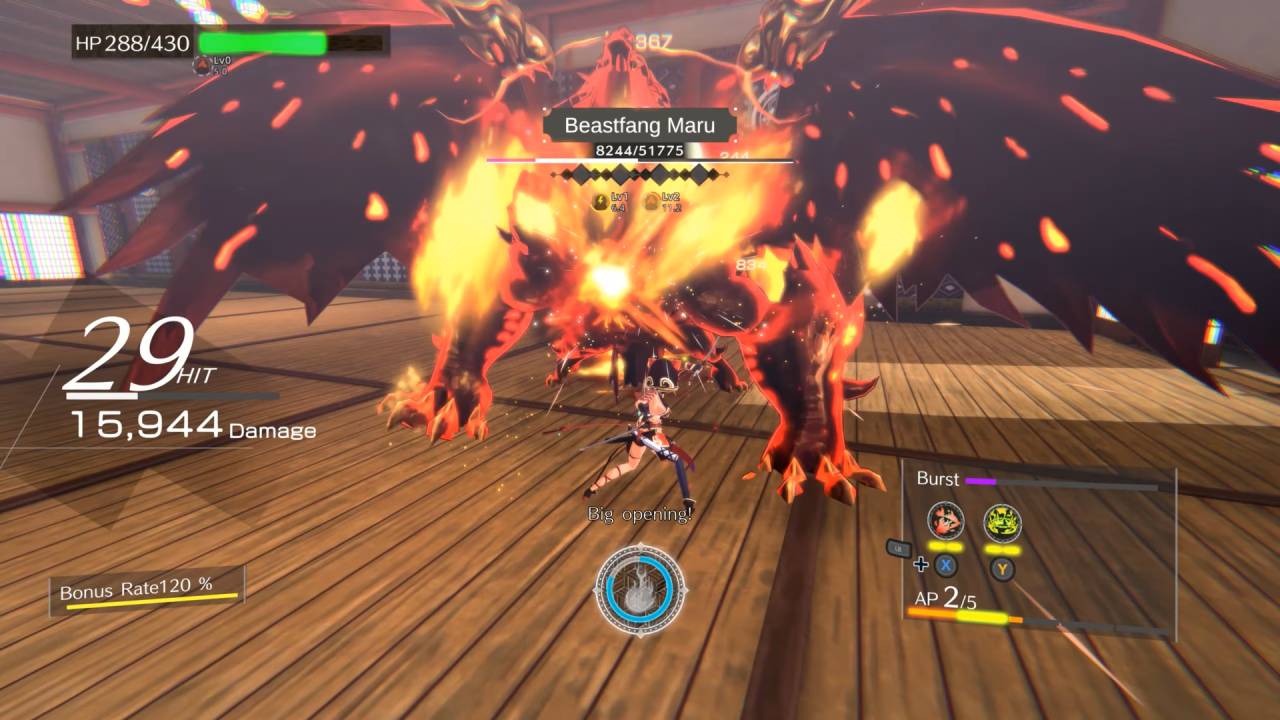
There is no clothing destruction here, and the roster is smaller than in Senran Kagura, so the appeal sits in the style and the combat.
The soundtrack in Eternal Palace Sakura fits the aesthetic and matches the pace of the fights. Audio stays balanced at the default settings, so you don't need to adjust levels before starting. It supports the action without getting in the way. This game is a project with a clear idea and a handful of interesting mechanics.
The Mugen Depth system, which makes enemies grow stronger alongside you, could make every choice on the map matter if the balance gets tuned. The four customizable Arts and Overtension leave plenty of room to try different builds. It comes across as a compact, energetic arcade action game centered on an anime character.
If roguelikes are not usually your thing, the character design and combat may pull you in anyway, and starting over after a death is simply part of the genre. At the same time, Eternal Palace Sakura will not suit everyone. If you want a deep story, you will not find one.
If you want acrobatic action with jumps and aerial combos, Retla's mobility feels limited. If harsh penalties for exploring do not appeal to you, Mugen Depth may feel more like a restriction than a challenge. For $12 on Switch, Eternal Palace Sakura delivers what you would expect from a roguelite take on Senran Kagura, and it offers a solid foundation to build on.
Editor, NoobFeed
Verdict
Eternal Palace Sakura is an energetic, affordable $12 anime roguelite with satisfying Arts-driven combat and a clever Mugen Depth idea, but stiff controls, limited mobility, and swingy balance keep it from reaching its full potential.
75
Related News
No Data.