
STEINS;GATE RE:BOOT Review
PC
A beautiful return to Akihabara that struggles to justify its existence.
Reviewed by Asura Kagawa on Aug 14, 2026
Few visual novels have had a cultural impact as profound as STEINS;GATE. Originally distributed as part of MAGES. The game soon became one of the most famous titles in the Science Adventure series because of its iconic characters, convoluted time-travel story, and eventual anime adaptation. I
It is set in a shared universe that includes the games CHAOS; HEAD, ROBOTICS; NOTES, STEINS; GATE 0 and ANONYMOUS; and CODE, and the series is connected by common concepts, organizations, and world-building. But regardless of that broader history, STEINS; GATE was always the clear showpiece, making it particularly tough to return to without wondering whether the story truly deserves another iteration.
That question gets more critical with STEINS; GATE RE: BOOT.
This isn’t the first time the renowned visual novel has been remade. STEINS; GATE ELITE updated the experience by using animated video from the anime and rewriting the original screenplay.
STEINS;GATE RE:BOOT emerges as a second interpretation, keeping much of ELITE's lean text but rebuilding the presentation from the bottom up. So you get a strange mixture of old and new: classic plot beats, fresh recordings, updated characters, additional scenes, and an entirely new Moeka route.
That sounds like quite a package on paper. In practice, the game often wants to save the original while also updating it. Its new look is probably its greatest success, though the narrative enhancements are far less ambitious than longtime fans might have expected.
The biggest question is whether STEINS; GATE remains great after several iterations of the same plot. It does. The question is: does this version give players enough reason to go through it all again?
At its heart, STEINS;GATE RE:BOOT is still the story fans know and love. Players play as Rintaro Okabe, also known as the self-proclaimed mad scientist Hououin Kyouma, who spends his days with the eccentric members of the Future Gadget Laboratory in Akihabara. What starts as a fun collection of experiments suddenly gets dramatically serious when Okabe and his friends realize their modified microwave can send messages into the past.
Those experiments become increasingly difficult over time.
The trio draws the attention of SERN, gets caught up in increasingly convoluted worldlines, and learns that changing the past has ramifications none of them can fully comprehend. The story’s greatest strength is still its slow build-up. The first few chapters build up characters, relationships, and the odd daily life of the Future Gadget Laboratory and then slowly morph into a gripping science fiction thriller.

Okabe remains the emotional core of the story.
At first, his over-the-top manner can be a bit much, but the writing slowly shows the insecurity and fragility beneath the Hououin Kyouma image. Kurisu Makise is just as significant, providing an intelligent contrast to Okabe and serving as one of the game's strongest connections. The supporting cast also benefits from the methodical buildup, with characters like Mayuri, Suzuha, Faris, Luka, and Moeka getting chances to develop along their own paths.
The largest story addition to RE is the new Moeka path. Moeka was the only heroine from the original STEINS; GATE who did not have a route. The new route takes inspiration from the Hyde of the Dark Dimension drama CD and its Gamma worldline, but it’s not a straight-up copy. The structure, character histories, and circumstances differ, giving the path fresh material of its own.
This contribution is especially noteworthy because of its potential connection to the larger Science Adventure universe. RE has room to grow beyond a simple remake with the Gamma worldline, the Committee of 300, and ideas brought forth through ANONYMOUS; CODE.
Unfortunately, the route is still somewhat short, which makes the potential look bigger than the real payout. Fans looking for a substantial new chapter in the franchise’s narrative might come away feeling they’ve witnessed a fascinating experiment rather than the dramatic expansion the series could have provided.
The remaining additions are similarly minor. Suzuha and Faris get more scenes, Luka’s route has been tweaked, and there are a few new moments sprinkled throughout the main tale. There’s also an important post-credits sequence after the true conclusion that lifelong Science Adventure fans will surely want to watch.
The main problem is that STEINS;GATE RE:BOOT still uses ELITE’s truncated script as its base.
Some of the descriptive content cut from ELITE is back, but a lot of the original visual novel’s extra writing is still missing. This is a weird compromise—RE is longer than ELITE but still shorter than the original. As a result, the pacing is simpler, but some of the internal storytelling and ambient details that made the original so immersive have been sacrificed.

STEINS;GATE RE:BOOT, like most visual novels, has no traditional combat, exploration, or mechanics. Your main job is to read the story, watch events unfold, and make choices that will affect the route the story takes. The core interactive system is still the phone-and-email mechanic.
Okabe receives messages from various characters during the story. You can select how to react, and those reactions can affect character pathways and ultimately lead to different endings. Several times, failing to act causes the plot to split into a character-specific ending, while sending the correct message lets Okabe move on to the next chapters.
Kurisu’s emails are vital to reaching her conclusion and, eventually, the true ending. This means responses that seem unimportant can matter later, encouraging you to listen to conversations instead of just scrolling through dialog.
Visually, RE is a little better, with some replies animated as if Okabe is typing them in real time. It brings a bit more immediacy to what otherwise is a stagnant procedure. Unfortunately, the remake loses one key convenience from the original: you can’t just back out once you’ve selected an answer and choose another choice.
Understandable and disappointing.
The phone system itself is not much different. The other Science Adventure games have brought in more unique interaction elements, such as the Delusion Trigger in CHAOS; HEAD and the hacking-based mechanics in ANONYMOUS; CODE. The phone system, by contrast, may be rather passive.
STEINS;GATE RE:BOOT has no traditional combat system, no puzzle-solving structure, and no advancement through XP. The challenge lies in knowing the story and making the right choices to unlock alternative paths and endings.
That works since the game is really about watching cause and effect. Every email, every response, every choice feeds into the larger architecture of the worldline system. The problem isn't killing foes; it's understanding the characters and how your actions affect the timeline.

The catch is that the phone mechanic doesn’t always feel meaty enough to be the main interaction system of the game. For the most part, the player just moves through the plot, with branching elements at well-regulated intervals.
There is no experience system, no levels, no grinding, no gear progression, and no character stat growth. The narrative is the only progression. You progress through reading chapters, hitting route branches, unlocking endings, and slowly piecing together the longer time travel puzzle.
This structure suits the genre because grinding would only detract from the tale. The player grows their knowledge of the world, rather than enhancing Okabe through statistics. Completing the various routes also gives you additional background, making subsequent playthroughs more meaningful.
The Observer feature has just been added, and it fits this evolution perfectly.
It describes the many worldlines and shows where the plot branches. It is a useful reference tool for anyone trying to understand the convoluted structure of STEINS;GATE RE:BOOT. Unfortunately, it doesn't go far enough to be a fully interactive chapter selection. This function would be much more useful if you could zoom out further or jump directly to previously completed events.
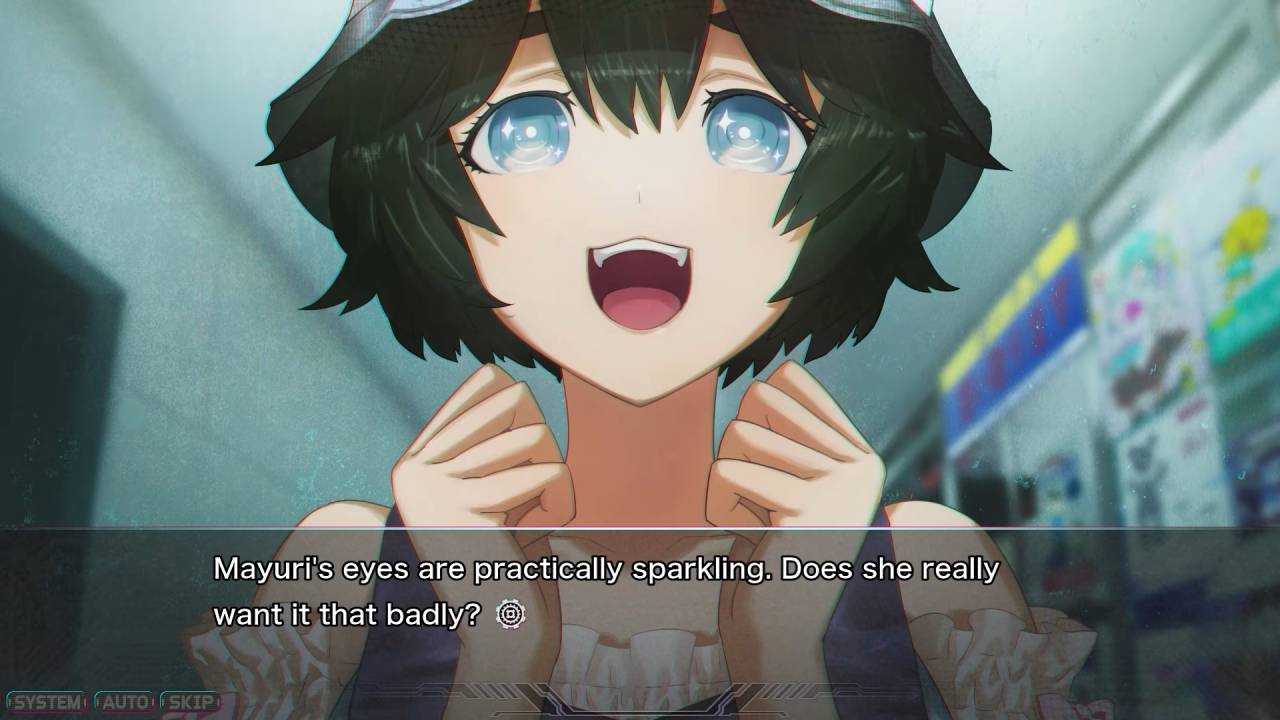
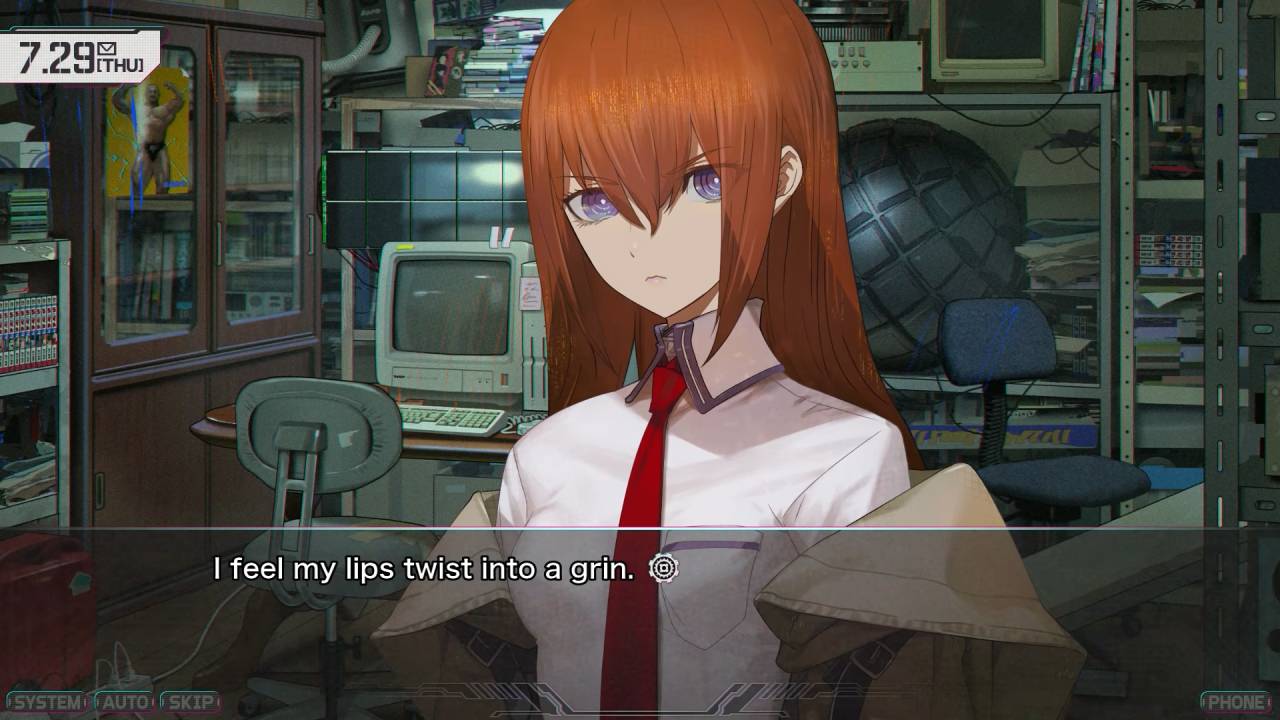
Perhaps the greatest achievement of STEINS;GATE RE:BOOT is in its visual presentation. They’ve painstakingly reconstructed the surroundings, and the reproduction of Akihabara as it looked when the original game took place in 2010 is particularly impressive. Streets, businesses, buildings, and landscapes are much more detailed, giving a great sense of place.
The character presentation has also been reworked with a 2.5D approach that uses the E-mote system. Characters now transition seamlessly between expressions and poses rather than just showing static sprites. The hair moves when people walk, faces shift from one mood to another, and tiny movements make interactions feel more alive.
This approach has a downside. The original STEINS; GATE had a distinctive visual identity, largely thanks to artist Huke. RE keeps bits of that identity but drifts closer to the anime's more approachable look. This can make the game easier for newbies to approach. But longtime fans may have to get used to the new style.

The cosmetic update, however, is well done. It doesn’t feel like a generic modernization that strips away the original's personality. Rather, it occupies a midway ground between the visual novel and anime versions.
The opening movie and other animation scenes have also been redone, but in the same direction as before.
Mamoru Miyano is still a remarkable Okabe. His enthusiastic and convincing portrayal of Okabe's over-the-top Hououin Kyouma persona, combined with his more subdued emotional acting, gives the character a good deal of depth. And Moeka gets the extra attention that Saori Goto gets with her new route.
The soundtrack has been rerecorded as well, albeit the compositions are still mainly recognizable. Some changes are subtle; others are more obvious to experienced players. The music is polished, like the remake itself, but retains the original's identity.
STEINS;GATE RE:BOOT is a good example of a remake that is remarkable yet difficult to defend at the same time. The core tale remains one of the best visual-novel stories of its generation. Okabe, Kurisu, Mayuri, and the rest of the Future Gadget Laboratory crew are still compelling characters, and the gradual shift from weird humor to high-stakes time-travel drama is still surprisingly effective.
The problem is that the game doesn’t go far enough beyond what came before. The updated graphics look outstanding, the rerecorded performances sound fantastic, the meticulously redone soundtrack is a treat, and the Observer system is a wonderful addition. The Moeka route also has real new material and maybe interesting connections to the greater Science Adventure universe.
However, these positives are offset by the fact that the game is now yet another retelling of a story many fans have already gone through numerous times. What makes the continuous use of the ELITE screenplay more aggravating is that it still omits some of the descriptive richness and internal monologue of the original visual novel. The new route, however, is interesting but too short to fully change the experience.
Ultimately, STEINS; GATE RE:BOOT works best as a modern retelling of STEINS; GATE, rather than a radical remake.
If you want to experience the traditional plot with current visuals and performances, you may find something to admire. But for returning fans, the choice is a lot harder. There’s no doubt that STEINS;GATE RE:BOOT is still worth experiencing. It really is. The question is, does this specific release have enough fresh content to warrant another trip to Akihabara?
The sheer technological polish and the evident love for the source material in RE create a slightly uneasy sense that MAGES could have really pushed for something much more ambitious.
Had this remake featured a brand new tale, a deeper expansion of the Science Adventure mythos, or a much longer Moeka route, it would have been a must-own title. It’s a cool but tentative return to a story that’s already had a few lives, though.
Staff Writer, NoobFeed
Verdict
STEINS;GATE RE:BOOT beautifully modernizes a legendary visual novel with outstanding visuals and performances, but limited new content and reliance on ELITE make another purchase difficult to justify.
72
Related News
No Data.