
Orbitals Review
Nintendo Switch 2
A co-op space adventure that turns an ’80s anime dream into a short, thoughtful journey built around communication, curiosity, and clever teamwork. Orbitals keeps its focus on shared problem-solving.
Reviewed by Adeela Tas on Sep 02, 2026
The people building Orbitals tell you almost everything about what to expect. Shapefarm's roster includes veterans who worked on It Takes Two and Split Fiction, and the studio has paired that pedigree with Japanese anime talent to chase a very specific look.
What comes out of that combination is a Nintendo Switch 2 exclusive built to feel like it stepped straight out of a late '80s or early '90s anime. That intention shows up immediately, right from the opening presentation: sweeping anime-style framing, cel-shaded characters rendered in 3D, cinematics that lean into a 2D aesthetic, and a score crafted to match the era it's channeling.
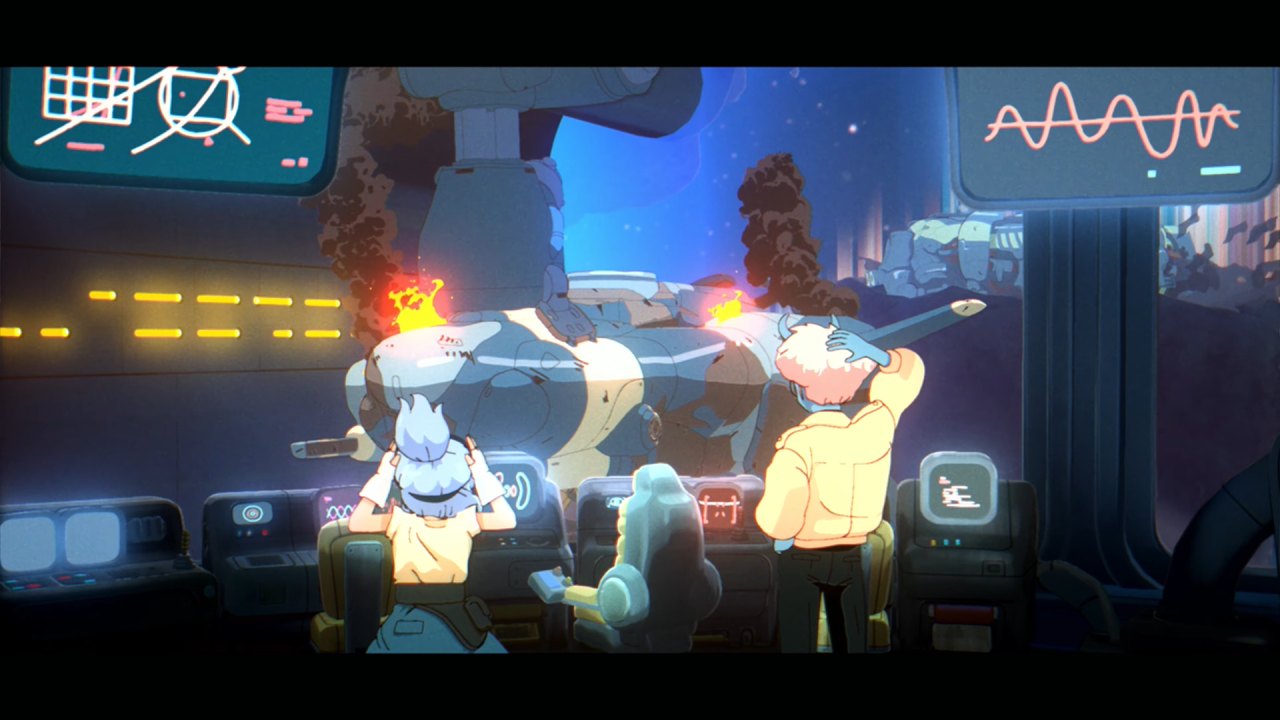
What sets Orbitals apart is that it simply won't let you play solo.
A second person has to be along for the ride from the very first scene to the last. That flexibility extends to how you connect, too: local co-op, online play, or GameShare, the latter letting a friend jump in without buying the game themselves via a friend-pass setup. Even playing remotely, split-screen keeps both viewpoints on screen at once.
The story opens with Maki and Omura as kids, thrown into chaos when their space Settlement is hit by the Storm Wall, a violent rupture in spacetime that puts their entire home at risk. Following the initial crisis and a jump forward in time, the two find themselves grappling with what's left behind, dispatched beyond the wrecked Settlement to hunt down technology that might keep their community from collapsing.
When death catches up with these characters, it's not the end — the I.M. Machine brings them back by constructing an entirely new body, one that somehow holds onto every memory, emotion, and thought they had before. This is what roots the story in science fiction, and it grows more compelling as the plot digs into questions of identity; namely, whether the duplicate is truly the same person.
Omura often wonders if each reprint still leaves him intact, giving the story room to explore what it means to stay yourself once your body has been remade. The problem is that these ideas rarely get enough room to develop. The game introduces interesting concepts about existence, the approaching storm, and the future of the Settlement, but often moves on before those ideas can deepen.
Orbitals also makes exploration part of that rhythm.
You can also notice this unevenness in the way information is delivered. Some questions raised near the beginning receive answers later, sometimes immediately after a puzzle or through a short radio conversation with Togen, the Settlement's leader. Important terminology and details about the universe can arrive quickly, leaving you to connect the pieces yourself.
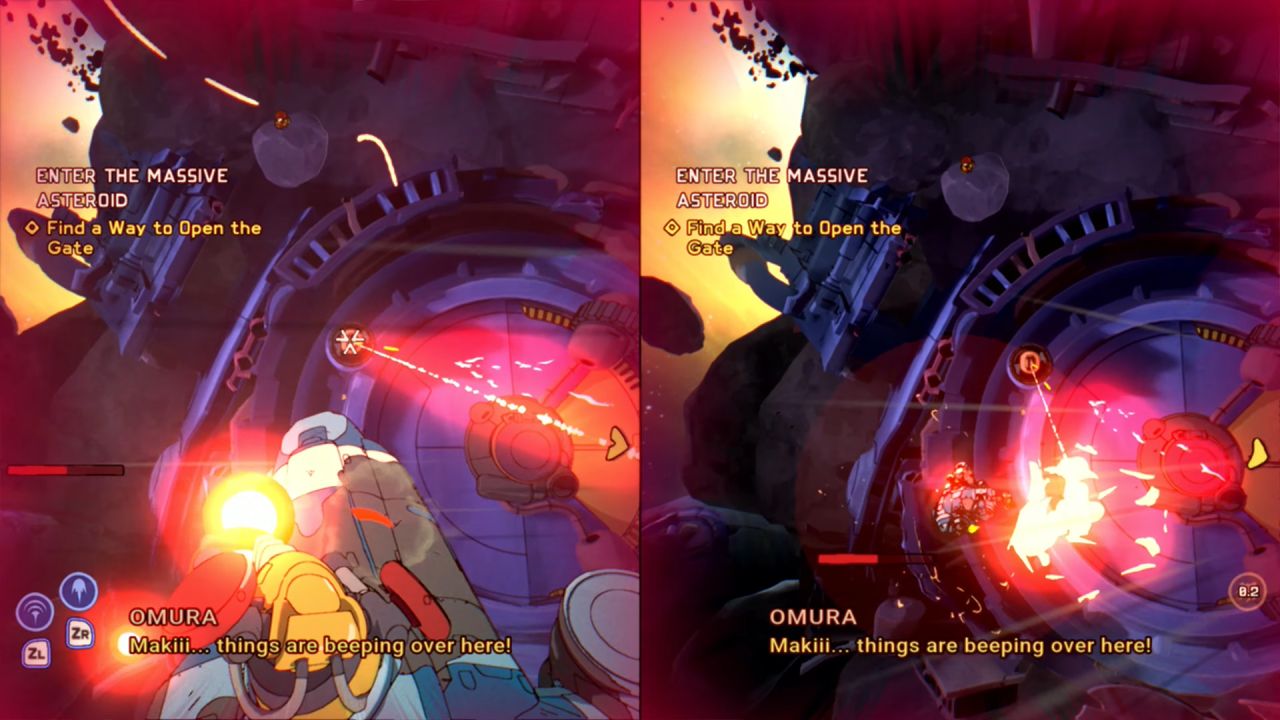
Maki and Omura themselves are easy to like, even if their personalities do not change as much as the setup suggests they might. Maki carries a more energetic, disorganized optimism, while Omura tends to be calmer and more analytical. Their contrast gives the dialogue a natural balance, and small details make them feel more personal than the main plot sometimes manages.
Their rooms aboard the ship reflect their personalities, while little running animations, gestures, and interactions with objects give them life between major scenes. The best way to approach Orbitals is without treating every strange object as something that must lead to a reward. The ship works as a hub where you can talk with its crew, investigate machines, find optional interactions, and discover diversions.
Later, new creatures and odd pieces of alien scenery appear throughout the environments. A strange object may exist simply because it is fun to activate. A creature may be worth interacting with because the animation makes the moment enjoyable. That curiosity becomes one of the strongest parts of the experience.
Once you leave the ship, Orbitals settles into a mix of travel, environmental puzzles, platforming, and space combat.
The ship itself requires two jobs. One player pilots while the other controls the main weapon, so reaching the next destination already involves coordination. You can boost, dodge incoming attacks, fire at enemies and hazards, and deal with missiles or destructible objects along the route.
The flight system is limited mainly to horizontal movement, with the game handling much of the vertical positioning, which can feel unusual when you want more freedom. The space combat does not develop very far. The same basic actions return throughout the adventure, and some encounters can feel underdeveloped.
Repeated travel sections can also be interrupted by loading, which is noticeable when the journey is short. The stronger part of Orbitals comes after you step outside. Before entering a mission, you can choose from a selection of tools, with certain stages requiring particular combinations.
That freedom gives you more control than a system where each character is permanently tied to one ability set. You can work with equipment such as a grappling-style scrap hook, a liquid launcher that behaves like a physical water cannon, a beam weapon that can power machines or interact through glass, and a spirit microwave that lets you manipulate objects and, at times, robotic creatures.
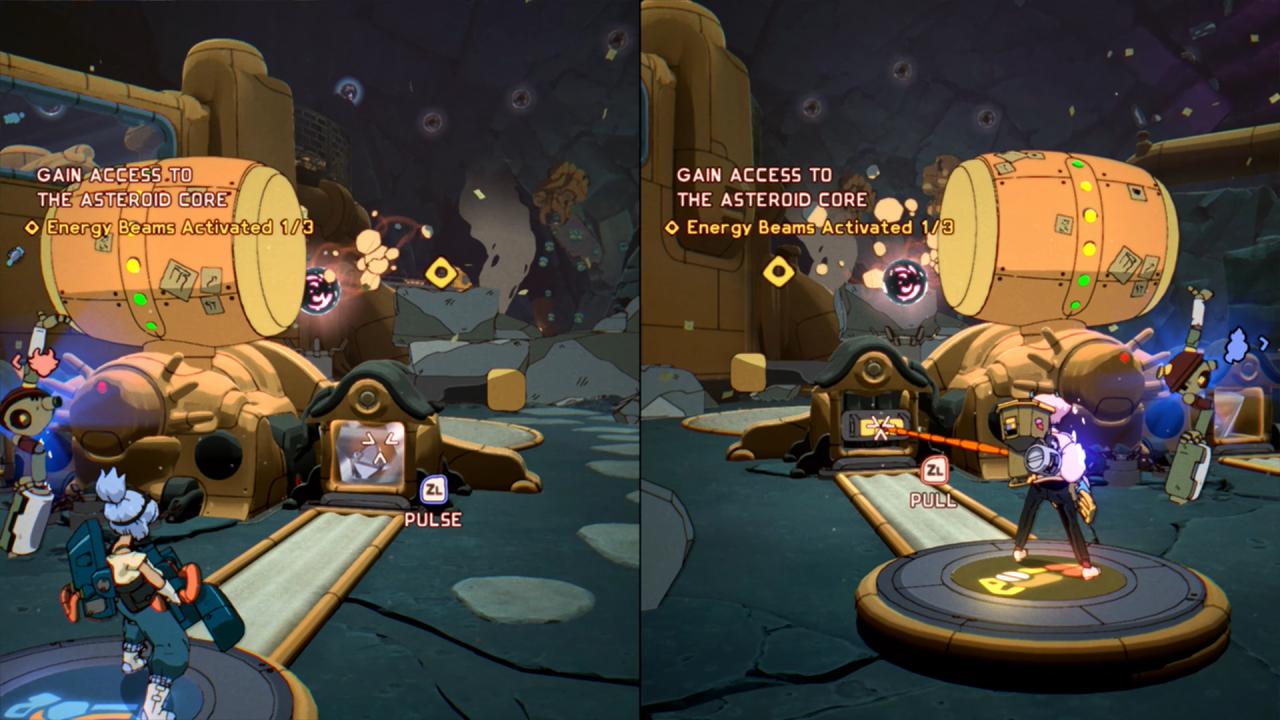
The game introduces its main tools relatively early, then changes the circumstances surrounding them rather than constantly replacing them with new systems.
That approach keeps the controls manageable and lets you concentrate on communication. It also means the game can sometimes feel more like a focused 3D platforming adventure than a traditional split-screen co-op title. You are constantly watching what happens on both sides of the screen and working out how one action affects the other player.
Since the split-screen never disappears, you can see a problem forming on your partner's side even before they notice it. That creates a particular kind of teamwork. You might understand the solution first, but you still cannot simply perform your partner's part. You have to describe what you see, wait for the other player to understand it, and then coordinate the actions.
When the two sides finally line up, the solution feels earned because communication becomes part of the mechanic rather than something happening outside the game. The puzzles vary in presentation. Some combine switches, platforms, grapples, and movement, while others ask you to manipulate objects together or guide a platform through tight turns.
A mining stage even builds its challenges around rhythm, with timed drums, moving platforms, and alien life reacting to the music. The most satisfying puzzles in Orbitals are the ones that make both players genuinely responsible for the solution. You can spend several minutes staring at the environment, trying an idea that seems ridiculous, watching it fail, and then suddenly understanding how the pieces connect.
The game often rewards lateral thinking and careful observation rather than simply remembering a sequence.
Mistakes usually lead to quick respawns, and previously activated mechanisms often remain active; experimentation carries little penalty. Still, the puzzle design has limits. The game can move away from a mechanic before you have had much time to master it, and some ideas appear only once when they could have supported additional challenges.
A few solutions can also feel unclear because the environment does not always communicate the intended interaction. You may complete something without fully understanding why it worked. The lock-on system can occasionally make precise interactions awkward as well.
Exploration in Orbitals has its own frustrations. Some areas can become difficult to revisit once you progress, and separating from your partner in certain spots can cause progression problems if you are careless. That is unfortunate because the game actively encourages curiosity.
Optional conversations, minigames, hidden interactions, and unusual creatures make you want to inspect every corner, yet moving forward can sometimes close off an earlier area without warning. Your best bet is to scout every corner before pushing ahead to the next area.
There is no traditional XP system or grinding loop driving progression here.
Instead, advancement comes from completing puzzles, reaching new locations, unlocking story events, finding optional interactions, and opening additional parts of the ship. That works well for the type of adventure being offered because the focus stays on cooperation rather than building characters through numbers. You are improving your understanding of the tools and the environment instead of grinding for stronger abilities.
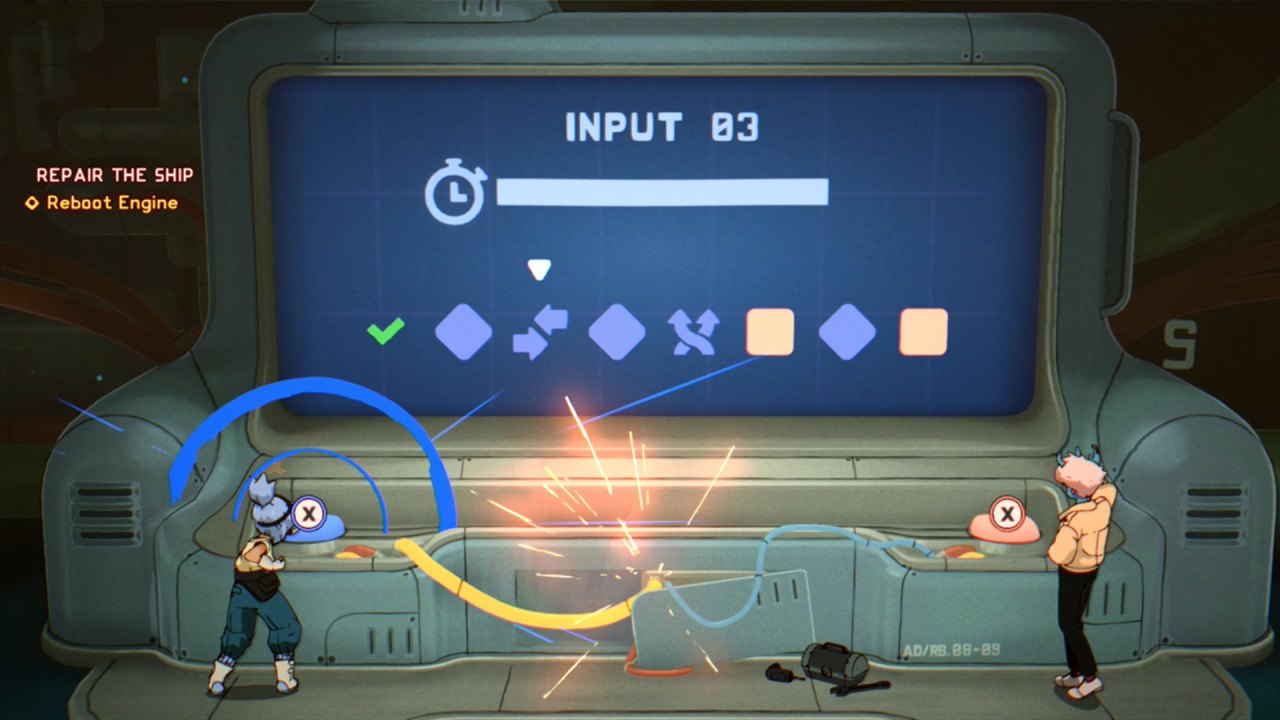
Boss encounters are where Orbitals most clearly tries to break its own routine. Rather than simply asking you to repeat the same puzzle skills, these fights can introduce changes during the encounter and force you to adapt. One particularly memorable type of sequence involves the ship being disabled while one player leaves the gunner position to repair or unfreeze it, as the other continues piloting and avoiding attacks.
These moments show how effective the co-op structure can be when the game builds a challenge around both roles at once. Visually, Orbitals is easily its biggest success. The intended anime influence is not limited to a filter placed over ordinary 3D graphics.
Character animation, lighting, framing, cutscenes, cel shading, and environmental design all work toward the same goal. Some cinematic sequences use 2D animation before blending back into 3D so smoothly that the transition can be difficult to notice. The overall presentation draws from the look of older anime while still using modern game technology.
Orbitals' Switch 2 performance is also carefully shaped around that visual direction.
The game targets a locked 30 frames per second, with character animation at 24 fps and some background movement at 12 fps. Those different animation rates help create the feeling of watching an animated production rather than simply playing a modern 3D game. Frame pacing remains steady, and the presentation can feel smoother than the number suggests because the animation style is so deliberate.
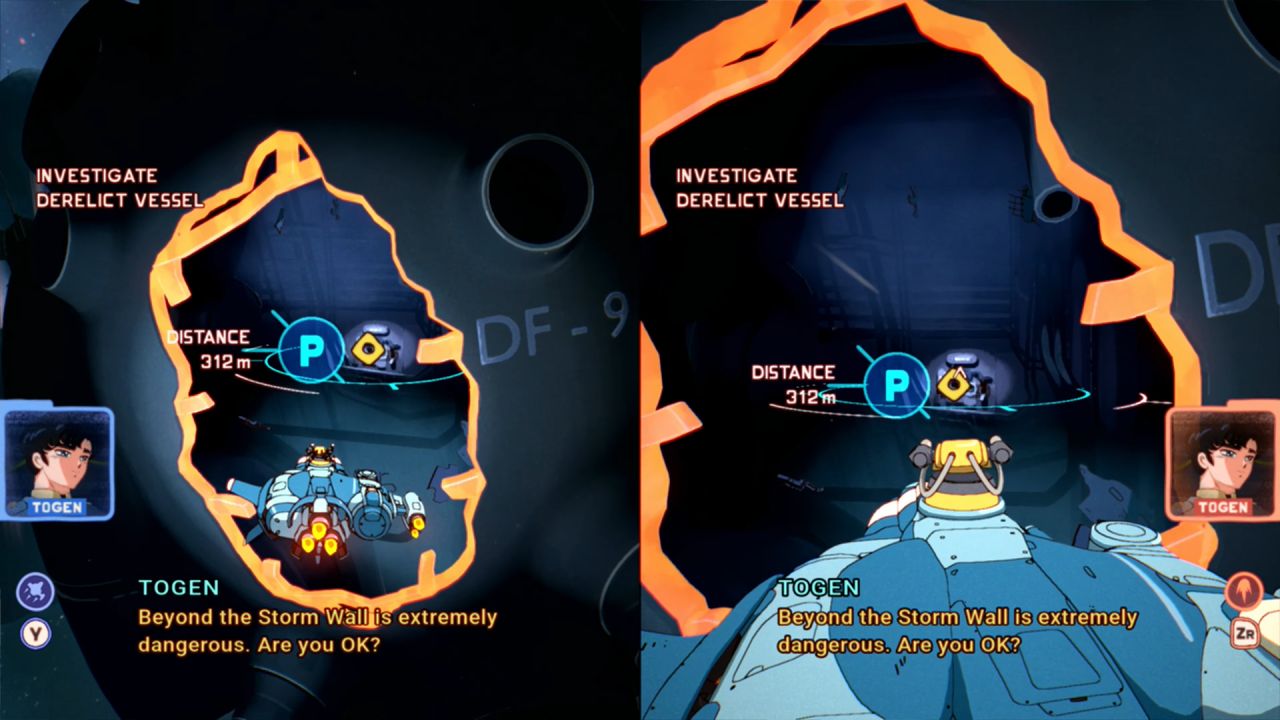
Screen shake can be disabled, although there are not as many Switch 2-specific control options as you might expect. There is no mouse and gyro aiming available, even though some weapons could use it. Standard controller movement feels good, although these features would have helped with aiming.
Handheld gaming entails another, rather noticeable trade-off. Because the split-screen remains active, each side of the display becomes smaller, and GameShare does not remove that requirement. The experience is therefore much easier to follow on a larger screen where both perspectives have enough space.
Orbitals' audio is another major strength. The soundtrack draws from the music associated with the anime era that inspired the game while still working as its own score. Dynamic music changes help give individual locations their own character, and the opening theme immediately establishes the intended mood. Voice acting is available in English, Japanese, and other languages, and it enhances the animated elements of the game.
The adventure lasts for about seven to ten hours, depending on how fast you go through it, and this makes it not too long for a game of co-op.
You will need one copy of the game for the GameShare feature, which lets two players stay together in online play even if they are apart. The price also sits below the cost of a typical full-priced release, making the shorter runtime easier to accept. By the end, the game's greatest strength becomes clear: it understands that co-op is not simply about putting two characters in the same level.
The split-screen, asymmetric tools, shared responsibilities, and environmental puzzles all require you to communicate. That structure can be frustrating when a partner misses something obvious, but it can also create the best moments because the solution belongs to both players.
Yet the world consistently gives you reasons to keep exploring. The anime presentation, soundtrack, ship interactions, varied puzzle scenarios, and small character details make the journey easy to enjoy, even when its larger ambitions are not fully realized. As a co-op adventure, the game succeeds most when it stops trying to be bigger than it is.
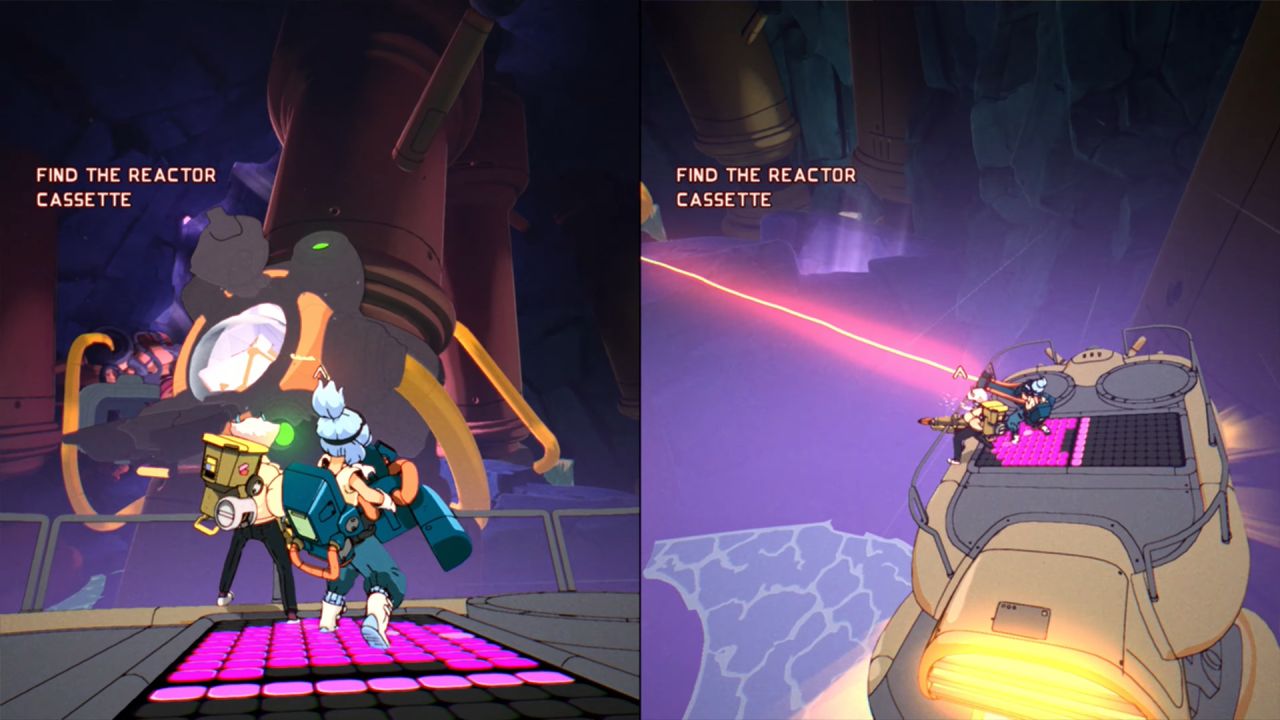
You get a compact trip through strange stations, alien environments, dangerous space routes, and a ship that slowly becomes familiar. You learn to communicate rather than simply solve everything yourself. Every gadget you pick up begs to be tested, every puzzle throws a curveball that leaves you scratching your head, and somehow you never mind pushing forward; there's always another weird room or unexpected encounter waiting just ahead.
If you've got a Switch 2 sitting there and you're on the hunt for something to play with a second player, this one hits different.
A strong visual identity paired with co-op mechanics that are easy to pick up but still leave you feeling like you actually accomplished something. It may not be the deepest or most varied of the best co-op titles, nor is the story as fleshed out as some would like, but it is still worth the trip. The adventure ultimately leaves its strongest impression by turning curiosity and communication into the main reward.
You are not collecting XP to become stronger or grinding through repetitive combat to unlock the next ability. You are learning how the world works and learning how to work with another player. That is a simple idea, but when the two sides finally coordinate and the solution clicks, it gives the short journey a satisfying sense of accomplishment.
Editor, NoobFeed
Verdict
Orbitals delivers smart co-op, varied puzzles, strong anime-inspired presentation, and a memorable world, though its story and final stretch leave some potential unexplored.
89
Related News
No Data.