
Ratatan Review
Nintendo Switch 2
A rhythm-driven roguelike where you lead a loud little army toward the Everafter.
Reviewed by Adeela Tas on Oct 14, 2026
If you played Patapon when it first came out, Ratatan's core idea will feel familiar before you press a single button. Patapon came out almost twenty years ago as a rhythm game where you led a tribe of small eyeball creatures into battle by tapping beats on the face buttons.
It was a strange little project, born from designer Hiroyuki Kotani's work with French artist Rolito Giuli, and it built a loyal following without ever becoming a household name. The two games in that series were later bundled into a remaster, giving fans a reason to return.
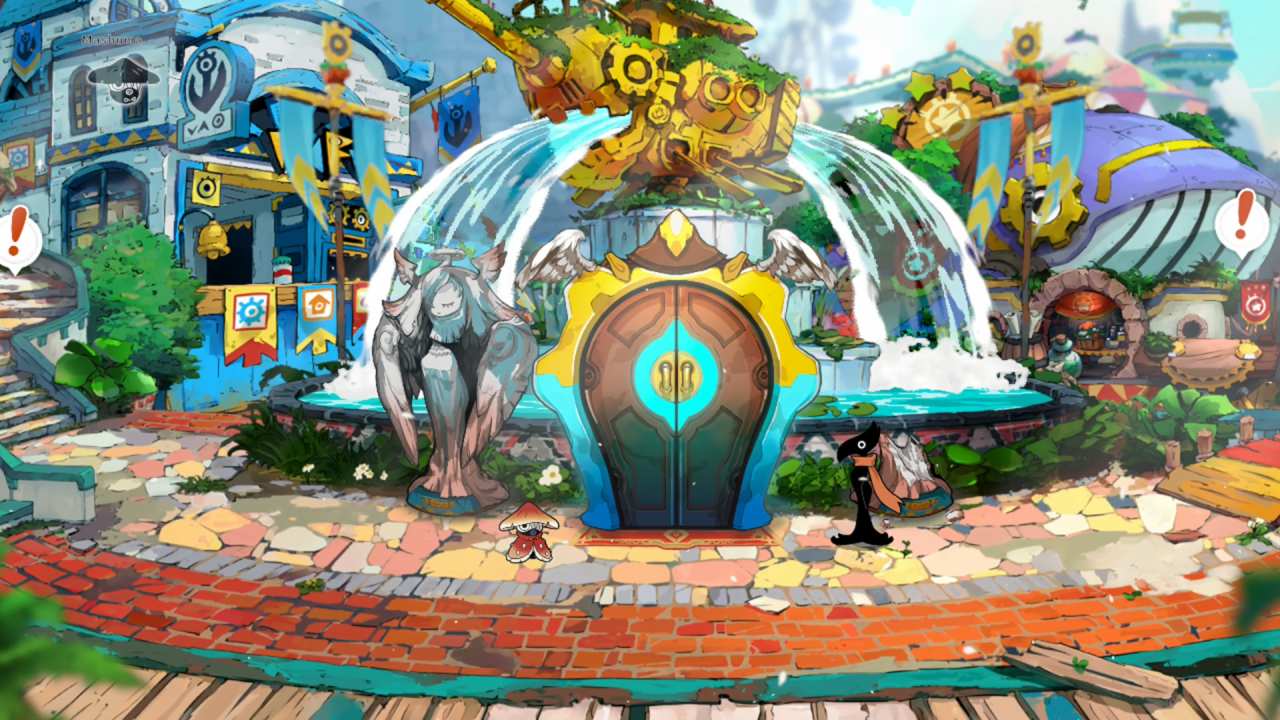
Ratatan is what Kotani has been working on since.
It began as a crowdfunded project, spent time in Early Access, and now arrives in full from the studio Ratata Arts, with Game Source Entertainment publishing. Kazuto Sakajiri is the lead producer, and several original team members returned to help.
This is a spiritual successor, not a direct sequel, and that changes how you should approach it. On Switch 2, it costs $34.99 and carries an E10+ rating. If you expect a second Patapon, you'll be confused. If you go in expecting a roguelike built on the same rhythm idea, you will be in a much better spot.
The story is simple and doesn't demand much of your attention. You play as one of the music-loving animals living on the island of Rataport, and they all share the same dream: reaching a place called the Everafter and meeting the Goddess who watches over them.
A large crow-like creature named Crow wakes you up and sets things in motion, and from there you cross rough country on your way. Along the way, you run into hostile tribes called the Testa, pirate captains, local wildlife, and giant monsters that take up most of the screen.
A pirate ship floats alongside you during stages as one of your guides, though you will probably forget it is there once the fighting starts.
The tone is light and a little tongue-in-cheek, with cartoon violence paired with a cheerful look. Underneath that, something darker is going on. Hints of a stranger and a darker backstory show up here and there, and the speech bubbles over your troops add to it.
Many are plain encouragement, but others are blunt, including a bubble that just says "Murder!" and another announcing that it is time to go to Hell. You will miss plenty of them because you are busy staying alive. The same goes for the lore, since new pieces come out slowly and often require repeated runs to uncover.
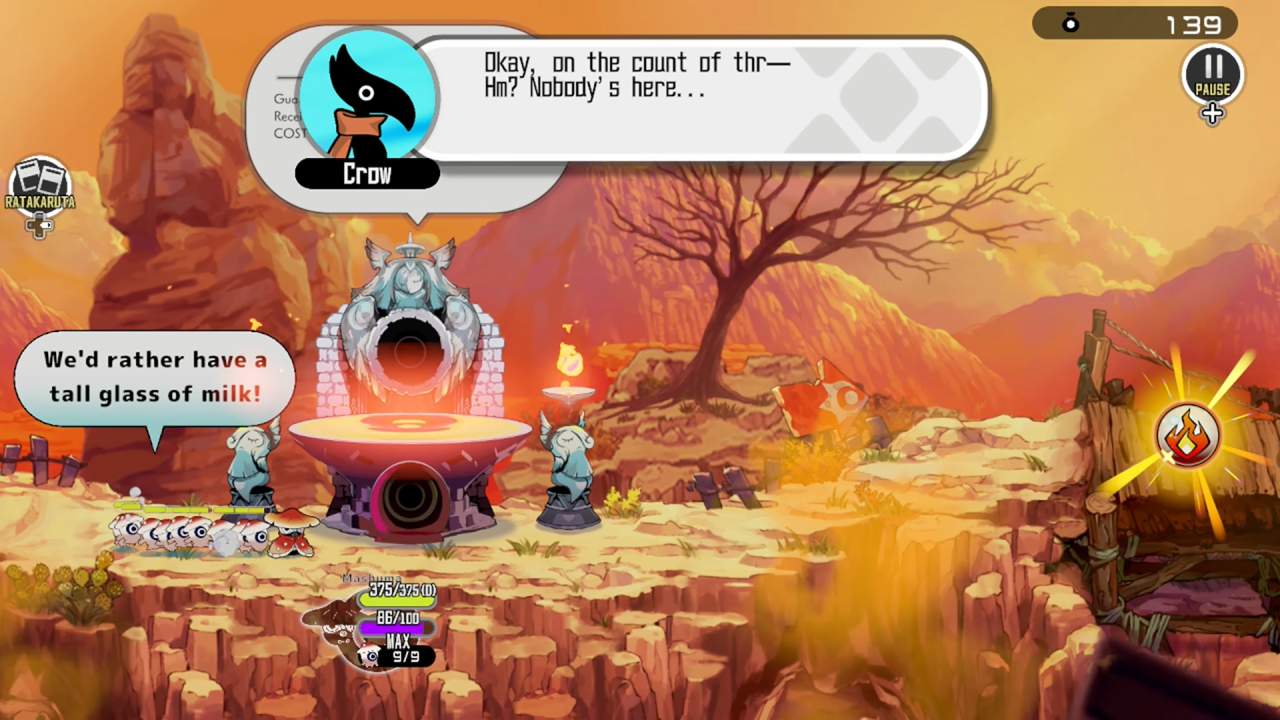
Every run in Ratatan has you moving through side-scrolling stages, much like the older games, except now you walk your own character around the battlefield. Your character can run and jump, and that is about it. Your army of Cobun handles the fighting; small creatures who carry weapons and follow your commands.
Your job is to put your character in the right spot so that, when you call the Cobun over, they land within range of the enemy. Cobun have their own health bars, but when they fall, they return after a while. Your character is the weak point. If they die, the run ends, and you're sent back to the hub. A run's structure is linear.
You go through five worlds, each divided into rooms joined by gateways.
After you clear a room, you choose what the next gate gives you: a health top-up, a shop stop where you can spend on trinkets, or a Ratakaruta card. Some rooms, called Intervals, have no combat and only hand out rewards. Each world ends with a boss. It follows the pattern you may know from other roguelikes: pick a reward, walk into the next room, fight, and repeat until you win or get knocked out.
Choosing a gate that hides an unknown enemy, hoping for a buff that carries you through the next boss, becomes a hard habit to break. Combat in Ratatan is where the rhythm comes in. Music plays whenever you enter a room with enemies, and you give orders by pressing a sequence of up to three buttons in time with the beat.
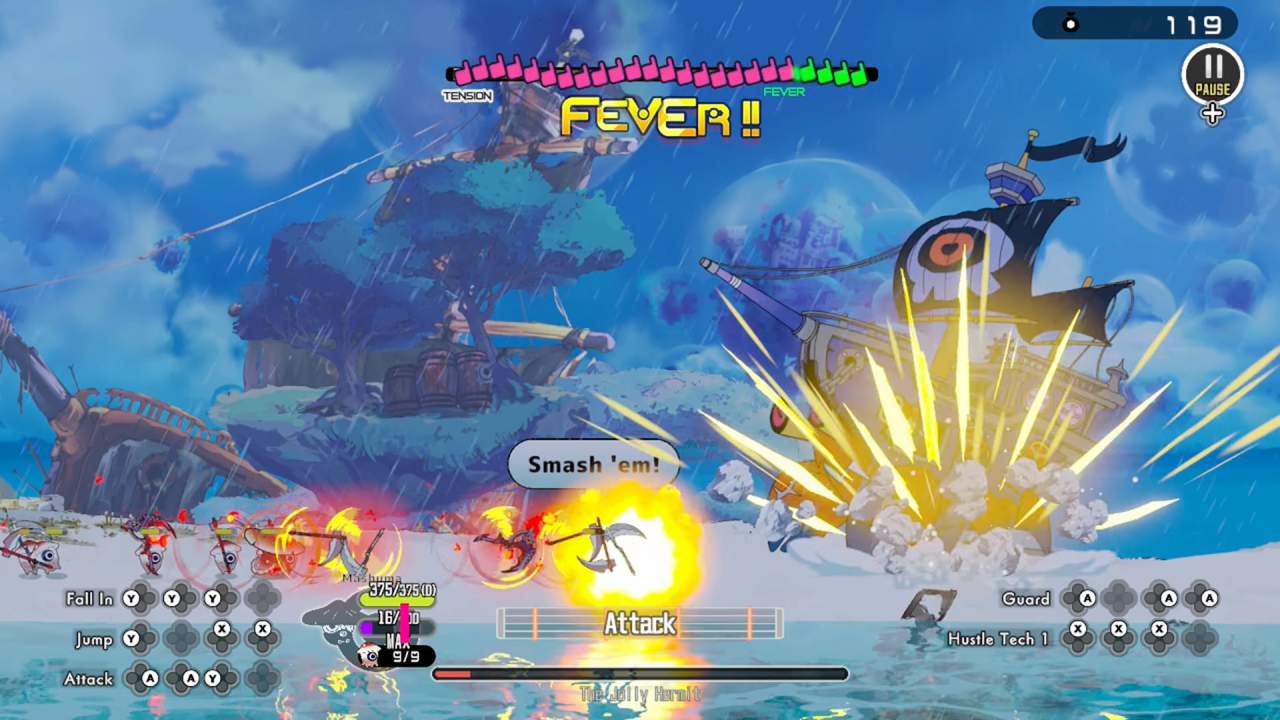
Even though the music runs on a four-beat count, you only input three. The chants have names like Ra-ta-tat, Zun-taka-tan, and Ya-hoi-hoi, and different combinations trigger different commands. You can order a basic attack, a guard, a jump, or a move that pulls the whole group toward your character. Special skills, called Hustle Tech or Rush, also cost MP.
If you press a pattern you haven't unlocked, or press the right one with bad timing, the Cobun just stands there. A list of available commands sits at the bottom of the screen, letting you learn the inputs before the game lets you use them. Timing matters.
Good presses earn a JUST rating, restore more MP, and fill the Fever gauge, which is also called Tension.
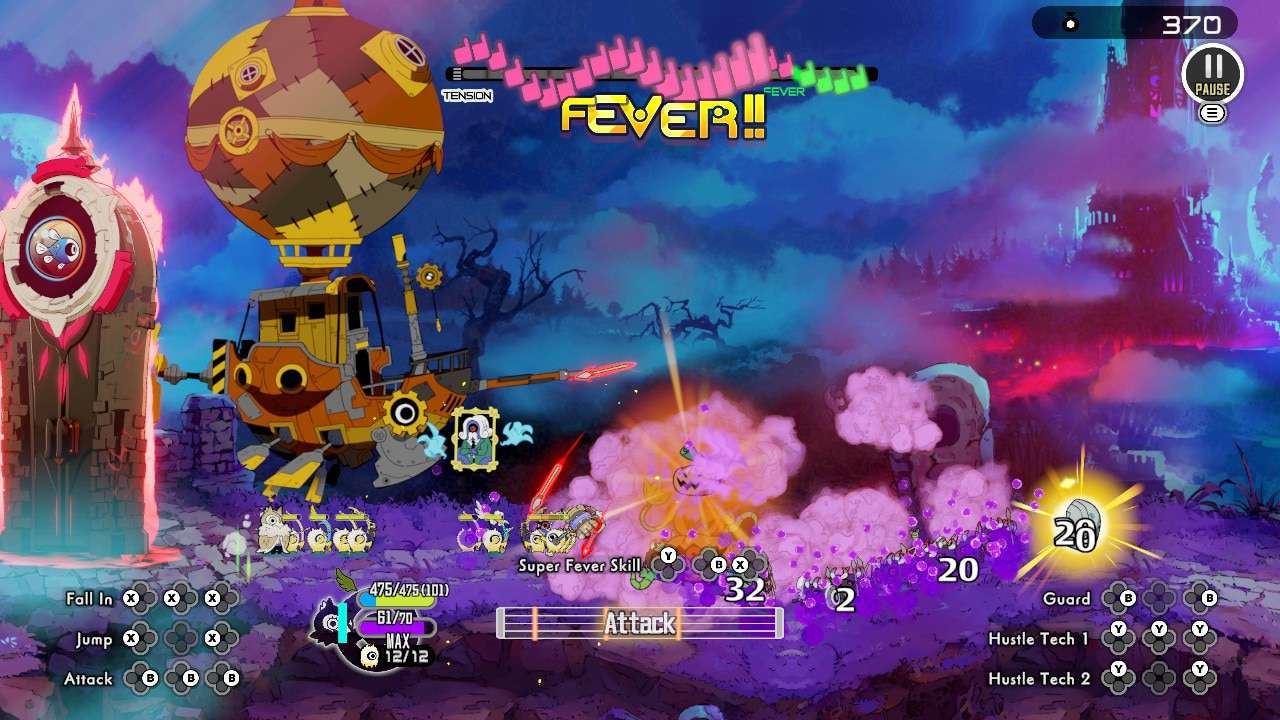
When it is full, you can trigger an unlockable Super Fever attack, and that one always uses the same buttons. You do not have to be perfect, though. The timing windows feel forgiving, partly because you can move your character freely. A good sense of rhythm helps your performance but isn't strictly required.
The default setup is simpler than the older games, but you can switch to an advanced mode if you want the original's more complex button commands back. The best part of Ratatan's combat is how it ties your two jobs together. You decide when to call the Cobun in, when to send them at an enemy, and where your character stands while you do it. That adds strategy the older games lacked.
Boss fights show it best. The attacks are clearly telegraphed, each boss has its own look, and some fill the screen. When your gear is strong enough, these fights shine. The bad side shows up when things get crowded. Your character has to stop moving to play the musical commands, so in a hard fight you either stand still and risk a hit while you tap out a pattern, or you keep dodging and let the Cobun sit idle.
Idle Cobun means your Tension drops and your damage falls with it. It feels like being a general who also has to fight, with troops that refuse to act on their own. At some point you will wish for a bit of automation. Your character can also vanish into attacks from both sides, and a few enemy moves catch you off guard.
Newcomers may also find the onboarding thin; the prompts help, but the game does little to explain how the pieces fit together.
Next come the Ratakaruta, the cards that define each run in Ratatan. They are elemental buffs covering fire, ice, water, thunder, poison, and wind. Some change how your normal attacks and Rush skills work. Others give passives, such as making status effects hit harder or generating shields.
They come in different rarities, and collecting several of the same element unlocks unique passives and eventually opens the door to stronger cards, including ones that blend elements. You can swap cards by hand. If you find a card that adds poison to your attacks, you might have to remove a wind card that boosts your critical hit rate to make room for it.
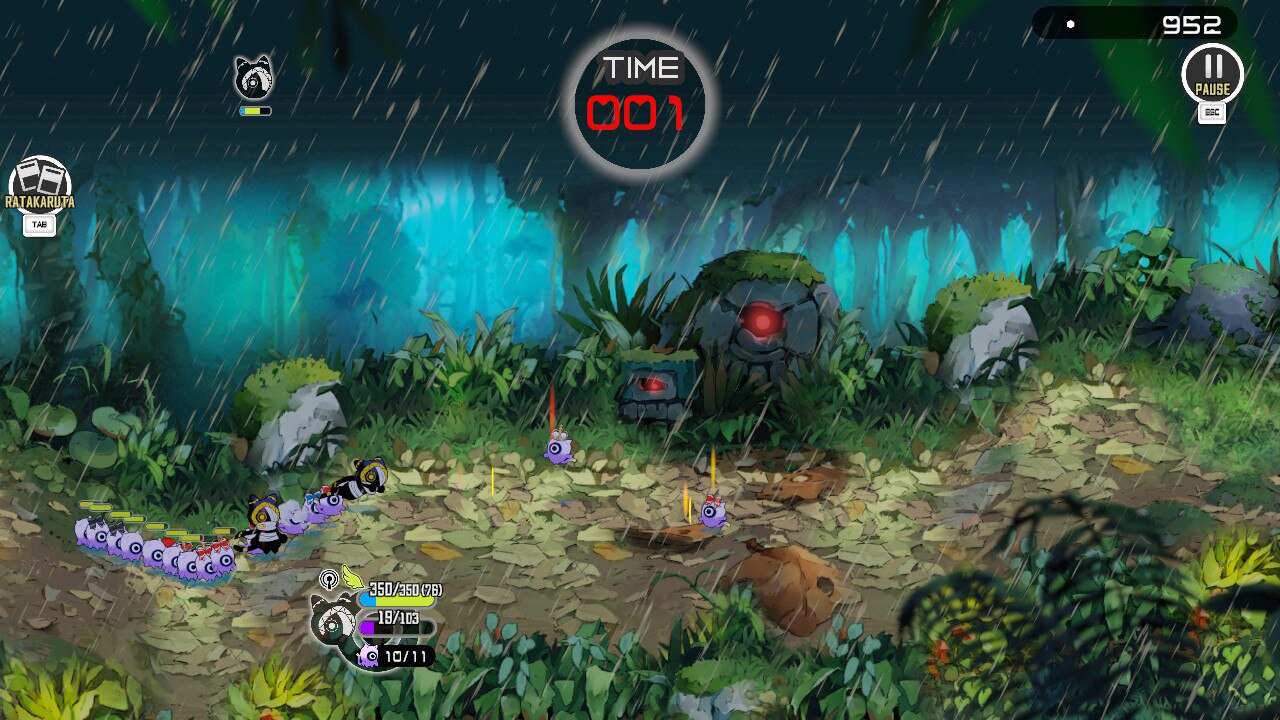
This part works, but it has weak spots. Some cards feel close to useless. You can get one that makes burn do 38 percent more damage when you can't inflict burn, which is like getting a saddle before you own a horse. The game also does little to link the elements, so planning a build offers little reward, and you end up taking whichever option has the biggest number.
A poison build and a fire build can feel nearly the same in practice. Still, when a strong card shows up, the damage quickly gets out of hand. Some bad rolls will also end a run early or make you want to start over. Ratatan's real weight lies in what happens between runs.
When you return to Rataport, you can spend what you collected on permanent upgrades.
Some are unlocked with candy, donuts, and other sweets, which suits the cheerful mood, and they cover things like more health, stronger Cobun, and guaranteed room types. Achievements, like beating the first boss or clearing ten rooms in one run, also give rewards. Equipment, materials, and candy stay with you even if you lose, so each attempt feels like a small step forward.
You can also craft weapons and feed unneeded gear into your best ones. The blacksmith is one of the few places in the hub that does not flash an alert when something new is ready, so you can easily forget it exists and wonder why you are falling behind. This is where the grind enters, and it shapes how Ratatan feels from hour to hour.
Each character has two Cobun classes, and each uses a different weapon type, so the weapons you build up might not match the character you want to play. Weapon upgrades are the main way past the first world, since enemy health jumps sharply afterward.
Beating the second boss can take hours of repeating the same stage to farm materials, and the third is the same. Many meta features are locked until the first end-credits sequence, including the option to swap weapon classes for each character. That discourages trying new characters, because they start behind your main and need a lot of work to catch up.
Reaching those first credits in Ratatan takes around twenty hours, and that only covers the first of three episodes.
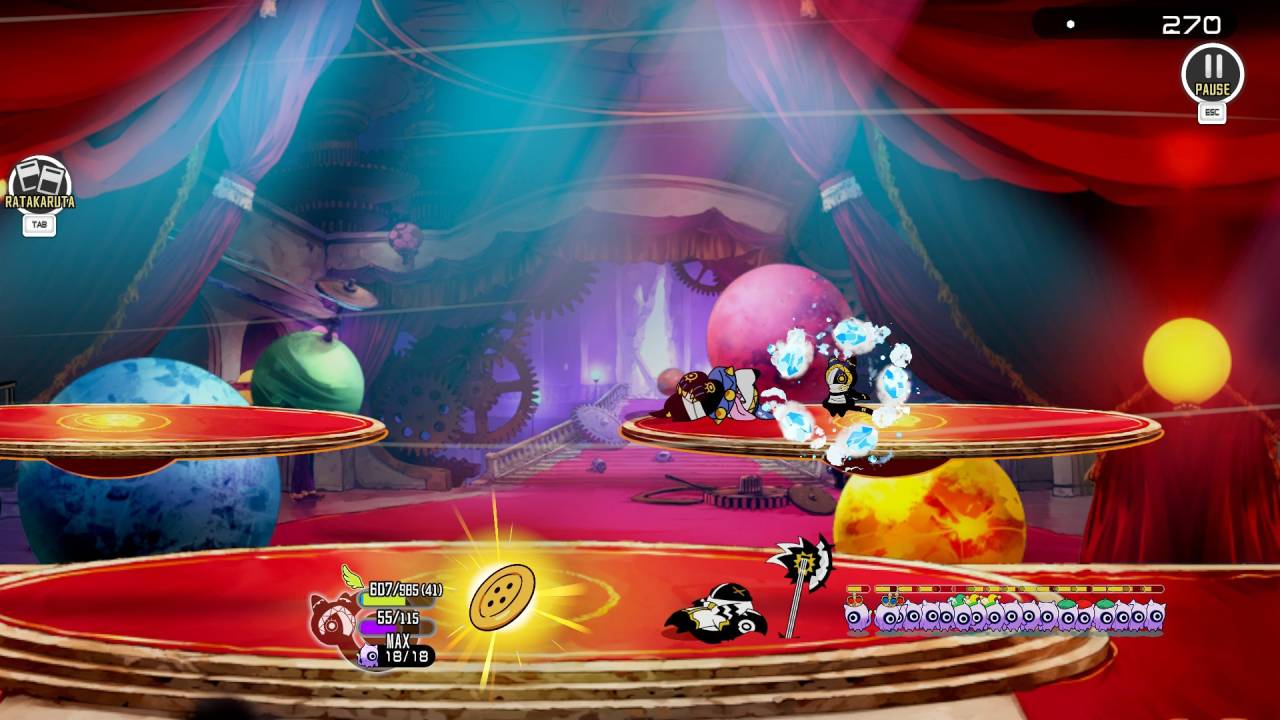
After it, you unlock challenge modifiers and boss variants. The variants add new elements and more aggressive attack patterns and are mostly well-made, but by then you're fighting the same five bosses over and over. Episodes two and three reuse the same environments and demand rare materials just to raise each weapon's level cap.
If the grind works for you, there's plenty to do. If it doesn't, the game starts to feel like a test of patience as you wait to hit the damage threshold that lets you brute-force your way through. The hub is also quiet, with little activity to break things up. Co-op is an open question. Ratatan supports four players online, which would likely make the chaos louder, but it doesn't include local co-op.
Visually, Ratatan is bright and busy. Where the older games used a minimal look, this one goes for a cel-shaded carnival style with strong colors and big, chunky characters. The animation is frequently excellent, and each world has its own look and theme.
Bosses are another standout, with designs big enough to fill the screen and plenty of personality in how they move. The hub could have been a plain menu screen, but it has real charm. Still, trying different characters is worth it just to see their gear and accessories, and the cast runs from a bunny with a guitar to a pirate ship.
Performance on Switch 2 is mostly smooth, with a steady frame rate.
In handheld mode, the game fits well. The side-scrolling stages and simple controls suit the smaller screen, and the explosions read clearly. Up close, some character models show a little pixelation. Docked, the picture is sharper, and the cartoon style comes through more cleanly, though a few rough edges can make it feel less polished.
The game freezes during a few room transitions, which is rare but odd for this hardware, and some runs ended early because of technical problems. The screen also gets so crowded with effects that you sometimes have to search for your character.
The sound in Ratatan is loud, and that is the first thing you notice. Instead of tribal drums, the game leans into a marching-band feel. Your character shouts, your Cobun chant like children, and the background instruments are dense, so your ears rarely get a break.
The voice work follows a call-and-response pattern in Japanese and fits the game even if you do not speak the language. The characters are slightly off-tune on purpose, which makes them sound like odd little friends heading out on a trip. Kemmei Adachi and Sadaki Naoe composed the music, and it deserves good speakers or headphones.
The music reacts to what you do.
It changes when you enter a combat room, shifts again for Interval rooms and boss fights, and gets more interesting the longer you keep the rhythm going into a Fever. A more melodic soundtrack also makes hitting the beats easier. The problem is variety. With five worlds, you get roughly five main themes and a few boss tracks, and the later episodes reuse the same environments with nothing new.
Because the rhythm system depends on listening, you cannot mute the game. After many hours, the same handful of tracks starts to wear on you. Ratatan has a strong core, but its structure sometimes works against it. The rhythm combat is satisfying, the controls are easy to learn, and moving your own character makes it feel more active than the older games.
The colors, the characters, and the music give it personality. The roguelike layer gives you reasons to come back for one more run, and carryover rewards keep you moving forward. The weapon grind, limited music and stage variety, occasional freezes, and busy screen hold it back, and you have to accept that this is a different game from Patapon.
If you liked the older games, or you enjoy leading a small army with music, you will find a lot to like here, and it is an easy pick if you are open to trying something new on Switch 2. If you want a deep roguelike with lots of build variety, the rhythm controls and grind may frustrate you. Ratatan works best when you know what it is and don't measure it against what you hoped it would be.
Editor, NoobFeed
Verdict
Ratatan pairs sharp rhythm combat with a catchy, colorful roguelike loop, but the weapon grind and repetitive music wear you down at times. Fans of Patapon and newcomers will enjoy it.
79
Related News
No Data.