
Blades & Battles Review
PlayStation 5
QUByte Interactive's hack-and-slash adventure brings back the Golden Axe era with modern controls, co-op combat, and a surprisingly flexible visual style.
Reviewed by Mahi Araf on Sep 29, 2026
If you grew up playing games like Golden Axe, Knights of the Round, Gauntlet, or Rastan Saga, you probably know exactly what Blades & Battles is trying to recreate. These old-school arcade brawlers had a simple formula: pick a warrior, walk from one side of the screen to the other, beat up anything that gets in your way, take down a few ridiculous bosses, and have a good time doing it.
That formula has become much less common over the years, which makes Blades & Battles an interesting throwback. Developed by QUByte Interactive, the game is a 2.5D side-scrolling hack-and-slash that clearly wears its influences on its sleeve. It feels like someone took the classic fantasy arcade brawler, kept its straightforward structure, and rebuilt it with a modern engine.
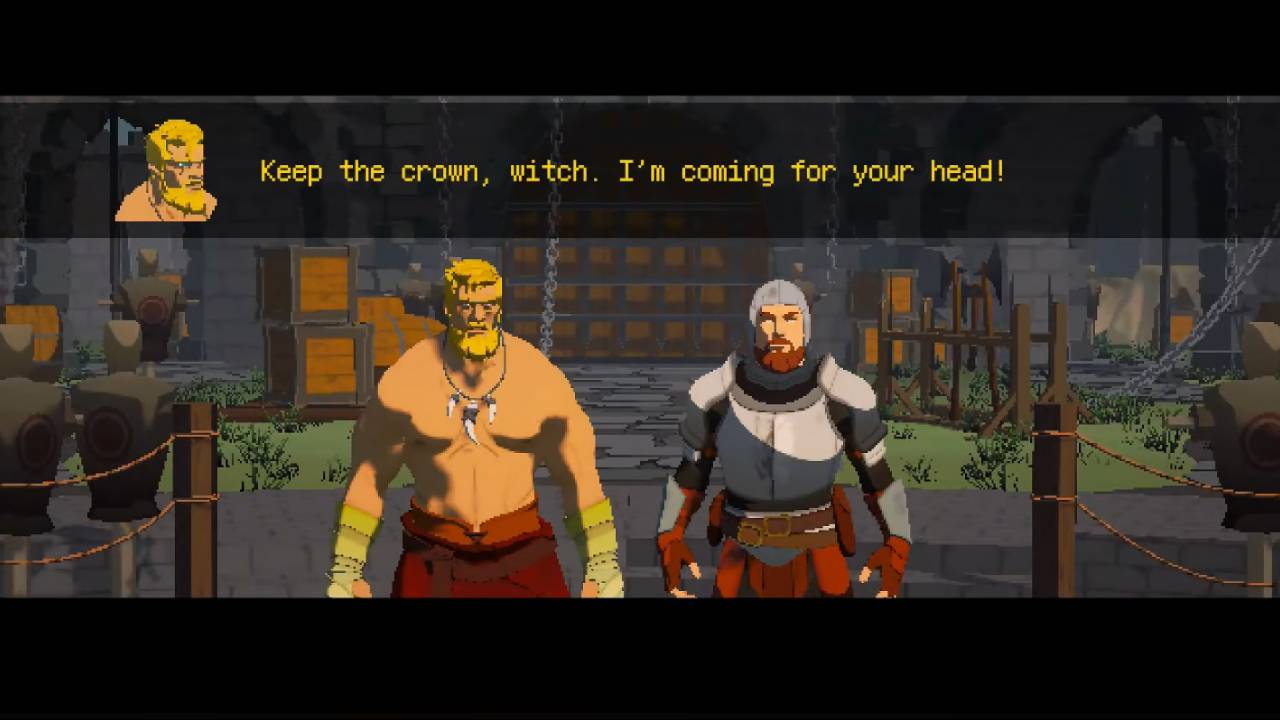
The developers have been open about the games that inspired Blades & Battles, with Golden Axe, Gauntlet, and Rastan Saga being obvious references. You can also spot little nods to other classics as you progress through the stages.
Some locations and encounters feel deliberately familiar, and part of the fun comes from recognizing what the developers are paying tribute to.
At the same time, this isn't simply an old game with a new coat of paint. Blades & Battles runs on Unity, offers modern visual options, supports two-player local co-op, and gives its two playable characters very different combat styles. That combination makes it feel more like a modern interpretation of an arcade classic than a straight recreation.
The story keeps things simple, which is probably the right choice for this type of game. Blades & Battles takes place in a fantasy Arthurian setting before the famous Round Table has even become part of the legend. You play as a young Arthur, fighting alongside his companion, Lancelot.
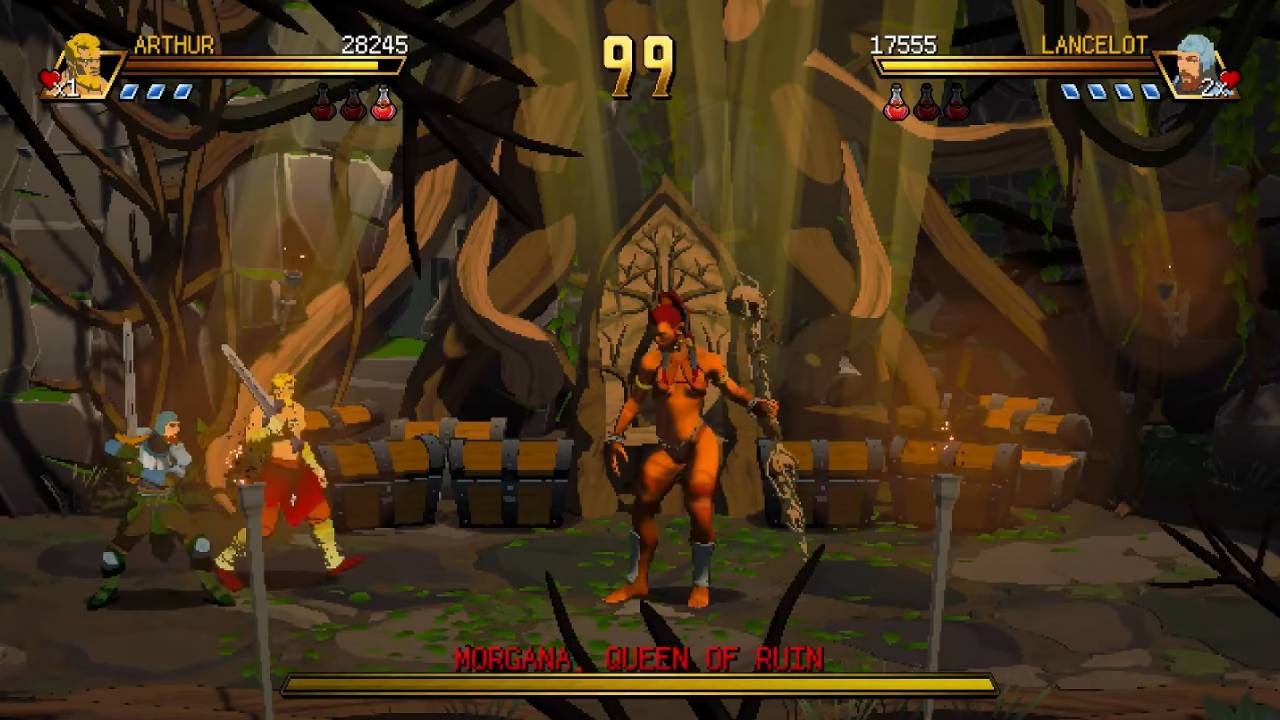
The kingdom of Camelot is under attack by the sorceress Morgana Le Fay, who has unleashed hordes of supernatural creatures and mythical beasts across the land. Morgana has also taken Merlin, giving Arthur and Lancelot another reason to set out and fight their way through the kingdom. From there, the story mainly moves you from one location to the next.
You travel through dark forests, mountains, caves, and other fantastical locations, facing monsters and bosses that stand between you and your objective.
There isn't much dialogue or character development, and Arthur and Lancelot don't spend much time having serious conversations. You get a few small interactions through the game's cutscenes, but this is clearly an arcade-style adventure first and a narrative-heavy game second.
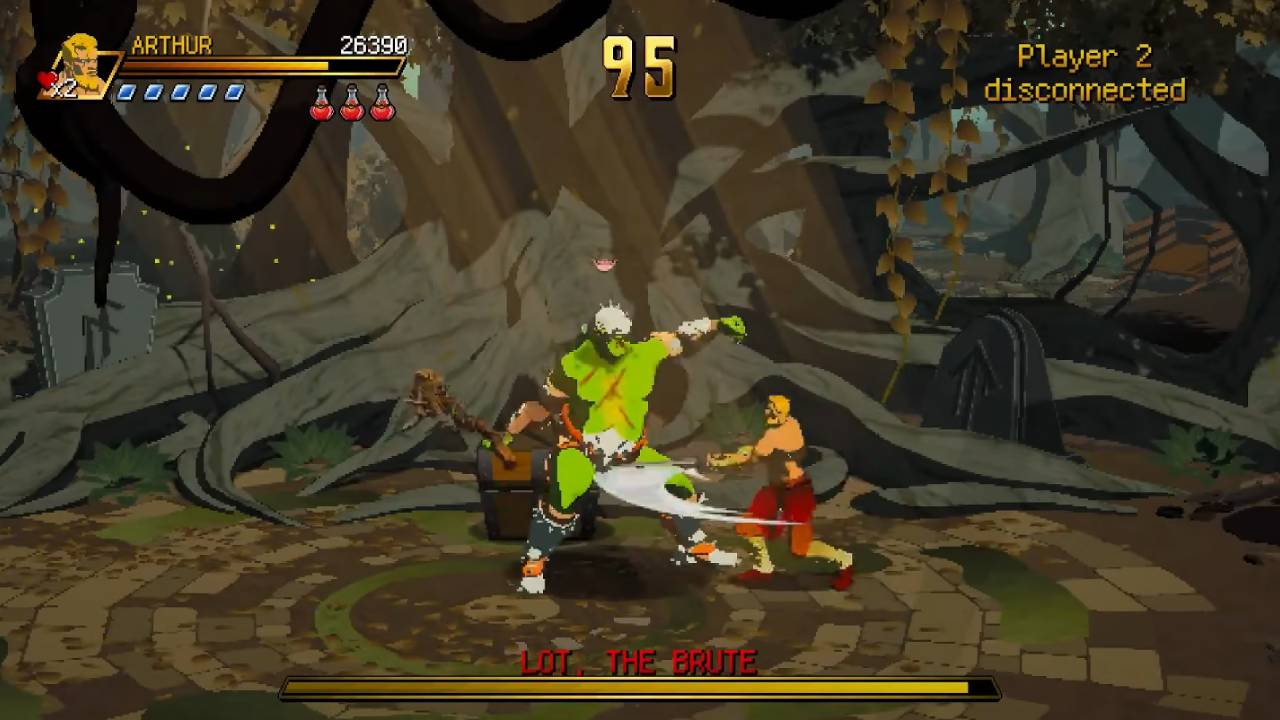
That works in its favor. The story is easy to follow, doesn't take itself too seriously, and gets out of the way when you need to start fighting. The Arthurian setting also gives the game plenty of room to introduce recognizable characters and fantasy creatures without overcomplicating things.
The basic gameplay is exactly what you'd expect from a classic beat 'em up. You move through side-scrolling stages, fight groups of enemies, dodge attacks, use your abilities, and eventually face a boss. You can play alone or bring another player into the campaign through local two-player co-op.
The biggest difference between the two playable characters is their combat approach.
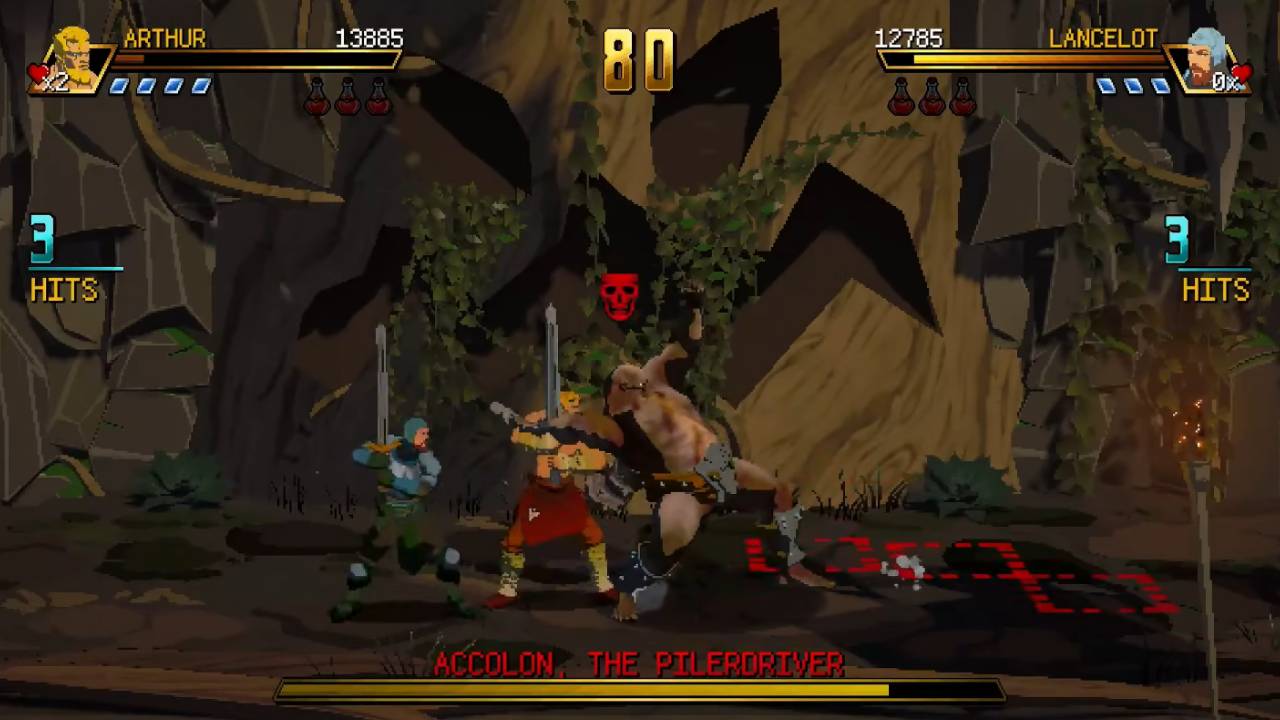
Arthur focuses on strength and crowd control. His attacks hit harder and feel heavier. This lets him deal with groups of enemies more easily and create space when he's surrounded. He lands heavy hits that can send a few enemies flying, making him feel like the duo's tank.
Lancelot is almost the reverse. His fighting style focuses on speed, agility, and precision. His attacks are faster and can be chained into multi-hit combos. He also has a dash that lets you close the distance to an enemy or quickly move away from danger.
Because the two characters aren't simply palette swaps with different appearances, choosing between them actually changes how you approach the stages. A group of enemies you might handle by pushing forward with Arthur might require a more careful, mobile approach as Lancelot.
This becomes even more interesting in co-op.
Having Arthur controlling groups of enemies while Lancelot moves around them and focuses on individual targets creates a natural division between the two characters. It gives the co-op more purpose than simply putting two players on the same screen.
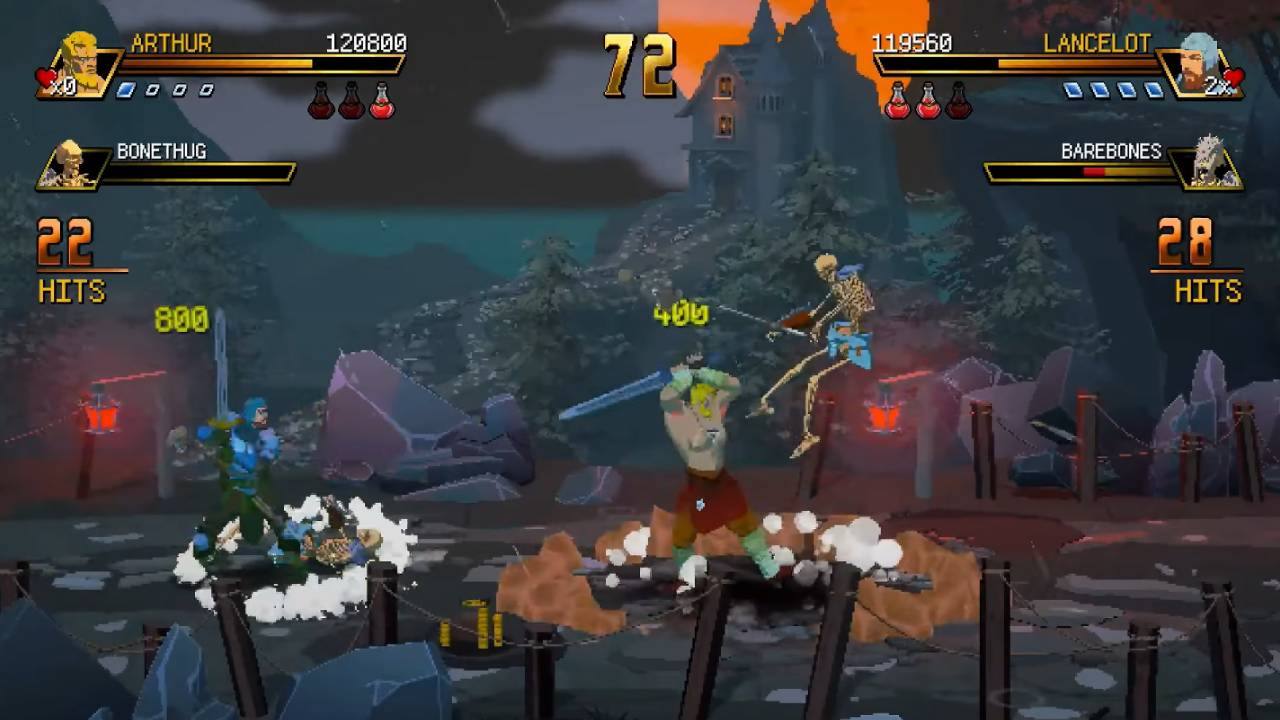
Your character also has to manage health and a mana bar while using abilities and avoiding incoming attacks. You have access to special moves, magic, and desperation attacks, giving you more options than simply hitting the same attack button over and over.
The combat can become surprisingly technical. You can launch enemies into the air and continue striking them while they're airborne, building long attack chains. Pulling off one of these combinations feels satisfying, especially when several enemies surround you and manage to keep the sequence going. So, while the basic structure is familiar, there is a skill ceiling here for anyone who wants to learn the combat properly.
You have to pay attention to positioning, enemy attacks, dodging, and the timing of your own moves.
Blades & Battles doesn't really have a traditional puzzle system. The challenge is almost entirely based on combat, movement, enemy placement, and learning how to handle each encounter. This is where the game succeeds most of the time, though it has a few rough edges. The hitboxes can feel a bit off, and some attacks don't have the precision you'd expect from a modern action game. The fighting can also feel slightly boxy at times.
That doesn't completely work against the game's design, though. Blades & Battles intentionally draws on an era when combat wasn't as refined as it is today. If you've played older arcade beat 'em ups, some of these limitations will probably feel familiar rather than completely out of place.
Younger players or anyone expecting extremely precise modern combat may find the lack of finesse frustrating. The controls are straightforward, and the tutorial does a good job explaining the basic moves, but mastering the combat still takes practice.
The stages also provide a reasonable variety of encounters. Early on, you'll meet standard enemies before the game throws larger, more dangerous opponents at you. Bosses are where your understanding of movement and attacks is tested most heavily.
Your journey begins by leaving Camelot Castle and heading toward Sherwood Forest, where you eventually encounter Lot, a huge brute who acts as one of your first real tests.
You have to wait for the right time to attack or evade, not just run in. Next up are Robin and Hood in Sherwood Forest. These dangerous archers' combined attacks require careful movement across the battlefield. Mobility is key as their attacks can fill the screen with danger.
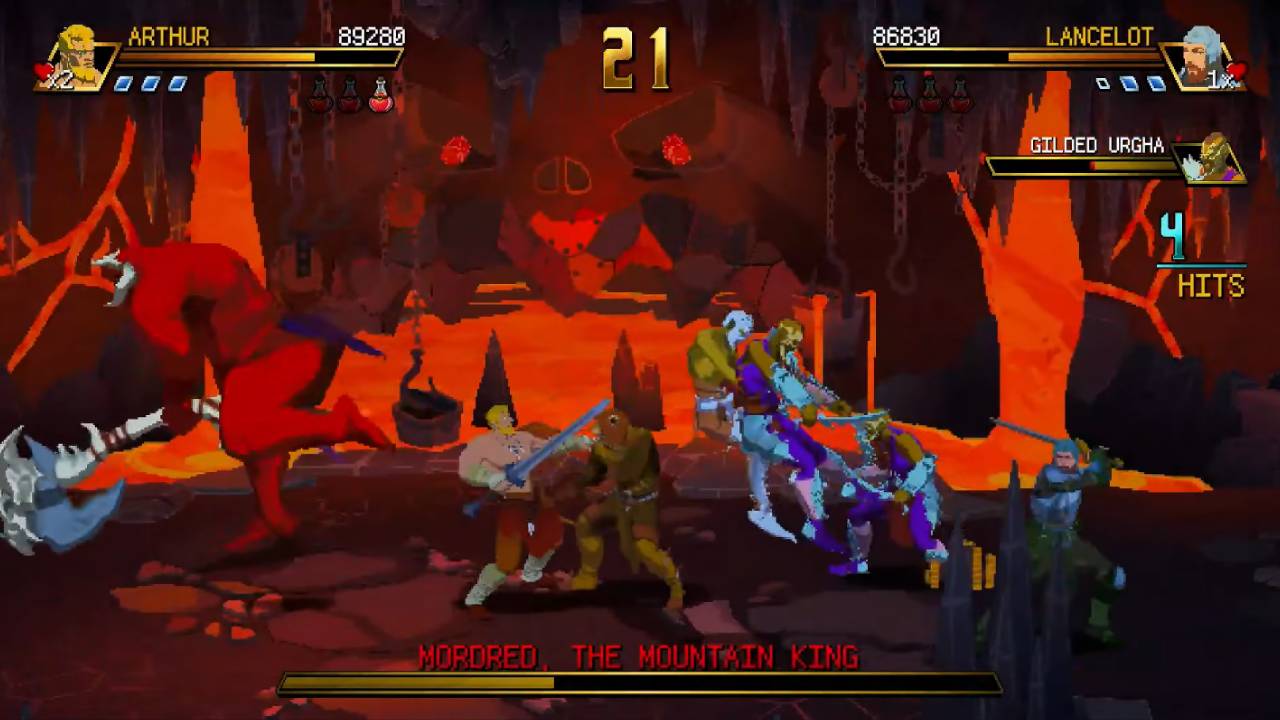
You finally reach Camlann Mountain and enter an underground area filled with skeleton warriors and other monsters. The world darkens and closes in on you until you're finally face-to-face with Mordred in his demonic form. He's quick and aggressive, and a good test of the combat system's dodge and combo mechanics.
The campaign has eight distinct levels, each with its own setting and collection of enemies and bosses. The adventure also includes plenty of small references to older games scattered throughout. Some stages feel fairly plain, while others suddenly make the inspiration obvious, creating moments when you recognize exactly what the developers were referencing.
One of the bigger limitations is progression. There are no major weapon upgrades or extensive character development systems to chase. What you start with is essentially what you use throughout the game. That can feel restrictive if you're looking for a modern progression loop, but it also keeps the focus on learning your character and improving your own ability.
No XP-grinding system drives the experience, either.
Instead of constantly upgrading stats or farming enemies for experience points, your progression comes from progressing through the campaign, learning the combat system, and getting better at using the tools already available to you. That fits the game's old-school design. The downside is that players looking for a deeper progression system may find the experience somewhat limited.
Visually, Blades & Battles has one of its most interesting features: you can choose how you want the game to look. The developers call it a "dual mode nostalgia engine," and it essentially gives you different ways to experience the game's presentation. The clean 3D mode uses a colorful, stylized 3D art direction. The environments have depth and clarity, and the overall presentation looks like a modern animated production.
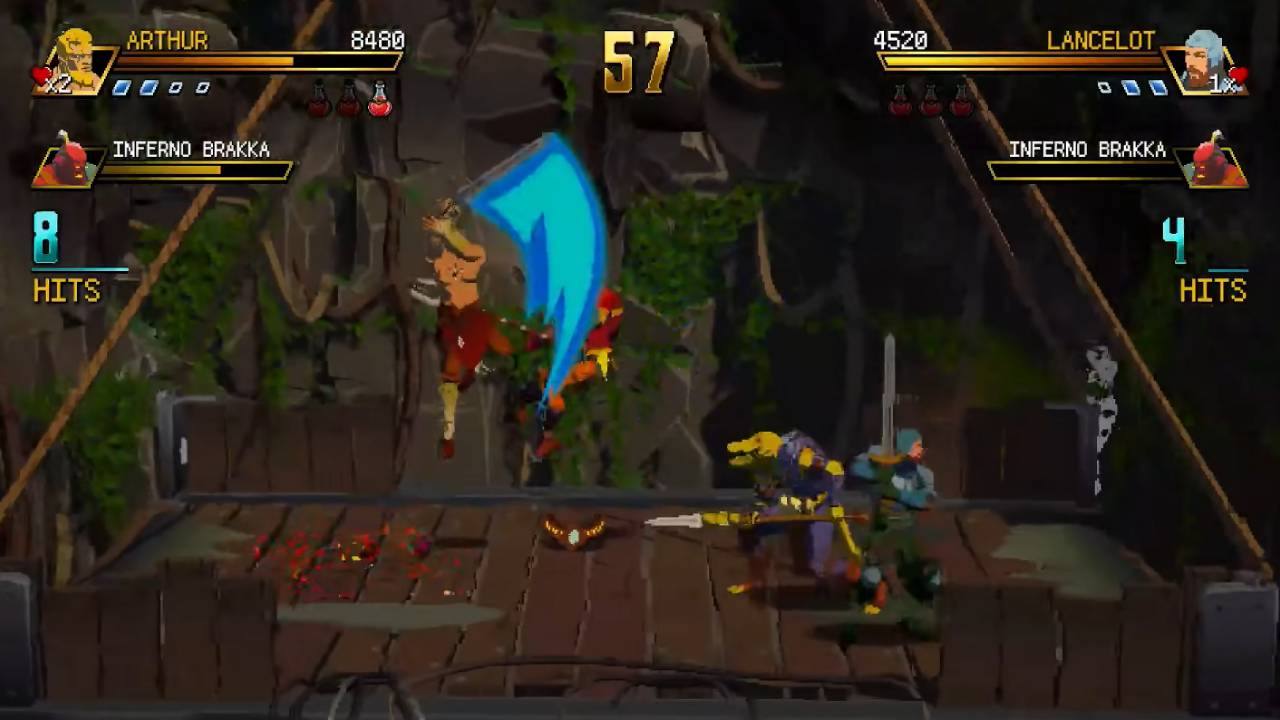
If you want something closer to the game's arcade inspirations, you can switch to pixelated mode. This applies a retro, arcade-style pixel-scaling effect that makes the game feel much closer to something you might have played in a '90s arcade. There's also a super-pixelated mode for players who want an even more authentic 16-bit appearance. It gives the game a crunchier presentation that resembles older arcade hardware and CRT displays.
The environments have a decent amount of detail, and the game includes a solid selection of monsters and bosses. Some stages may feel a little bland, but others clearly include nods to classic games. The performance is also good. The game maintains a steady frame rate, and the modern presentation doesn't seem to come at the expense of smooth gameplay.
The audio fits the retro direction, with a chiptune-inspired style and more dramatic, somber tracks.
The music fits the fantasy setting and lends itself to the old-school arcade feel. But the sound effects are not as consistent. Some are over the top and can get a little old after you've been fighting for a bit. The audio isn't a deal-breaker, but it's not quite as good as the combat or the visual presentation.
The controls are easy to learn, and the tutorial gets you into the action quickly. Attacks, movement, dodging, abilities, and other mechanics are easy to pick up. At times, the controls and combat feel slightly clunky, especially when you're dealing with the game's less reliable hitboxes.
Still, the overall response is good enough that you rarely feel like the controls themselves are stopping you from playing. That responsiveness matters in a game built around dodging, combos, and enemy positioning. Blades & Battles generally feels fluid, and even on moderate hardware, the performance remains smooth.
The biggest problem is that the campaign is short. One playthrough can take about three hours, depending on your playstyle. A second player makes the experience easier, especially when you combine Arthur and Lancelot's different strengths.
A difficulty scale gives you some incentive to revisit the game, but it doesn't fully address the lack of additional content.
Once you've seen the campaign and learned the stages, there isn't much progression left to chase. A larger cast of characters, additional secrets, more upgrades, or extra weapons could have given the game more longevity. As it stands, the replay value comes mostly from trying the other character, playing co-op, increasing the difficulty, and improving your performance.
Blades & Battles understands exactly what it wants to be. It isn't trying to turn the classic arcade beat 'em up into a massive action RPG with endless progression systems. Instead, it takes the basic formula of games like Golden Axe and rebuilds it for a modern audience. That's also why the lack of upgrades and the short campaign can be both a strength and a weakness. You don't have to spend hours grinding for better equipment before you can enjoy the combat.
You simply pick Arthur or Lancelot, learn their abilities, and start fighting.
The two characters provide enough variety to make another run worthwhile, particularly when you switch between Arthur's heavy crowd control and Lancelot's faster, more precise combat. Local co-op adds another layer, and the differences between the characters make playing together feel purposeful rather than simply doubling the number of players on screen.
The eight-level campaign also does a good job of moving through different environments, from Camelot to Sherwood Forest and eventually into the darker areas around Camlann Mountain. The bosses break up the regular combat, while the visual references to older games add an extra layer for anyone familiar with the genre.
It isn't perfect. The hitboxes can be inconsistent, some animations can look a little choppy, and the combat doesn't always have the precision you'd find in a more modern action game. The audio could also use more variety, and the campaign is over fairly quickly. The absence of upgrades and weapons may leave you wanting a deeper progression system.
Still, the game gets the important part right.
It feels like an arcade brawler. The combat is enjoyable, the co-op works well, the two characters play differently, and the visual modes let you choose between a modern presentation and a more classic arcade experience.
At its core, Blades & Battles is a straightforward game that knows its audience. If you miss the days of walking through fantasy stages, beating up groups of monsters, learning boss patterns, and playing alongside a friend on the same screen, this captures much of that feeling without simply copying the games that inspired it.
The short length means you shouldn't expect dozens of hours of content, but the game doesn't need that to work. Its appeal comes from being easy to pick up, fun to play, and focused on the kind of uncomplicated arcade action that has become increasingly rare.
Senior Editor, NoobFeed
Verdict
Blades & Battles delivers a fun old-school beat 'em up with distinct heroes, solid co-op, satisfying combat, and flexible visuals, although its short campaign, limited progression, and occasional hitbox issues hold it back.
60
Related News
No Data.