
Crusader Kings III: Silk & Silver Review
PC
From bustling markets to political power struggles, this expansion gives you more reasons to think beyond the throne.
Reviewed by Sarwar Ron on Nov 18, 2026
Crusader Kings III is at its best when you let its characters, family relationships, and political drama shape your story. You can spend generations building a dynasty, arranging marriages, fighting wars, and dealing with the consequences of decisions made long before your current ruler was born.
However, while the series has always been a strong role-playing experience, its economic systems have sometimes felt like they take a back seat to everything else. With Silk & Silver, Paradox Interactive attempts to change that by giving you more ways to make money, develop your territory, and turn economic influence into political power.

This is a substantial expansion, but its biggest contribution isn't simply adding another government type or a handful of new activities. It changes how you approach the map and manage your realm. Trade goods now matter when deciding what to build, settlements develop through a new district system, and merchants and republics introduce entirely different ways to experience the medieval world.
Even if you prefer playing as a traditional feudal ruler, many free updates change how your campaigns develop.
The central idea is straightforward: money should be more than a number that keeps increasing in the background. You should care about where your resources come from, what your settlements produce, and how other realms fit into your economy. Fortunately, Silk & Silver makes those decisions relevant without turning every campaign into an exhausting exercise in economic management. Not every feature works equally well, but the overall direction is exactly what Crusader Kings III needed.
There isn't a traditional story campaign here, and that's not what you should expect from a Crusader Kings III expansion. Instead, the narrative comes from the characters and political situations you create as you play. Your merchant family might spend generations expanding its commercial network, a republic might gradually abandon its democratic foundations, or an Italian ruler could become involved in a struggle that determines Northern Italy's future.
The Italian content focuses on the historical conflict between the Guelphs and Ghibellines.
The Guelphs support the Pope and independent Italian cities, while the Ghibellines favor the Holy Roman Emperor. The expansion offers two starting dates, 1066 and 1178, so you can experience different stages of the conflict. The earlier start focuses on its gradual development, while the later one drops you into an already active political confrontation.
The struggle progresses through several phases as you recruit influential characters and strengthen your side. Reaching 70 percent of the overall power gives your faction an advantage, while falling below 60 percent can push the situation back into agitation and make wars cheaper to declare. Depending on how things unfold, the consequences can be significant.
A Guelph victory frees imperial vassals in Northern Italy and prevents the Holy Roman Empire from declaring wars for three decades. A Ghibelline victory brings the Kingdoms of Italy and Romania into the Holy Roman Empire's de jure territory. A compromise outcome also gives the Emperor more control over his Italian vassals, although both leading figures lose popularity.
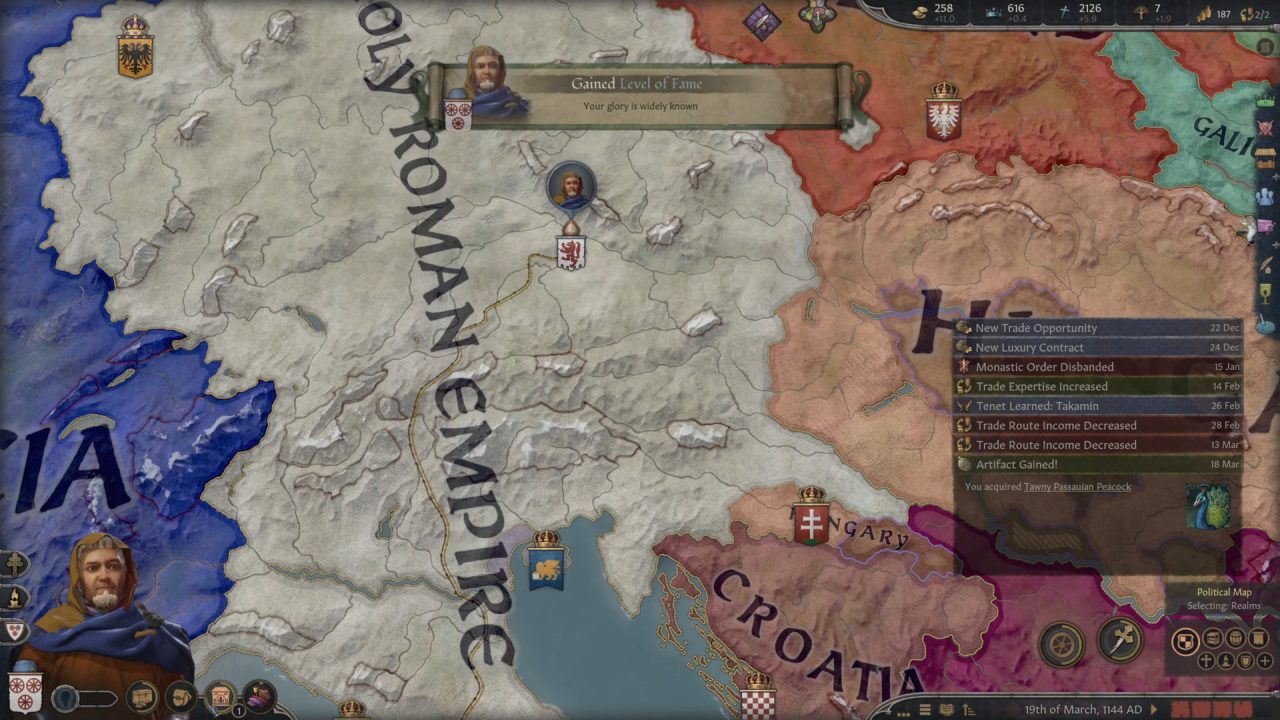
It's an interesting historical addition, but the amount of information involved can make it easy to ignore. The conflict has several phases, characters, and political details to track, and the game doesn't always make it feel essential to your campaign. If you aren't particularly interested in its history, you can spend a considerable amount of time playing without properly engaging with the system.
Italy also receives new traditions, religious and Roman law content, a carnival activity, and a redrawn map, providing more flavor to the region.
Where Silk & Silver really succeeds is its economic overhaul. The map is divided into more than 900 markets, with each county producing resources through its own resource district. There are over 40 types of trade goods, and these aren't simply items you collect to increase your income. Buildings now have specific resource requirements, meaning the goods available in your market can influence how effectively you develop your holdings.
For example, a fishing building benefits from having access to salt, while military buildings can consume metal to improve the performance of stationed men-at-arms. Markets regularly calculate which goods are in demand and which are available in excess.
Merchants and republics then establish trade routes, purchasing goods in one market and selling them in another. You don't have to manage every transaction yourself, which is one of the system's best features. Trade runs in the background, letting you benefit from the economy without constantly checking prices or adjusting routes.
You also feel a sense of progression as you specialize in particular goods.
Trading the same resource over time increases your expertise, and that expertise becomes associated with your merchant title. If your family spends decades trading cheese, for instance, it can develop a reputation for that particular business.
Traders operating in the same market compete based on their commercial strength, although market owners can grant monopolies to give certain merchants an advantage. Some monopolies can even take goods away from local populations, adding another layer to the relationship between commercial power and territorial control.
One more interesting detail is the appearance of trade roads.
When trade routes remain active for long periods, these roads gradually develop and can help armies move faster. If the trade disappears, the roads eventually deteriorate. It's a small addition, but it gives your commercial activity a visible impact on the map and makes the economy feel connected to the wider world.
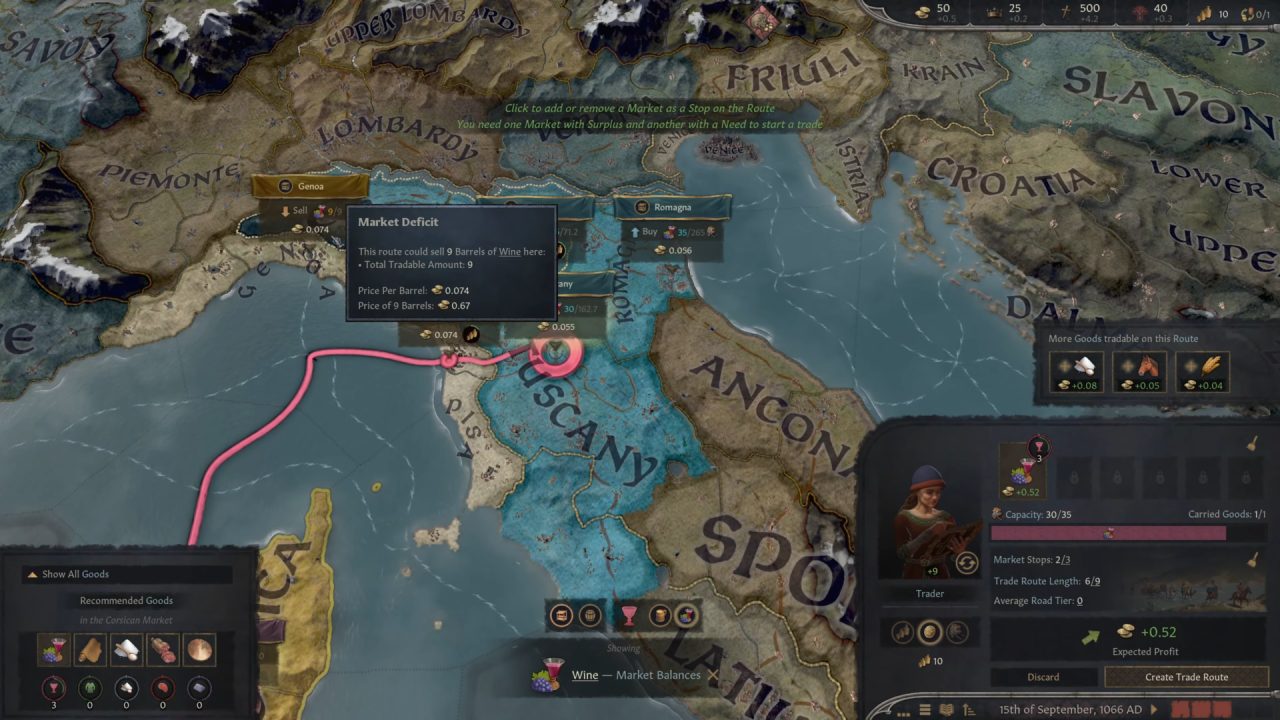
You don't need to play as a merchant or republic to benefit from these changes, either. Traditional rulers can establish distribution routes between two markets within their realm, moving basic resources such as grain, stone, and wood without generating commercial profits.
These routes help supply buildings with the goods they need. You can also commission merchants to establish trade routes when your market lacks particular resources, though these arrangements require prestige and must be renewed every ten years. This lets you solve shortages without forcing you to become an economic specialist.
The biggest change for regular rulers, however, comes from the new district system.
The previous building structure has been replaced with themed districts, each offering different buildings and bonuses. Development is now divided into settlement size and prosperity. Settlement size determines how many districts a holding can support, while prosperity reflects its wealth and increases the taxes it generates. As a result, larger settlements have more room for development, while prosperous holdings become more valuable sources of income.
This makes your holdings' location more important. A major city such as Constantinople can support more districts than a smaller settlement, giving you more opportunities to specialize. You can develop military districts to improve your armies, entertainment districts to maintain popular opinion, or guild districts to strengthen your economy. Rural and urban settlements also have different advantages.
Urban holdings generate more taxes but consume more goods, while rural settlements are easier to maintain but offer fewer expansion opportunities.
The system works particularly well because resource requirements influence your building decisions without completely controlling them. If you want to strengthen your heavy infantry but lack access to iron, you can either choose a different military specialization or look for a way to bring iron into your market. You might even conquer a county that produces the resource you need. Alternatively, you can use a merchant to establish a route and supply your holdings from elsewhere. The choice is yours, and you rarely feel forced into one particular approach.
There are a few shortcomings, though. Each county can potentially produce several goods, but you only discover its alternative production options after owning it. That makes it difficult to plan conquests around specific resources because you cannot always know what a territory can produce beforehand. The district selection could also use more variety.
As your settlements grow, you eventually discover yourself building many of the same districts because certain options are simply more useful than others. Military districts are difficult to ignore if you want stronger men-at-arms, while ports and certain economic buildings offer particularly valuable bonuses. More districts with meaningful trade-offs would make specialization more interesting.
Still, the new system is a considerable improvement over the previous building structure. It also gives you more reasons to care about secondary holdings. You might develop a smaller castle to improve control in your capital county or use another settlement to produce resources for your main holding. These decisions make managing your territory feel more involved without demanding constant attention.
If you want a completely different way to play, you can establish a landless merchant family.
You can begin as a merchant almost anywhere on the map, while certain landed rulers can also abandon their titles and enter the commercial world. Your family operates from a mansion that serves as your business hub. Every trade route begins there, and upgrading the estate allows you to expand your network and unlock more opportunities. Your company gradually develops from a small business into a major trade empire.
You can choose from four merchant roles. The reputable approach offers a more traditional commercial experience, while artisans focus on creating artifacts and influencing supply and demand. Creditors make money by lending to rulers, and caravaners specialize in long-distance trading and luxury contracts. These choices give your business some direction, although their usefulness varies considerably.
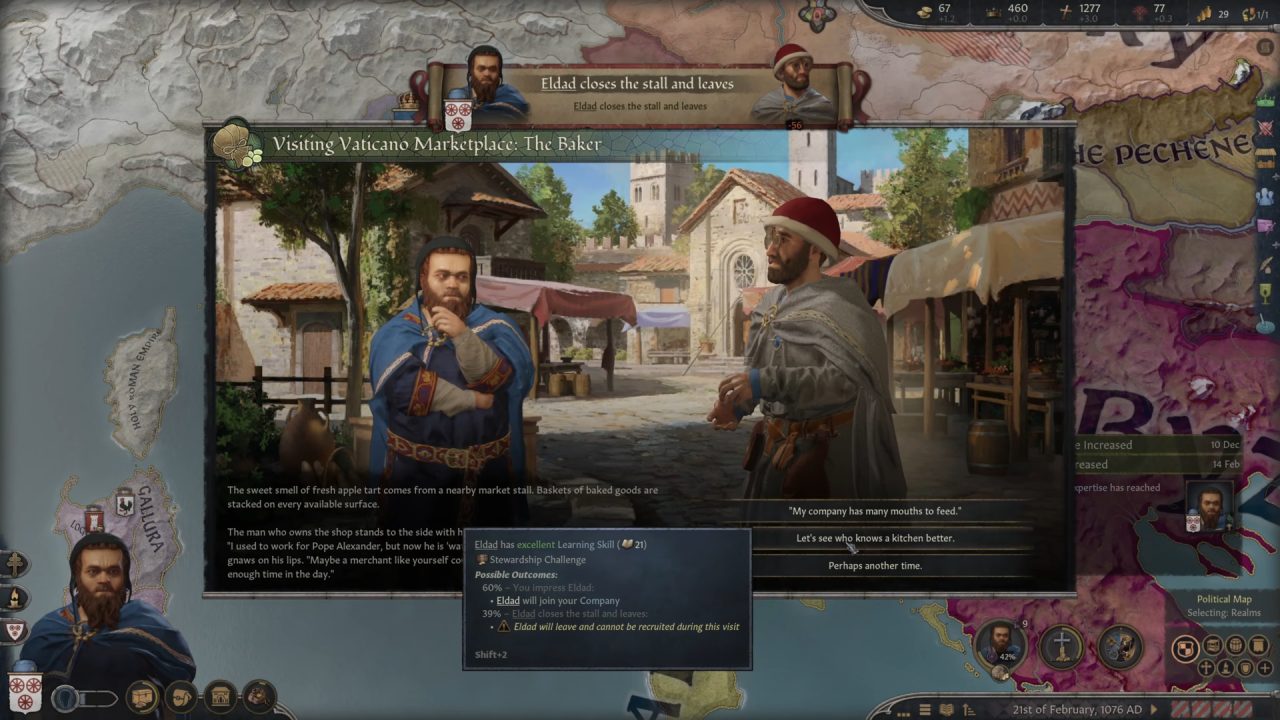
You also need to maintain a relationship with the ruler who controls the county where your mansion is located. This character becomes your patron, and earning their favor can grant you a charter. You can use that charter to invest in their territory, gain prestige, or take risks that could eventually land you in prison. Individual trade routes also have assigned traders whose specializations influence their performance. You can even recruit talented traders away from competing companies.
Merchants have several ways to make money beyond their ordinary trade routes.
Landed rulers can commission them to complete specific routes for an upfront payment, though these contracts don't provide the same ongoing profits or expertise as regular trading. You can also lend money to rulers and receive a strong hook that remains until the debt is repaid. Open interest increases the amount owed, while disguised interest hides the additional cost through fees and gifts. Loans can also be inherited, so a ruler's death doesn't simply erase the debt.
Competition between merchant families can become rather unpleasant, too. You can steal trade secrets, sabotage another company's competitiveness, or convince its patron to withdraw its charter. If your business becomes powerful enough and you have the right influence over your target, you can even launch a hostile takeover. These mechanics give merchants interesting ways to interact with the political world, although the overall experience can still feel passive.
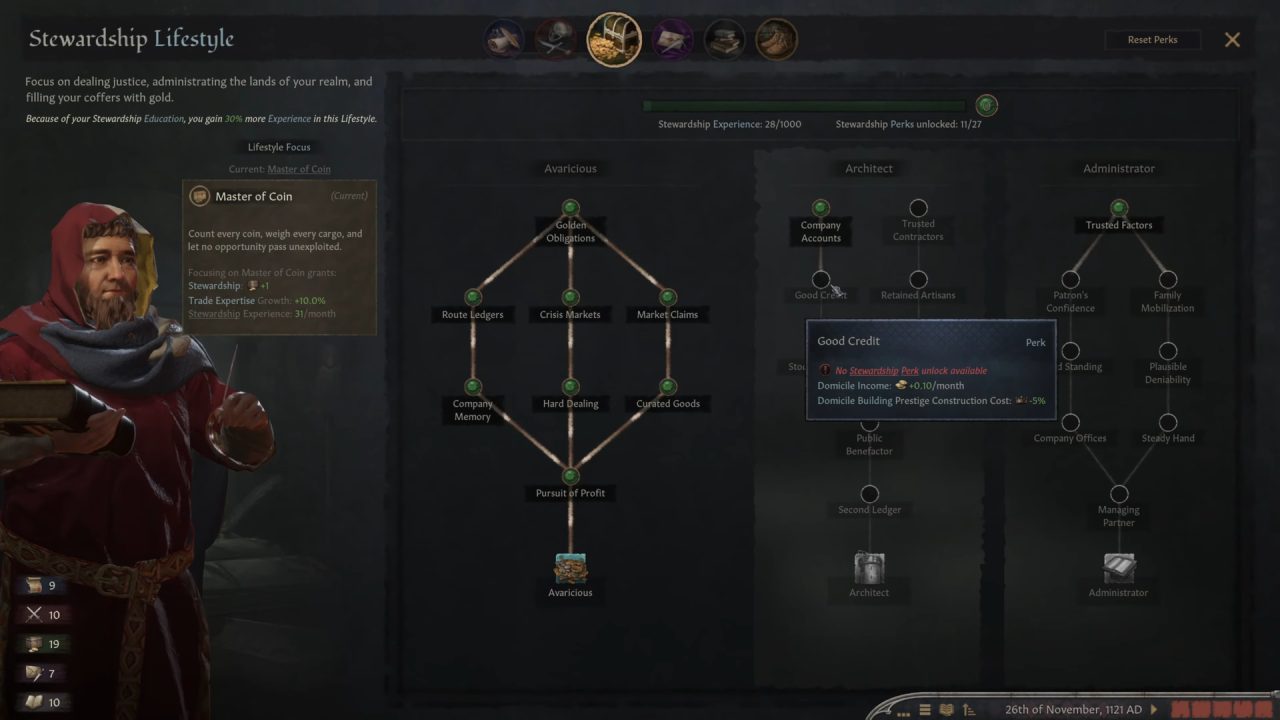
That's the biggest problem with playing as a merchant. Once your trade network becomes profitable, there isn't always much left to do beyond expanding your routes and improving your estate. Watching your monthly income grow is satisfying, but the excitement can wear off when you're mostly waiting for buildings to finish.
Some merchant purposes also feel underdeveloped. Artisans can create artifacts, but you have limited control over the results, while creditors can struggle to find rulers who actually need loans. Caravaners are more appealing if you enjoy expanding trade routes across the map, but the overall system could offer more meaningful activities.
Republics are a much stronger addition.
They give you a government that relies on commercial wealth rather than the traditional structure of a feudal kingdom. You can earn considerably more money through trade, but you have to deal with lower domain and vassal limits, political pressure from your capital's population, and elections. Your success depends on developing a prosperous city while keeping the people and other patrician families on your side.
As your capital grows, your republic can advance through different tiers and unlock more opportunities. The real experience begins around the duchy level, where you can manage several patrician families and participate in the political assembly. Members can propose laws, which are then voted on over six months. You can change who gets to vote and whether a law requires a simple majority, a two-thirds majority, or unanimous support. Every patrician house also has ambitions that influence its voting behavior, creating another layer of political competition.
However, the system has a balancing problem.
It is surprisingly easy to dismantle the democratic structure and turn your republic into something closer to a dictatorship. With enough prestige, money, and loyal council members, you can gradually change the laws and remove elections with little resistance. You can then use the republic's wealth to maintain popular support through decrees. It's an entertaining role-playing possibility, but it removes much of the political cost that should come with abandoning democracy.
Trade posts are another major advantage for republics. Patricians can build them in counties they don't own, letting them expand their influence beyond their borders. These posts provide useful buildings, access to local men-at-arms, and additional starting points for trade routes. You can compete with other families for valuable locations, convince them to give up their posts, or take them through schemes. Owning a trade post can even provide a reason to declare war on a neighboring or coastal county.

Republics can also establish trade leagues, which offer increasingly valuable bonuses as their cohesion improves. New war reasons let you challenge rival leagues, establish new republics, or enforce monopolies. The idea is appealing, but the system can be difficult to understand, and the overall republic experience can become extremely powerful once you have enough trade posts. Even so, its political and economic systems provide a welcome alternative to feudal rule.
Progression in Silk & Silver isn't built around traditional XP grinding.
Instead, you work toward better settlements, stronger trade networks, higher prestige, and greater political influence. Merchant families improve their businesses by expanding their estates and developing trade expertise, while republics advance through popular opinion, fame, and the size of their capital settlement. For traditional rulers, settlement growth becomes especially important because each new level can unlock another district and create opportunities to increase income or military strength.
The pace of this progression is one of the expansion's more interesting changes. Settlement growth can be slow, particularly early in the game, but that gives you a reason to invest in your holdings rather than constantly expanding your borders. You might find yourself waiting for a settlement to grow just to unlock another district. It can become surprisingly engaging, although it also encourages you to spend more time developing a handful of territories instead of building a large empire.
The free update also adjusts the wider economic balance.
Building costs and income have been reduced, while additional cultural innovations make technological progression last longer across a campaign. Control and popular opinion now gradually move towards a baseline rather than remaining fixed indefinitely. These changes make it harder to snowball too quickly and give you more reasons to think about your realm's long-term development.
That said, the balance isn't perfect. Republics can become extremely powerful because their trade posts provide bonuses that stack across multiple locations. At higher levels, these bonuses can make their armies surprisingly effective despite their lower domain limits.
Some existing governments and regions also appear to have been overlooked. The Mandala government and nomads, for example, can remain exceptionally powerful because their existing mechanics haven't been adjusted to fit the new balance. The economy can still produce too much money in the mid- and late game, while settlement growth sometimes feels slower than it should.
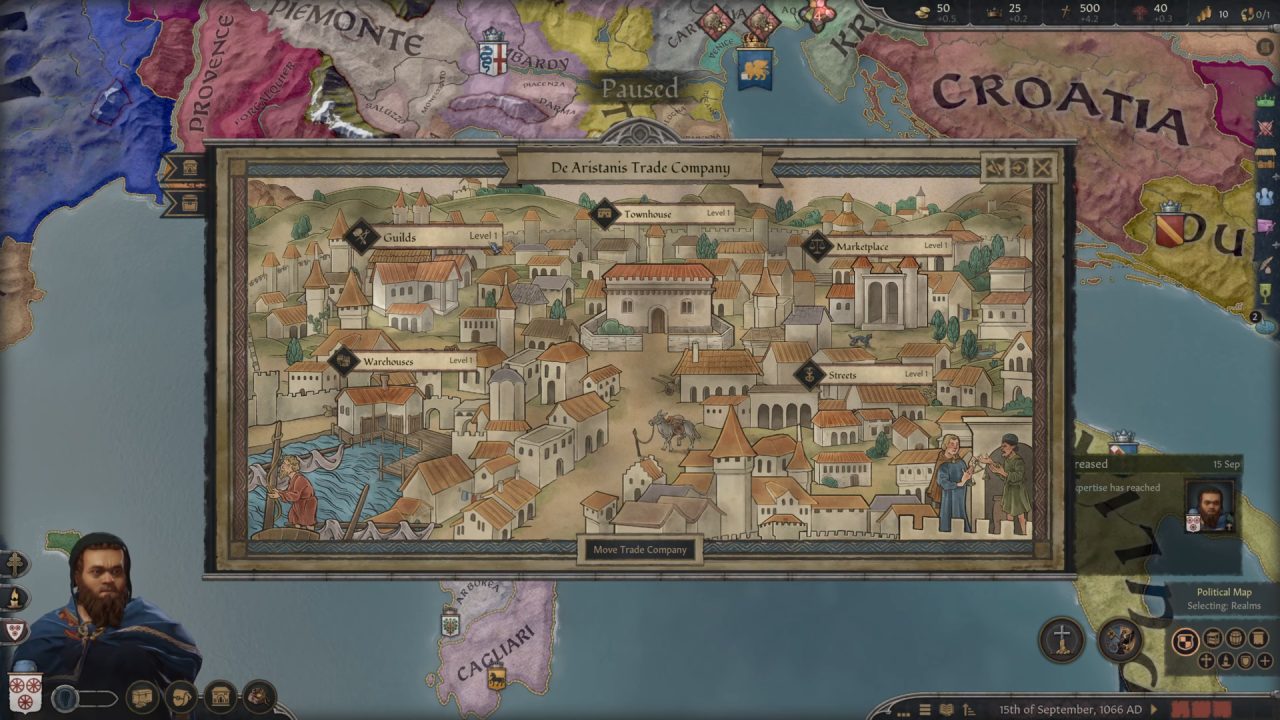
Visually, the biggest improvements come from how the map communicates your economic development. The new districts give your holdings more structure, while trade roads provide a visible indication of long-running commercial activity.
The redrawn Italian map also gives the regional content a fresh presentation. The expansion's strongest visual ideas are connected to the systems you're managing rather than a complete overhaul of the game's presentation. The transcripts don't identify major changes to the soundtrack or sound design, so there isn't enough to suggest that the audio experience has received a similar upgrade.
Ultimately, Crusader Kings III: Silk & Silver succeeds because it gives you more meaningful things to do between wars, succession crises, and political disputes. The trade system is simple enough to remain enjoyable without demanding constant attention, and the district overhaul makes developing your territory more rewarding. Republics are entertaining, even if their political systems need some balancing. At the same time, merchants offer a slower experience that will appeal to players who enjoy watching a business grow over several generations.
The Italian content is less convincing, mainly because it's easy to overlook if you aren't interested in the historical conflict.
Merchant gameplay also needs more meaningful activities to keep you involved after your company becomes profitable. These are noticeable weaknesses, but they don't undermine the expansion's strongest additions. The new economy fits naturally into Crusader Kings III, and the free changes make the wider game feel different even if you never purchase the expansion.
Silk & Silver is worthwhile because it doesn't try to turn Crusader Kings III into a completely different strategy game. Instead, it builds on what already works and gives you more ways to create your own stories. You can become a wealthy merchant, lead a powerful republic, or remain a traditional ruler who uses trade and settlement development to strengthen a dynasty.
Not every path is equally engaging, but having those choices makes each campaign feel more open-ended. If you've been looking for a reason to spend more time developing your realm rather than simply conquering the next territory, this expansion gives you plenty to work with.
Admin, NoobFeed
Verdict
Silk & Silver gives Crusader Kings III a stronger economy and more rewarding ways to build your realm. Merchants and balance need work, but the trade and district overhauls make this one of the game's most worthwhile expansions.
75
Related News
No Data.