
Monopoly Star Wars: Heroes vs. Villains Review
PlayStation 5
A century-old property game gets pulled into a galaxy far, far away, and somehow it actually works.
Reviewed by Maisie Scott on Jul 03, 2026
Monopoly has been sitting on family game shelves for close to a hundred years now, and in that time, it has worn just about every costume imaginable. You've probably seen versions built around Mario, Animal Crossing, Dungeons & Dragons, and dozens of other franchises.
Each one is trying to bolt something new onto the same old property-trading formula. As Monopoly moved into video games over the past few console generations, most of those licensed spin-offs did the same thing: swap the properties and pieces, keep the rest exactly the same.
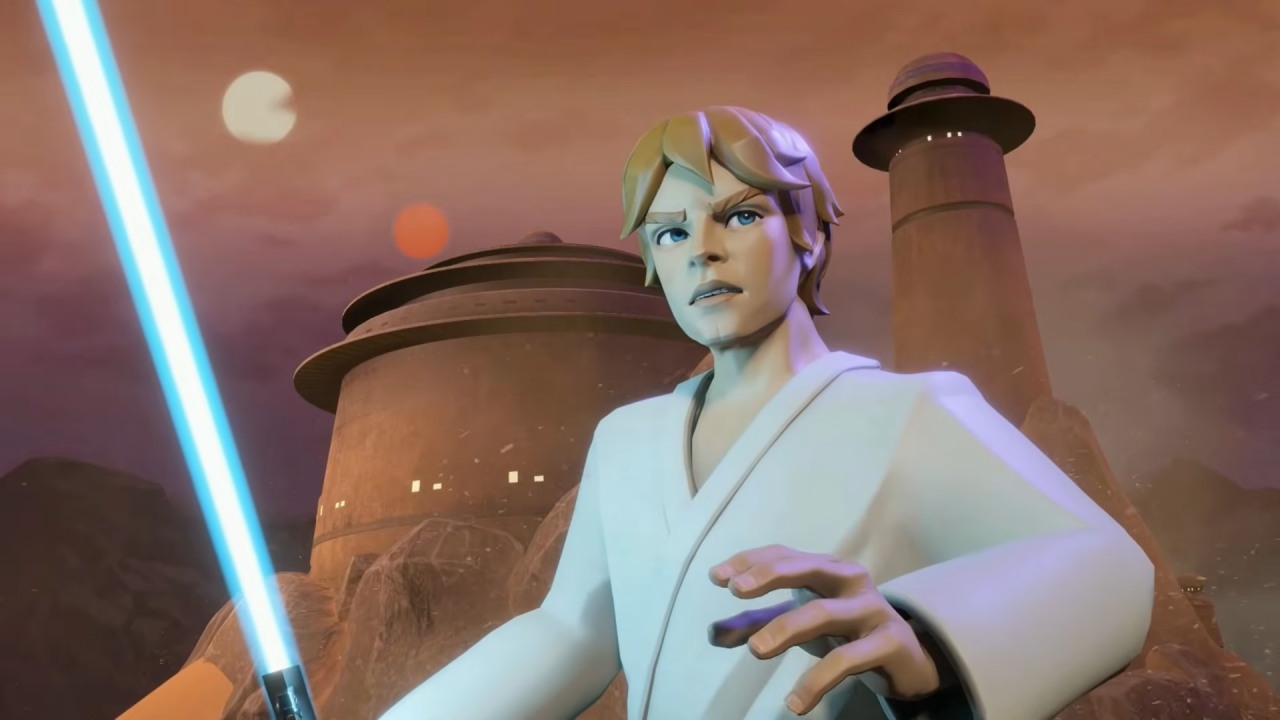
Star Wars and Monopoly actually go back further than you might expect.
With a collector's tabletop crossover edition landing all the way back in 1996. Monopoly Star Wars: Heroes vs. Villains isn't a simple reskin of the standard digital Monopoly game that came out a couple of years ago. This one comes from Ubisoft, in partnership with Hasbro, with development handled by Behavior Interactive.
This is the studio best known for Dead by Daylight. That pairing alone tells you this isn't going to play it safe, and once you sit down with Monopoly Star Wars: Heroes vs. Villains, you'll notice the changes almost immediately. There isn't really a story to follow here in the traditional sense.
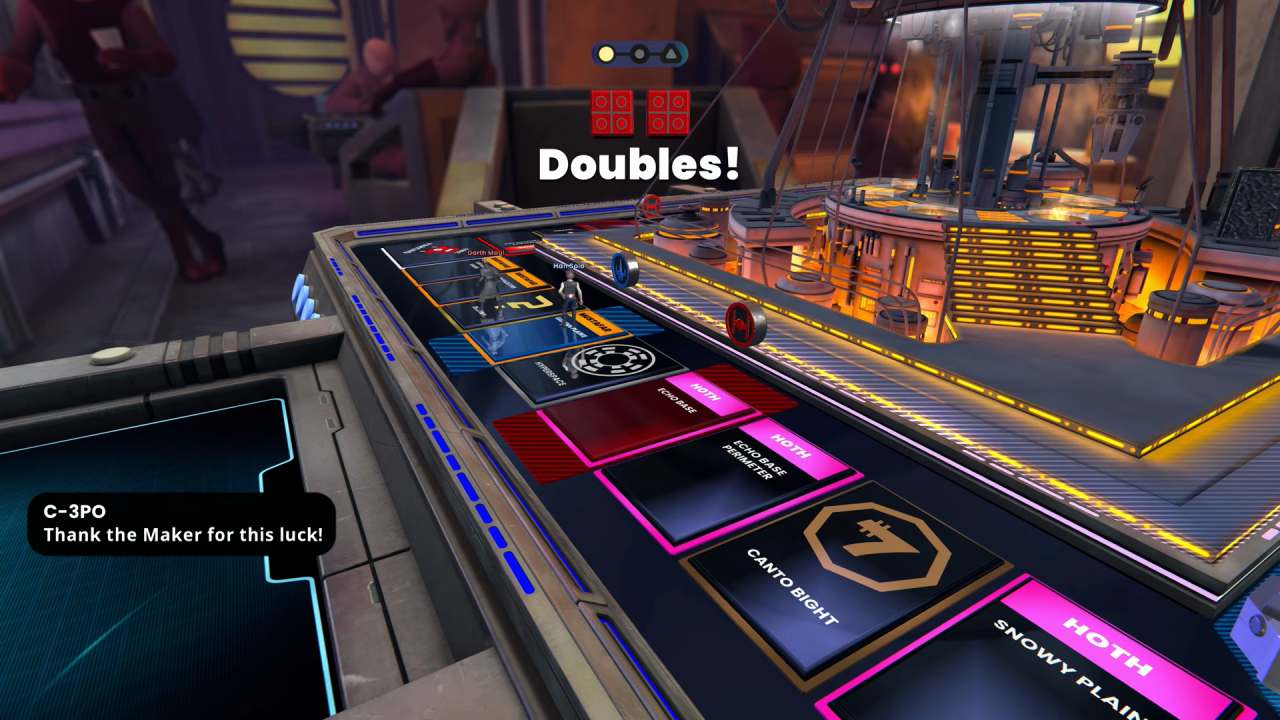
But the game does a good job of giving you a sense of place and occasion before you ever touch the dice. You start in a cantina, and in the corner, there's a glowing holographic table that looks like something pulled straight off the Millennium Falcon.
C-3PO and R2-D2 sit with you the whole way through, narrating your turns and reacting to whatever chaos unfolds on the board, occasionally rambling on about the match ahead before the table itself transforms into a fully animated Monopoly board.
It's a small touch, but it makes every session feel like an event rather than just another board game night.
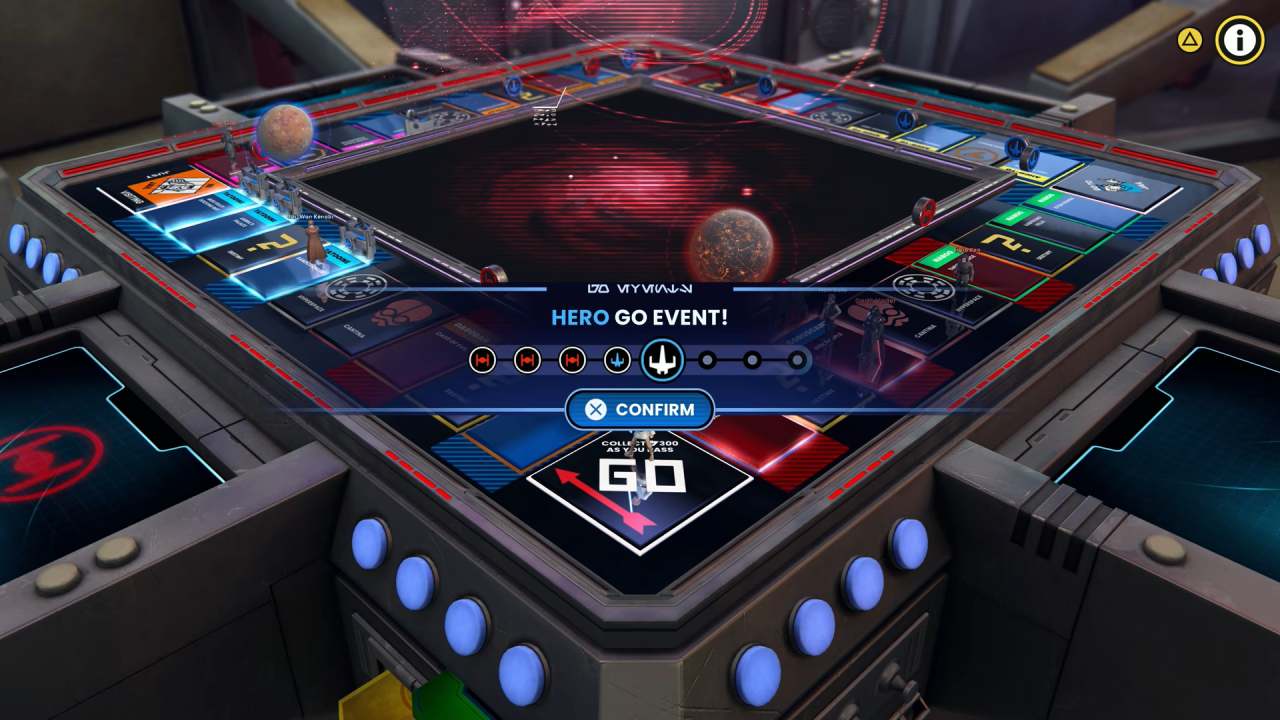
Where the narrative actually shows up is in the Go Events, short cinematic vignettes drawn from across the entire Star Wars timeline, spanning the original trilogy, the prequels, the Clone Wars, and the Disney eras alike. You might find yourself threading torpedoes down a trench on the Death Star.
Other times, you'll be watching Yoda haul an X-wing out of a swamp, or seeing Anakin take down a droid control ship. These moments aren't just cutscenes you sit back and watch either, since your own dice rolls determine whether they succeed or fail, so you end up playing through a highlight reel of the saga one turn at a time instead of just observing it.
As for how you actually play, Monopoly Star Wars: Heroes vs. Villains splits everyone into teams instead of the usual free-for-all you'd get in classic Monopoly. You'll set up either a 2v2 or 3v3 match, choosing to fight for the Heroes or the Villains, and each side draws from a pool of 28 total characters, split evenly between the two factions.
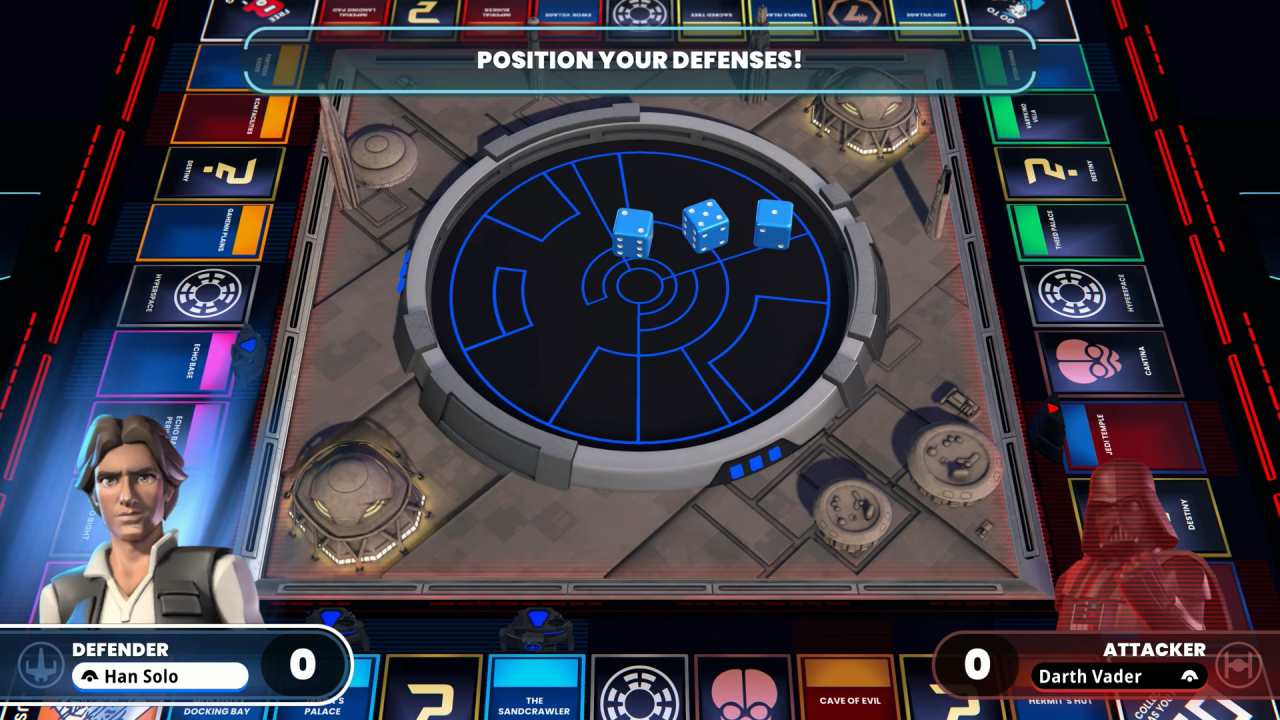
Names you'll recognize are all over the roster, from Han Solo, Obi-Wan Kenobi, Ahsoka Tano, Chewbacca, and Jyn Erso on the hero side, to Darth Vader, Emperor Palpatine, Count Dooku, Asajj Ventress, Cad Bane, Bo-Katan, and Aurra Sing on the villain side.
An in-depth tutorial walks you through how the new systems in Monopoly Star Wars: Heroes vs. Villains work.
A player profile tracks your progress and whatever objectives you've still got left toward unlocking new characters. Once your team is picked, you're moving around the board buying up Star Wars locations instead of Boardwalk and Park Place.
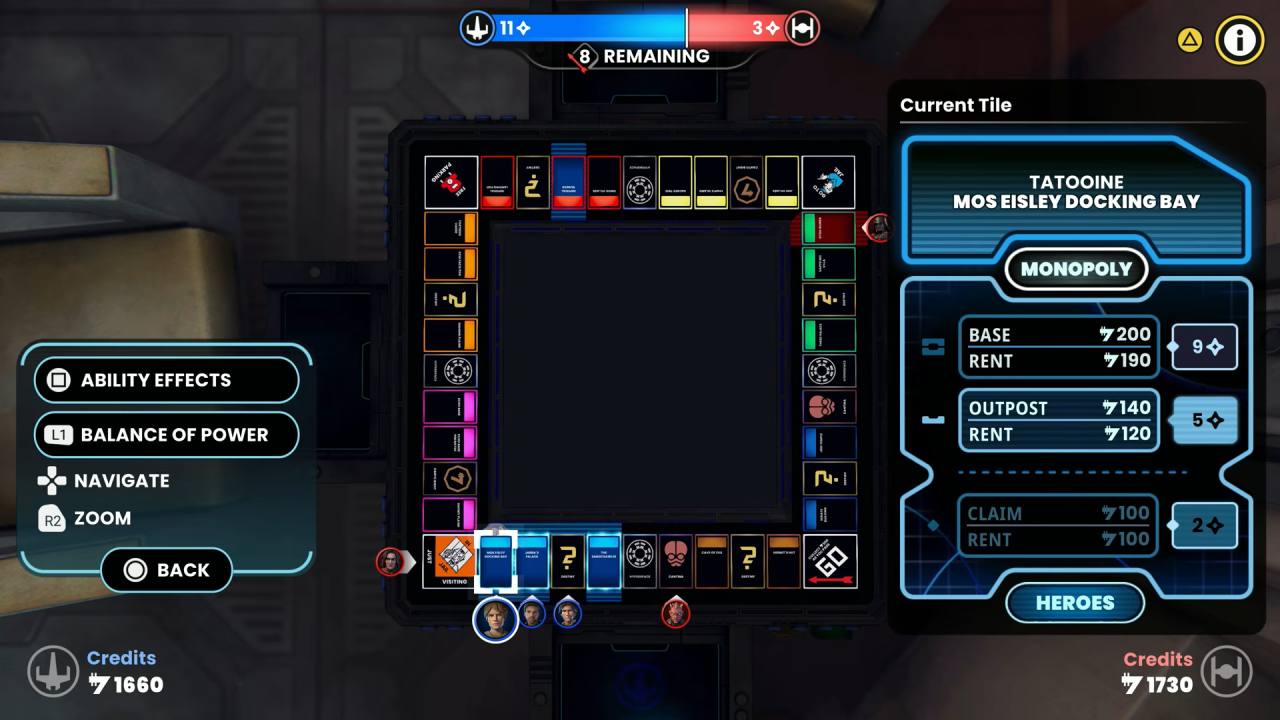
Everything from Hoth and Endor to Tatooine, Mustafar, Coruscant, and Naboo. The win condition has shifted away from bankrupting everyone else entirely. Instead, you're chasing Influence Points, which come from buying and upgrading properties, winning fights against opposing players, and clearing those Go Events as your team makes its way around the board.
There's no bankruptcy ending and no property trading between players in Monopoly Star Wars: Heroes vs. Villains, which are two of the bigger departures from the tabletop version you probably grew up playing. A handful of other classic mechanics have been swapped out for Star Wars equivalents, too.
Jail has been replaced with getting frozen in carbonite, train stations are now hyperdrive warp points, and Chance cards have become Destiny cards, dressed up with fun little art and events that fans will recognize. Canto Bight shows up as a gambling stop where you can multiply your credits, and the cantina lets you hire extra help for your team along the way.
Houses and hotels are gone in favor of outposts and bases.
This raises the rent you charge whenever an opponent lands on your turf, though those upgrades can also be destroyed or captured outright if the other team decides to get aggressive about it. You can set how many Go Events happen before a match ends.
Up to a maximum of eight, and that number basically decides how long you'll be playing, anywhere from around 40 minutes to closer to an hour and a half, depending on how you've set things up going in. The game also saves after every single turn, so nothing forces you to finish a session of Monopoly Star Wars: Heroes vs. Villains in one sitting if life gets in the way.
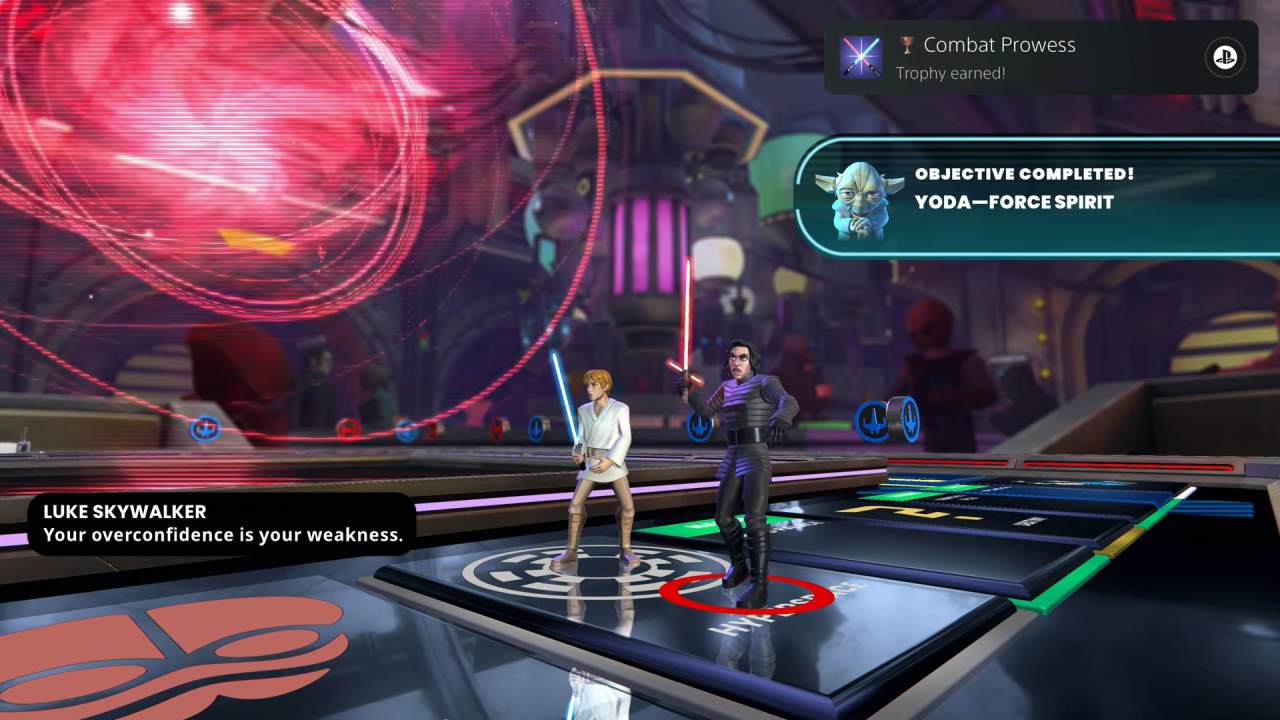
The combat is really where Monopoly Star Wars: Heroes vs. Villains earns its keep, and it's the part you'll spend the most time thinking about once you're a few matches in. Whenever you or a teammate lands on a tile an opponent already owns, or when two rival players land on the same spot at the same time, it kicks off a dice battle right there in the middle of the board.
Each side rolls a trio of dice, and whoever ends up with the highest total wins the tile along with the Influence Points that come with it. What keeps this from being pure luck is that the second player gets a chance to nudge or knock one of the first player's dice after it lands, physically changing that die's result and swinging the whole battle in their favor.
It adds a surprising amount of tension to something that could have easily just been a coin flip.
As you're reading the table and reacting in real time instead of watching numbers add up on their own. Win a battle, and you're rewarded with a short cinematic, sometimes a spaceship duel that ends with your opponent's ship going up in flames, sometimes a recreated scene featuring whichever character you're playing.
It's a detail that makes even a routine property fight in Monopoly Star Wars: Heroes vs. Villains feel like it actually matters. Character abilities layer even more strategy on top of those dice battles, and this is arguably where the whole package comes together.
Every character brings a passive or active skill, and building a team around abilities that complement one another changes how a match plays out far more than you'd expect from something with Monopoly in the title. Chewbacca can charge straight to the nearest opponent and force a fight on demand.
Essentially working like a mobile threat that speeds around the board, unlocking Go Events faster than anyone else. Mace Windu hands every ally on his team an extra die during battles, which quietly makes every fight your side gets into a little more winnable.
Luke Skywalker can send Wedge Antilles off to snap up a property for you without spending your own turn on it.
Darth Maul gets to throw again if his first roll isn't good enough. Other characters in Monopoly Star Wars: Heroes vs. Villains lean toward stealing credits off opponents as they pass by, or advancing directly toward an enemy to pick a fight on their own terms.
On the whole, this is the strongest part of the package, since it turns what could have been repetitive rent collection into a series of small, tense showdowns with just enough player input to feel earned rather than purely random. The flip side is that things can drag a little in the early turns of a 3v3 match before abilities really start coming online.
The buy, battle, repeat loop does start to feel familiar if you're playing back-to-back sessions in one sitting. There's also the occasional rough patch. Technically, including one instance where an AI-controlled teammate got stuck endlessly toggling its own ability on and off, forcing a full restart of the match before things would move again.
Progression in Monopoly Star Wars: Heroes vs. Villains is handled outside the individual matches, and it's more generous than you'd expect from a board game adaptation. Completing objectives while you play unlocks new playable characters, alternate costumes, cosmetic dice sets, and spaceship skins.
It also gives you what amounts to alternate versions of characters you've already got.
Letting you unlock a different-era take on someone like Luke Skywalker as a kind of bonus variant to show off. Ubisoft Connect ties into this too, handing out free themed dice and other cosmetic extras the more you play, and it's satisfying watching your collection grow across sessions.
None of it changes how the core game actually plays, but it gives you a reason to keep coming back the way an Assassin's Creed-style unlock system would, rather than treating every match as a self-contained one-off with nothing to show for it afterward.
You can also tune the difficulty of AI opponents if you're playing solo or filling out a team missing a player, which makes the whole thing scale reasonably well, whether you've got a full group around the table or you're just testing out builds by yourself.
Visually, Monopoly Star Wars: Heroes vs. Villains leans into a cartoonish style that lands somewhere between The Clone Wars and the chunky toy-figure aesthetic of Disney Infinity. It suits the material well, and the 3D dioramas built for each location on the board are genuinely detailed, whether you're looking at the swamps of Dagobah, the neon glow of Canto Bight, or the snowy stretches of Hoth.
Character models get individual walking animations and entrances as they step up to take their turn.
The interface stays clean and easy to navigate, even when you're juggling team currency, abilities, and cooldowns all at once. Performance held up well, too, running at a steady 60 frames per second with quick load times on both PS5 and Nintendo Switch 2, which matters given how much of Monopoly Star Wars: Heroes vs. Villains revolves around watching short cutscenes back to back throughout a match.
The audio side is a little more of a mixed bag. Sound effects land exactly where you'd want them, with lightsaber clashes and blaster fire doing a lot of work to sell the atmosphere without ever becoming distracting. The music is where things get a little odd.
Since the game opts for compositions that echo familiar Star Wars motifs rather than actually using the iconic themes you'd expect to hear the moment you boot it up, and that choice sticks out a bit the longer you play. Voice acting fares better overall, doing a solid job of standing in for the original actors across most of the cast, though a few performances land a little flatter than others here and there.
Taken as a whole, Monopoly Star Wars: Heroes vs. Villains works best as exactly what it sets out to be. A new spin on a board you already know, dressed up with enough Star Wars flavor and team-based strategy to feel like its own thing rather than a simple licensed reskin.
It's not trying to reinvent the property-trading genre from the ground up.
But for a casual pick-up-and-play session with friends or family, Monopoly Star Wars: Heroes vs. Villains delivers a genuinely fun, fast-moving experience that holds up better solo than you'd expect. And with cross-play spanning PS5, Xbox Series X/S, Switch 1 and 2, and PC all pulling from the same player pool, it shines brightest with other people around the table.
At a price point sitting around thirty dollars, factoring in the cost of the license alone, it's a fair ask for what you're getting, and it's the kind of game that's easy to keep coming back to for one more round before you've even realized how much time has passed.
Editor, NoobFeed
Verdict
A fun, team-based reinvention of a familiar formula. Great with friends, backed by clever abilities, cinematic Star Wars flair, and a progression system that keeps matches feeling worthwhile.
73
Related News
No Data.