
R-Type Tactics I • II Cosmos Review
PlayStation 5
Slow, cold calculation meets the high-stakes action of a legendary arcade universe.
Reviewed by Maisie Scott on Jun 19, 2026
Irem’s legendary franchise proved its worth over the years with its well-established shoot-’em-up credentials, complex bosses and a wide array of weapon upgrades. It was a universe of reflex-based action, where the clock and arcade tokens were the measure of success. However, in 2007, a radical experiment flipped this legacy on its head.
With the release of R-Type Tactics, the franchise traded its fast-paced, side-scroller action for a turn-based strategy RPG filled with Earth technology and vicious Bydo foes. It was a shocking, but brilliant, change of pace that swapped twitch reflexes for deep, cerebral planning, all while maintaining the signature fiendish difficulty curve of the series.
While 2009 brought an ambitious sequel titled R-Type Tactics II: Operation Bitter Chocolate, it was unfortunately never localized for Western audiences and remained an exclusive to Japan. For over a decade, international strategy fans could only look on with envy at the missed tactical depth of that sophomore entry. Now, the modern gaming landscape has finally corrected this historical oversight.
Developer Granzella, a studio proudly formed by former Irem staff who carried the original creative torch, has meticulously remastered these cult-classic entries for modern platforms. Bound together as a definitive collection, R-Type Tactics I • II Cosmos steps out into the light, introducing a new series of encounters alongside a complete overhaul.
Players navigate a fractured universe while facing a terrifying biomechanical threat.
In R-Type Tactics I • II Cosmos, players are thrust into a grim, beautifully realized single-player campaign where they initially command the Earth Space Corps during a desperate interstellar crusade to eradicate the Bydo Empire.
The Bydo are not mere alien invaders; they are a terrifying, ever-evolving biomechanical alien armada that warps organic life and machinery into horrifying amalgams. As the human fleet ventures deeper into hostile, uncharted space, victory comes at a heavy, existential price for soldiers and commanders alike.
This first campaign takes a dark and psychological turn halfway through without giving too much away. The perspective shifts completely to the Bydo, forcing you to wage war against your fellow humans.
This flip of the ideological coin provides a haunting look at the conflict, transforming former allies into cold targets on a cold grid. The sequel in the collection takes the story in an even broader direction, adding human factionalism, showing that humanity’s worst enemy isn’t always the alien threat.
A brutal civil war breaks out between the Earth Allied Armed Forces and the Granzella Revolutionary Army, a renegade faction calling for independence and the right to wield weaponized Bydo technology. This more complex political strife is further explored through branching paths and shifting moral alliances, offering players multiple endings based on the tactical choices they make throughout their deployment.
Modern visual enhancements bring the massive scale of interstellar warfare to life.
To bring these multi-layered conflicts to life, the developers fully upgraded the scenario cutscenes, ensuring the R-Type unit rosters and Bydo adversaries stay true to their original designs while delivering modern visual pop.
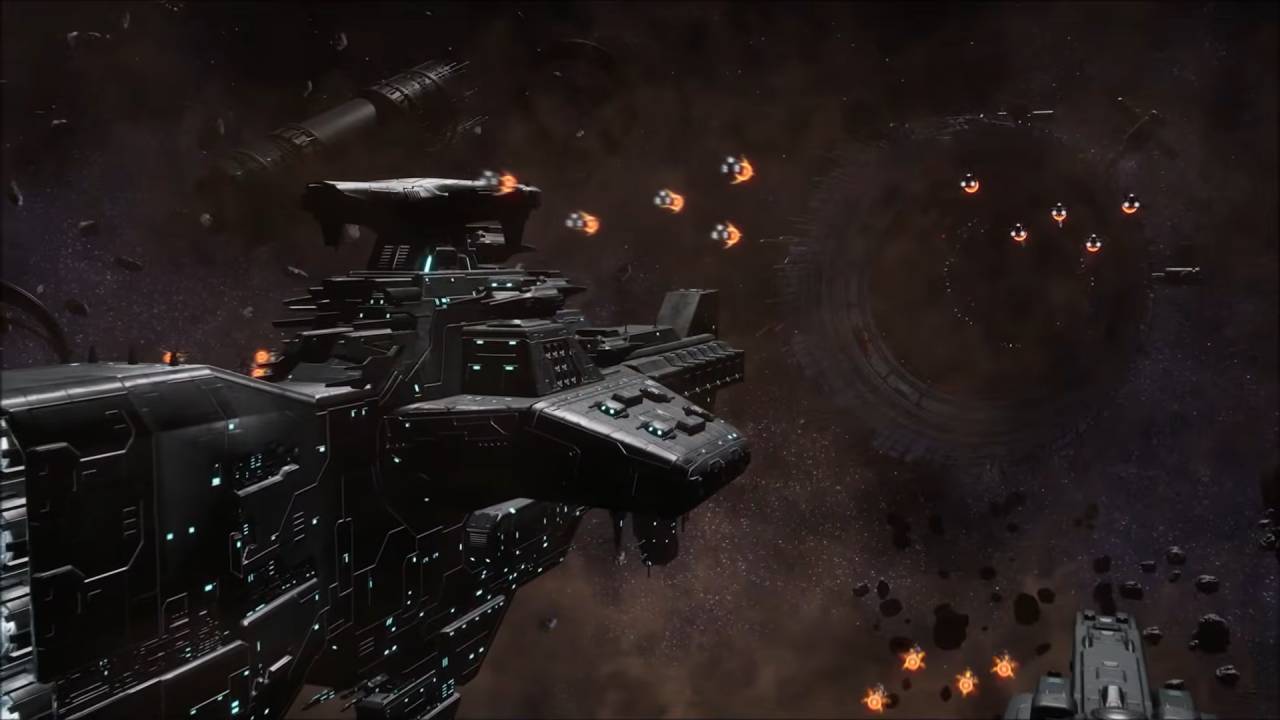
It is incredibly easy to identify brooding Striders, deploy distinct Force designs, and navigate massive, complex Bydo platforms. Capital ships and towering bosses dominate the screen with lethal, finely animated details and grotesque limbs.
Sumptuous background and level designs showcase a mix of biomaterials, floating Bydo structures, and eye-popping 3D dimension effects that leverage the power of modern rendering engines. Sharp colors and shading enhance the ship models, which shine brightly during the animated 3D combat vignettes that trigger during engagements.
While you’ll likely skip these cutscenes during longer, more exhausting encounters, they add a great deal of immersion to the turn-based actions. Dramatic voiceovers and a driving, tense soundtrack complete the strong visual and auditory experience of R-Type Tactics I • II Cosmos, wrapping a threadbare but atmospheric plot in premium sci-fi presentation.
A demanding gameplay loop exposes some dated menu systems and onboarding hurdles.
When it comes to interacting with this cosmic theater, control and selection work perfectly fine across the board. The developers ensured that either controllers or traditional keyboard and mouse setups can seamlessly navigate the menu-driven action, allowing a comfortable experience whether you prefer a gamepad or a desk setup.
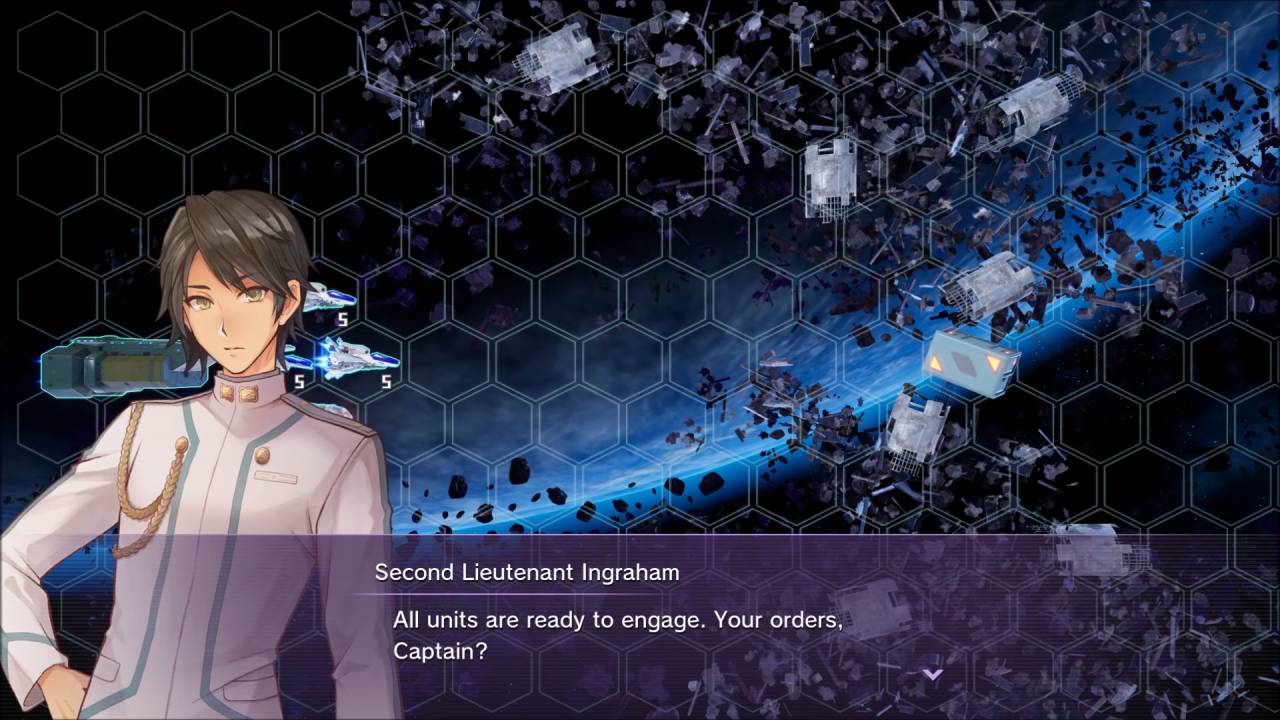
However, beneath the smooth modern interface, the core gameplay loop frequently slows to a crawl. Even when you crank the animation speeds to their absolute maximum, managing a large interstellar army can feel like a genuine chore.
Clicking through dozens of individual units just to move them a few spaces and assign basic actions reveals the clumsy, dated bones of the 2007 original. While the developers at Granzella spruced up the user interface and added helpful tooltips for various units, onboarding remains one of the game’s most glaring weaknesses.
The title completely lacks an interactive tutorial to ease newcomers into its complex ecosystem. Instead, R-Type Tactics I • II Cosmos expects you to wade through a dense, dry lore dump of text buried in menus.
Compounding this issue, the game fails to explain critical combat keywords and unit statistics well, leaving players to learn their actual battlefield impact through painful trial and error. During the tactical combat phase, you command your entire army before handing the turn over to the enemy AI.
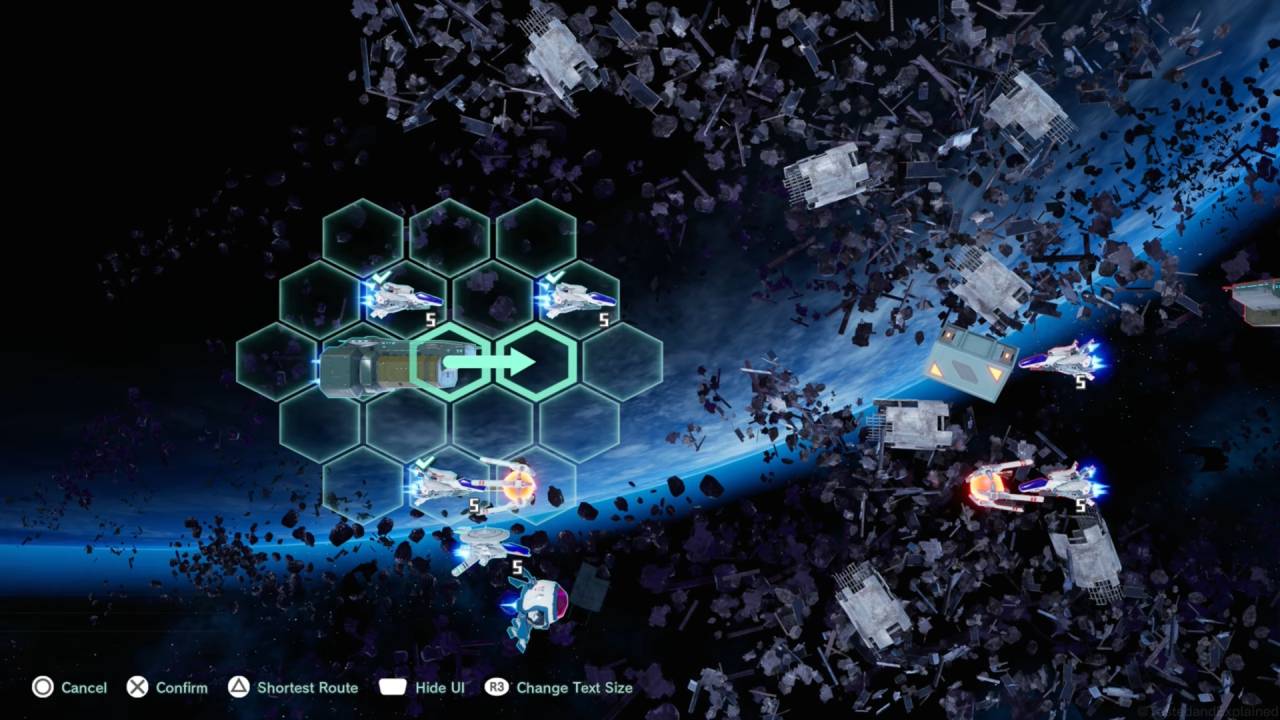
Every battlefield is a high-stakes tactical puzzle on a rigid hex-grid.
Each unit can move once and execute a singular command, such as launching a direct assault, deploying a defensive decoy, or utilizing specialized support skills. Tactically, the game relies on familiar genre staples, yet it deploys mechanics that delightfully resonate with its shoot-’em-up roots.
For instance, fighters can attach to deployed Force modules. This homage to the original side-scroller arcade shooters demands intense forward-thinking; docking a module consumes a precious action but unlocks broader attack and defense configurations on the following turn, depending on the Force configuration you choose.
There is another fascinating constraint: your fleet always advances from left to right across the map, with unit models maintaining this rigid orientation. This is far more than just a visual nuance or a nod to the past; charged shots are only generated to the right of your units, and vice versa for enemies, meaning your positioning on the field dictates your offensive capability.
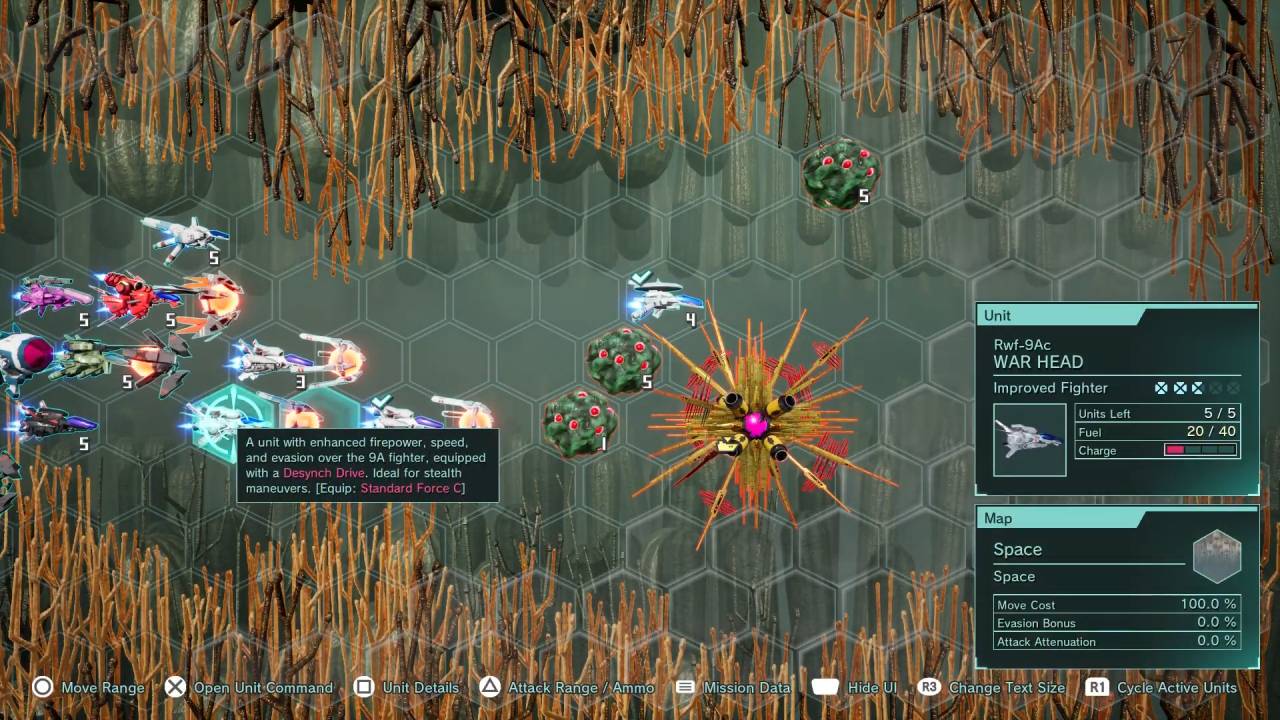
The core tactical innovation of R-Type Tactics I • II Cosmos lies directly within these franchise-specific mechanics, mapped across a vast, unforgiving hex-grid. Balancing long-range artillery units, support craft that resupply ammo and repair hull damage, and multi-attack dreadnoughts transforms every battlefield into an engaging, high-stakes puzzle of positioning and resource management.
As your unit options expand over the course of the campaigns, the true depth of the game’s positioning and tactical tricks comes to the forefront. Success requires mastering specific battlefield counters, such as using weak, rapid harrying attacks to disrupt and completely cancel an enemy’s devastating, slow-building charged strikes.
Advanced environmental hazards demand tight resource management and mobile bases.
Formation management is equally critical to survival. You would do well to scatter your fighter wings across the hex-grid to prevent a single enemy line attack from wiping out entire squadrons in one fell swoop. Larger ships take more deployment space, often in odd, cumbersome shapes, forcing you to consider whether a large, bulky cruiser will be as effective in a tight corridor as several nimble fighter craft.
These fundamental principles manifest early in the campaign, making every encounter feel like a sci-fi chess match. Ultimately, Granzella deserves immense credit for how perfectly this strategic dance mirrors the rhythm of the original arcade games: you must constantly calculate when to push forward, when to withdraw, and whether to unleash a devastating strike or defensively deny the enemy their own.
Later levels require smart resource management, meaning you’ll have to place mobile bases to establish key supply points deep within enemy lines. The introduction of “desync” craft and phasing abilities opens up your tactical options considerably, allowing ships to pass straight through solid terrain.
This encourages clever plans to work around deadly bottlenecks and ambush unwary enemies, though it requires a tight supply chain, as phasing burns fuel much faster. Further variations soon mix up even these expectations, keeping the combat puzzle fresh.
Fog of war blankets certain maps, water-based levels significantly reduce your fleet's movement, and vertically-aligned levels pop up to render traditional horizontal charged shots far less useful. When combined with strict turn limits, these mechanics create an incredibly demanding experience that will test the patience of casual strategy fans.
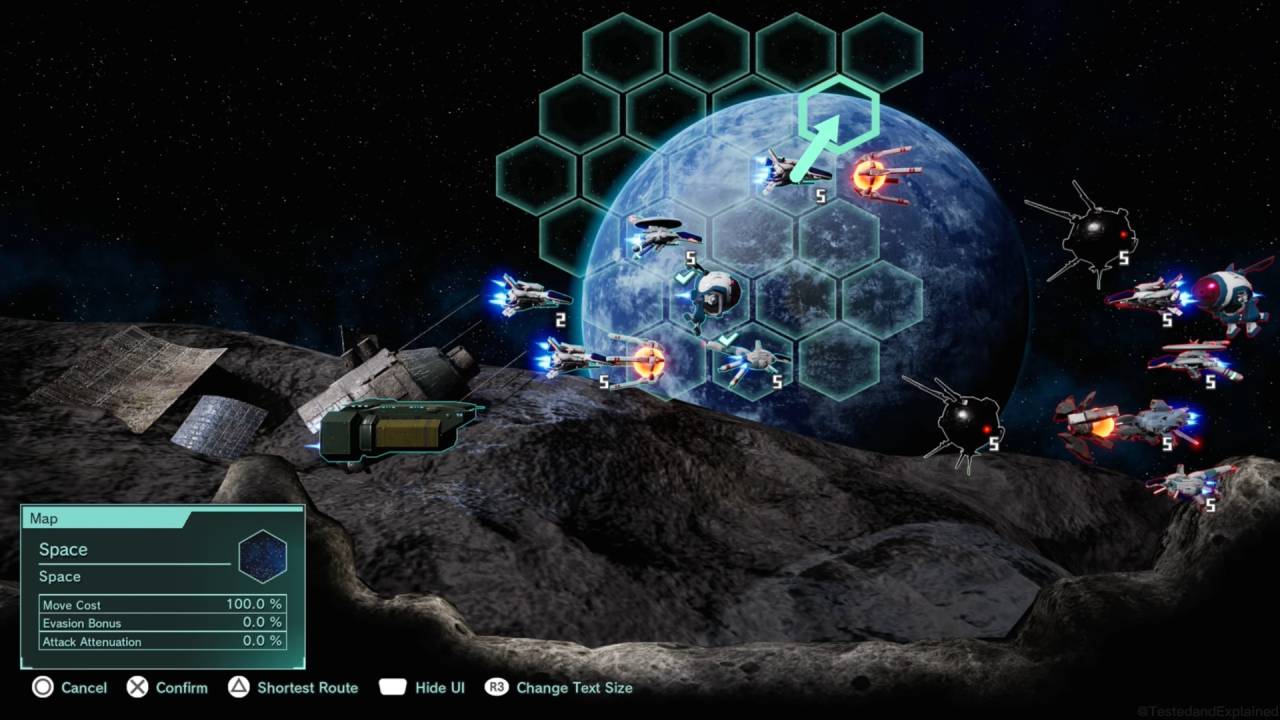
On the positive side, this creates an unparalleled sense of satisfaction when a plan comes together, turning a seemingly impossible wall of Bydo forces into a beautifully dismantled puzzle. On the negative side, strict adherence to rigid mechanics means that a single positioning mistake can snowball into total defeat, forcing a complete restart of a mission that may have already taken upwards of an hour to play through.
Persistent fleet upgrades and deep grinding determine the war's outcome.
Much like its brutal arcade inspiration, failure in R-Type Tactics I • II Cosmos is a natural, expected part of the progression loop. Losing a mission is rarely a total waste of time, as you retain mined resources to reinvest back into your fleet development, which is the standard order of the day. Furthermore, your defeated leaders slowly accumulate experience over time, earning minor but vital permanent boosts to their health and evasion stats.
Consequently, the game requires far more grinding than it initially lets the player know. Because the user interface provides very little direction or warnings, you can easily waste precious materials upgrading the wrong ships or unlocking dead-end tech trees that offer little utility on the current frontlines.
In many ways, the design hearkens back to a punishing, old-school era of gaming where you were practically expected to fail a level just to learn the required loadout and enemy spawn patterns. While not an outright dealbreaker for patient players, this trial-by-fire approach becomes increasingly tedious as the battles grow longer and more involved.
Thankfully, there is plenty to sink your teeth into across both games included in this comprehensive package. The three core campaigns themselves are dozens of hours long, with an almost endless variety of approaches possible, assuming you have the time and inclination to collect resources and develop new ship designs in the hangar.
Given that a massive part of the campaign involves playing as the biomechanical enemy, the options here literally double the tactical possibilities, as Bydo units operate on completely different rules of growth and regeneration compared to human tech.
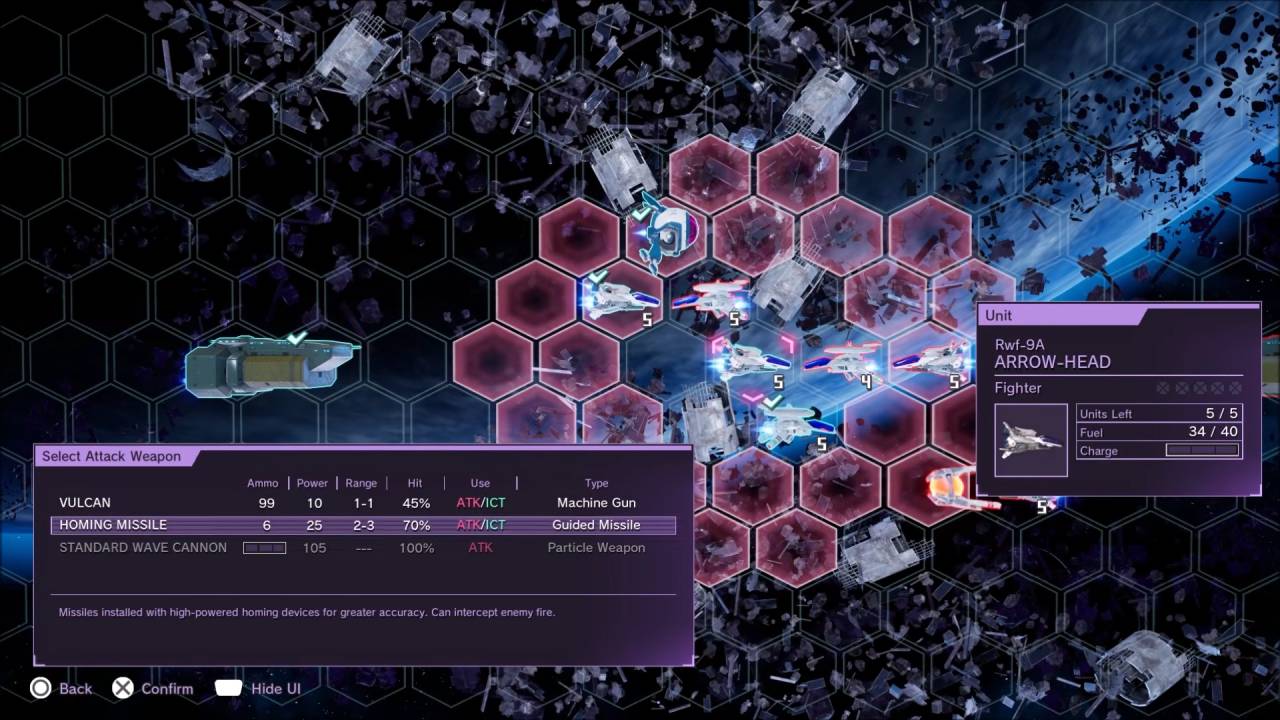
The sequel includes more visual novel elements, branching mission paths, and dialogue choices during briefings that alter your campaign trajectory, though the narrative is admittedly not on a contemporary epic level. Like a swarm of alien forces filling the screen, R-Type Tactics I • II Cosmos is beautiful and compelling, but difficult and overwhelming at times.
It is evidently a huge labor of love from Granzella, and long-time fans who know the intimate lore differences between an Arrowhead and a Cerberus fighter will have an immense amount of fun with the game’s clever nuances. For the standard strategy RPG enthusiast, it will undoubtedly require a significant time investment, a willingness to overlook clunkiness in the UI, and a rather threadbare story.
All those years ago, the original arcade classic challenged gamers with a simple decree: "the fate of two races depends on you." Now, with your controller in hand, you must decide if that fate truly compels you to the far reaches of space. It is a hard, grind-heavy fight, but for the right commander, the stars have never looked more inviting.
Editor, NoobFeed
Verdict
R-Type Tactics I • II Cosmos offers a great UE5 upgrade to a nice pair of cult-classic strategy games. Despite a steep learning curve and slow pacing, its deep tactical hex-grid combat and massive dual campaigns make it a must-play for genre fans.
83
Related News
No Data.