
Well Dweller Review
PlayStation 5
A matchstick, a missing family, and a queen who wants feathers.
Reviewed by Adeela Tas on Sep 21, 2026
Within minutes of starting Well Dweller, you can tell where it got its ideas. The combat, the platforming, and the moody hand-drawn look all point straight at Hollow Knight and Silksong, and if you've beaten both, that link is hard to ignore.
That fades as Well Dweller finds its own footing, and after a few hours, you stop comparing and start playing. Kyle Thompson developed it, and Top Hat Studios is publishing it. Thompson also made Islets and Crypt Custodian, and his brother Eric is back to handle the music. You sit down planning to play for an evening and end up giving it your whole weekend.
The setup is grim for something so cute.
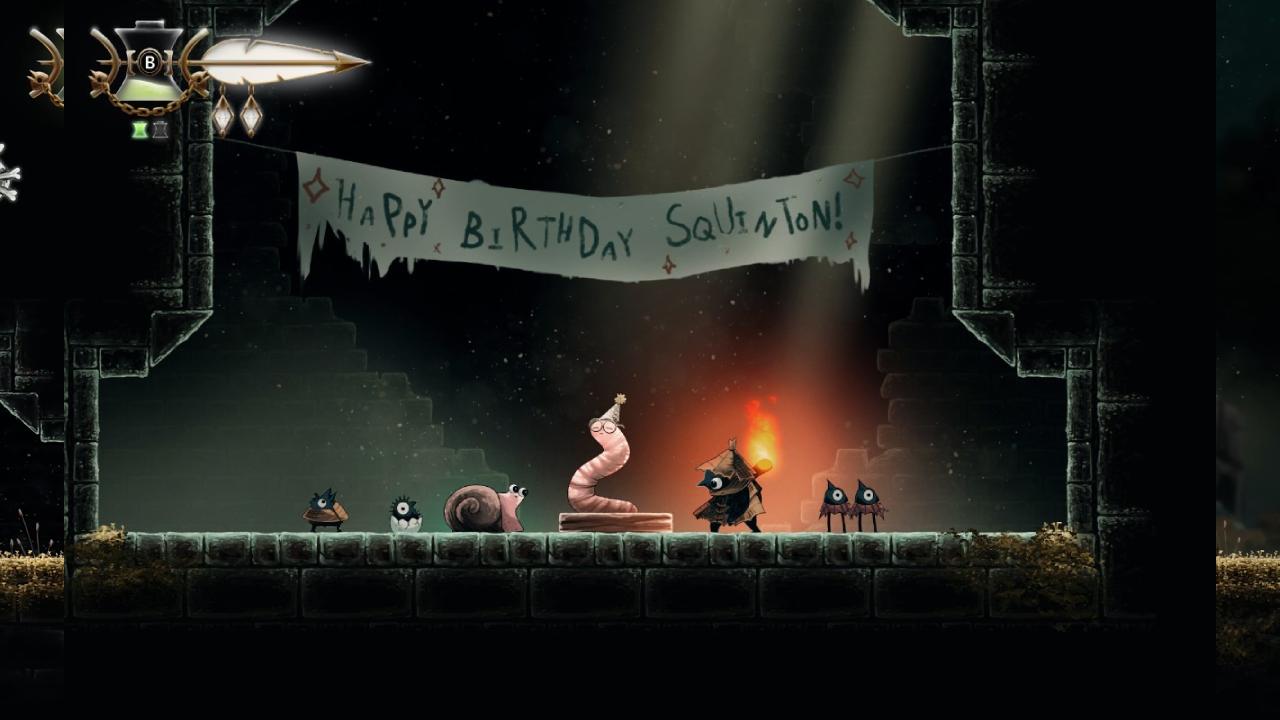
A queen wants a gown made from bird feathers, and she has hunted birds so hard that almost none are left. In Well Dweller, you play as Glimmer, the eldest in a family of birds hiding at the bottom of a well. Your mother is too weak to go out for food this time, so the job falls to you.
You grab your matchstick, bring your siblings along, and head to a hunter's house to sneak in while he sleeps and take something to eat. The younger ones are no help (one is still an egg), so you wait by a nearby tent. It should be simple, and it isn't. The hunter carries your family off, and you set out to get them back.
Along the way, you gather enough golden feathers to be let into the royal home, where the queen seems set on killing them. The opening stretch spends real time on your ordinary life before it gets torn apart, and that gives the rescue some weight even though the plot stays basic.
The story follows a small kid doing something brave while everything around him is bleak, and you can feel how young Glimmer is in the small moments with his brothers and sisters, each cute and funny in their own way. The people you meet on the road add a lot. You see mice running from the queen, scavengers hunting for loot to sell, travelers with their own goals and troubles, and a shopkeeper who acts a bit erratically.
A few of them end up selling you things or drawing maps.
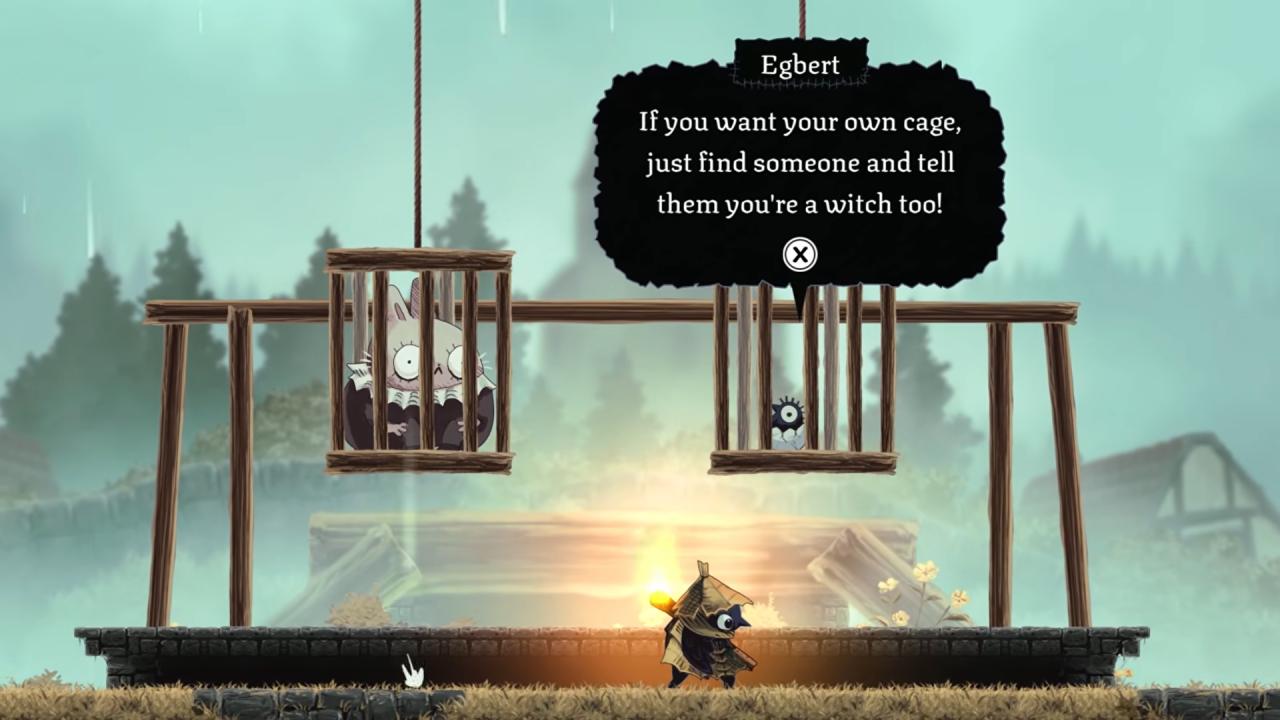
Everybody has a story about what the queen has done to them, and that gives Well Dweller a quiet sadness that sets in early. The humor sits right beside it. In one scene, a sibling gets accused of witchcraft and sentenced to burn next to an actual witch, and his last request is to have his cage lowered so he can see better. It's a strange joke, and it lands because nothing else gets undercut. One other character gets a laugh out of nearly every line.
The art looks like an illustrated storybook that has gone sour. Characters are minimal and bug-eyed in the style Thompson is known for, but the environments and monsters in Well Dweller have far more detail than his earlier games.
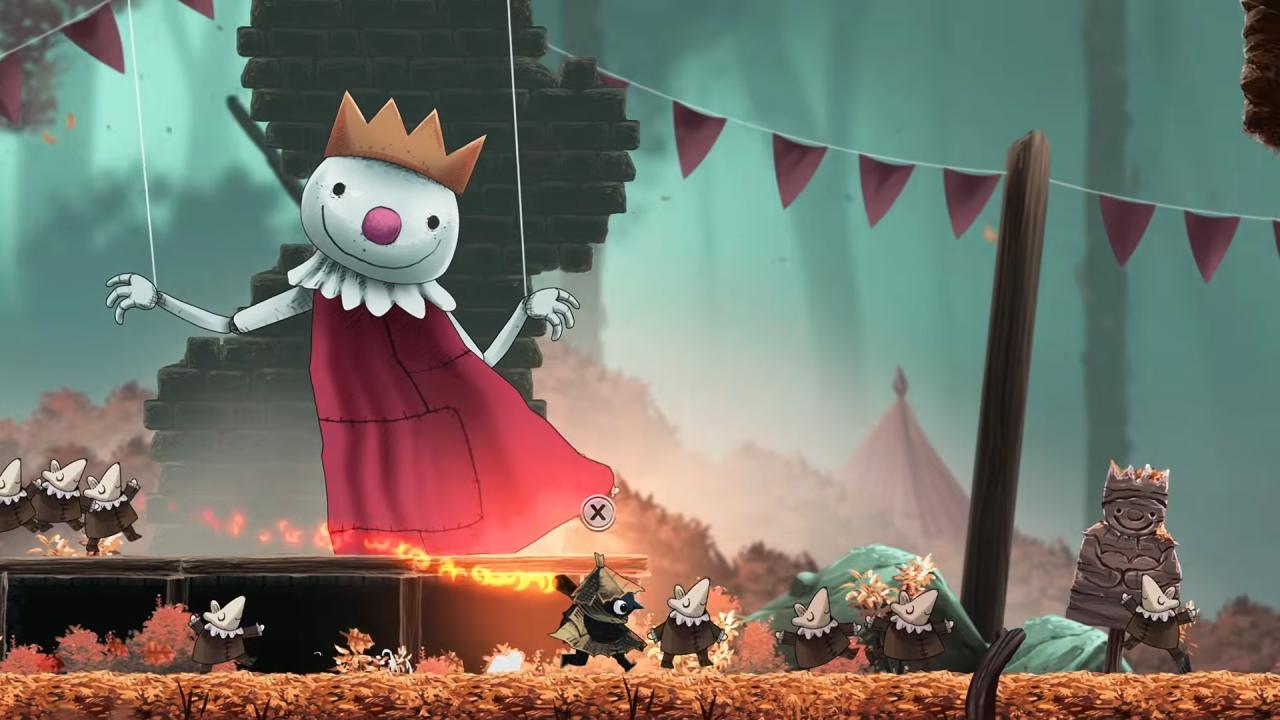
You move through fog and heavy shadow, then glowing embers and moonlight cut across it, and the lighting does a lot of the mood work. The land feels like an autumn that has been dying for years. Each area has its own theme, residents, and hazards, so you never feel like you're looking at the same place twice.
The enemies remind you of an older kids' film like Coraline, only hand-drawn and a little more cartoonish, and the first time the hunter shows up, he makes you flinch. Small morbid details fill every biome, and the whole thing reads like a spooky tale from a dusty old book.
Eric Thompson's soundtrack for Well Dweller has a spacey, synthy sound that sits well beside those visuals.
The exploration music is quiet and a little sad, and it picks up energy when a fight or boss begins, without ever taking over. Every area gets a tune that tells you what the place is like, and the piece playing around the docks is the one that stays with you longest.
Combat in Well Dweller is simple, and it feels good. Glimmer's matchstick gives you a two-hit combo on the ground and in the air, and every hit that lands pushes enemies back a bit. The swings are fast and dependable, so the controls turn into muscle memory quickly. The matchstick also doubles as your health bar.
At full health, the flame burns bright, and as you take damage, it shrinks until you're carrying around something closer to an ember. Your ranged option is a flaming bottle, basically a Molotov. You toss it, then whack it with the matchstick while it's still in the air, and it flies at your target.
It homes in, so you rarely miss as long as your swing connects, and it hits for surprisingly serious damage. Hitting enemies up close refills it, and around four hits tops it off, so you end up using it constantly. Sliding gives you invincibility frames, and it's your main way of dodging attacks and hazards.
Healing in Well Dweller takes a little getting used to.
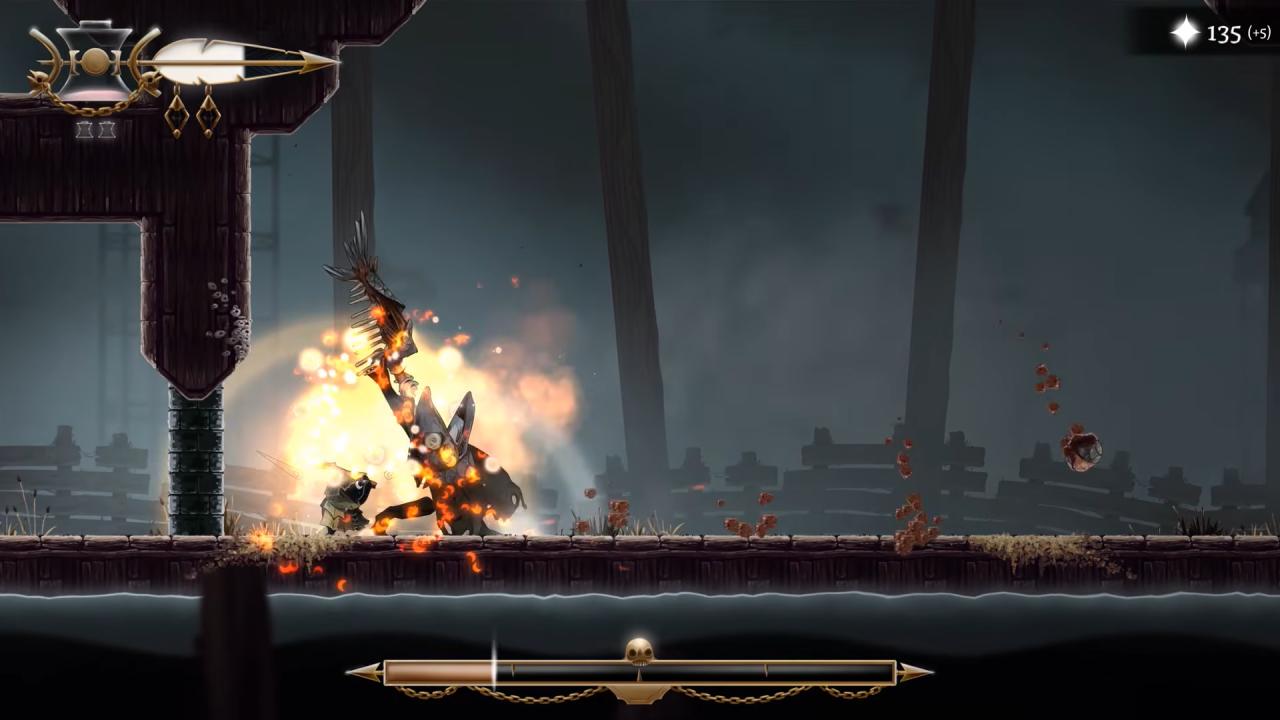
You drink an oil vial, and a marker moves across a meter above Glimmer's head. Stop it on the glowing section to recover health. Think of a free throw in NBA 2K, or the active reload in Gears of War. If you miss, the vial stays with you, and you try again. A successful heal also raises your attack strength for a short time, so it's worth going for mid-fight.
Later you get a slingshot that fires the matchstick at enemies. It doesn't do much damage, but calling the matchstick back feels like whistling for Mjölnir, and when it sticks in a wall, it becomes a springboard. Then there are trinkets, which work a lot like charms in Hollow Knight.
Some raise your damage at full health and others when you're low; some reveal hidden passages, and one surrounds you with spikes when your health falls under 25%. Another leaves a line of fire behind you when you slide. Each trinket eats a certain number of slots, so you can't wear everything and have to decide how you want Glimmer to play, much like badge points in Paper Mario.
You can upgrade trinkets with crafting tokens and currency, and the damage ones are worth the spend. Enemies are easy to read. Their attacks are telegraphed, with pink graphics flagging the ones that matter, and some wrap themselves in flames while others explode when they die, so your approach shifts from area to area. You rarely get swarmed, and you don't seem to take damage from simply bumping into things.
Locked arena fights pop up now and then, usually with two or three waves, and once you clear one, you can try again with a no-hit condition for extra currency.
Played on Normal, Well Dweller comes across as fairly easy, and that's on purpose. There are three difficulty levels, Easy, Normal, and Hard, plus accessibility options that make things more forgiving still. Even on Normal, you need to read patterns, especially in tight spaces, but the skill ceiling is low, and fights rarely stall you. That balance keeps you in a flow state: you have to stay alert, yet you're never stuck for long.
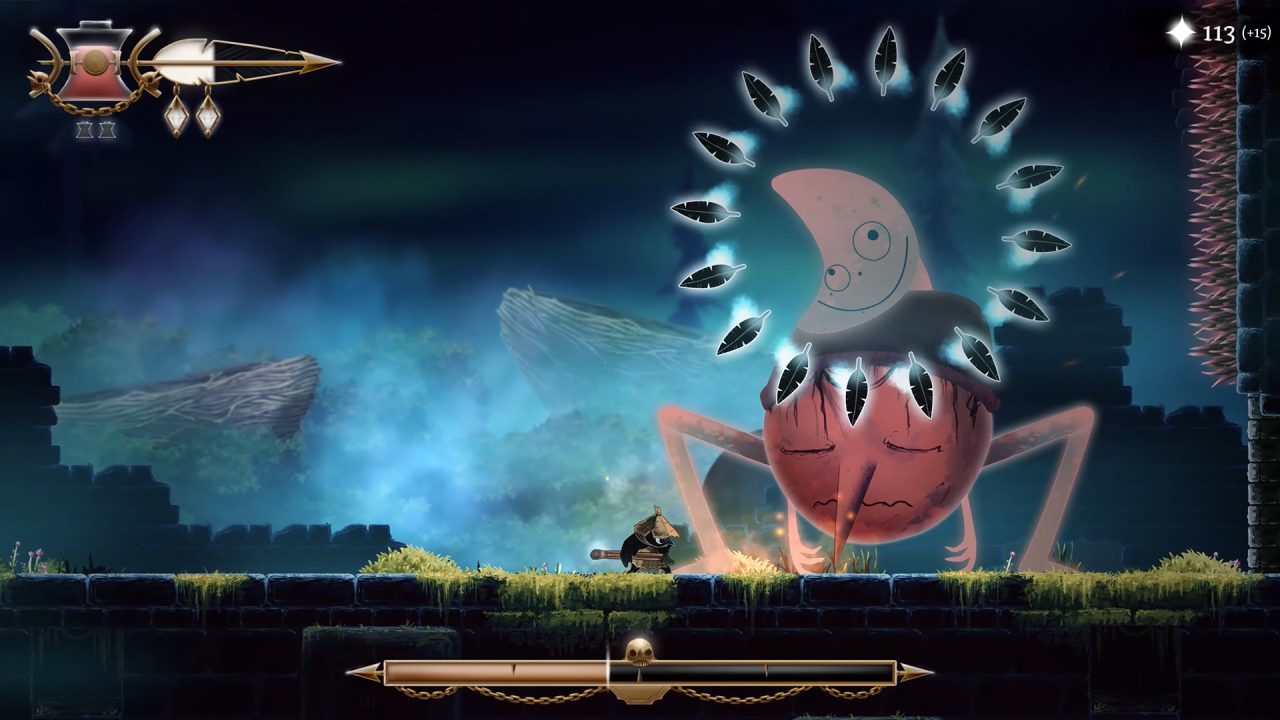
The one complaint is that a different battle idea or two would have kept the loop from feeling samey now and then. Bosses are huge, creepy, and drawn in more detail than almost anything else. You have to learn their patterns, but on Normal they're fair and leave room for mistakes.
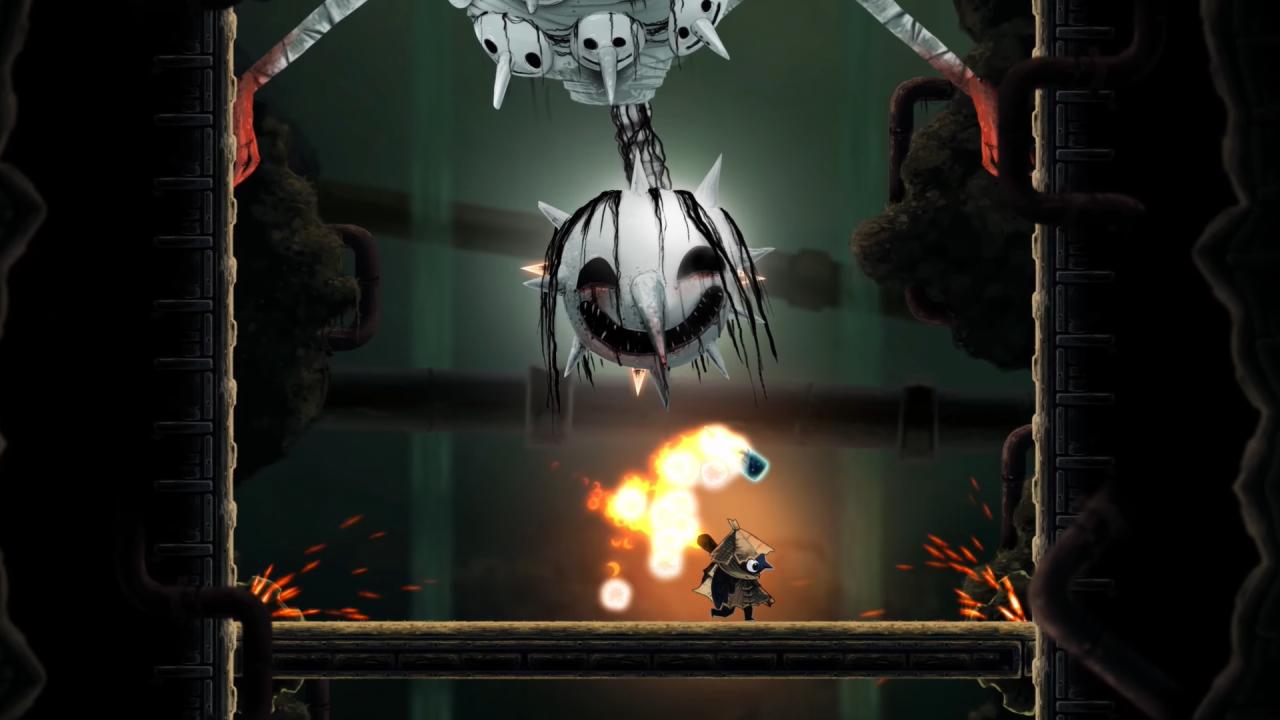
Most go down in one or two attempts, and a slightly tougher fight would have been welcome, since Well Dweller's approachable design speeds up your progress. Some add platforming to the mix, like the swarm fight, which feels like a nod to Grime's final act.
Mid-to-late bosses can make you sweat for a moment, and beating one often gives you a new traversal ability. One encounter isn't a standard fight but a three-part chase, and dying in any part sends you back to the start. It isn't long, and it took four tries, but it's the one place that might frustrate you.
Glimmer moves well - after a few seconds of walking forward, he breaks into a run, and you need that momentum for certain jumps and for the time trials scattered around.
He can't stay in the air long, which is odd for a bird, at least at first. You start with a bubble you can jump into, steer, and pop out of; later, you aim it and bounce it off walls or the ground to get past spikes. The slingshot is where traversal gets fun.
Firing the matchstick into a wall leaves a platform you can bounce off or stand on, giving you the same feeling as the plunger gun in Quackshot on the Sega Genesis, only expanded. Other abilities include climbing with a circular stamina meter like in Breath of the Wild, wall jumping, riding wind currents, and hovering.
One biome even lets you fly briefly once you pick up a special power-up. You can combine these, and each biome brings different hazards, from wind gusts to bouncy mushrooms. Sometimes an egg teleports you to a separate section to try a skill out before sending you back.
The optional platforming challenges are worth the detour. There aren't puzzles exactly, but short gauntlets ask you to study them and execute cleanly, and they pay out trinkets and slots. The time trials demand near-perfect movement. Standard stretches tend to end just as you settle into a rhythm, and longer ones would have been nice.
The world is split into 15 biomes, each with its own small story.
One asks you to find a ticket to attend a witch burning, and another sends you after pearls to open a gate tied to a missing crew. That makes Well Dweller feel more like a series of levels than a standard Metroidvania, and it's more linear than the genre usually is. Still, the areas feed into each other, and revisiting them with new abilities pays off. Backtracking is light, and when it comes up, the routing shows you old areas in a new way.
You can wander off the main path until a missing skill turns you around, and breakable walls, hidden passages, puzzles, and time trials await. If you die, you don't lose your currency, so there's no need to run back to pick anything up.
Well Dweller has trinkets, trinket slots, crafting tokens, key items tied to each biome, and 20 lost bird spirits. Bringing spirits back home earns you rewards, and a save tent sits right outside. Storybook pages also turn up, covering folktales in an illustrated style that looks like the children's books you may have read growing up.
There are three storybooks in all, and chasing the final page of each tale sends you back through areas you thought you'd left behind. Mailboxes hold letters from your mom and other characters, and some nudge you toward things you haven't found, like side activities and places you missed.
The map is one of the best parts of Well Dweller.
You can zoom in and out, switch between a detailed style and a simpler boxy one, and see biomes in different colors with points of interest labeled for you. You can place your own markers, and the upward arrow is handy for flagging spots you can't reach yet, so when a new ability arrives, you know where to head back. You can pay to pin collectibles you've missed, or the next story objective, and the minimap helps too.
Two trinkets help as well: one shows secret entrances in walls, and another gives a visual cue when there are items in the room. Every save tent you find works as a fast travel point you can jump to straight from the map, and it unlocks early and costs nothing. That takes away some of the tension of backtracking, but reaching new places sooner is worth the trade.
On PlayStation 5, it runs smoothly overall, and the only thing you notice is a slight delay when moving between screens. Progression is lean. There's no XP, no leveling, no skill tree, and no stats. You customize Glimmer through trinkets, and nothing you find boosts the matchstick or adds health for collecting a set number of items. You buy extra flaming bottles and oil vials.
The shop travels with you and sets up in your save tents, and you pay with the white currency enemies drop. The catch is that you can buy all 100 trinket slots there for cheap, and since enemies respawn each time you save, you could farm currency and skip looking for slots entirely. That weakens the value of finding them, and you do reach a point where you can equip every trinket in Well Dweller.
There are no real side quests either; story pages, optional platforming challenges, and postgame content fill that space.
Length depends on how much you dig. A regular playthrough runs about 10 to 14 hours across 15 biomes and 13 bosses. After the credits, you get a postgame that serves as a second ending, and a speedrun mode if you want another reason to return. All of that costs about twenty dollars. The ending itself is satisfying and funny, and it fits the tone of the rest of the story.
Well Dweller won't win you over if you're waiting for a Metroidvania that reinvents the genre. Instead, it takes familiar ideas and makes them fit together so well you barely notice the seams. Combat becomes instinctive, enemies keep you paying attention, fast travel cuts the dead time, and new abilities get put to use almost immediately.
None of those parts is revolutionary on its own, but they rarely get in each other's way. The complaints are small: platforming that ends early, a shop that makes trinket slots too easy to buy, one chase that can be irritating, and a combat loop that could use another idea. If you enjoy Metroidvanias, especially ones that go a little dark and a little odd, Well Dweller is a solid pick.
Editor, NoobFeed
Verdict
Well Dweller wears its Hollow Knight influence openly but earns its own identity through tight combat, clever traversal, and a moody storybook world. Not genre-defining, but the polish, humor, and dark whimsy make it a solid Metroidvania.
87
Related News
No Data.