
Tiny Bookshop Beginner's Guide | Gameplay Tips & Essentials
A beginner's guide to help you understand the core mechanics of Tiny Bookshop.
Game Guide by Faviyan Mustafiz on Sep 01, 2025
In Tiny Bookshop, every action you take contributes to creating a thriving literary hub while fostering relationships with the town's colorful characters.
Understanding the fundamental systems—such as stamps, memories, and shop management—will give you the foundation to tackle challenges with confidence.
This guide focuses on the essential mechanics you need to know, from collecting stamps and fulfilling memories to mastering book sales and navigating interactions with customers and characters.
Stamps and Challenges
Every place you go to has a set of tasks that you can complete to get a stamp in your journal. These stamps are essential steps on your trip and are usually linked to specific locations, so you must be in the right place to move forward.
After completing a challenge, you may need to return to its associated location before you can fully finalize it and collect the stamp.
Challenges often unlock sequentially, meaning a new one may only appear after finishing the previous task and revisiting the area.
If you ever feel unsure about what to do, hovering over a challenge in your journal provides helpful details to guide you.
Memories

As you progress, characters will make requests, and fulfilling them rewards you with a memory polaroid in your journal.
These memories serve as markers of your relationship and the shared experiences you had with the characters. Some memories are earned by completing a location's challenges, while others arise without any request attached.
Specific memories unfold over multiple smaller requests but eventually condense into a single, complete entry. For example, Klaus's A Rusty Proposition evolves from various tasks into one cohesive memory.
Every character also has a Core Memory, bordered in gold, representing the climax of their personal storyline. Just like challenges, hovering over requests in your journal gives more insight if you're uncertain about the next step.
Character Interactions
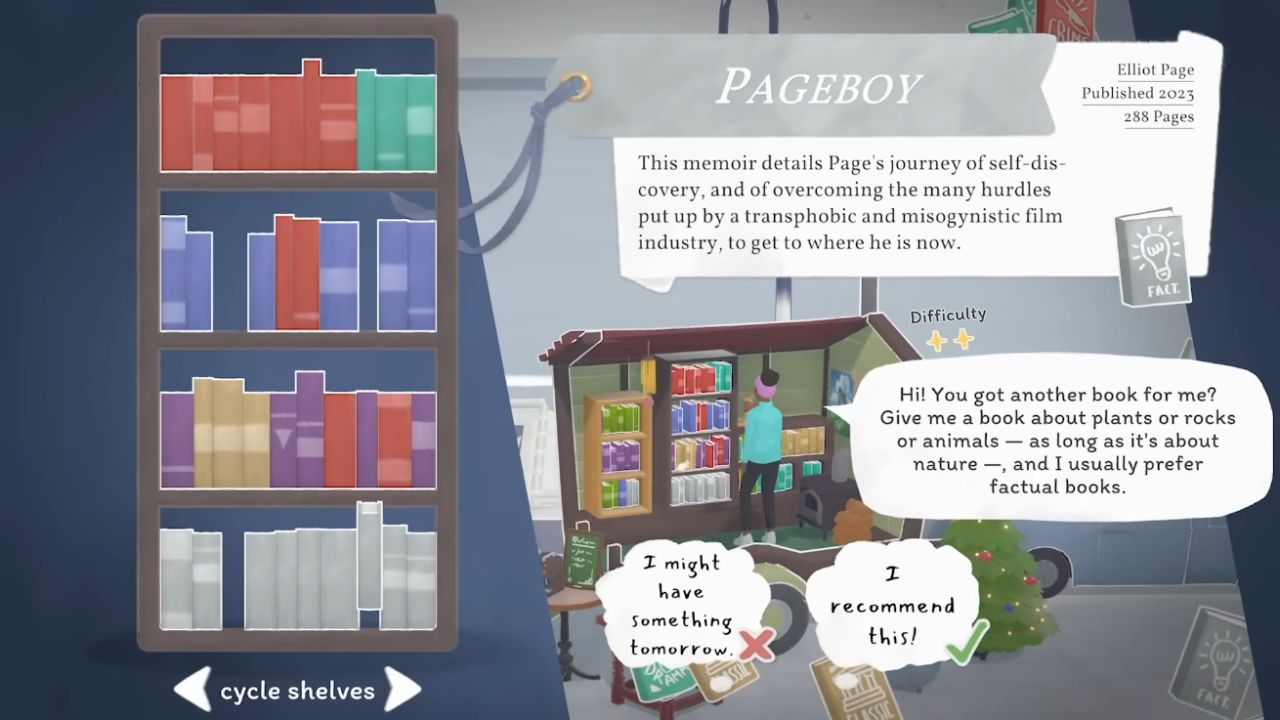
Characters in Tiny Bookshop usually focus on one topic per day. If you want to discuss something specific, it may take several days of encounters before the subject arises.
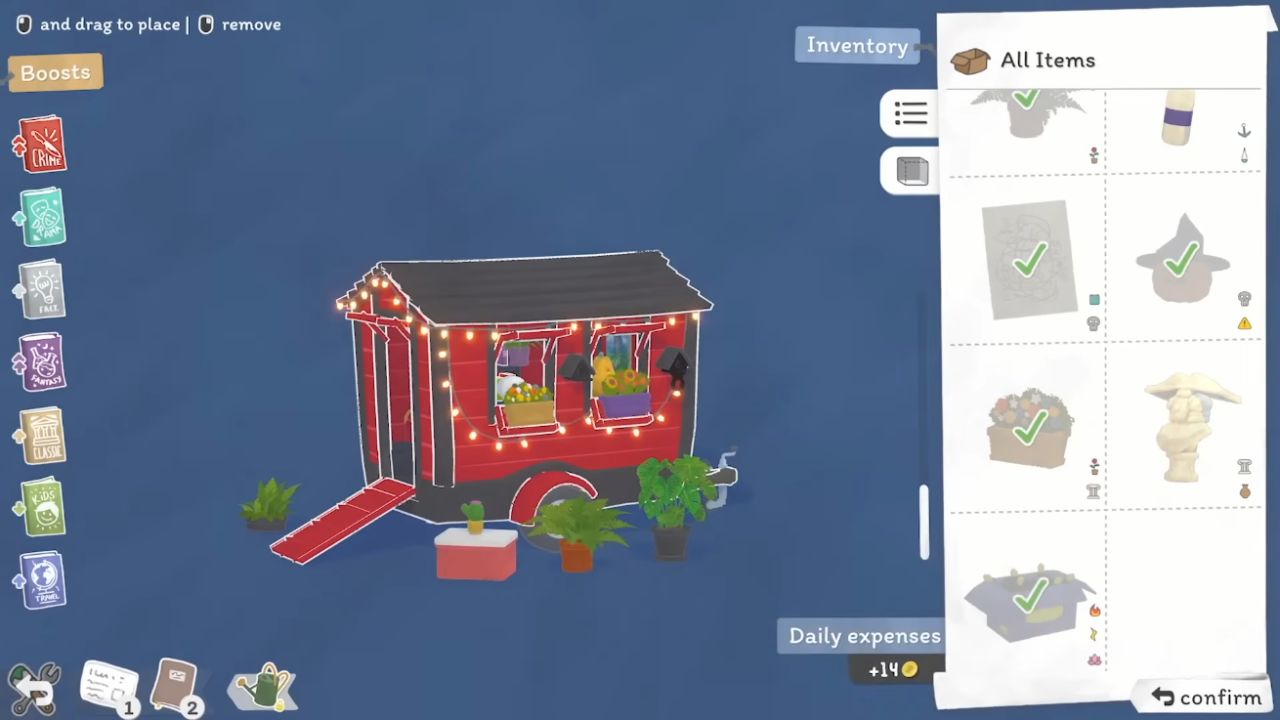
Many requests and challenges depend on equipping relevant items in your shop. For instance, if you are delivering collected funds, you must have the donation box equipped.
In most cases, items automatically equip themselves when received as part of a request or gift, but if no slot is available, the game will unequip something to make space. Always check your shop setup afterward.
Purchased items from vendors or the newspaper do not auto-equip and must be added through the customization screen. Since some tasks only progress with certain items equipped, double-checking your shop setup prevents unnecessary delays.
Exploration and Hidden Interactions
Every place has secrets and things that you can connect with. As the seasons change or problems get harder, you may find new chances in places you thought you knew a lot about. Returning to places you've been before can often lead to discoveries.
Bookshop Tips
Stocking the right genres for each location is crucial. Your journal lists which genres are most popular at each place, once you have visited it at least once. Matching your stock to these preferences significantly increases sales chances.
Sales can also be influenced by the number of books you carry from a particular genre and the overall ambiance of your shop. Decorations can boost or reduce sales chances, so rotating them frequently is beneficial.
Successful recommendations provide a temporary sales boost across all genres, while unsuccessful ones carry no real penalty beyond the customer's decision to leave. This means it is always worth attempting a recommendation, even if uncertain.
The number of recommendations requested per day can also change depending on the items you have equipped. This can be useful if you need to complete a challenge tied to recommendations.
Your journal also lists current shop effects, making it easy to adjust your setup for the next day.
Lastly, please pay attention to customer clothing colors, as they hint at their preferred genres. Learning to read these signals helps anticipate what your customers want before they even ask.
Contributor, NoobFeed
Latest Articles
No Data.