
AMD Ryzen 5 9500F Review: Balanced Performance and Limited Value in a Cut-Down 9600X Design
AMD’s Ryzen 5 9500F delivers expected performance with reduced clocks and no integrated graphics for cost efficiency.
Hardware by Nahe Yan on Nov 08, 2025
AMD Ryzen 5 9500F has garnered significant attention since its introduction to the Ryzen lineup. It is quite similar to the release sequence of AMD's other "F" series CPUs, which are cheaper versions of their X series processors that don't have built-in graphics.
Although availability has been limited so far, it has already generated interest among users seeking a budget-friendly CPU with solid gaming performance.
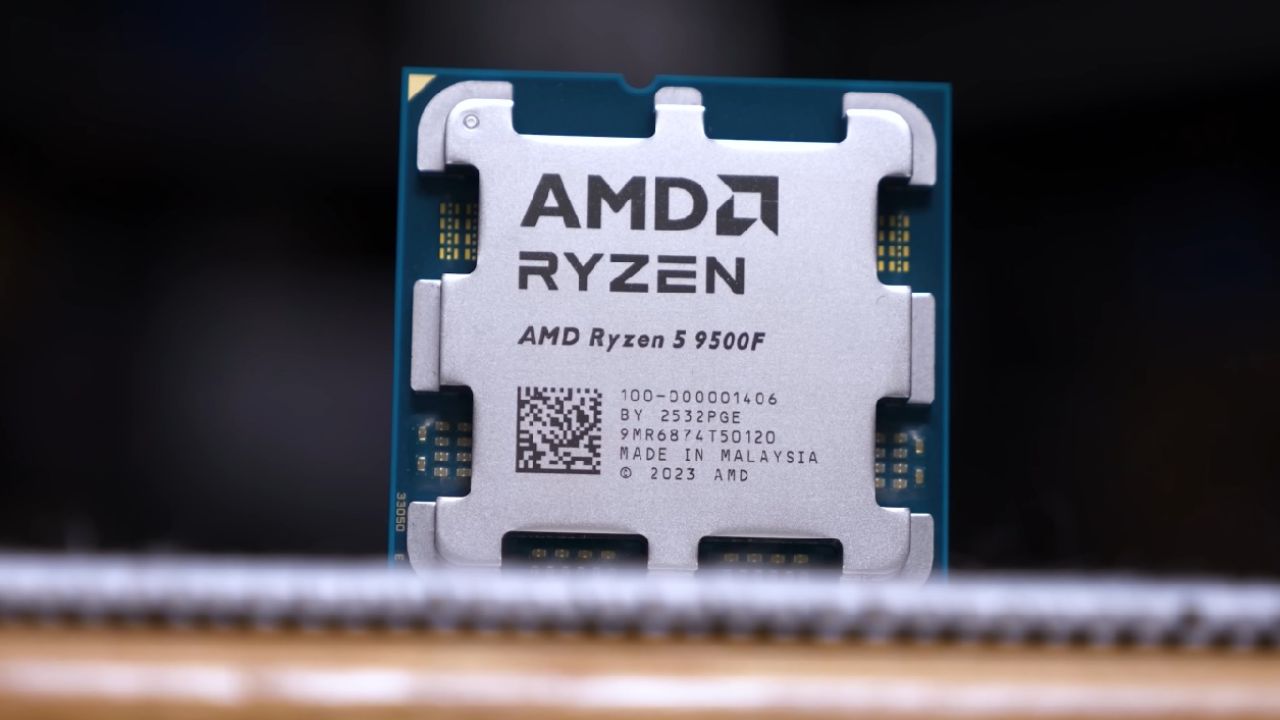
What is the Ryzen 5 9500F
The Ryzen 5 9500F is a modified version of the Ryzen 5 9600X, featuring slightly lower clock speeds and no integrated graphics. The base clock speed drops from 3.9GHz to 3.8GHz, and the boost clock speed drops from 5.44GHz to 5.0GHz.
It still has a 65W TDP, six cores and twelve threads, a single CCD, the full 32MB L3 cache, and 28 PCIe 5.0 lanes, four of which connect to the chipset.
The processor is functionally identical to the 9600X in terms of architecture, but operates at lower frequencies and lacks the RDNA2 iGPU.
Test Setup
We used a standard AM5 test system with a Gigabyte X670E motherboard and DDR5 memory at 6000 CL30. The Ryzen 5 9500F was put through its paces against a group of six-core, twelve-thread AM5 CPUs, such as the 9600X and 7500F.
An Arctic Freezer 36 kept the system cool enough for the benchmark results to remain consistent.
Cinebench Performance
During the Cinebench multi-core benchmark, the Ryzen 5 9600X achieved an average clock speed of 5.0 GHz across all its cores. It got very hot, up to 74°C, and needed 88W of power. The Ryzen 5 9500F maintained a clock speed of 4.75GHz, resulting in the 9600X being around 5% faster. The 9500F also remained cooler, with a maximum temperature of 70°C while operating at 86W. The 9500F hit 5.05GHz in the single-core test, but the 9600X stayed ahead at 5.45GHz.
Gaming Benchmarks
In gaming workloads, the Ryzen 5 9500F delivered results close to expectations based on its clock speeds.
In Baldur's Gate 3, it was 7% slower than the 9600X at medium settings and 4% slower at ultra. It performed close to the 7600X and 6–7% ahead of the 7500F.
In Counter-Strike 2, it achieved 8% higher performance than the 7600X at medium settings and matched it at ultra, remaining 7% below the 9600X.
In Marvel Rivals, the 9500F matched the 7600 at 173fps on medium, making it 8% slower than the 9600X. On ultra settings, it was only a few frames behind the 9600X and slightly ahead of the 7600X.
In Rainbow Six Siege, the 9500F delivered 469fps on medium, 16% faster than the 7500F, 10% faster than the 7600X, and 6% behind the 9600X. Even at ultra settings, it remained 6% slower than the 9600X while staying ahead of both the 7600X and 7500F.
In Space Marine 2, the 9500F was 4% slower than the 9600X at medium settings and 2% slower at ultra settings, roughly equal to the 7600X.
In Assetto Corsa Competizione (ACC), it performed exceptionally close to the 9600X, just 2% slower at medium and 16% faster than the 7500F at epic settings.
In Cyberpunk 2077, the 9500F matched the 7400F, slightly trailing the 7500F, and was 7% behind the 9600X on medium settings and 5% behind the 9600X on ray tracing ultra.

Shader Compilation
When testing shader compilation performance, the Ryzen 5 9500F completed the workload 5% slower than the 9600X at 332 seconds, matching the Ryzen 5 7600X and 2% faster than the 7500F. In Stalker 2, results were similar, showing a 5% performance gap to the 9600X.
In The Last of Us Part I, the 9500F also trailed the 9600X by 5%, completing the task in nearly 17 minutes, similar to the 7600.
Average Results
Across 12 tested games, the Ryzen 5 9500F was, on average, 5% slower than the 9600X at medium settings and 3% slower at ultra.
It performed 5% faster than the 7500F overall, which aligns with the expected behavior of Zen 5 versus Zen 4. The data shows predictable scaling based on the clock speed reductions.
Value and Pricing
The Ryzen 5 9500F is only approximately 12% less expensive than the 9600X right now, which isn't a great deal since it doesn't have integrated graphics, and imported units don't come with a warranty. The cost-per-frame difference is small, about 8–9% compared to the 9600X, while the 7500F is about 55% more expensive, making it a better value.
The 7600 also offers better long-term practicality, as it includes a box cooler and local warranty support. The 9500F's pricing advantage only becomes meaningful if it approaches $200 in the US market.
At that point, it could represent the best cost-effective choice for AM5 users seeking solid gaming performance without integrated graphics.

Final Thoughts
The Ryzen 5 9500F works just like a 9600X with a lower clock speed and no iGPU. There are no hidden sacrifices, and it meets the expected levels of performance, thermal efficiency, and power consumption.
But given its current pricing, it's not as appealing as the 9600X and 7600. If the price drops closer to $200, it will probably be a good bargain for AM5 platforms. Until then, though, it's better to get something that's already been out for a while.
Also, check our other AMD articles:
- AMD Ryzen 9 9950X3D Review: Setting The Standard For 2025 Gaming CPU
- AMD Ryzen 7 9800X3D Review: 3D V-Cache Goes God Mode with Stunning Gaming Performance
- AMD RX 9070 Performance Review: Thermals, Clocks, and Real-World FPS
- AMD Ryzen 5 7600 Review: Best Budget Gaming CPU of 2025?
- AMD Radeon RX 7800 XT Review: RDNA 3 Power For Midrange Gaming
- Sapphire NITRO+ AMD Radeon RX 9070 XT Review: The Ultimate 4K Gaming GPU
- AMD Ryzen 7 7800X3D: Delivers Gaming Performance Far Beyond Expectations
- AMD Ryzen 9 7900X Review: Powering the AM5 Era with DDR5 & PCIe 5.0
- ASRock Radeon RX 7800 XT Challenger OC Review: Best Price-to-Performance GPU of 2025
- Intel Core i9‑14900K vs. AMD Ryzen 7 7800X3D: Power Profiles & Gaming Benchmarks
Editor, NoobFeed
Gaming Hardware Updates
No Data.