
PS5 Path Tracing Tests Reveal Quake II RTX 60 FPS Potential and Cyberpunk RT Overdrive Limits
Linux support on exploitable PlayStation 5 consoles enables experimental path tracing workloads previously considered impossible on console hardware.
Hardware by Masaru Hoshino on May 22, 2026
Path tracing is one of the more challenging graphical technologies in gaming and has been restricted to high-end PC builds running on powerful Graphics Processing Units (GPUs) and advanced upscaling options. But with recent news of Linux support for older, vulnerable PlayStation 5 consoles, there has been a whole host of experimentation.
By installing Linux and running PC workloads directly on the PS5 hardware, developers and enthusiasts have started testing just how far Sony's console can be pushed beyond its intended design.
One of the most fascinating experiments involves running fully path-traced games directly on the base PlayStation 5. From classic titles like Quake II RTX to heavier modern showcases such as Portal RTX and Cyberpunk 2077 RT Overdrive, the results range from surprisingly playable to brutally compromised.
While none of these tests suggest that full path tracing is truly practical on current console hardware, they reveal just how close modern systems may already be to making it viable.
Quake II RTX Delivers Surprisingly Playable Results
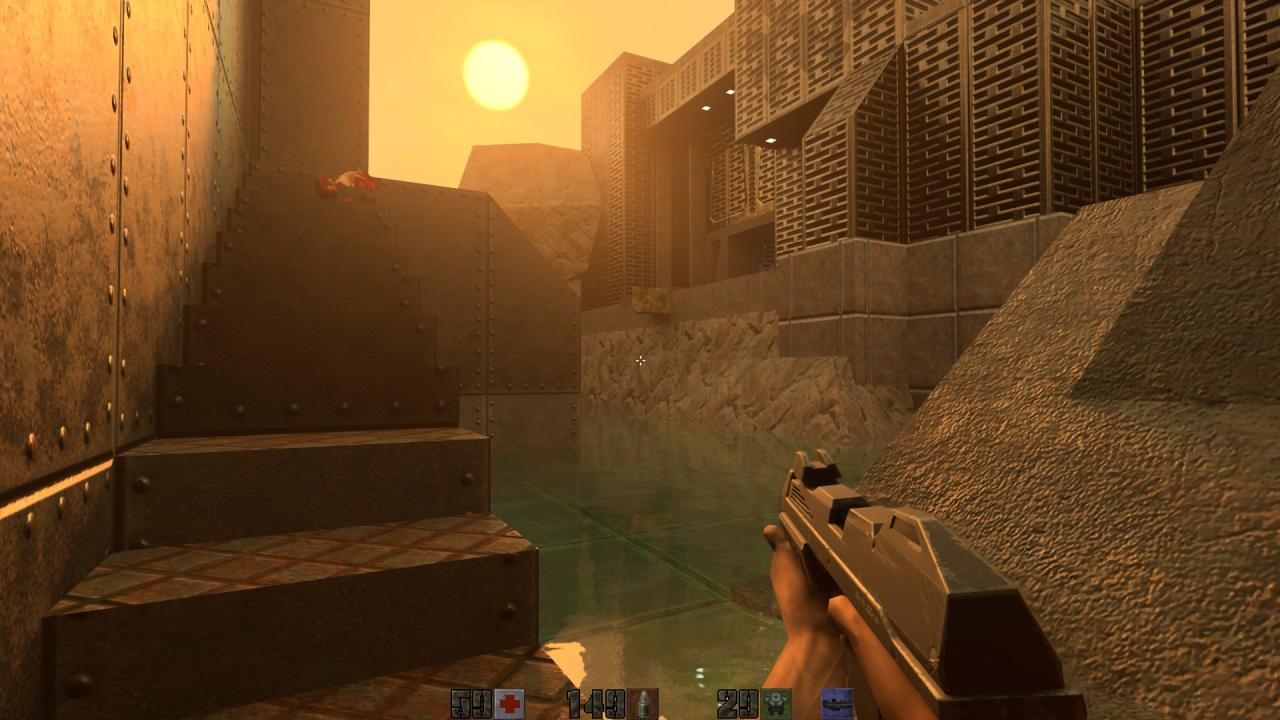
The first title tested was Quake II RTX, one of the earliest major path-traced releases on PC. Despite being based on a much older game, Quake II RTX remains an impressive showcase for real-time path tracing thanks to its complete lighting overhaul.
At native 4K with path tracing enabled on the PlayStation 5, performance was roughly 11.4 fps. That result was expected, given that the hardware was never designed for workloads of this nature. Things became significantly more interesting once temporal upscaling was introduced.
By default, the game runs at 1080p, and then the image is reconstructed to 4K, leading to an average of up to 40.4fps, which is a huge 254% over the native 1080p performance.
Dynamic resolution scaling took things one step further. The game had a locked 60fps target and a minimum resolution of 540p, maintaining a relatively smooth 60fps throughout the experience. Even though aggressive scaling was required, the results demonstrated that lower-complexity path-traced games are not completely out of reach for RDNA 2-class hardware.
The experiment also highlighted an important point about path tracing itself.
Path tracing is not a single fixed workload. Complexity varies dramatically depending on scene detail, lighting behavior, and the overall scope of the game world. Quake II RTX represents a relatively lightweight implementation compared to modern AAA titles, which is why it scales much better on limited hardware.
There was also discussion surrounding whether a title like Quake II RTX could realistically ship on consoles. Given that the game already runs on lower-powered handheld hardware like the Steam Deck, there is a genuine argument that the PlayStation 5 and Xbox Series X could handle it with acceptable compromises. Even the Xbox Series S was considered potentially capable due to its similarities with handheld RDNA 2 devices.
The experiment additionally reinforced how much path tracing can transform older visuals. While Quake II retains low-detail assets and classic geometry, the fully dynamic lighting system dramatically modernizes the presentation without needing photorealistic assets.
Portal RTX Shows the Limits of Current Console Hardware
The second experiment moved into significantly more demanding territory with Portal RTX, Nvidia's RTX Remix showcase title. Unlike Quake II RTX, Portal RTX relies far more heavily on modern rendering techniques, denoising, and reconstruction technology.
Running at a 1080p output reconstructed from an internal 540p resolution, performance fell below 30fps with noticeable image quality issues. Unfortunately, there was no sign of advanced denoising and modern upscaling solutions. Visual noise, instability, and soft image reconstruction significantly affected the overall presentation.
But, despite this, the game was still technically playable. Compared to older console versions of Portal, performance was arguably more stable despite the radically increased graphical complexity. However, the overall compromises clearly pushed the experience beyond what would be considered commercially viable.
The experiment highlighted one of the biggest current challenges facing path tracing adoption: denoising. Modern path-traced rendering relies heavily on sophisticated denoisers and temporal reconstruction systems to create stable images from very low internal resolutions. Without them, artifacts and instability become impossible to ignore
At the same time, these tests revealed how close the industry may already be to adopting broader path tracing. The technology itself is increasingly viable, but image reconstruction and temporal stability remain major hurdles. Current hardware is effectively "knocking on the door" of practical real-time path tracing, even if it is not yet fully ready.
There was also discussion about how indie developers could potentially make better use of these techniques. Lower-detail games inspired by older visuals could leverage path tracing much more effectively than large-scale AAA productions. Retro-racing or stylized racing games with more advanced lights may be a great fit with current consoles without being too demanding.
Cyberpunk 2077 RT Overdrive Pushes the PS5 to Its Breaking Point
The final and toughest challenge was Cyberpunk 2077 RT Overdrive, a very cutting-edge path-traced game that is among the PC's shakiest releases. Unlike the previous examples, Cyberpunk represents a fully modern AAA open-world workload with massive scene complexity.
Initial testing at 1080p output with XeSS Performance mode resulted in an average of 22.6fps. Surprisingly, that was better than expected, though still far from ideal. Performance improvements came through increasingly aggressive compromises.
Resolution was changed to an ultrawide 1920x800, resulting in an average of about 27 fps. More optimizations with a Nexus Mods path tracing optimization package brought it down to one bounce per ray and added another 32% to the frame rate, averaging up to 35.5 fps.
.jpg)
Benchmark numbers with AMD FSR 3.1 reached up to 70fps at the same time. In practice, however, the interpolated frames produced severe instability and visual wobble, making the experience feel far less smooth than the raw numbers suggested.
The internal rendering resolution eventually dropped to an astonishing 348p in order to maintain playable performance. At that point, image quality became extremely compromised. Combined with weak denoising and limited upscaling quality, the final result looked rough despite technically functioning.
Still, the broader implication remained fascinating. Even under such severe compromises, a fully path-traced version of Cyberpunk 2077 was running on a base PlayStation 5. That alone demonstrates how rapidly rendering technologies are evolving.
There was also significant discussion about what a PlayStation 5 Pro implementation could potentially achieve. With stronger ray-tracing hardware and improved upscaling solutions, a 30 fps path-traced mode may actually be possible, with noticeably better image quality. While such a mode would likely involve major sacrifices, it could still function as an experimental "here be dragons" graphical showcase option.
Others argued that rather than pursuing full RT Overdrive, a more balanced solution involving enhanced reflections and selective path-traced effects would likely provide a better overall experience on console hardware.
Linux on PS5 Opens the Door for More Experiments
In addition to path tracing, Linux on PlayStation 5 is shedding new light. It has definitely improved since the initial PS5 Linux testing, with fixes addressing graphical artifacting and correcting 4K output support through HDCP adjustments.
One of the most interesting things is the increasing experimentation with emulating RPCS3 on PS5 hardware. Emulation on PlayStation 3 is still very much a CPU-bound, SPU-centric process, although some titles are starting to yield fascinating results. This could be a very different story with future generations of hardware.
Well, these experiments aren't necessarily present-day commercial products, but they're definitely an interesting look into the future of console graphics technology. Quake II RTX showed that it is possible to reduce the complexity of path tracing, and Cyberpunk 2077 RT Overdrive proved that it is possible to push modern hardware to the limit to support path-traced AAA experiences.
Compromises are still on the extreme side, but these workloads are still running. In a base PS5, it is already an incredible technical feat.
Editor, NoobFeed
Gaming Hardware Updates
No Data.