
Horses of Hoofprint Bay Review
PC
A hand-drawn barn management game where daily routine, small details and real consequences come together.
Reviewed by Adeela Tas on Nov 05, 2026
Horses of Hoofprint Bay comes from Thogli Studios, and it feels like a project made by people who care about the subject. The game first reached players as a demo, and that early build already showed the plan: a 2D, hand-drawn, point-and-click barn build-up game that echoes the old browser horse games, think Charger Escape or Penny's Wild Ride, but plays with far more depth.
Since then, the studio has added Appaloosa coat patterns, head markings, traits and quirks, prestige, a ferry, extra trail rides, cross-country events and hired staff. The developers have said only bug fixes are planned after launch, so this is meant to be the finished version. After a long stretch with Horses of Hoofprint Bay, you come away with a clear picture of what it is: a focused stable sim that expects you to show up every day and do the work properly.
The main menu has a horse creator, and it is worth a visit before you start a save.
It gives you sliders for body color, mane and tail color, leopard spotting, tobiano patches, roaning, head markings,s and the height of the white on each leg. A note says horses made there cannot be moved into a playthrough, so treat it as a sandbox. It still shows how wide the range of coats is, so you have something to look for when you browse horses later.
You may wish you could carry those creations into a save. There is no story to speak of, and that is a deliberate choice. Horses of Hoofprint Bay opens on a ferry with a short setup: you spent your savings on a piece of land, quit your job,b and decided to build a life around horses.
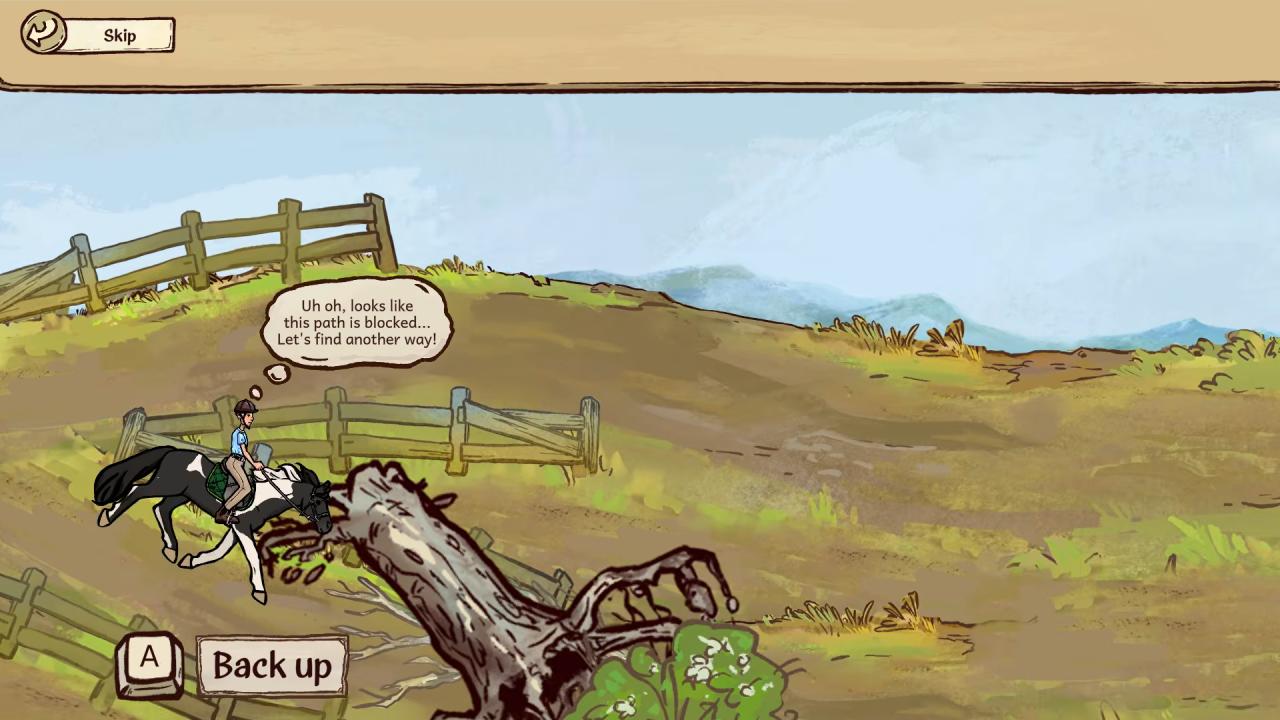
You type in a name, shape your look with hair, face, and outfit options, then pick a horse from a lineup you can scroll through. After that,t you ride to your new place, using D to pick up speed and the spacebar to choose a direction at forks and to clear a fallen log.
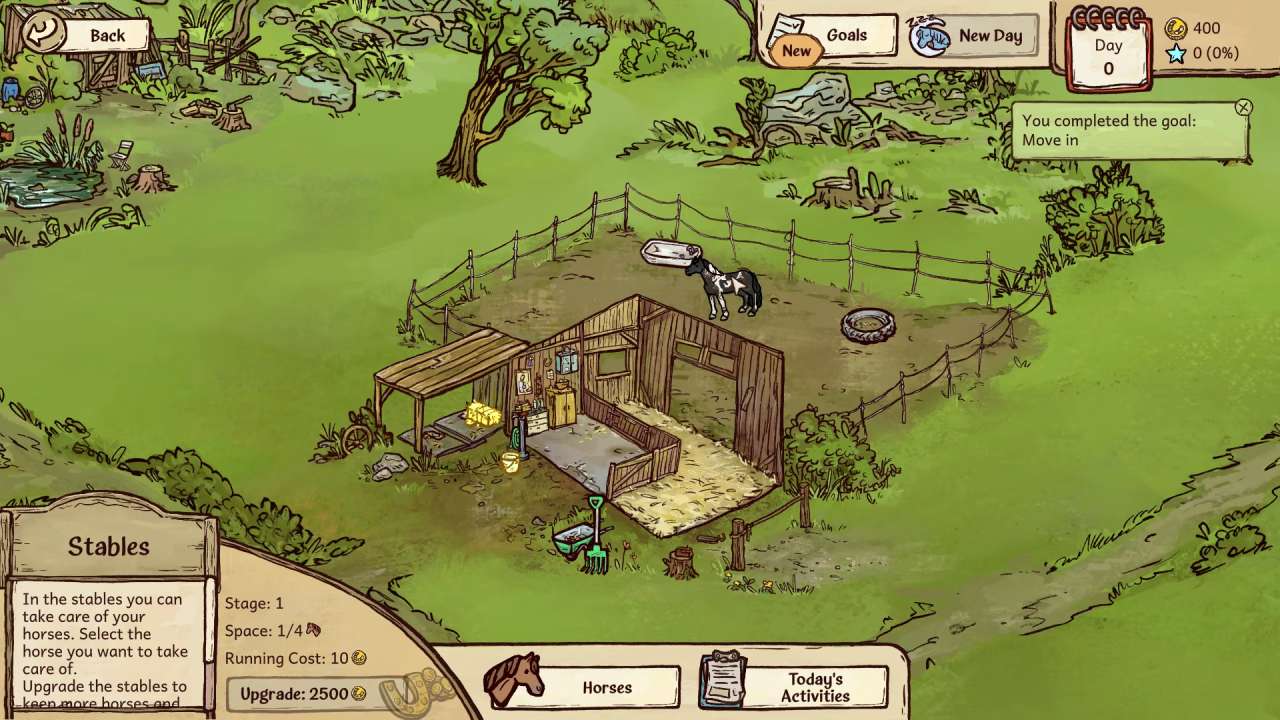
You arrive at a wonky shed that serves as a stable, with your uncle's old construction trailer as your home. That is where the plot ends. No town needs rescuing, and no family legacy needs restoring. The shop owner and the horse breeder have no names or dialogue, and the staff you hire come without backstories.
Without a plot, daily chores and goals drive everything in Horses of Hoofprint Bay.
What replaces a narrative is a list of goals, such as moving in, feeding and watering, reading the library, building an arena, and winning a first ribbon, each paying out gold and often prestige. Each day starts with chores, and the whole game is built around them. You drag hay from the storage beside the stable to the rack, haul water from the bathtub that doubles as a trough, muck out the stall, and groom your horse.
Grooming uses four tools: a curry comb that lifts dirt but roughens the coat, a soft body brush that smooths it back down, a hoof pick, and a brush for the mane and tail. You only clean one hoof, which keeps the routine from turning into busywork.
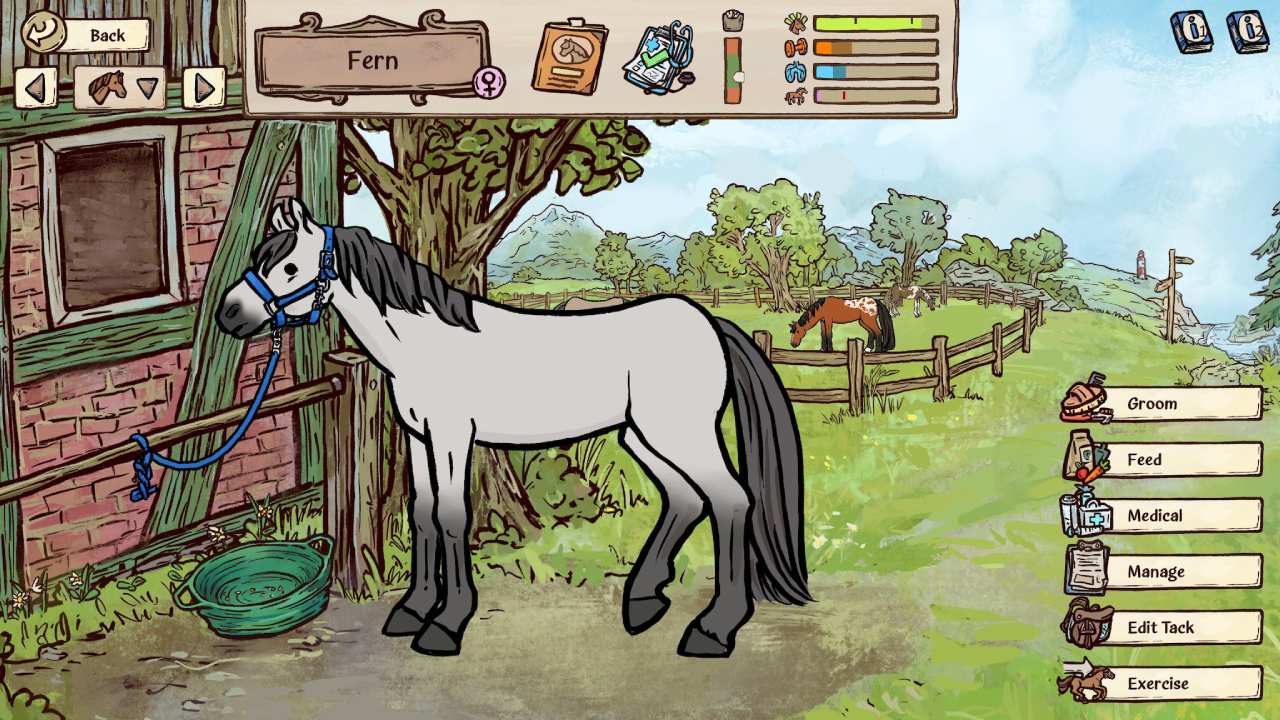
The care screen is where you hand out grain and treats, check medical status,s and read horse info. Once everything is done, press the New Day button, and an end-of-day screen sums up your money, prestige, and any changes to your horse. Horses always need hay or grazing, and hard-working ones also need grain, or their body condition slips.
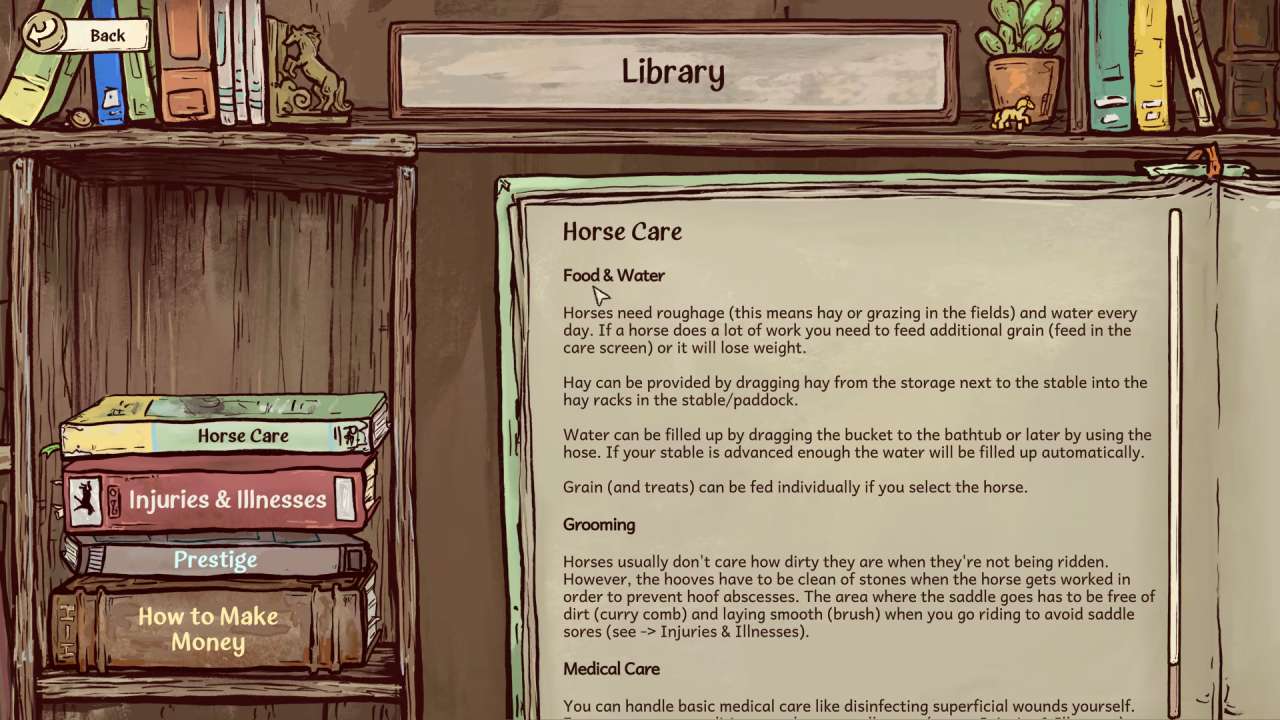
The library in your trailer is how Horses of Hoofprint Bay teaches you. New books unlock as you progress, covering horse care, injuries, prestige, earning money, training, lessons, gaits, competitions, confidence, breeding, horse value, and traits. They go into real detail, even describing the footfall pattern of a walk, trot, canter, and gallop, which makes the game welcoming if you have never been near a horse and still interesting if you have.
Money comes from several directions.
You can win competitions, give riding lessons, take in boarders, train and resell horses, breed and sell foals, finish quests, and later sell semen through a breeding station. Boarding requests appear in the office in three types. Part board means you only provide hay or pasture. Full board means you feed, groom, and monitor health while the owner handles exercise.
Schooling means you train the horse to a target before the stay ends, and it pays the most if you can pull it off. Pregnancy matters here too: if a boarded mare ends up in foal, the owner collects her early, and you lose that income, so until you upgrade the stable you take mares or geldings only.
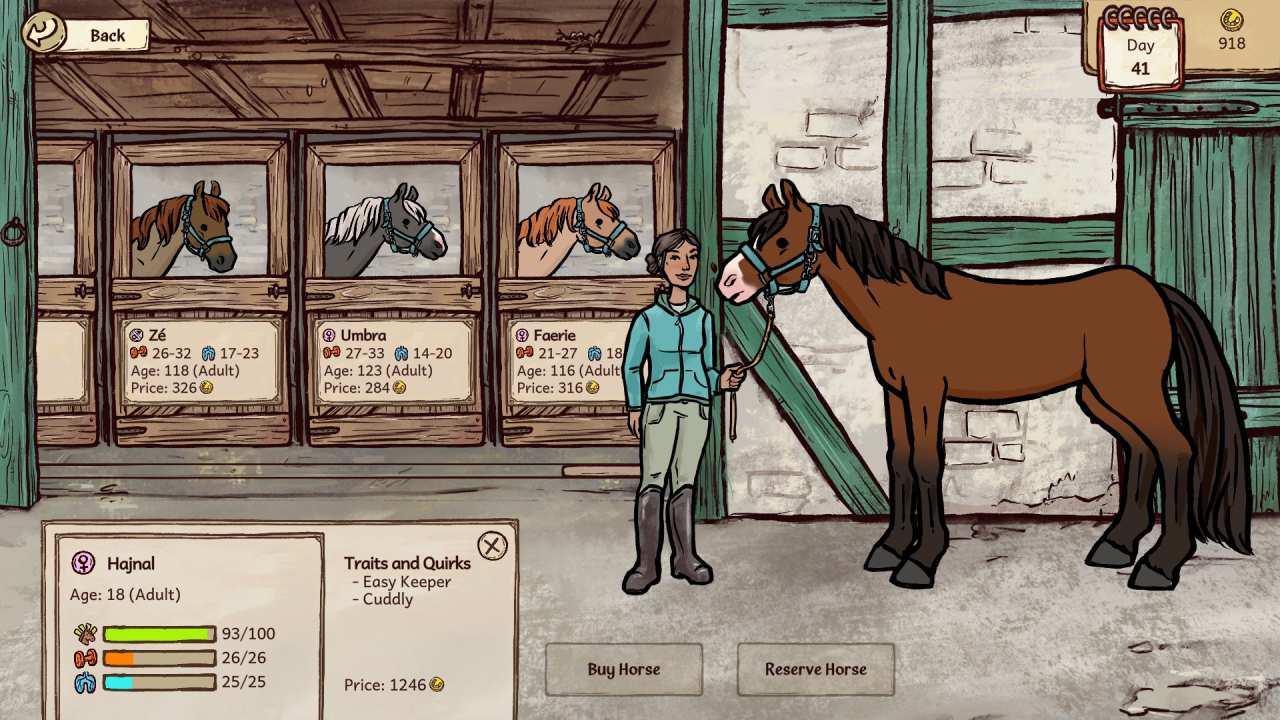
Town opens up a little way into Horses of Hoofprint Bay, and it has the store, the breeder, the competition grounds,s and the ferry. The store sells hay, grain, treats, tack, clothing, hairstyles, shoes, and boots, and it has a basket system and a sell button for gear you no longer want.
What it stocks depends on your prestige, which also decides the quality of horses the breeder offers and how many boarding and stud requests come your way. You gain prestige by winning, caring properly for boarders, and keeping your own herd healthy.
You lose it by failing events, riding without a helmet, entering with a dirty horse, or letting animals get seriously ill or get taken by animal welfare.
Gold also goes into building and upgrading: the arena, a parking lot for the trailer, fields, a yearling paddock, a breeding station, a larger stable, and the main house for staff. Everything builds overnight and has daily running costs, so your balance can dip below zero quickly.
Horses of Hoofprint takes health seriously. The list of ailments covers abrasions, cuts, dehydration, exhaustion, hoof abscesses, hunger, lameness, laminitis, saddle sores, sepsis, tendon injuries, thrush, and more. Each one has a cause and a recovery time that depends on whether you treat it. Skipping hoof picking can lead to abscesses, and a dirty stall can lead to thrush.
You deal with small problems yourself using antiseptic, cream,m or hydrogen peroxide, and you call the vet for the bigger ones. If a horse gets dehydrated, malnourished, or develops laminitis and nobody steps in, animal welfare takes it away. It is a much more grounded system than the quick band-aid approach most horse games use, and it explains why the chores matter.
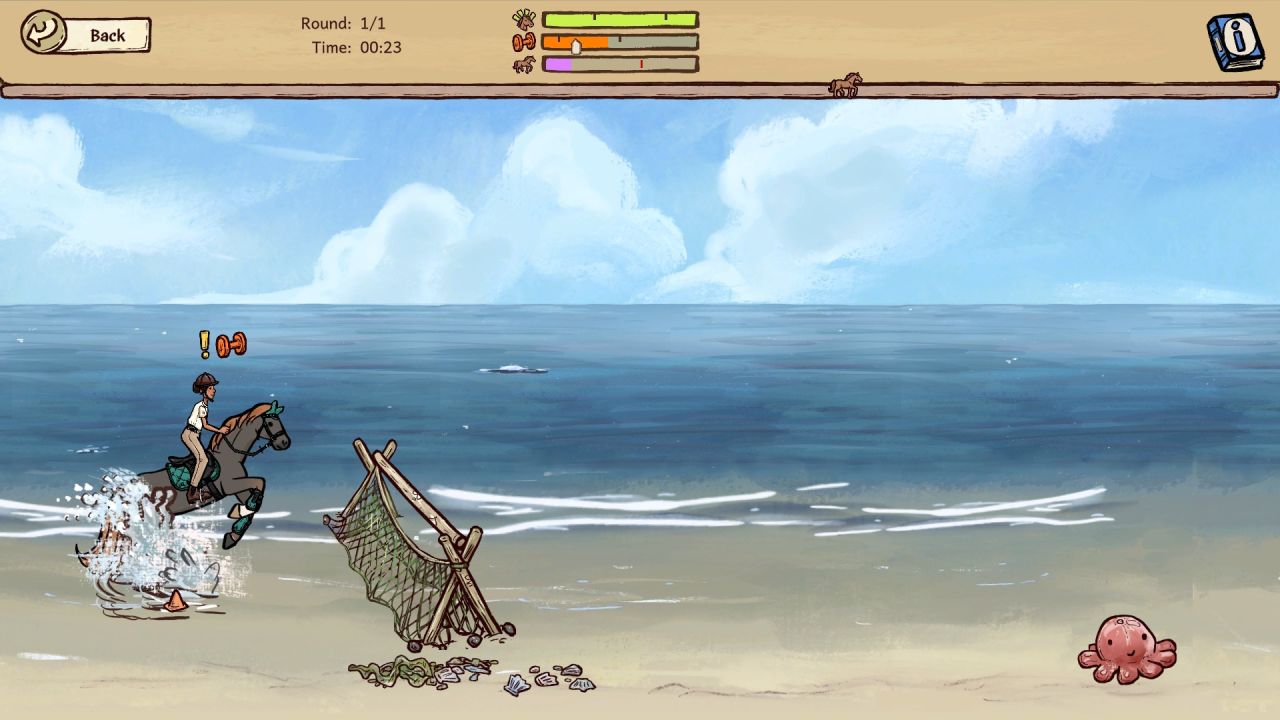
Training is the closest thing Horses of Hoofprint Bay has to combat or puzzles, and it plays out as short riding or ground exercises. Every course has a strength bar at the top. When it runs out, the horse refuses jumps, and the session fails, so you switch between gaits to balance speed against stamina.
Trot is the safe pace early on, canter suits high jumps, and gallop covers wide ones like water ditches.
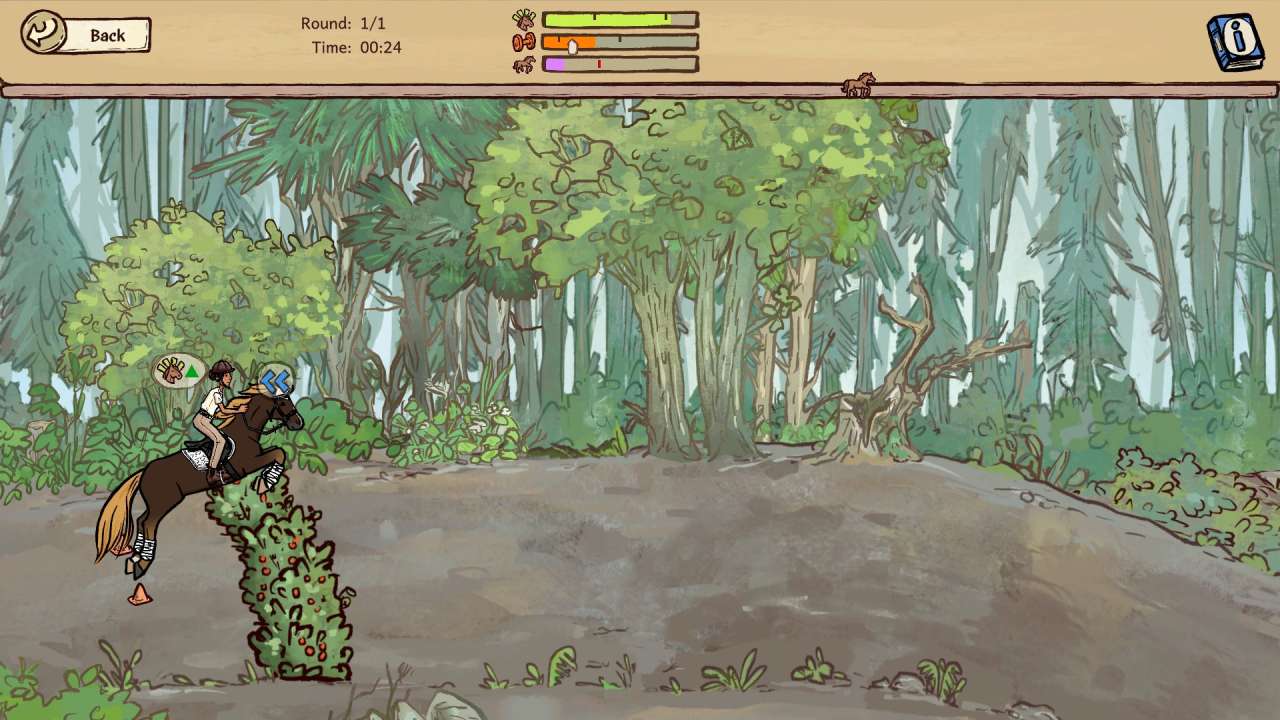
Small icons warn you when the horse is about to speed up or slow down on its own, and you can correct it, which feels a lot like sensing a horse's mood in real riding. Confidence decides how well the horse listens. Clean jumps raise it, knocked rails and refusals lower it, and a stumble over a solid obstacle drops it sharply. You can also lift it with treats, scratches on the horse's favorite spot, or praise right after a gait change.
The menu of exercises is wide. Cavaletti training is the starting point. Caprilli training asks you to hold a requested gait and change at the right marker, and it comes with a license you need before entering that kind of event. Show jumping has two levels: cross-country and lunging, which covers walk-trot, walk-trot-canter, transitions, and free lunging, which burns off a horse's extra energy.
Confidence training is a small puzzle of its own. Your horse spots something frightening, such as a plastic bag or an umbrella, and you watch its posture. Head down and nose forward means it is curious, so you press S to praise it. Head up, ears back, and a tense face means it is worried, so you press A to back off. Push too hard,d and it bolts, and the bolting animation is funny even when it costs you.
Lessons are a separate minigame. A rider sits on your horse with the reins tied off, and you correct posture as it slips. Q and E fix leaning, A and D fix the legs, and S and W fix hand height at higher levels. Beginners show one problem at a time, while advanced riders make smaller mistakes you have to spot faster.
Lessons pay decently, though each one wears the horse down.
Competitions pull everything together in Horses of Hoofprint Bay. You can enter once per day, and a single horse can enter in several classes if it qualifies. Caprilli scores the share of time spent in the requested gait, with four penalties for each knocked rail or refusal.
Show jumping adds a time limit, and cross-country prioritizes endurance, with shorter, harder lines or longer, easier ones. Before you can go, you need a license, a trailer, and a clean horse. Your horse arrives with a braided mane, and an announcer calls the action, which gives it a proper show atmosphere.
Some of this works very well. The warning icons and confidence system make a horse feel like it has a mind of its own, and the layers of exercise, strength, and confidence mean you cannot brute-force a course. The accessibility options are a real strength.
You can turn on auto-jumping so timing never blocks you, or switch on a jump indicator that places cones ahead of each fence to show when to press the spacebar, which is a good middle ground. Difficulty sliders cover quest rewards, prestige gains and losses, and competition challenge, and you can change them mid-save, so a stressful stretch does not force you to quit.
Horses of Hoofprint Bay has a few rough edges, mostly around timing and unexplained details.
Transition timing in Caprilli is hard to read at first, and it takes a few tries to work out that the cue belongs when the marker lines up with the horse's shoulder or the rider's seat, not when it first appears. Watching the strength bar while following the course means glancing away at bad moments.
Some small things lack explanation: hovering over a trait tells you nothing, and the star icon has no tooltip. Cover Mare at the breeder first without confirmation, and you cannot see the stallion's traits, so one stray click can start a pregnancy you didn't intend.
Progress in Horses of Hoofprint Bay comes from grinding stats, and the game is honest about it. Strength and endurance rise through riding, lunging, and trail rides, but both are capped by the horse's potential, shown as a bar with a solid portion and a hatched portion for what is still unknown. Exercise works as a daily budget that grows with endurance.
Go past the red marker and the horse is exhausted the next day, which weakens it and blocks gains; keep pushing, and you get a tendon injury that costs four to six days. Too little work makes a horse explosive. Idle horses lose strength and endurance, and mares lose some while carrying a foal.
Each day becomes a puzzle of how much exercise, feed, and rest you can fit in.
Goals push you along, such as reaching 20 strength and 15 endurance, then 30 and 25 for a Caprilli license, then 35 and 35 for show jumper status. Eventually a horse hits its ceiling, and you have to change approach by selling it, buying one with higher potential, or breeding for one.
Value depends on potential, training, prize money, health problems, and age, so a maxed-out horse sells for solid gold. That feels sad with your first horse, but it fits the business. Breeding is the long game in Horses of Hoofprint Bay. Foals inherit body and mane color separately, and potential usually lands slightly above the parents' average. Related parents lower it through a coefficient of relatedness, so unrelated pairs give the best results.
A mare carries for eight days, can be worked normally in the first half, can only be lunged in the second, and the foal becomes a yearling after four days and an adult at twelve. Traits add personality: easy and hard keepers, snacky, cuddly, neat freak, mud lover, surefooted, injury-prone, good mom, good and bad inheritance, rebellious, energetic and chill.
Bad inheritance can wreck a pairing, and finding out on the day the foal is born is both annoying and a little funny. A good mom adds strength, endurance, and confidence to the foal. Horses age too; they cannot be ridden or bred past 180, and move to a retirement farm at 192. The ferry gives a gentler goodbye: load a favorite horse, and it leaves the current save, but it waits for you in new ones.
An upgraded breeding station shows possible outcomes and later adds semen for artificial insemination.
The art carries Horses of Hoofprint Bay. Everything is drawn by hand, and the style is nostalgic without looking dated. The town has a fountain and a tack shop with a bearded owner and a small horse model; the yard has a lighthouse in the distance, chickens, and a napping dog; and the forest trails have mushrooms on logs and apple trees.
Horses show their moods through small animations, like friends grooming each other or a growing pregnant belly. Your stable changes visibly as you upgrade, going from a tilted shed to a livable barn with two yards, and your character's outfit, the tack, and the horse's braids change for shows.
Sound in Horses of Hoofprint Bay is a quieter strength. The music shifts when you head to town or out on a trail, and it suits each mood. Volume sliders split into effects, atmosphere, and music. The effects do their job: yawns, whinnies, the snort of a curious horse, hay being tossed, construction noise, crickets at night,t and the announcer at shows.
Not everything lands. The canter and gallop sound hollow, as if you were riding in an echoey room instead of on dirt, while walking and trotting sound fine. Horses of Hoofprint Bay does not try to be everything, and that works in its favor. It skips characters and plot twists and puts all its effort into one idea: running a horse yard from the ground up.
The systems connect in ways that reward attention.
Feeding affects weight, weight affects health, exercise affects confidence, confidence affects every ride, and every ride feeds your income and prestige. It looks cozy and simple at first, but the longer you play, the more the detail shows.
You can tune it to be relaxed or strict, and the game never hides that it is a grind. Rough spots like unclear timing and a few odd sounds are small next to what it gets right. If you like routine-heavy, solo play that rewards patience, Horses of Hoofprint Bay delivers a detailed and charming experience that keeps pulling you back for one more day.
Editor, NoobFeed
Verdict
Horses of Hoofprint Bay is a detailed, hand-drawn horse yard sim with deep care systems and flexible difficulty. A few rough edges barely dent a rewarding, grind-friendly experience for anyone who loves routine.
82
Related News
No Data.