
Penguin Colony Review
PC
A Lovecraft story retold from the ice, where the penguins stay calm and the humans come apart.
Reviewed by Asura Kagawa on Oct 20, 2026
Penguin Colony starts with sound before it shows you anything else. Wind howls across the ice, snow crunches under small feet, and somewhere close by a penguin squawks. Within a minute, you can feel the cold on your skin, and it has your full attention before it explains a single thing.
Origami Digital made it, the studio behind Umurangi Generation, and Fellow Traveler published it, the same label that put out 1000xRESIST and Citizen Sleeper. The title adapts H.P. Lovecraft's At the Mountains of Madness and borrows some from The Shadow Out of Time, but it doesn't retell either story straight.
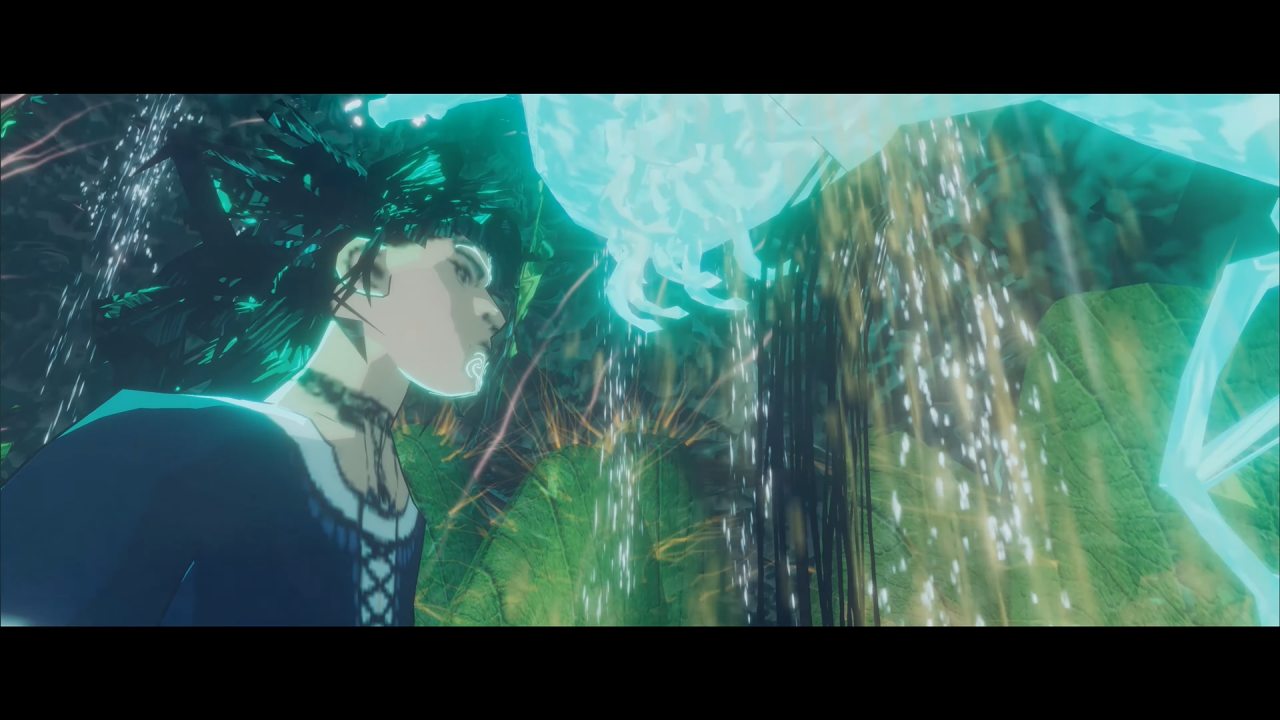
It questions them. The idea is that Lovecraft reads differently when you shift the center, because a new protagonist exposes how traditional the originals were. So you play as a penguin, or more accurately, as an entire colony, while the humans carry out their doomed expedition around you.
The humans' doomed 1939 expedition unfolds through the fragmented memories of narrator Howard Blakeley.
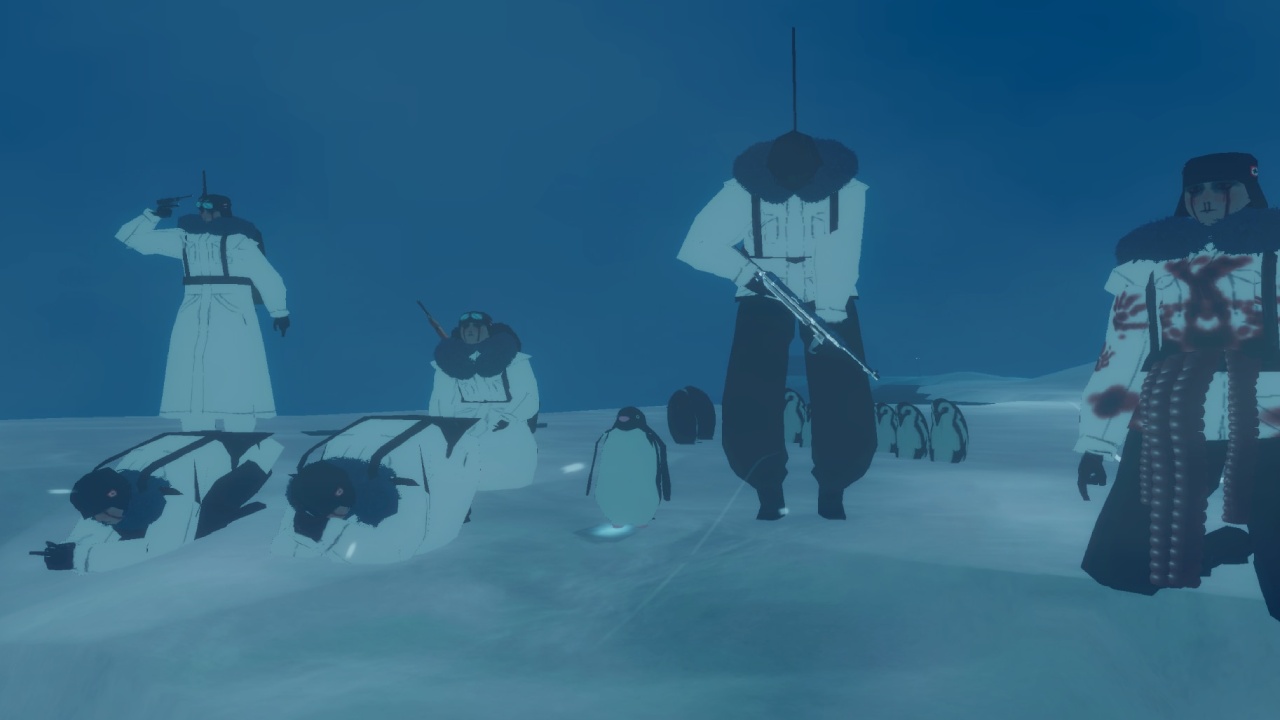
Every deliberate choice here, from the Nazi expedition to te reo Māori, serves a point. Antarctica has hosted horror many times before, and even the title lettering nods to The Thing, but Penguin Colony makes a different point. The year is 1939, and a Nazi expedition has come to the bottom of the world looking for the secrets of an ancient city buried in the ice.
You never control the humans. You slide, swim, and waddle through the landscape while a narrator named Howard Blakeley tells his own story in fragments. He takes the place of the explorer in Lovecraft's novella, a man who makes a huge discovery and then loses his mind over what it means.
Lenval Brown, known for narrating Disco Elysium: The Final Cut, voices him, and that deep, warm, crackling voice is one of Penguin Colony's best features. You hear it at most of the points of interest you stumble across. Blakeley's account starts well before the ice.
He was teaching at Miskatonic in Boston when he collapsed, and he woke seven days later with nothing physically wrong. His dreams were full of colors outside the visible range and of whole lifetimes passing in a blink, and when he woke he spoke fluently in a language no one had ever recorded.
The funding ran out, the sedatives got stronger, and with a month left before the bank took his estate, an anonymous contact reached out.
The contact was Dr. Walther Frei, a German scientist with money to spend and gold-inlaid equipment stamped with an eagle. Frei had been writing down the symbols Blakeley described in his sleep, and over time they pointed to a place. Frei's real conviction was that the Aryan people once ruled the world and that a figure named Zion, called the father of the Aryan race, lay frozen in the ice.
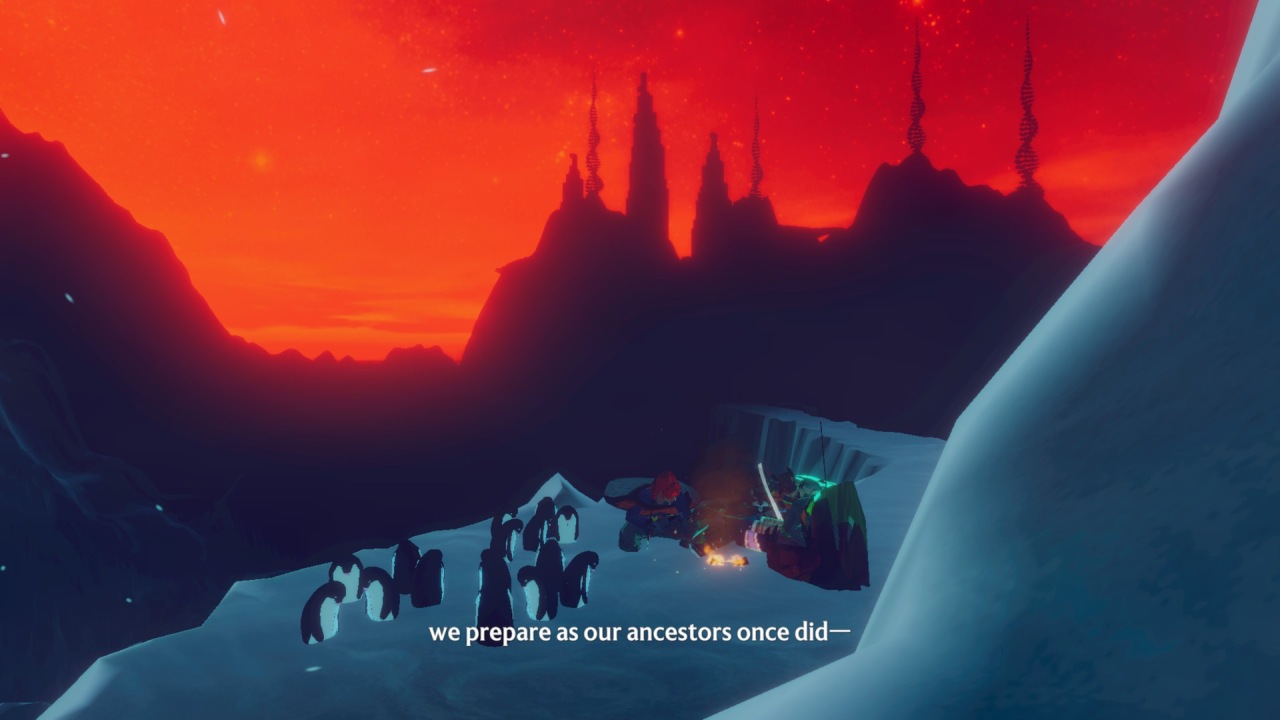
They flew out together with Roger, a photojournalist who saw himself as German at heart and was there to write the trip up as history. The first human camp you reach is burned out and nearly empty, and the few soldiers left have all gone mad.
One bangs his head against a wall in a steady rhythm. Another scalps himself. A third has his head burst a few steps from where you stand. Further along, bodies hang from the rafters of a mess hall, and men with bleeding eyes stand around speaking a language nobody knows. The gap between these loud scenes and the quieter story touches makes you want to reach the next big beat.
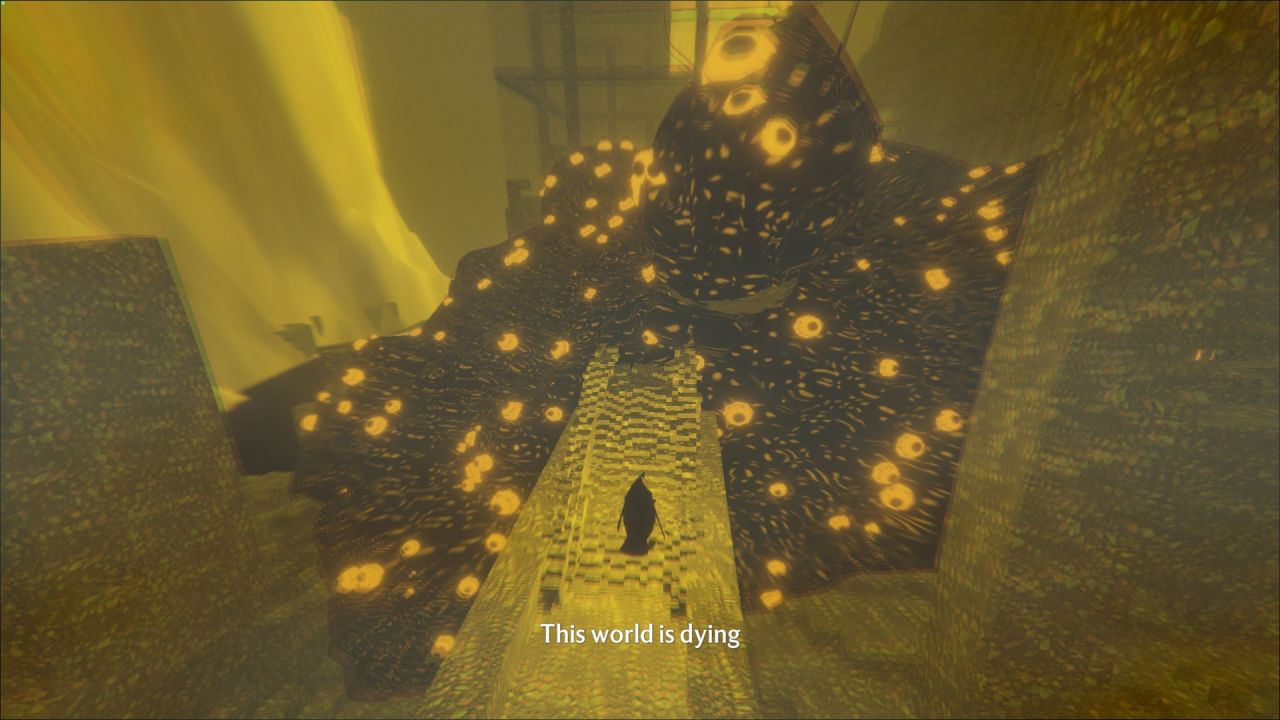
The deeper you go, the more the story shows you. In the caves, Blakeley names the creature the Great Antarctic Blob, a shambling thing that coughs up mounds of eyeballs and hair. You also see a sea creature frozen in the ice, and a boy slips into a mound of living mass and lets out a scream you won't forget. Frei explains that these are shoggoths, creatures that can take any shape and were made to serve.
Blakeley's dreams fill in the rest.
He sees a vast city of the far future where people celebrate the destruction of a planet, the one that became the asteroid belt, bombed for seventy-three centuries until only rock was left. Mars once had forests, and Venus had glowing insects, and the same beings stripped both.
The city under the ice was only one of hundreds of conquered places, and its masters cared nothing for the lives they ended. The shoggoths were made out of cruelty, by tearing creatures from another world apart and rebuilding them as an endless army of slaves. When their masters eventually turned to stone, the shoggoths crawled into the ocean and became the life that later rose from the sea. Then, for a moment, the whole universe went quiet.
The last stretch is where the story turns on Blakeley himself. Standing before the being at the center of it all, he sees eyes that register nothing, no interest in him or in any civilization but its own. He knows that freeing it would mean death for his world, and he knows he should destroy it.
Then the scientist in him takes over. He pictures the knowledge it holds, a library with his name on it, a place in every classroom as "Blakeley's Gambit," and a cottage in Western Victoria under two oak trees. He talks himself into sparing it. Alongside this runs the path of the Kaitiaki, Māori guardians who are trying to contain the ancient power and stop the Nazi invaders from disturbing the land.
In the end, a native girl gives herself up, the entity dies, and the whole place begins to come apart.
You slide out through the rubble toward a colony of your fellow penguins, and the eldritch ones are there too. That structure is what turns Penguin Colony into a statement about colonization. The Elder Things stand in for real colonizers, and the shoggoths they treat as perfect slaves stand in for the people on the receiving end of that desire.
In Penguin Colony, the Kaitiaki read as a second wave of defense against a second kind of invasion: the ancient gods taking over the Earth. As a penguin, you watch it all without fear. The horror here is not the unknowable kind. It is the kind that is already known, through every empire in history and through everyone living on land taken by force.
By the end, you can see that the real horror is a world that chooses not to look. Penguin Colony unfolds across seven chapters: Colony, Polystrate Society, Undiscovered Troglodyte, The Southern King, Capital City, Apotheosis, and Silence. The whole thing runs about four hours, and you move through a semi-open version of Antarctica.
In the first stretch, you can wander, learn how things work, and glide across wide plains on your belly at speed. Each penguin species handles differently, and swapping between them is the main way you get around. Bigger birds slide faster, some swim better, and the babies can squeeze through tight gaps.
A Royal penguin with its crest feathers is quick on the ice but weak at jumping, while the yellow-crested one jumps well.
A white penguin leads the pack, and later you meet the eldritch penguins, whose huge ancestor can see in the dark. Getting around mostly comes down to reading the world. Flares and lamp-topped flags mark the way early on; you can lock onto a distant focal point with a button, and the wind usually blows you in the right direction.
None of this stops you from drifting off the path into every cave, crack, and structure you see, and most of what you find there isn't marked anywhere. Points of interest give you English and Māori words, photographs, glyphs, and pieces of Blakeley's voice. Blue orbs let you decipher the unfamiliar language, slowly piecing together what happened to the expedition.
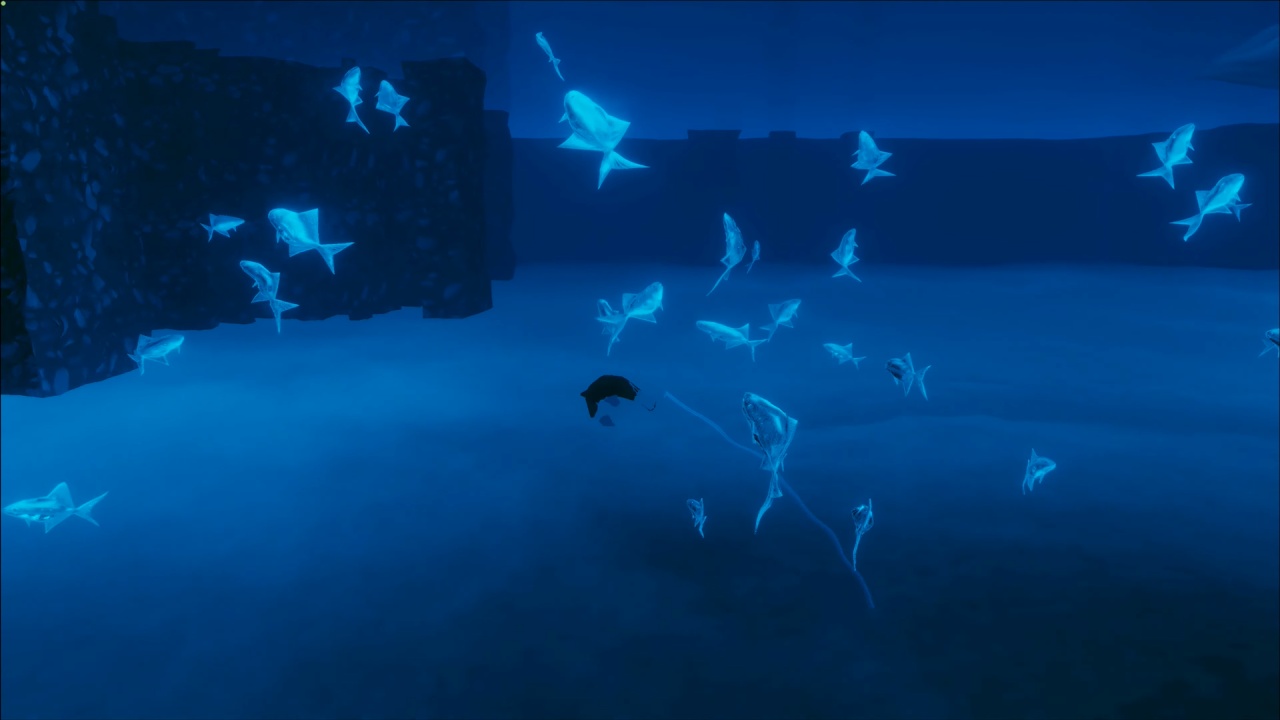
It has a style close to FromSoftware games, where you get scraps, are expected to fill in the blanks, and comparing what you find with other people is part of the intent. You don't build up experience points here. You collect only understanding, in the form of orbs, words, and photographs.
The puzzles in Penguin Colony are light and mostly built on the penguin swap. You find a hole too small for your body, so you look for a smaller bird. You find an orb on a ledge, and you need a better jumper. A button needs a heavy penguin standing on it. There is usually a way around if you get stuck.
One section late in the early chapters has you control two characters at once.
One uses the movement keys and the other uses the arrow keys, and it takes a while to figure out. The puzzle side feels underused. It starts interesting and then stays thin. Combat does not really exist. The closest you get to an enemy that reacts to you is a monster that chases you through the fourth chapter, and it turns into a controller-based fight as you try to platform your way out.
That level is dark and hard to read, and you spend much of it unsure whether you are running the right way or just circling. This is where Penguin Colony stumbles. Movement can feel stiff or slow, the camera does odd things, and platforming becomes more common as you go, making the rigid, low-poly architecture a pain to climb through. Sliding is the exception.
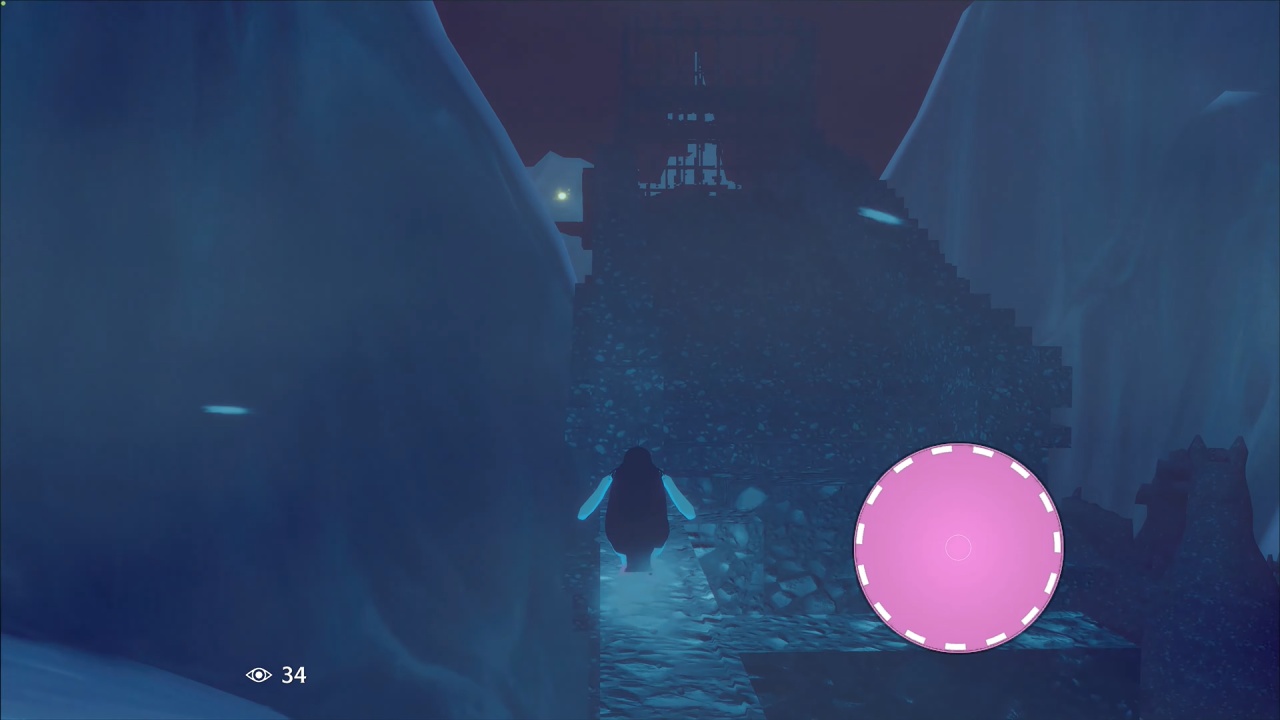
It is slippery enough to make some platforming tricky, yet it carries you along with generous momentum, and you wish Penguin Colony gave you more chances to use it, since much of the time it feels more like Rockhopper Parkour. The stamina bar is a problem too.
It appears as a big circle when your penguin speeds up, and it covers so much of the screen that you slow down just to keep the view clear. A bar that size could be a fraction of the size and still do its job. It also sits oddly beside a slide that is so good, and it feels like a penalty for using stamina.
The technical side of Penguin Colony adds to the roughness.
You can fall into an enclosed chamber with no way out, and you can drop into an endless fall that only ends by dying. A deliberate-looking gap in a wall can drop you off the map, and with the odd save system, you may have to start over. A bug lets you slide, return the stick to neutral, and jump three times in a row, and your penguin ends up floating in midair.
You may also run into crashes, Z-fighting, minor clipping, and screen tearing, though your setup could be causing the tearing. The developers patched it before release and improved performance, but the glitches still clash with the mood. A band-aid camera fix helps, though it also signals the camera needs a proper fix.
You also feel a lack of density more than anything else. In the first run, you can spend fifteen minutes fighting the controls and searching the ice without finding anything, and the story stalls just as it starts to grab your interest. Penguin Colony gives you no map until the end, and then it shows you the hundreds of points of interest and how few you reached. In your first playthrough, that is about a quarter.
The developers clearly meant to leave you without direction, and the closing message asks players to team up and uncover the rest together. It is a fair idea, but it hides the story and themes from many players. A second run helps, since you know where to look and can find major plot points tucked far out of the way, but you still wander for long stretches without finding anything new.
Penguin Colony relies on exploration without really encouraging it, so you may miss a few quality-of-life features.
Visually, it looks like a PlayStation 2 or Dreamcast game, and the choice works. Surfaces are flat and slightly blurry, with weather and fog dominating. The limits become a strength because the harsh white snow, deep blue fog, and cold gray architecture give the whole place a dormant, ancient feel.
The palette stays in whites, blues, and blacks, making surfaces easy to read and setting the huge alien structures against the snow around them. Those structures are all jutting shapes, angular spires and wide chasms, and they feel built for something other than you.
As a penguin, you get swallowed by them, and moving through them makes you feel like an intruder. The world is huge and, at times, suffocating in a way that suits the themes, though it feels too sparse for its size. The fourth chapter leans on red and blue, and it stands out against the game's colder palette.
The sound in Penguin Colony is a high point. The score is beautiful, a little haunting, and tastefully nods to Jerry Goldsmith's music for Alien. The team recorded real penguin sounds in the field, and those sit alongside howling wind, the hum of electric lights, and the crackle of fire.
Each one pulls you further in, and together with Brown's low voice, they carry a lot of weight when the gameplay doesn't.
His delivery of Blakeley's final monologue is one of the best things you will hear in any medium, and it brings the game to a roaring finish. Penguin Colony will not suit everyone, and at times it plays like an anti-game. If you want tight movement or heavy puzzles, you will probably find it cumbersome.
If you like exploring with no hand-holding and putting a story together from fragments, it may become one of your favorites. You spend the whole time swinging between enjoying the story and wishing the gameplay had more substance. Go in knowing as little as you can, and be ready to dig.
Staff Writer, NoobFeed
Verdict
Penguin Colony tells a sharp, brilliant story about colonization, but slow controls, intrusive design choices, and ongoing technical problems keep dragging it down. If you can push through the jank, real brilliance is buried in the ice.
68
Related News
No Data.