
TANUKI: Pon's Summer Review
Nintendo Switch
A lazy shrine keeper, a BMX, and one month to get everything ready.
Reviewed by Adeela Tas on Nov 10, 2026
Plenty of games try to capture a long summer break, where the days have no structure and something unplanned always turns up. Cozy games have produced plenty of versions of that idea, and indie developers keep finding new angles.
TANUKI: Pon's Summer, made by Denkiworks and published by Critical Reflex, is another take, and what sets it apart shows up within minutes: you play as a round little tanuki who rides a BMX. The game launched on November 10, 2026, so you start a summer story as autumn settles in.
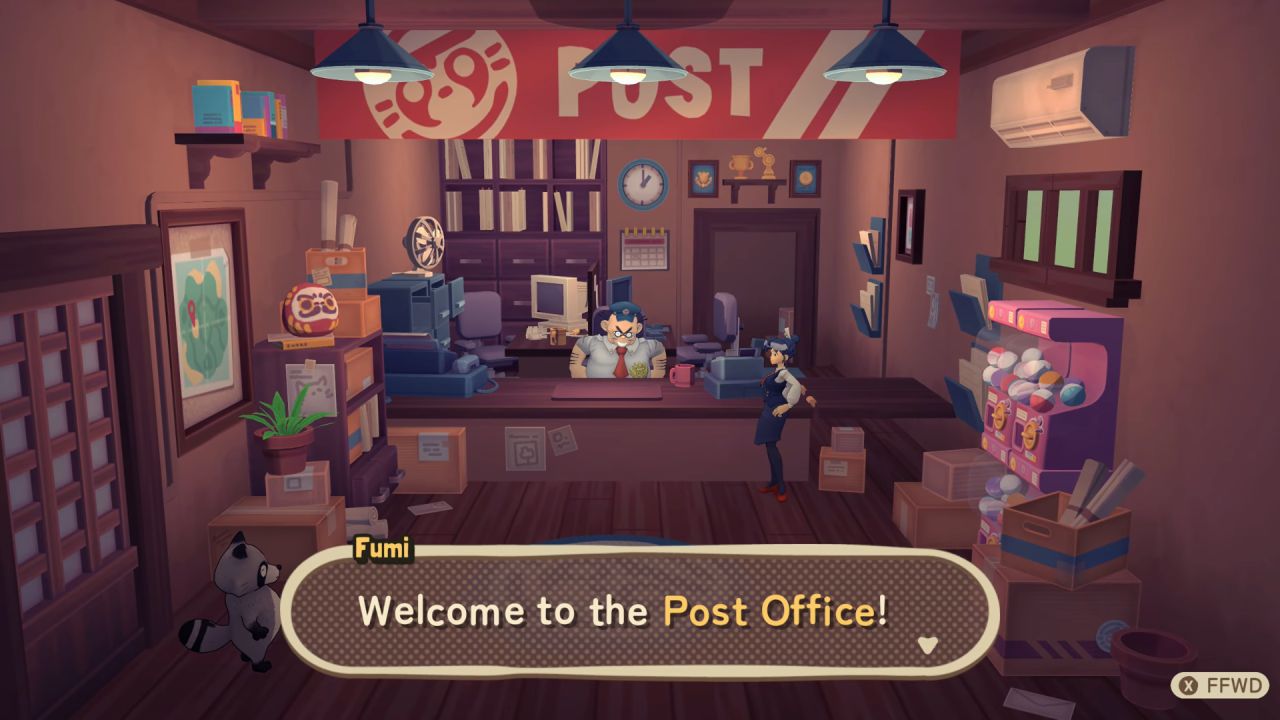
The story is quiet, built around a lazy tanuki and a deadline.
The main story takes around fifteen hours. On paper, TANUKI: Pon's Summer looks like a delivery game, the small genre where you connect characters by carrying things between them, but it leans harder on trick riding, odd jobs, and the people you meet than on the cargo.
The story opens with Pon asleep on a bench in the middle of the day, and ends with him walking back to the shrine and falling asleep again. He is the latest in a line of tanuki who have looked after this shrine, and he has barely done any of it.
The grounds are falling apart; the money set aside for repairs went on video games, and he spends most of his time napping and playing consoles in his small room. He even sleeps through a documentary about the upcoming festival, which is when the tanuki god of the shrine steps in.
The festival is the Great Tanuki Matsuri, held once every 50 years, and it takes place at the end of the month. Before then, TANUKI: Pon's Summer has you restore four sacred fixtures: the torii gate, which leans badly; the komainu guardian statues; the ema stand where visitors hang their wishes; and the chozuya used for purification. Two garden areas are overgrown, and the rest of the grounds are bare.
With the emergency savings gone, the god tells you to head into town and earn money through work.
Finding work takes a while. Sakamori, who runs the local bar, asks you to grind a rail as an audition. He likes it but turns you down anyway, since a tanuki on a bike is no use to him once customers are inside, and he hands you a little cash for the effort.
A local businessman named Kato has you throw boxes into a marked area, and when you finish, he refuses to pay. You go home, hand over a box of old games for pickup, and the story skips ahead while Pon falls back into Street Fighter and Space Invaders. A week goes by like that.
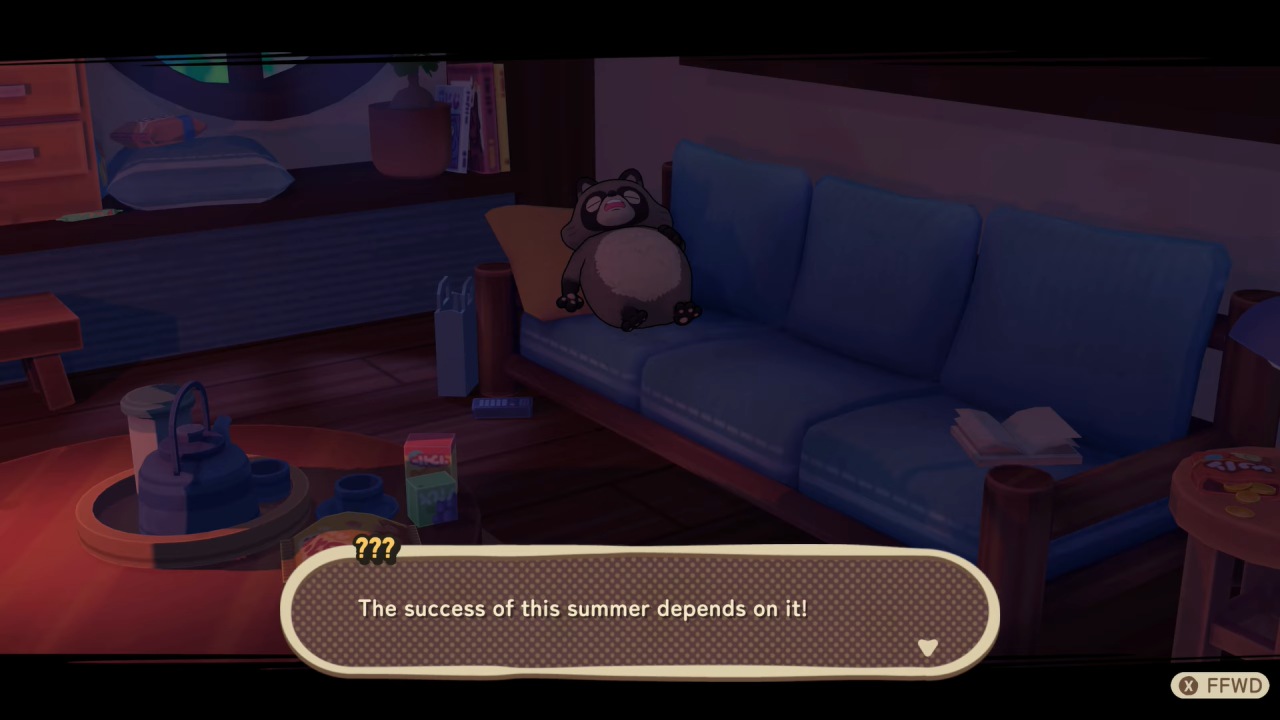
What breaks the cycle is Fumi, a postal worker, who shows up to collect the games and apologizes for the delay because the post office is short-staffed. That gives Pon the idea to apply. The post office is a small building with the postal symbol on it, surrounded by sunflowers. The postmaster, Bunta, is skeptical, since Pon doesn't look like he has ever held a job.
Fumi has seen him ride, though, and Bunta reluctantly offers a trial run. The plot of TANUKI: Pon's Summer has no villain and no global threat, only a lazy animal and a deadline. Pon never speaks. In conversations, you choose between two answers, each marked with a small emoji of his face showing whether he agrees or disagrees; those emojis, along with his gestures, convey his reactions to whatever people say.
The pacing is slow on purpose, and it suits the story.
The story is about getting to know the locals and preparing for the festival, so if you want twists or heavy drama, you may get bored, but if you like the relaxed rhythm of Animal Crossing, you will fit right in. The people you deliver to keep it moving.
Over the course of the month, you help a man who wants to fish, a sushi restaurant owner whose staff all quit, and Hitomi, a photographer who has lost her creative spark and spikes her camera on the ground in frustration, only to watch it bounce back into her hand. Kacho, a scheming businessman, opens a game center partway through.
The way the scenes are staged, with shifting camera angles and text sizes, gives some conversations a feel closer to the 3D Zelda games. The setting stands out too, since it isn't the Tokyo that most games use to represent Japan. In TANUKI: Pon's Summer, you spend your days riding through smaller communities and fields, and four towns inspired by real places appear: Kyoto, Aomori, Sapporo, and Beppu.
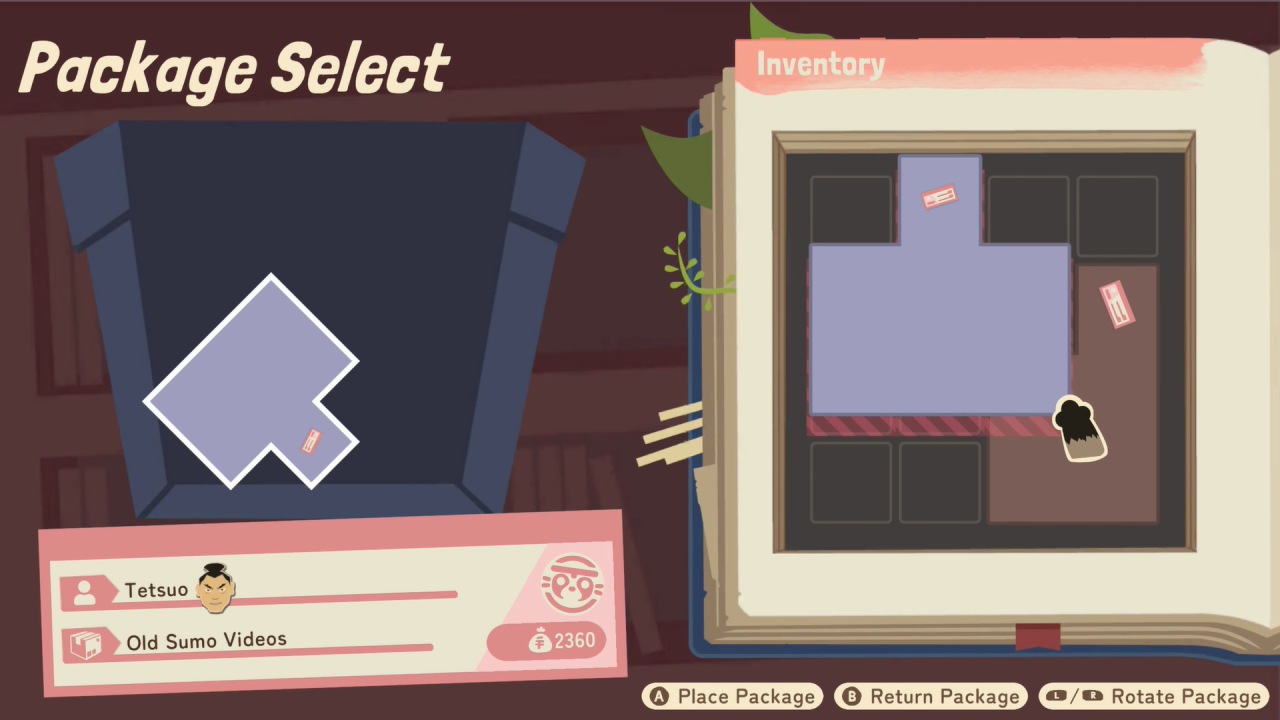
The roads are almost maze-like at first, but after a few days you start finding your own shortcuts to get to work, and the island begins to feel familiar. Each day begins at the post office, where you pick up the day's parcels. Before you leave, you arrange them in your bike's basket on a grid, fitting different shapes together much like the inventory puzzles in Tetris or Resident Evil 4.
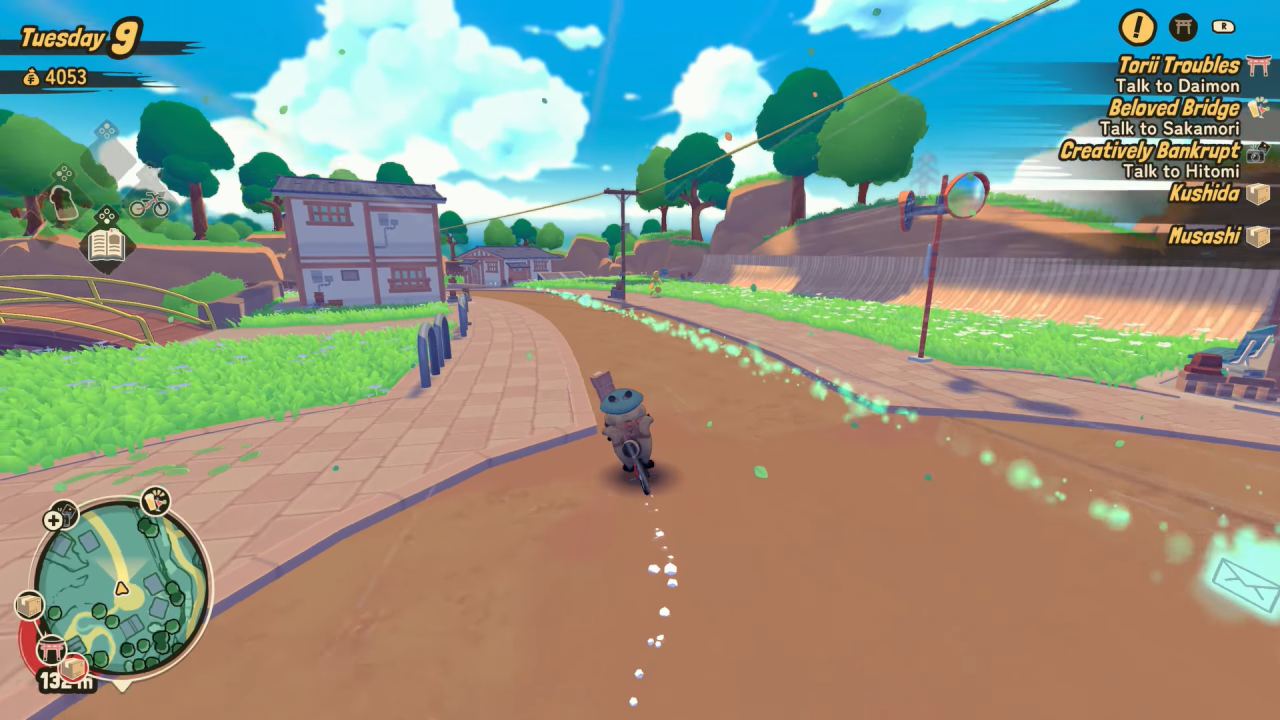
Sizes, weights, and shapes vary, so how you pack matters.
It isn't hard, but it makes you think before heading out. In TANUKI: Pon's Summer, most days list three to five objectives, and you choose the order. A delivery rarely ends when you hand over the box. Recipients often ask Pon for help, and these detours provide most of the variety.
Your first rush package goes to Tetsuo at the sumo ring: tapes of his old championship matches that he had been waiting on for months. He cheers up and says nothing in the rules stops an animal from competing, so you become the first tanuki sumo wrestler.
In the practice match, you stomp, slap, and dodge belly-smashes, and winning a best-of-three earns cash and a sumo statue for the shrine. You assemble sushi, pour drinks, cut down a tree, paint the shrine, do carpentry, drum in a live band, pinch-hit in a baseball game, carry elderly people, and handle garbage disposal.
Some deliveries need side work first, like collecting questionable goods for the arcade owner before he accepts his package, and he threatens to cut your pay if anything gets damaged. You never know what the next delivery in TANUKI: Pon's Summer will ask for, and that keeps things interesting.
The trade-off is that most of these activities appear once, as a story objective, and then they are gone.
You can't return to the sumo ring or the taiko set whenever you like, which is a shame, since several are fun enough to repeat. Some are less fun than others, but none go on long enough to wear you out. Fishing and throwing share an imprecise aiming system: once the wind-up starts, you can't change your sideways direction.
The game forgives misses within a few feet, but finer control would have helped. The bike is your main way of moving, and the world is built around it. The island works like a large skate park, with ramps, grind rails, and quarter pipes placed all over, and there is rarely only one route to a destination.
The trick system calls to mind Tony Hawk's Pro Skater, with jumps, flips, grinds, and combos you chain together. In the early tutorial of TANUKI: Pon's Summer, you learn to bunny hop, hold the button to go higher, and start a grind by hopping onto a rail and holding another button.
The backflip, front flip, and Superman follow, and you have to hop first, or the trick gets almost no air. Two control layouts are available, and you can swap between them at any time. The default is called Tanuki. The other, Bird, puts tricks on the left and right face buttons and grinding on the top face button, in the style of Tony Hawk or SSX, and it is more comfortable if you have that muscle memory.
With the default scheme, movement and acceleration sit on the left stick while the triggers handle boosting and braking.
Together with floaty physics, the bike feels like it slides more than it grips. Turn sensitivity is also higher than you would expect, so you will overshoot corners early on. Tricking is optional, and staying on the ground is usually quicker, but the jumps and rails are tempting enough that you will squeeze them into deliveries anyway. The timing window is forgiving, so small mistakes don't send you crashing.
Once you find a new route, you can keep a combo going through areas you have crossed dozens of times. The downside is that tricks can't be upgraded, so the available moves feel limited once you are comfortable, which is a missed chance.
There are a few smaller annoyances. Pon has no jump animation on foot, so clearing a low fence means calling the bike and bunny hopping. You can summon the bike anywhere, so it barely slows you. Riding isn't allowed on shrine grounds, so you go on foot there and can forward roll.
Some deliveries track damage, and if you take too many hits, your pay gets docked, but the penalty is small enough that it doesn't discourage you from experimenting. Away from deliveries, TANUKI: Pon's Summer spreads challenges across the map.
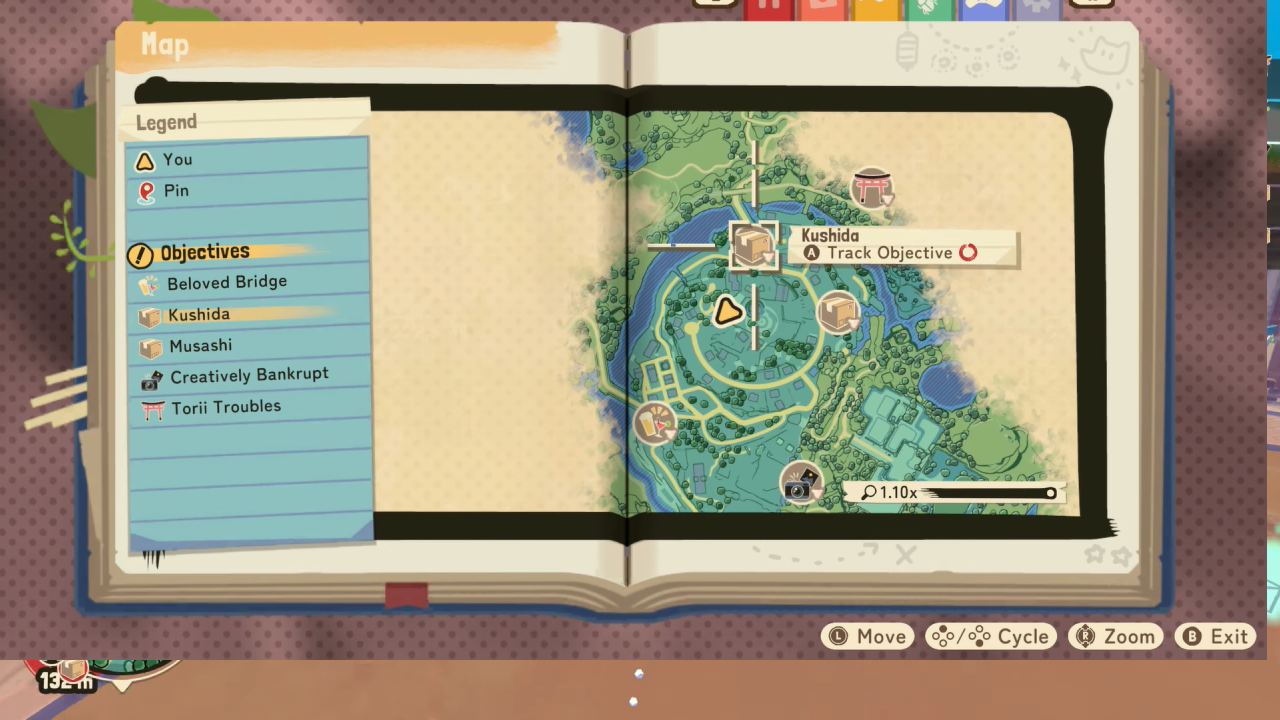
Away from deliveries, over a hundred optional challenges spread across the map.
More than a hundred are on offer, including races through torii gates, score targets within a time limit, combo challenges, collecting letters that spell out the game's title in a small area, and routes hidden across rooftops and through alleys.
All of them are optional, and they pay out money. They also point you to places you might otherwise miss. The structure is a lot like Tony Hawk's Underground: a large open area, with tasks to find and finish. Getting around is less smooth than it could be. You get a minimap and waypoints, plus a dust trail that leads to your marker.
It helps when you just want to finish a drop, though it confused you once. Later on, you unlock a net and a fishing rod, which lets you catch insects and fish in any water you find. TANUKI: Pon's Summer has no experience system to grind. Progress comes from money earned through deliveries, odd jobs, and challenges; new regions and people unlocking over the days; and repairs and decorations at the shrine.
Days have no time limit, so you can ride around, ignore objectives, or do things in your own order. Your earnings go straight into the shrine, which gives you a reason to keep earning. In TANUKI: Pon's Summer, the shrine is where your money ends up.
Completing missions adds items to a catalog, and you buy them and place them in and around the grounds.
A fox spirit vendor sells further stock. There is no cap on how many items you place, so you could cover the area in vending machines or sumo statues. Walls let you split the space into sections for seating or amusement areas, and you can decorate individual rooms too. The shrine changes as repairs pile up, showing how far along you are.
Placed objects do very little, and that is the main letdown. Furniture with small animations or interactions would have made the shrine feel more alive. The arcade cabinets are the biggest miss, since Pon loves video games and you can't play any of the machines you put in his home.
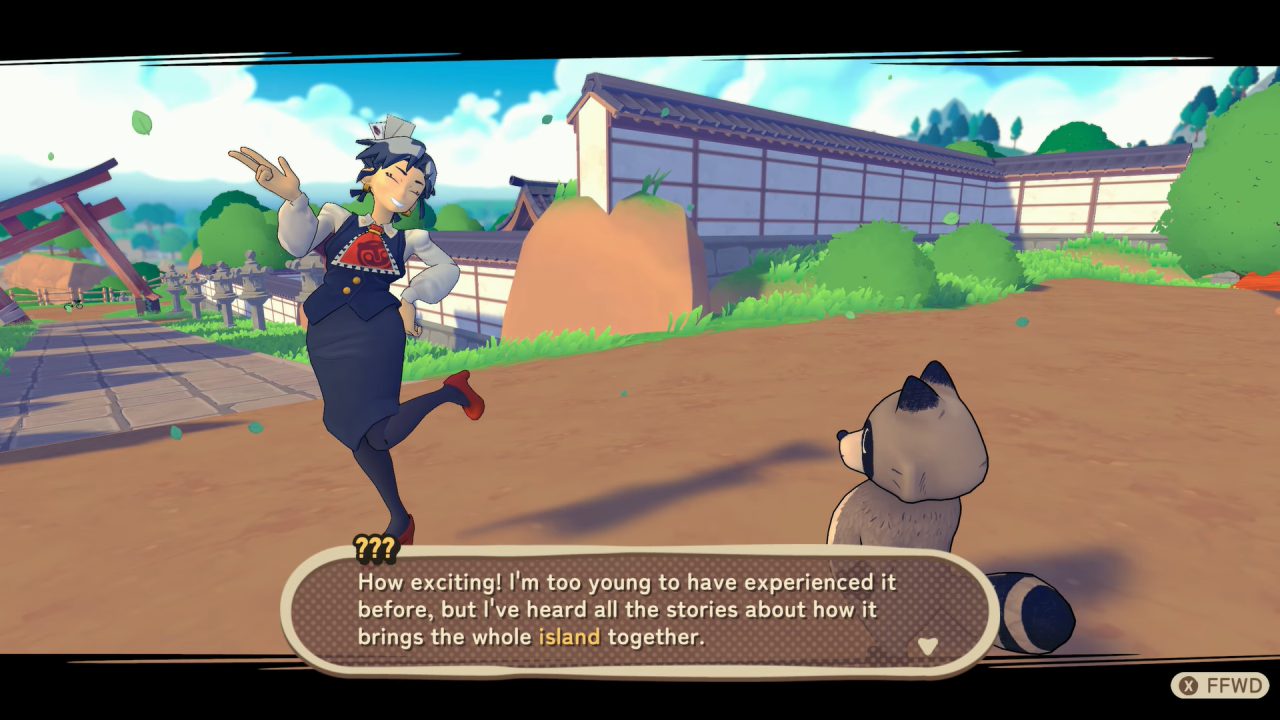
Even so, it is a place to return to each day, and the festival deadline fades into the background. Visually, TANUKI: Pon's Summer is bright, with thick character outlines and plenty of variety among the townspeople. Pon's animation stands out: he waddles, sprints with his arms awkwardly stuck out, and squashes down before springing up when he pops an ollie.
Fields, mountain passes, hilltop views, lakes, and painted-looking architecture make riding around worthwhile even without a goal. On Switch, there are compromises. Textures and objects often pop in; some textures look smeared and lower-res than they should, and performance chugs at times while aiming for 30 FPS.
It doesn't ruin the experience of TANUKI: Pon's Summer, but it is noticeable.
Load times are the bigger problem: roughly 66 seconds between major events or days, which is long for a world this size. There's also odd geometry, like an invisible wall blocking a jump to a clear landing spot, or a small slope you can't roll up. The opening stretch is long, too.
Cutscenes and tutorial prompts come one after another, and the constant conversations break the flow. Things settle after the tutorial, but you need patience to get there. If you want combat or a farming game with deep management like Stardew Valley, you won't find it here.
Sound is one of TANUKI: Pon's Summer's highlights. When you start pedaling, the soundtrack kicks in with guitar-heavy J-rock that still keeps a bit of mischief. On foot, you get calmer tracks, some led by piano in a style similar to Breath of the Wild, along with Japanese folk instruments mixed with modern touches.
Akari Kaida, known for Okami and Mega Man, and Junya Nakano, known for Final Fantasy, are among the contributors. The music fades in and out depending on what you are doing, and after racing across a field or a mountain pass, the timing feels right. A lot of the melodies stay in your head after you put the Switch to sleep.
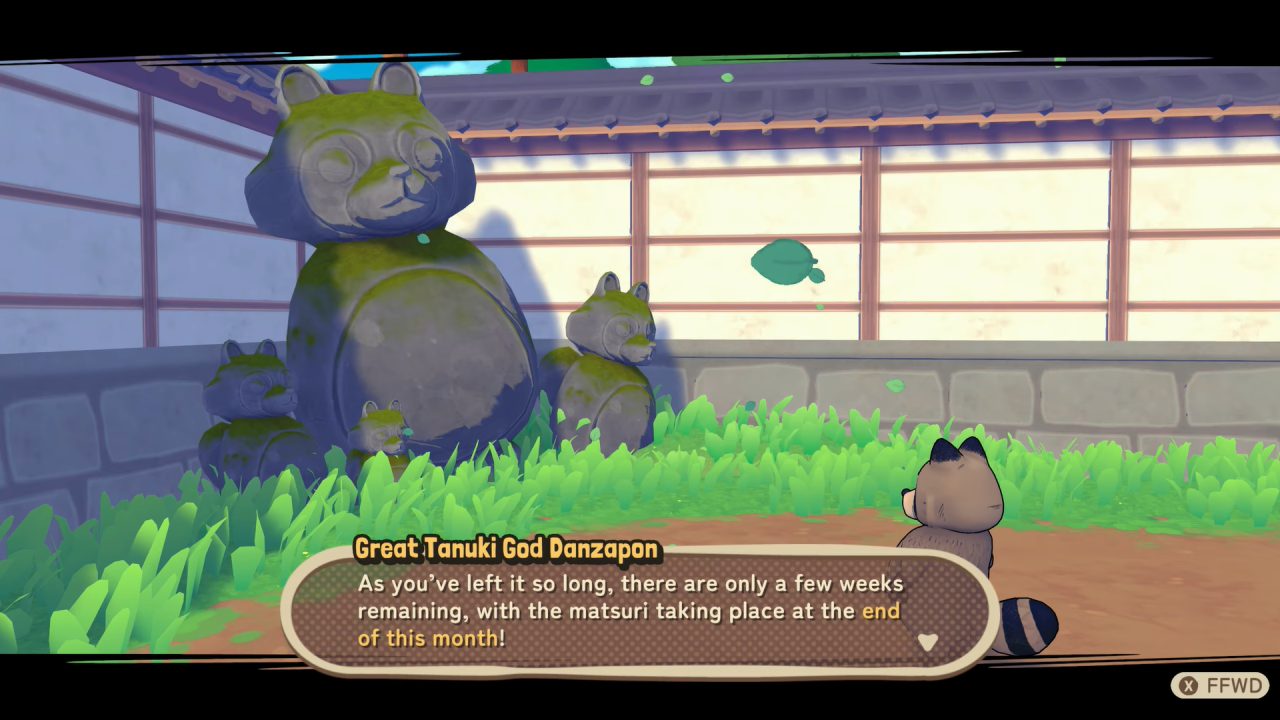
TANUKI: Pon's Summer is a modest game that doesn't try to be bigger than it is, and it works because of that.
The core loop of deliveries, tricks, activities, and shrine building has more variety than it first seems to. The game is built around community, helping people, and spending time together, and Pon carries that well. Long loading screens, rough Switch performance, a long introduction, and one-time activities all get in the way.
If you can get past those, you get a relaxed month on a bike with a likable character. TANUKI: Pon's Summer suits you best if you want something between a cozy life sim and a trick-riding game, and it is a good way to spend fifteen hours.
Editor, NoobFeed
Verdict
TANUKI: Pon's Summer is a warm, funny trick-riding delivery game with a strong soundtrack, but long loads and one-off activities hold it back on Switch.
74
Related News
No Data.