
DLSS 5 Controversy: How Nvidia’s AI Tech Is Changing Game Graphics
NVIDIA DLSS5 introduces generative AI rendering that alters textures and faces, raising concerns about consistency and artistic control.
Hardware by Nahe Yan on Mar 23, 2026
NVIDIA has revealed its newest upscaler, DLSS5, which many are calling "garbage AI slopification" or "slop yasification" that makes characters look like models on Instagram. The head of Nvidia responded that the outcry's critics are absolutely wrong. The answer was that DLSS5 combines generative AI with the ability to manage the game's geometry, graphics, and everything else.
It was also said that developers can make small changes to the AI without losing artistic control. But another source said that the developers of the games that were shown found out about it at the same time as everyone else. DLSS5 appears to be different from earlier versions.

Worries About Control and Replacement
This is Nvidia's most recent effort to take over PC gaming. It feels like the beginning of ray tracing, but more so. There is also talk about the next RDNA graphics cards. RDNA4 is focused on mid-range cards, while RDNA5 could greatly improve compute units and ray tracing performance. If AMD improves both ray tracing and raster performance, Nvidia might change its focus again and focus on neural rendering instead.
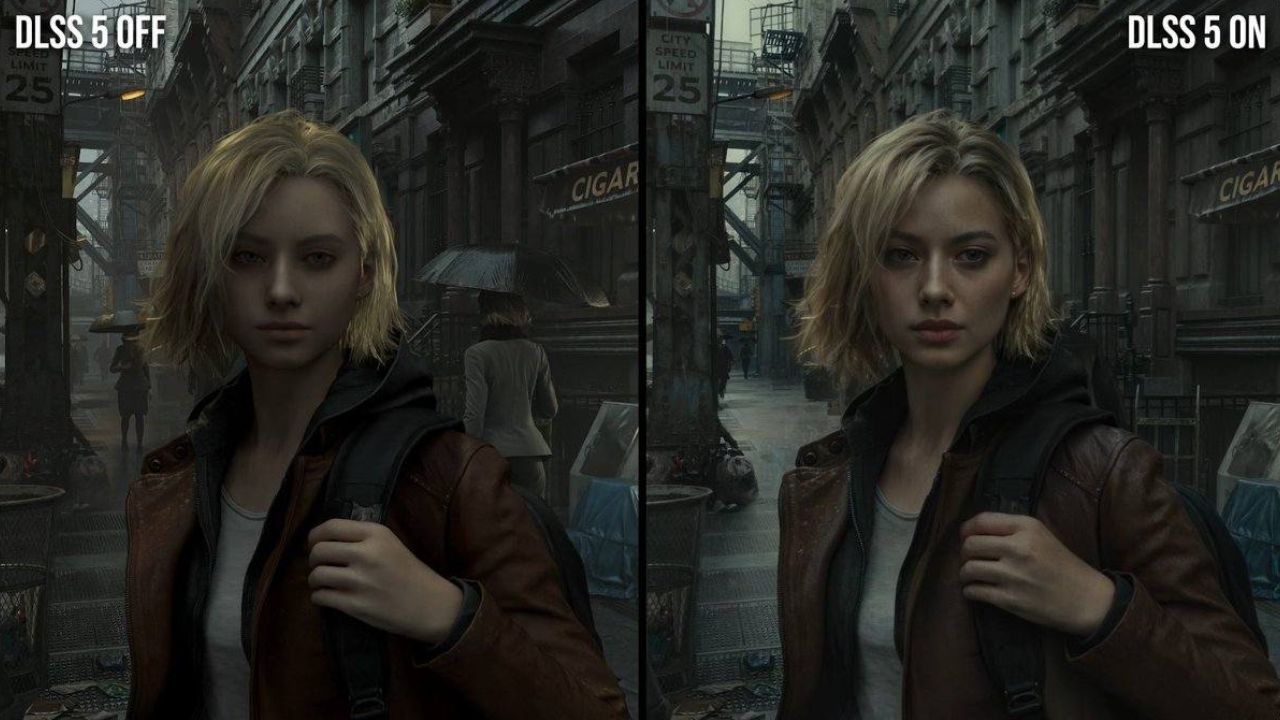
DLSS5 changes faces rather than just making them look better. NVIDIA reps made it clear that the system only takes in a frame and motion vectors, not geometry, PBR data, or lighting sources. The generative AI figures out the geometry, lighting, and textures from the frame itself. It doesn't modify the fundamental polygons, but it does change how textures appear by adding features that weren't there before.
Artistic Intent and Consistency in Visuals
We can see that some of the faces generated by DLSS5 look OK on their own. But they don't fit in with the scene. You may not be able to put your finger on the problem right away, but it makes the character and the setting feel disconnected. The end effect looks more like an Instagram filter than a model that stays the same in the game.
People are also worried about the baseline comparison. The character models used in demos differ from those in the game. This makes people wonder if the improvement is real or just a result of comparing it to lower-quality assets. Even with high-end gear like dual RTX 5090 configurations, the output doesn't look better, just different.
Hardware Needs and Usefulness
It's hard for us to explain why the hardware requirements are what they are. The demonstrations needed two RTX 5090 GPUs, which makes it unlikely that anybody will use them in real life. Even if scaling improves, limiting it to just one high-end GPU still makes it hard to reach. You won't buy this kind of hardware when prices are already rising, especially if memory prices are rising too.
This makes a gap between people who can use the technology and others who can't. This method doesn't work on most consoles or mid-range technology, which is what most gamers utilize. Because of this, DLSS5 creates a "have and have not" situation in gaming.
How the Industry is Using it and how Developers are Responding
Developers and studios have had different reactions. Some companies have signed up, but executives are making the decisions instead of artists or engineers. You can expect these selections to be more influenced by money and partnerships than by creative intent.
People are also unsure if developers really support the technology. Management makes public affirmations, but many developers voice their concerns privately. You might observe that studios work with Nvidia because it is a leader in AI and has a big impact on the market as a whole, not necessarily because the technology makes games better.
Effect on Making Games
If DLSS5 becomes popular, it could be less necessary to create intricate assets. Developers might use AI to improve models that aren't very good, thereby saving time and money. But this also means all games look the same because the same AI procedures are used in all of them.
You might notice a shift where automated improvements replace artistic originality. If many studios use the same system, the visual style of all the games could become more similar.
The Debate Between Real-Time and Pre-Processing
It isn't necessary to deploy generative AI in real time. A better approach would be to use AI throughout development to improve assets before they are put into the game. This lets developers check and manage the final product.
You can observe that real-time processing increases hardware requirements and decreases control requirements. Pre-processing would give the same results without needing high-end GPUs when playing. The decision to use it in real time has more to do with hardware sales and AI infrastructure than with improving the game.
Long-Term Outlook and Market Strategy
We can see that Nvidia's gaming revenue is a smaller part of its overall business than its AI revenue. This means that technologies like DLSS5 are designed to fit into broader AI plans. High-end GPUs are becoming increasingly like professional or AI-focused technology, with gaming features used to back up their claims.
This method makes it easier to replace your hardware often. DLSS5 and other features need newer GPUs, which makes people buy more expensive ones. But because of current pricing trends, it's still unclear if mass adoption will happen.
Final Thoughts
Both customers and developers will push back. Limited access, high hardware requirements, and concerns about visual uniformity could slow adoption. You may face resistance, especially from people who care more about performance and consistent visual direction.
The technology will change and become more useful. How DLSS5 is used and whether it solves current problems with control, consistency, and hardware demands will determine how widely it is adopted.
Also, check our other hardware articles:
- AMD Ryzen 9 9950X3D Review: Setting The Standard For 2025 Gaming CPU
- Amazon Luna 2025 Review: Is Prime Gaming's Cloud Service Your Go-To For Casual Fun?
- AMD RX 9070 XT Review: AMD's RDNA 4 Champion for 1440p Gaming
- GeForce Now Ultimate: Ditching Your Gaming PC For Cloud RTX 4080 Power?
- NVIDIA GeForce RTX 5080 Review (2025): Still A 4K Gaming Powerhouse?
- Intel Core Ultra 9 285K Review And Performance Breakdown (2025)
- AMD Ryzen 7 9800X3D Review: 3D V-Cache Goes God Mode with Stunning Gaming Performance
- Intel Core Ultra 9 285K vs AMD Ryzen 7 9800X3D: In-Depth Gaming Performance and Benchmark Comparison
- NVIDIA GeForce RTX 5080 Super Performance In Cyberpunk 2077: Path Tracing & DLSS 4.0 Tested
- AMD Radeon RX 9070 XT In Cyberpunk 2077: Ray Tracing & FSR 4.0 Tested
- Intel Arc B580 Review: The $250 GPU Revolutionizing 1440p Gaming
- Intel Arc B570 Vs. B580: Value, Specs, And Real-World Gaming Performance
- RTX 5090 Laptop Vs. M4 Max MacBook Pro: Ultimate Raw Performance Vs. Battery Endurance
- Intel Arc b580 Vs. RTX 4060: Game Performance And Value Analysis
- RTX5090 Hell Is Us Demo 4K Ultra Benchmark: DLSS Vs. Native Performance Guide
- NVIDIA RTX 5070 Review: Mid-Range Muscle or Marketing Hype?
- Nintendo Switch 2 Review: Handheld Performance, Features & Value Breakdown
- RTX 5070 Ti Review: Performance, Thermals & Power Efficiency Tested
- Samsung Odyssey OLED G81SF Review 2025: Ultimate 32-Inch QD-OLED Gaming Monitor
- AMD RX 9070 Performance Review: Thermals, Clocks, and Real-World FPS
- AMD Ryzen 5 7600 Review: Best Budget Gaming CPU of 2025?
- AMD Radeon RX 7800 XT Review: RDNA 3 Power For Midrange Gaming
- Asus ROG RTX 5090 Astral OC Vs. Founders Edition: The 4K Gaming Benchmark
Editor, NoobFeed
Gaming Hardware Updates
No Data.